Quarterly Estimated Taxes for the Self-Employed: A Step-by-Step Guide
When you're self-employed, nobody withholds tax from your income throughout the year.
The IRS still expects to be paid as you go, not just once a year at filing time, which means you're responsible for sending in estimated payments yourself, four times a year.
Miss a payment, even if you pay everything you owe by April, and you can still end up with a penalty.
Here's exactly how it works.
Why Estimated Taxes Exist
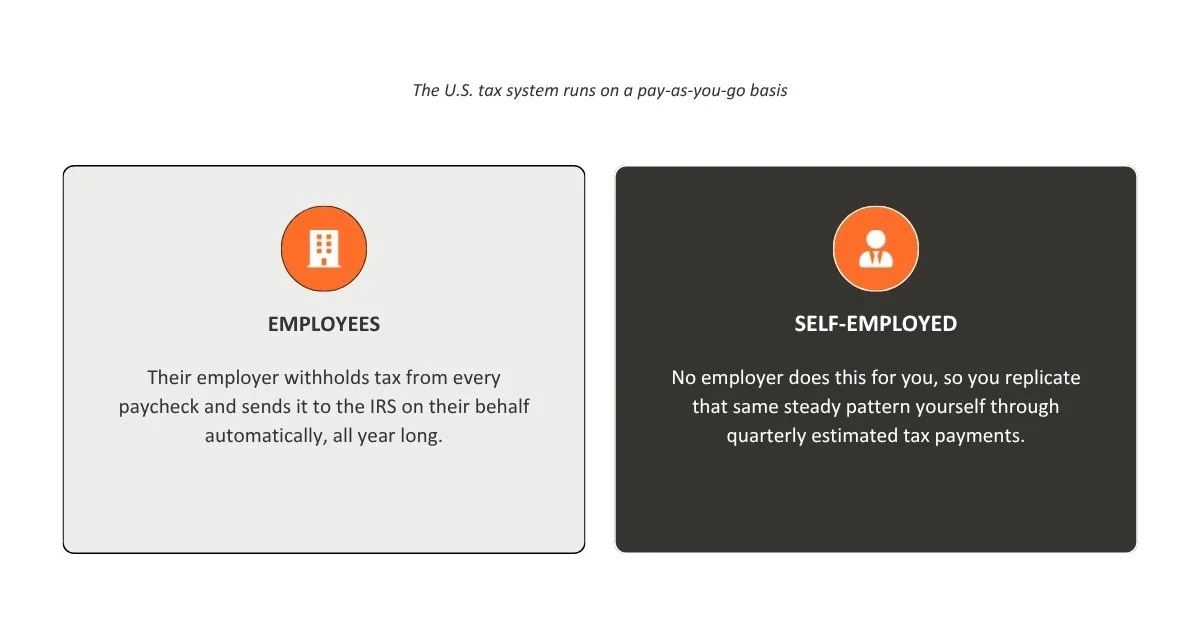
The U.S. tax system runs on a pay-as-you-go basis. Employees have this handled automatically, their employer withholds tax from every paycheck and sends it to the IRS on their behalf. When you're self-employed, there's no employer doing that for you, so you're expected to replicate that same steady payment pattern yourself, through quarterly estimated tax payments.
Who Needs to Pay Quarterly Estimated Taxes?
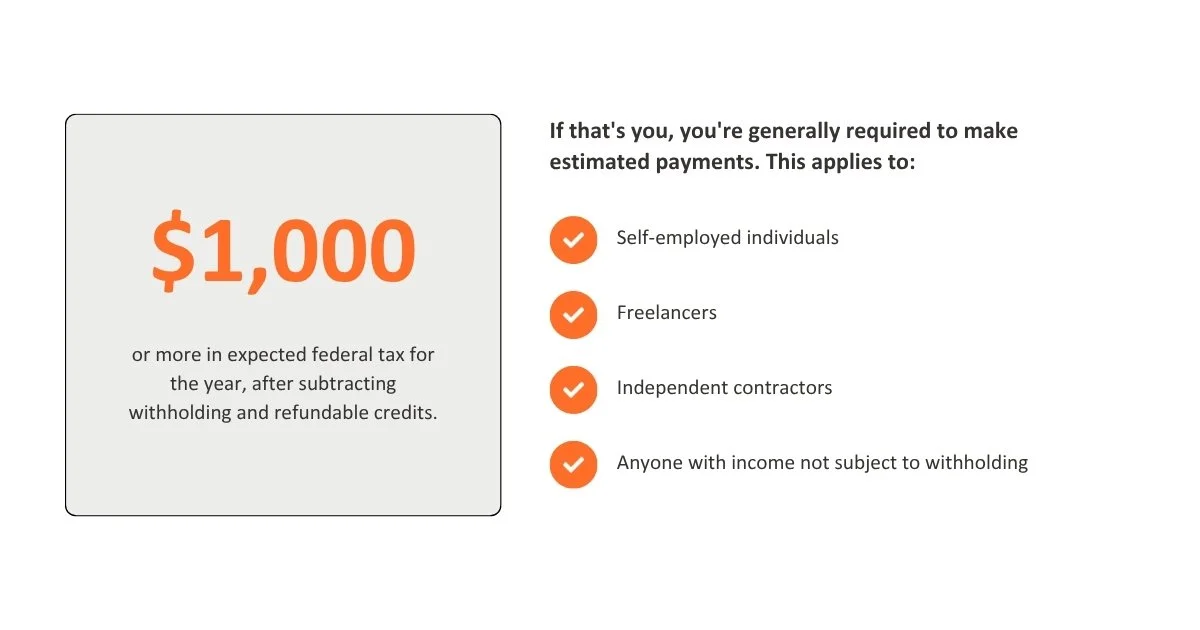
The general rule: if you expect to owe at least 1,000 dollars in federal tax for the year, after subtracting withholding and refundable credits, you're generally required to make estimated payments.
This applies to self-employed individuals, freelancers, independent contractors, and anyone else with income that isn't subject to withholding.
The 2026 Payment Deadlines
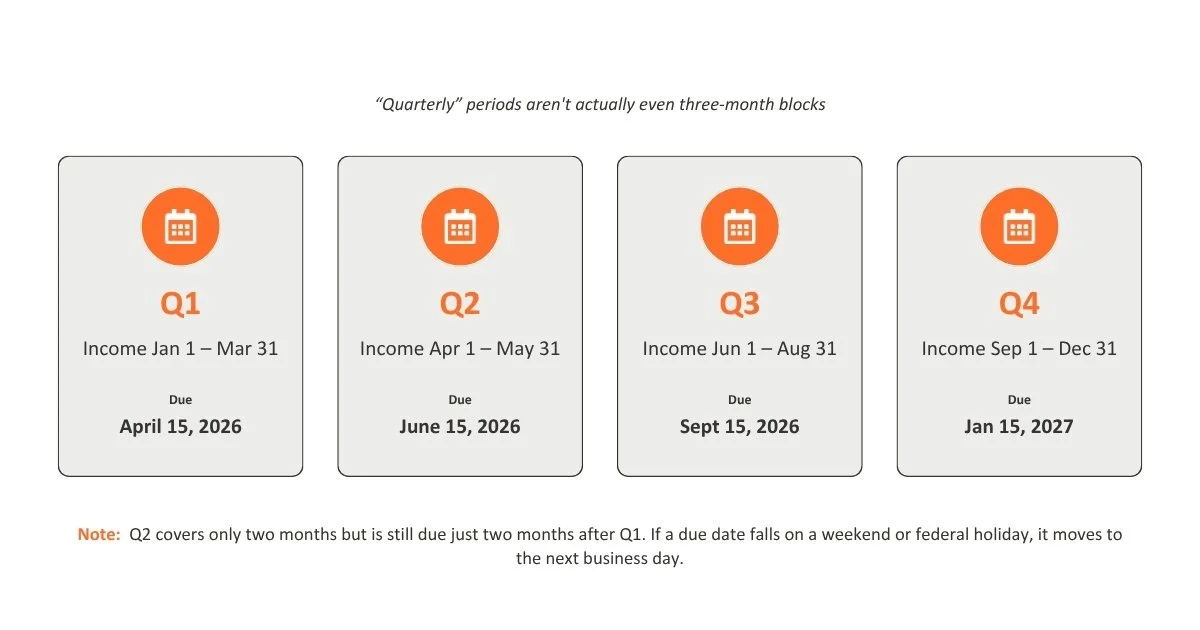
Estimated payments are commonly called quarterly, but the periods they cover aren't actually even three-month blocks, which catches a lot of first-time filers off guard.
Here's the 2026 schedule:
Q1 (income Jan 1 - Mar 31): April 15, 2026
Q2 (income Apr 1 - May 31): June 15, 2026
Q3 (income Jun 1 - Aug 31): September 15, 2026
Q4 (income Sep 1 - Dec 31): January 15, 2027
Notice that the Q2 period only covers two months of income but is still due just two months after Q1. If a due date falls on a weekend or federal holiday, it moves to the next business day.
How to Calculate What You Owe
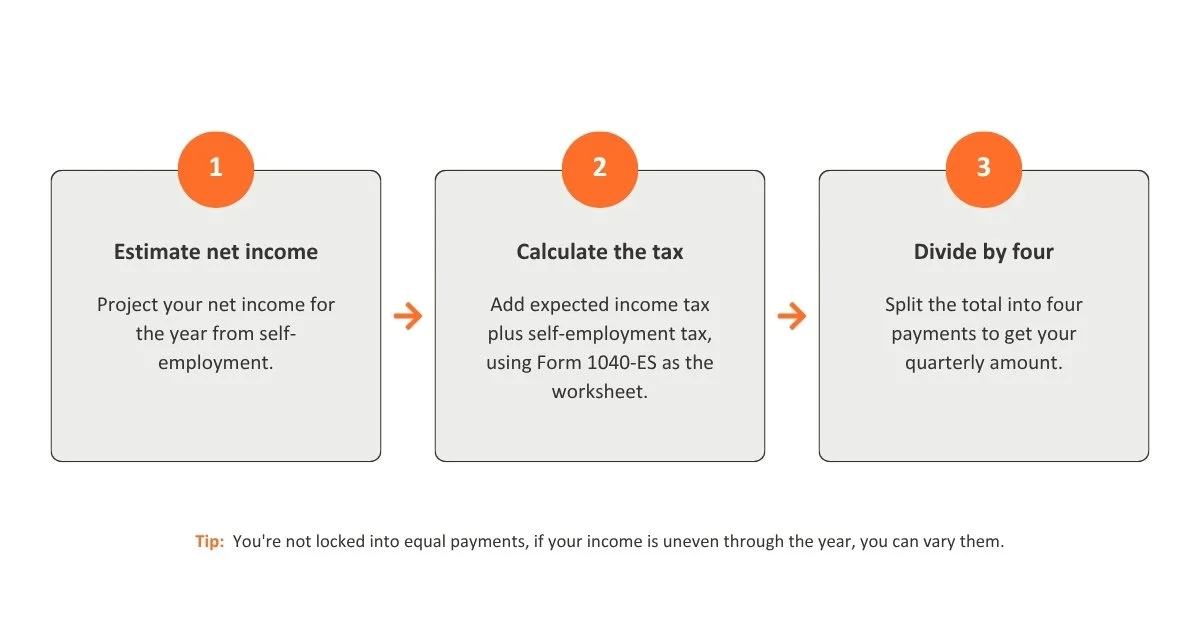
Start by estimating your net income for the year from self-employment. From there, calculate your expected income tax plus self-employment tax on that amount, using Form 1040-ES as the standard worksheet for walking through the math.
Divide the total by four to get your quarterly payment amount, though you're not locked into equal payments if your income is uneven throughout the year, more on that below.
Safe Harbor Rules: How to Avoid a Penalty
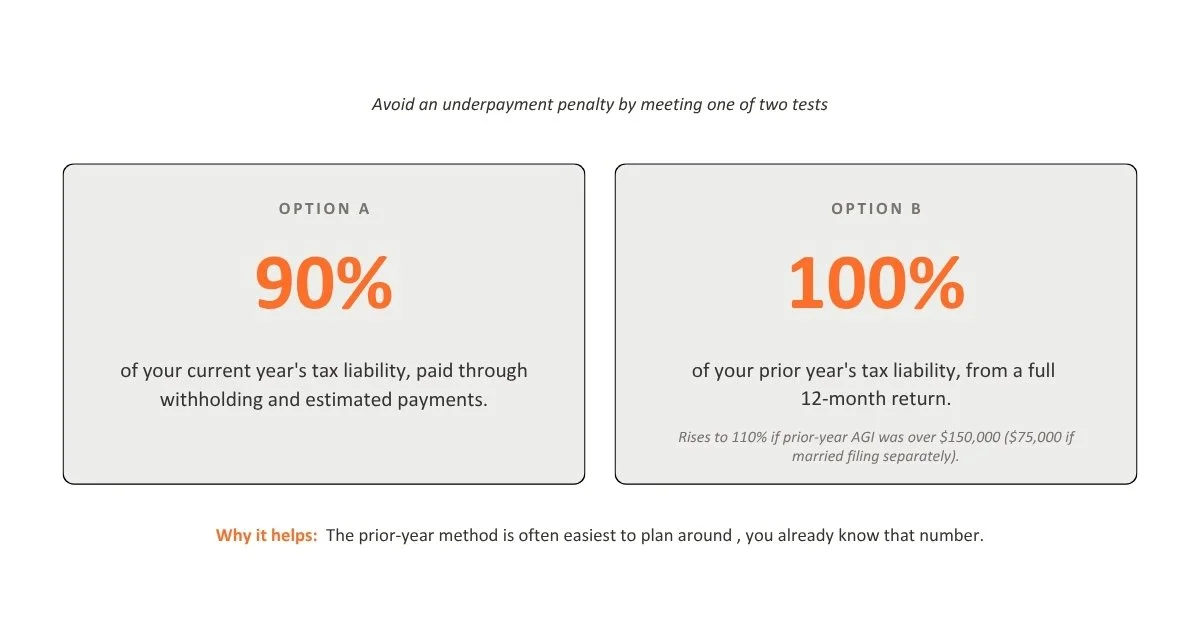
This is the part that actually protects you from a penalty, and it's worth understanding well. You generally avoid an underpayment penalty if you meet one of two safe harbor tests: paying at least 90 percent of your current year's tax liability through withholding and estimated payments, or paying at least 100 percent of your prior year's tax liability, shown on a full 12-month return.
If your prior-year adjusted gross income was over 150,000 dollars, or 75,000 dollars if married filing separately, that prior-year safe harbor threshold rises to 110 percent instead of 100 percent. The prior-year method is often the easiest to plan around, since you already know that number, while your current year's actual liability isn't fully known until you prepare the return.
How to Actually Pay
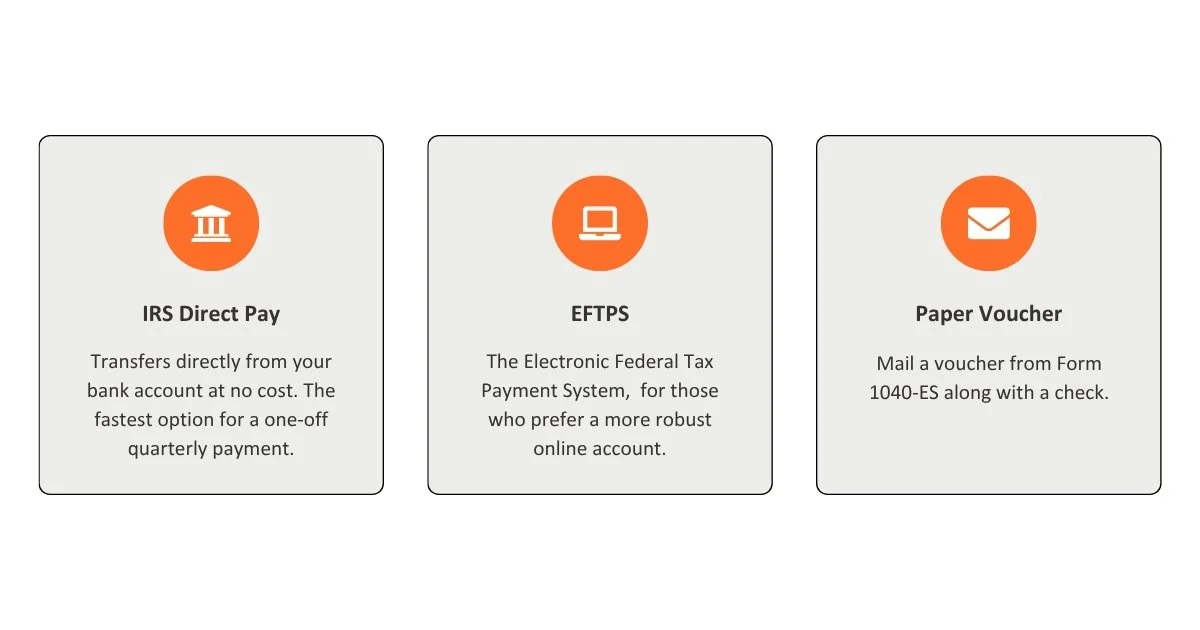
The IRS offers a few straightforward ways to submit estimated payments: IRS Direct Pay, which transfers directly from your bank account at no cost, EFTPS, the Electronic Federal Tax Payment System, for those who prefer a more robust online account, or mailing a paper voucher from Form 1040-ES along with a check.
Direct Pay is the fastest option for most people making a one-off quarterly payment.
What Happens If You Underpay
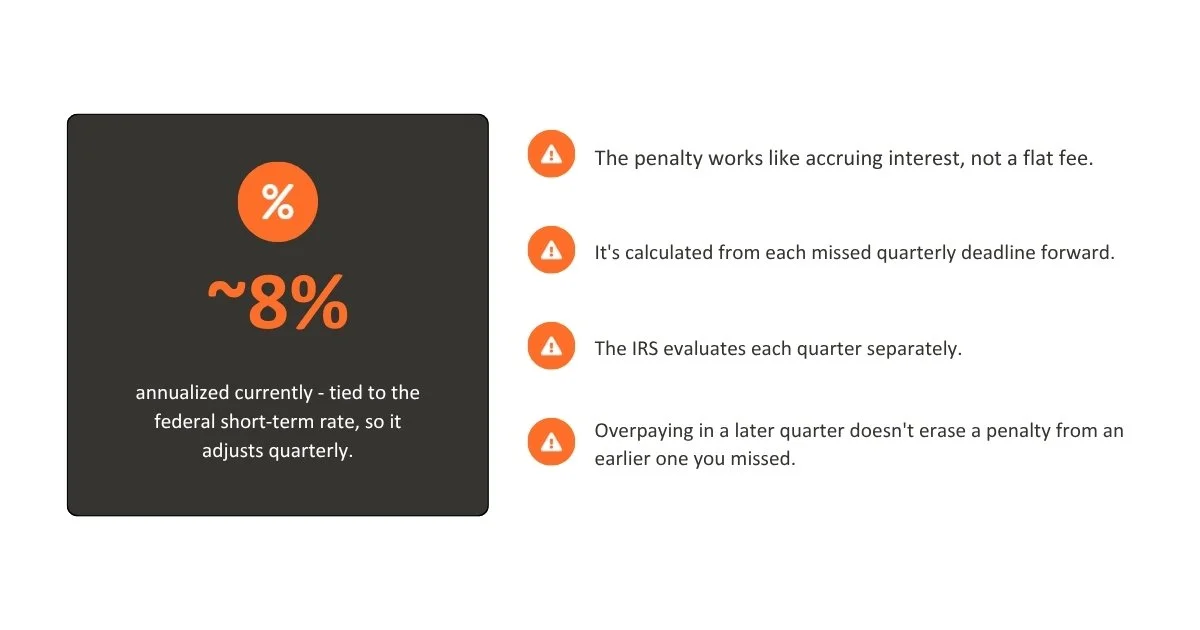
The underpayment penalty works more like accruing interest than a flat fee. It's calculated from each missed quarterly deadline forward, roughly around 8 percent annualized currently, though this rate is tied to the federal short-term rate and adjusts quarterly, so it moves over time.
Because the IRS evaluates each quarter separately, overpaying in a later quarter doesn't erase a penalty from an earlier one you missed.
Frequently Asked Questions
-
You're not required to pay four equal installments. If your income is seasonal or uneven, you can use the annualized income installment method, which calculates each quarter's required payment based on income actually earned in that period, rather than assuming a flat one-fourth of your annual estimate.
-
Likely yes, and California's rules genuinely differ from the federal ones in ways that trip people up. California's threshold for needing to pay is lower, 500 dollars of expected tax owed, compared to the federal 1,000 dollar threshold. California's safe harbor also isn't the even 25 percent per quarter that federal uses, it follows a 30/40/0/30 schedule: 30 percent due April 15, 40 percent due June 15, nothing due in September, and the final 30 percent due January 15.
That zero-payment third quarter surprises a lot of people who assume the state mirrors the federal cadence. -
Without a prior-year return to base the 100 or 110 percent safe harbor on, you'll generally need to rely on the 90 percent of current-year tax test instead, which means estimating your current year's income and tax liability as accurately as you can.
-
Yes. You can recalculate your remaining estimated payments at any point during the year if your income changes meaningfully, whether it's higher or lower than expected. Both the IRS and California FTB allow this adjustment.
Staying current on quarterly payments, federal and California, is one of the simplest ways to avoid an unpleasant surprise at filing time. A tax professional can help you calculate the right amount and stay on schedule all year.