Both Section 179 and bonus depreciation let a business deduct the cost of equipment or property faster than standard depreciation schedules allow. Business owners often assume they have to pick one or that they work the same way. Neither is true, and for California businesses in particular, the difference between them matters more than most people realize. Here's how each one actually works, and how to think through which fits your situation.
What Is Section 179?
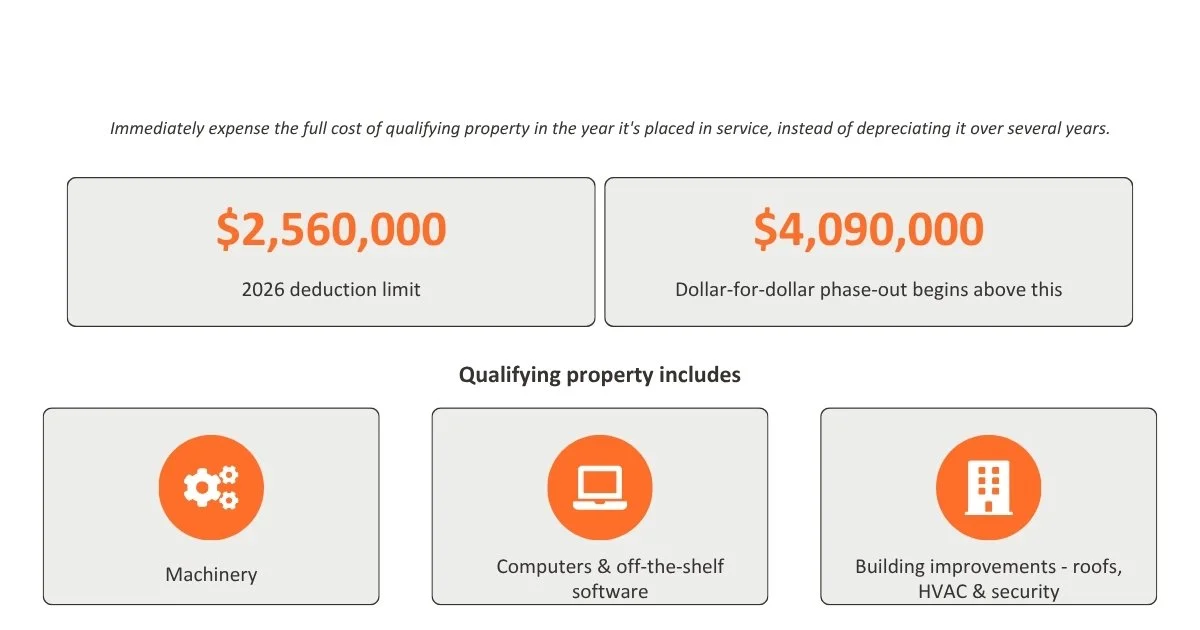
Section 179 lets a business immediately expense the full cost of qualifying equipment or property in the year it's placed in service, rather than depreciating it over several years. For 2026, the deduction limit is 2,560,000 dollars, with a dollar-for-dollar phase-out beginning once total qualifying purchases exceed 4,090,000 dollars for the year. Qualifying property includes machinery, computers, off-the-shelf software, and certain building improvements like roofs, HVAC systems, and security systems.
What Is Bonus Depreciation?
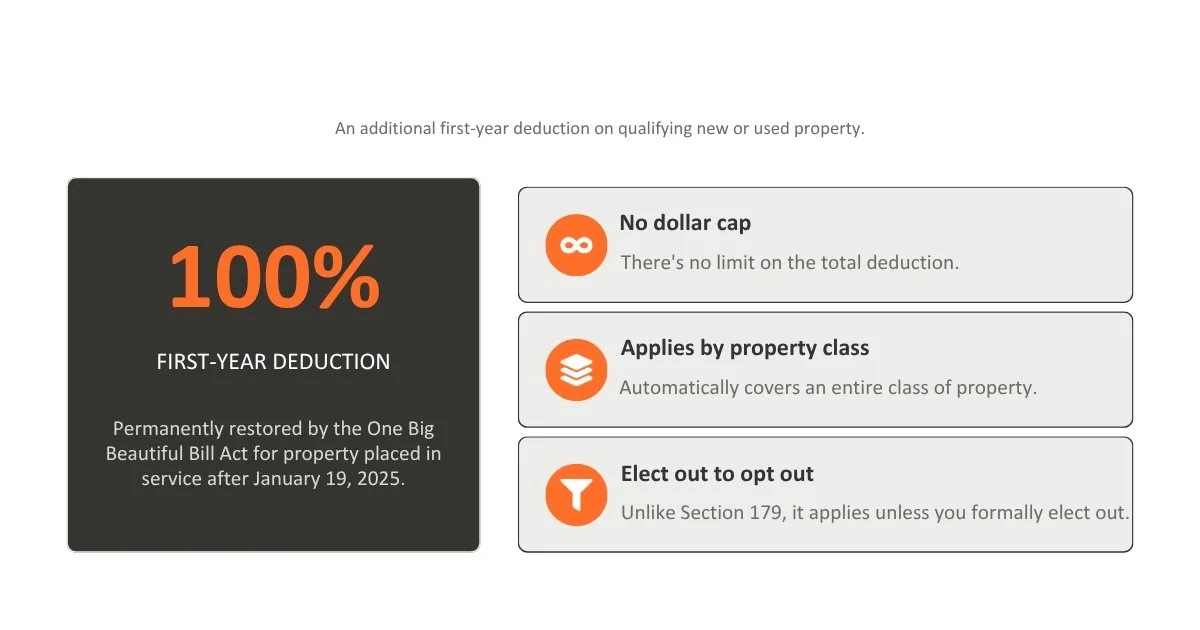
Bonus depreciation allows an additional first-year deduction on qualifying new or used property. Recent federal legislation, the One Big Beautiful Bill Act, permanently restored bonus depreciation to 100 percent for property placed in service after January 19, 2025, reversing a phase-down that had been scheduled to bring it down to 20 percent in 2026 and eliminate it entirely by 2027. There's no dollar cap on bonus depreciation, and unlike Section 179, you don't have to elect it asset by asset, it applies automatically to an entire property class unless you formally elect out.
Key Differences Between the Two
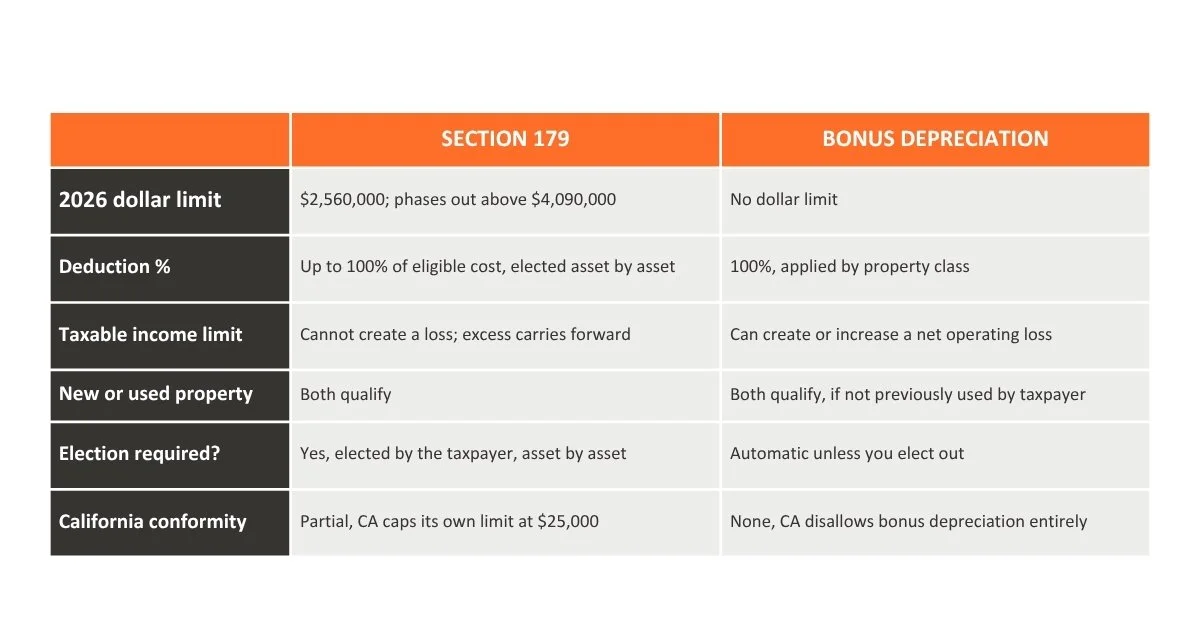
| Section 179 | Bonus Depreciation
2026 Dollar Limit | $2,560,000, phases out above $4,090,000 | No dollar limit
Deduction Percentage | Up to 100% of eligible cost, elected asset by asset | 100%, applied by property class
Taxable Income Limit | Cannot create a loss; excess carries forward | Can create or increase a net operating loss
New or Used Property | Both qualify | Both qualify, if not previously used by taxpayer
Election Required? | Yes, elected by the taxpayer, asset by asset | Automatic unless you elect out
California Conformity | Partial, CA caps its own limit at $25,000 | None, CA disallows bonus depreciation entirely
Can You Use Both Together?
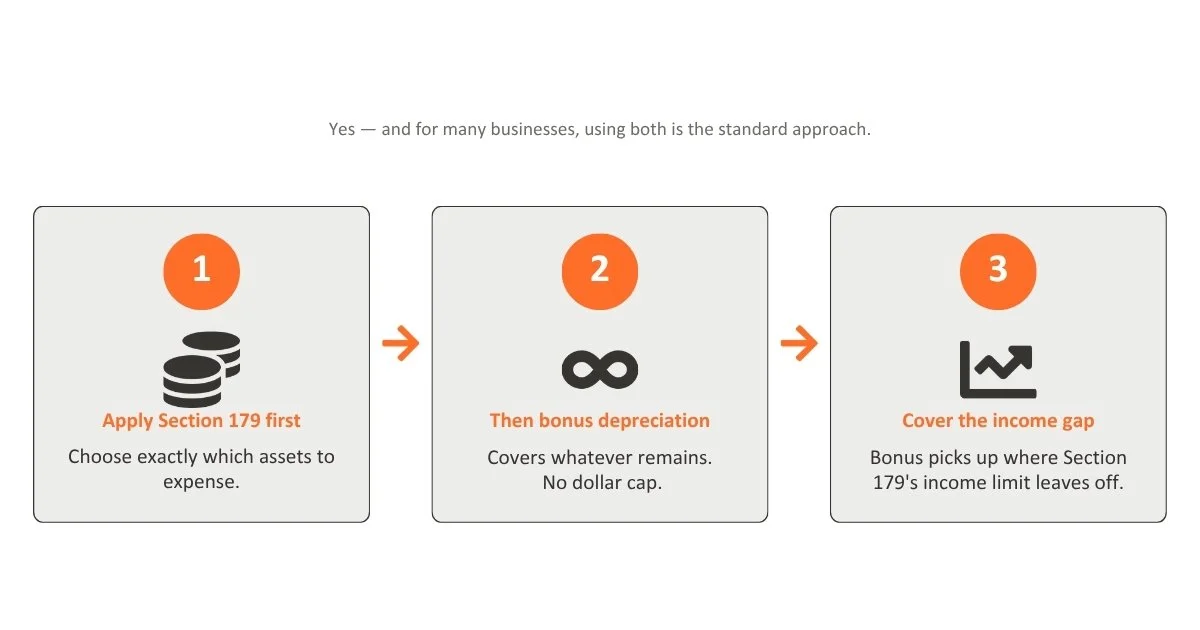
Yes, and for many businesses, using both is the standard approach. The typical order is to apply Section 179 first, since it lets you choose exactly which assets to expense, then apply bonus depreciation to whatever remains. Because bonus depreciation has no dollar cap and can create a net operating loss, it's often used to pick up where Section 179's income limitation leaves off.
Which One Should Your Business Use?
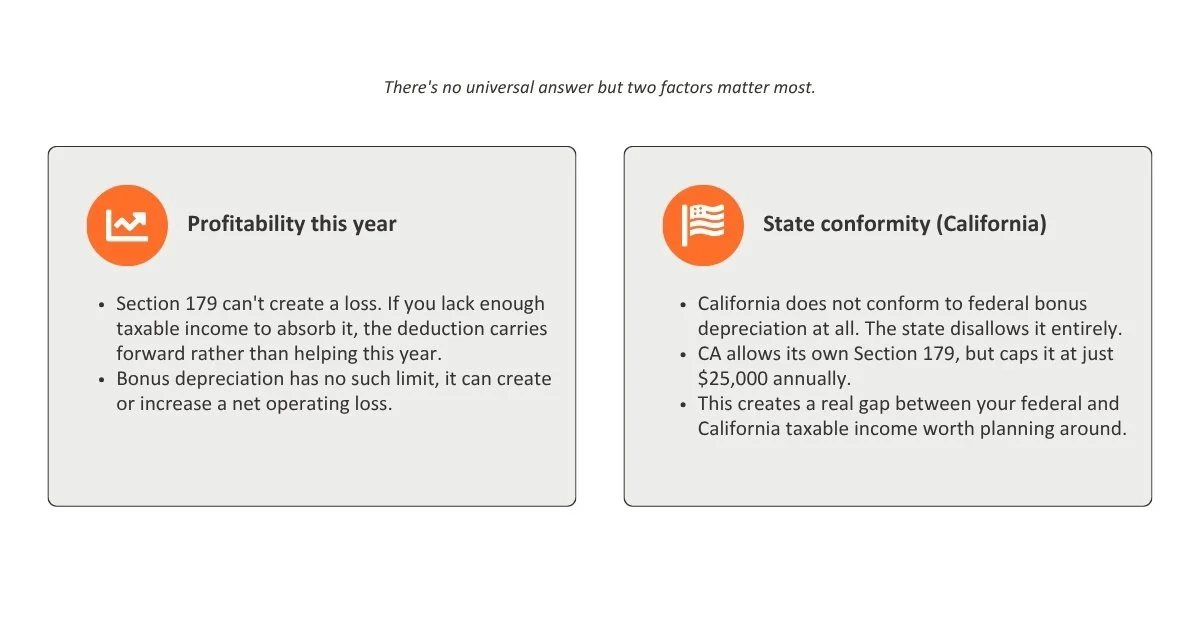
There isn't a universal answer, it depends on your business's specific situation. A few factors matter most. Profitability this year is one: Section 179 can't create a loss, so if your business doesn't have enough taxable income to absorb the deduction, it carries forward rather than helping you this year. Bonus depreciation doesn't have that restriction, and can create or increase a net operating loss that carries forward under its own rules.
State conformity is the other major factor, and it's a significant one for California businesses specifically. California does not conform to federal bonus depreciation at all, the state disallows it entirely, meaning an asset fully expensed on your federal return still gets depreciated the normal way, over several years, on your California return. California does allow its own version of Section 179, but at a far lower limit than the federal amount, capped at 25,000 dollars annually, with its own phase-out threshold. This creates a real gap between your federal and California taxable income that's worth planning around rather than discovering at filing time.
A Simple Example
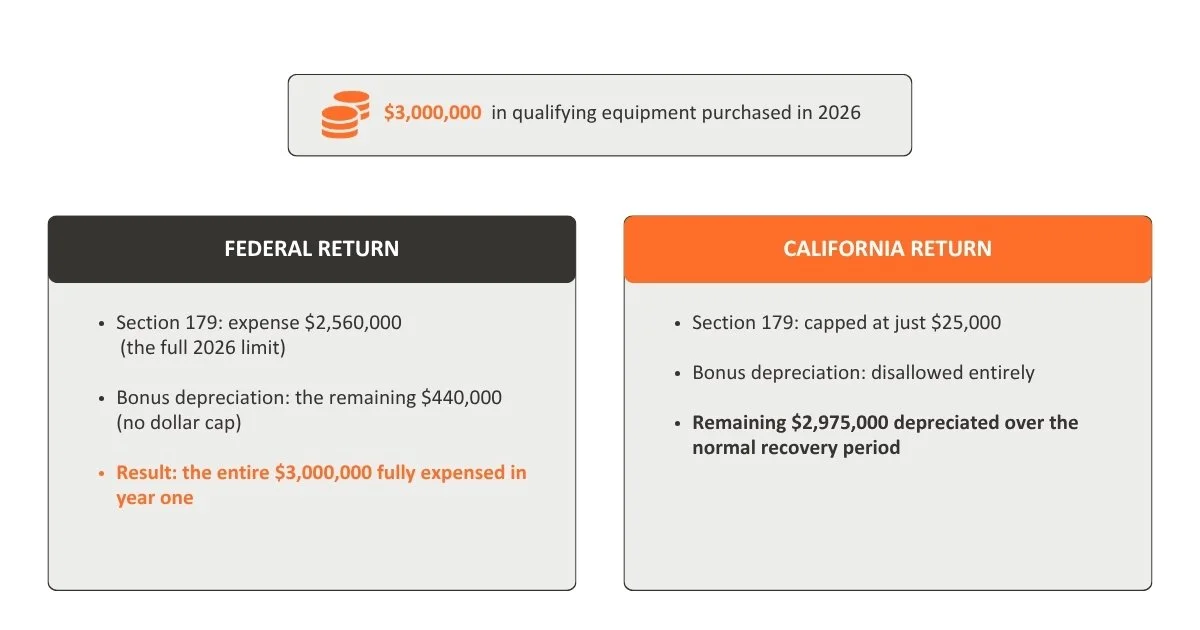
Say a business purchases 3,000,000 dollars in qualifying equipment in 2026. Using Section 179 first, the business can expense 2,560,000 dollars, the full 2026 limit, assuming sufficient taxable income to absorb it. The remaining 440,000 dollars can then be deducted under 100 percent bonus depreciation, since bonus depreciation has no dollar cap. On the federal return, the business has fully expensed the entire 3,000,000 dollar purchase in year one.
On a California return, the outcome looks very different. California's Section 179 limit caps the state deduction at 25,000 dollars, and California disallows bonus depreciation entirely. The remaining 2,975,000 dollars gets depreciated over the equipment's normal recovery period on the California return, even though it was fully expensed federally.
Frequently Asked Questions
-
No, not fully. California disallows bonus depreciation entirely and has never conformed to it, under any version of the federal rules. California does allow its own Section 179 deduction, but caps it at 25,000 dollars annually, far below the federal 2,560,000 dollar limit for 2026.
-
The unused portion carries forward to future tax years rather than being lost. This is one of the situations where bonus depreciation, which isn't limited by taxable income, can be more useful in a low-profit year.
-
Yes, though vehicles come with their own additional limitations, particularly for passenger vehicles under luxury auto depreciation caps. Heavy vehicles, generally those with a gross vehicle weight rating over 6,000 pounds, are treated more favorably under both provisions than standard passenger cars.
-
Not under current law. Recent federal legislation removed the scheduled phase-down entirely and made the 100 percent rate permanent, with no expiration date currently in place. That said, tax law can change, and this is worth confirming again if you're planning purchases several years out.
The right mix of Section 179 and bonus depreciation depends on your business's profitability, purchase timing, and where you file. A tax professional can help you structure equipment purchases to get the most out of both, federally and in California.