S Corp Reasonable Compensation: How the IRS Determines a Fair Salary
Electing S corp status lets you split your income into two buckets: salary, which gets hit with payroll tax, and distributions, which don't. That split is the entire reason many owners make the election in the first place. But the IRS doesn't let you decide that split freely. Your salary has to be reasonable for the work you're actually doing, and if it isn't, the IRS can step in, recharacterize your distributions as wages, and hand you a bill for years of back payroll tax. This is the single most common audit trigger for S corp owners, and it's worth understanding before you set your own salary.

What "Reasonable Compensation" Means
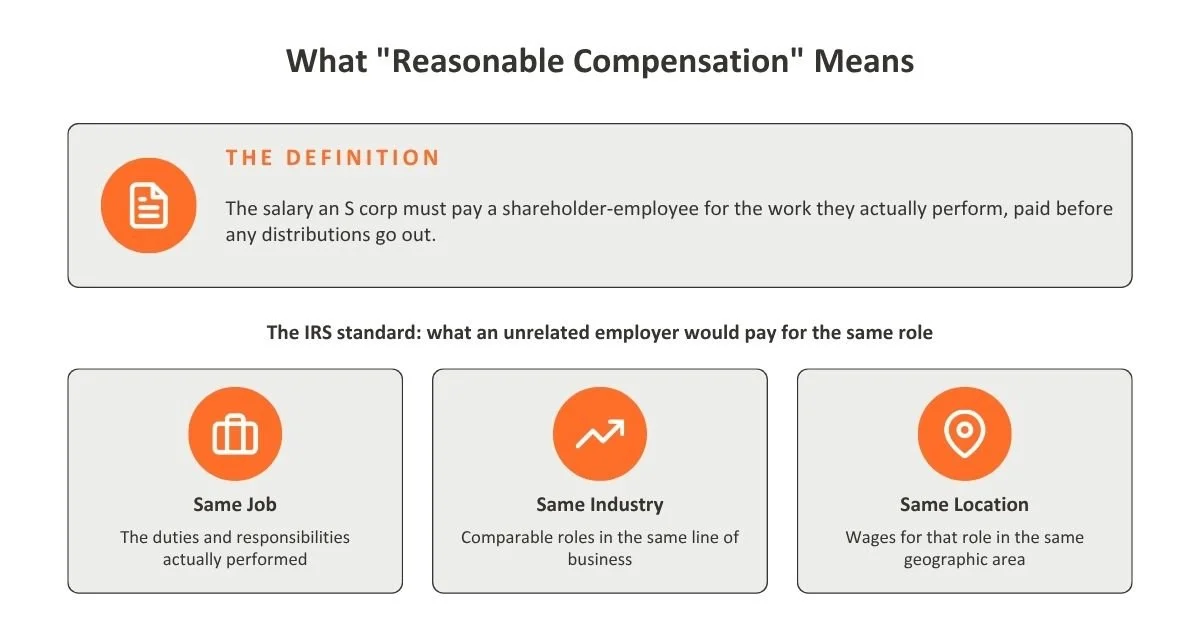
Reasonable compensation is the salary an S corp must pay a shareholder-employee for the work they actually perform, before any distributions go out. The standard the IRS and courts apply is simple to state and harder to nail down in practice: it has to reflect what an unrelated employer would pay someone else to do the same job, in the same industry, in the same location.
Why the IRS Scrutinizes S Corp Salaries
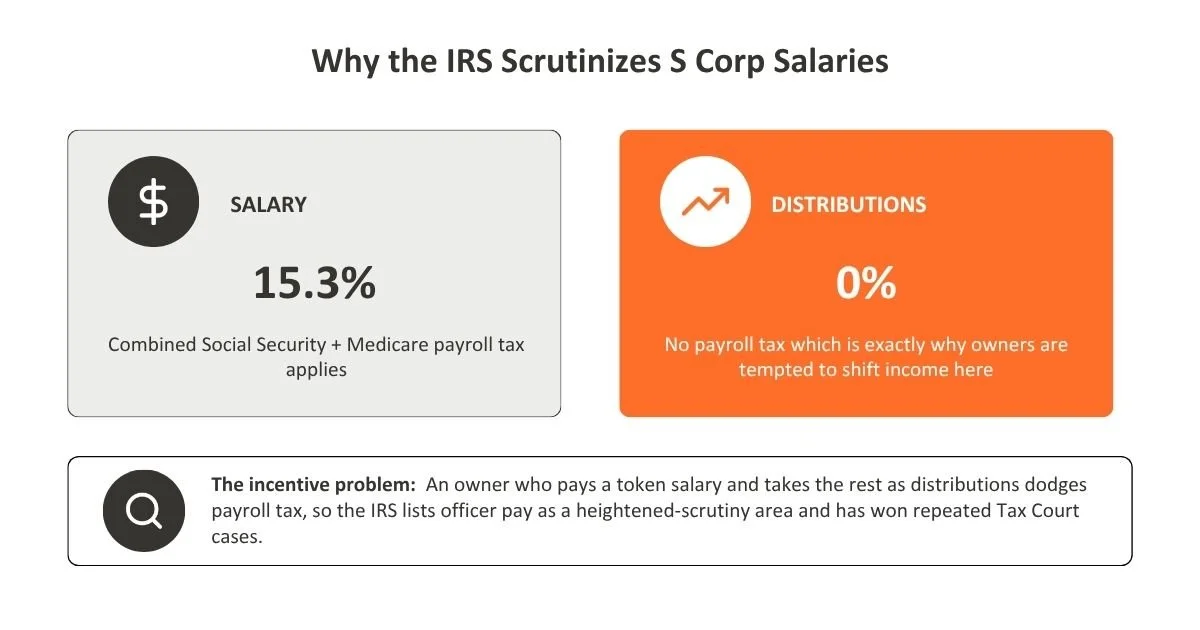
Here's the incentive problem the IRS is guarding against. Salary is subject to Social Security and Medicare payroll tax, currently 15.3 percent combined between employer and employee portions. Distributions are not. An owner who pays themselves a token salary and takes the rest of their profit as distributions can avoid a large chunk of payroll tax entirely, at least on paper. The IRS has specifically listed S corp officer compensation as an area of heightened scrutiny, and has won repeated Tax Court cases against owners who tried exactly this pattern.
How the IRS (and Courts) Determine What's "Reasonable"
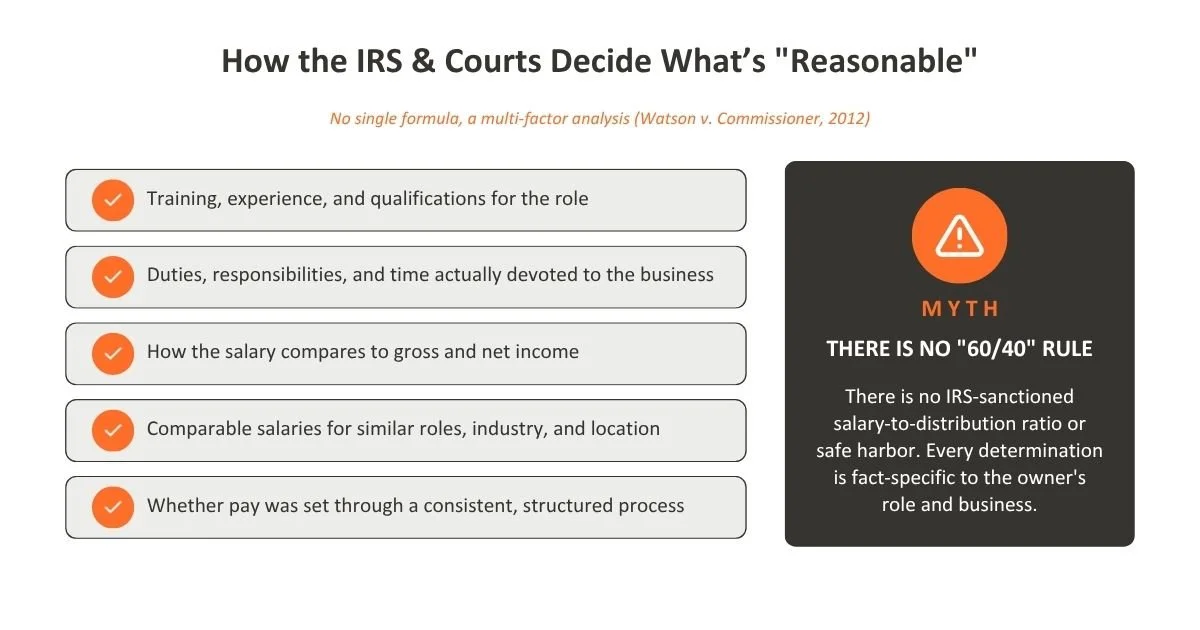
There's no single formula. Courts have relied on a multi-factor analysis built up over a series of cases, most notably Watson v. Commissioner, decided by the 8th Circuit in 2012 and left standing when the Supreme Court declined to hear the appeal. The factors courts have applied include: The shareholder-employee's training, experience, and qualifications for the role. The duties, responsibilities, and time actually devoted to the business. How the salary compares to the company's gross and net income. Comparable salaries for similar roles in the same industry and geographic area. Whether compensation was set through a structured, consistent process rather than an arbitrary number. One myth worth clearing up directly: there's no IRS-sanctioned 60/40 salary-to-distribution ratio, or any other fixed ratio that counts as a safe harbor. That idea circulates often, but it has no legal basis. Every determination is fact-specific to the individual owner's role and the business.
What Happens If Your Salary Is Too Low
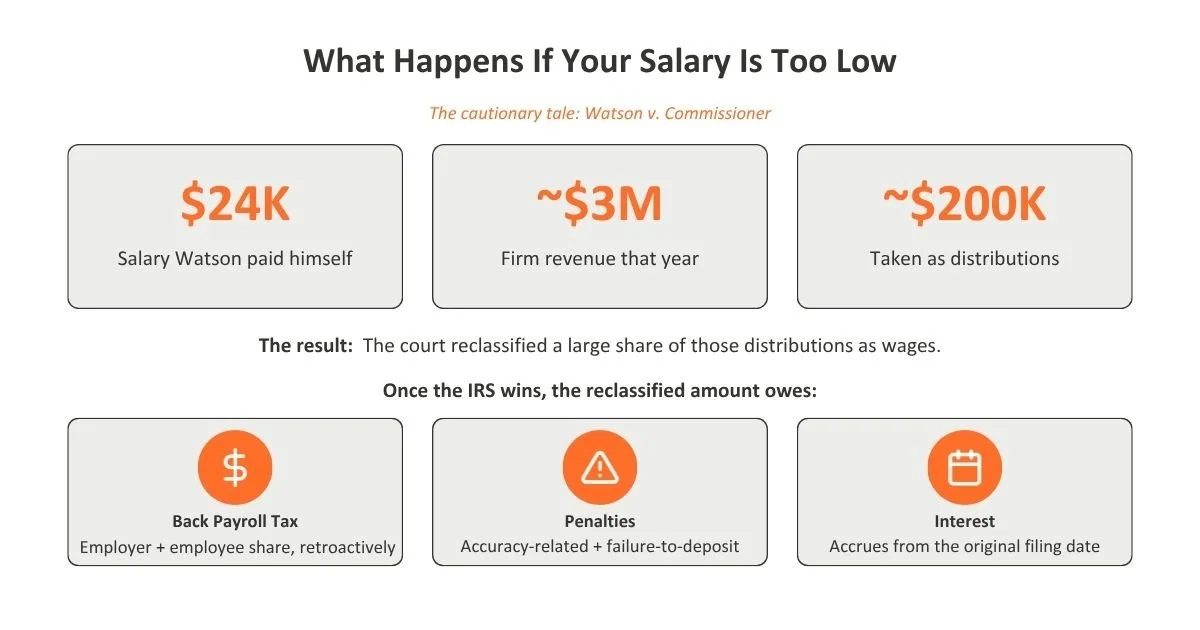
The clearest example remains the Watson case itself. David Watson, a CPA and sole shareholder of his accounting firm's S corp, paid himself a 24,000 dollar annual salary while the firm generated close to 3 million dollars in revenue and distributed roughly 200,000 dollars to him. The IRS successfully argued that a beginning accountant would have earned more than that, let alone someone with Watson's experience, and the court reclassified a large portion of his distributions as wages. When the IRS wins this argument, the consequences aren't small. The reclassified amount becomes subject to payroll tax retroactively, both the employer and employee share, plus accuracy-related penalties, failure-to-deposit penalties, and interest that accrues from the original filing date. In some cases, the additional tax and penalties from an unreasonably low salary can exceed whatever payroll tax savings the owner thought they were capturing in the first place.
How to Set (and Document) a Reasonable Salary
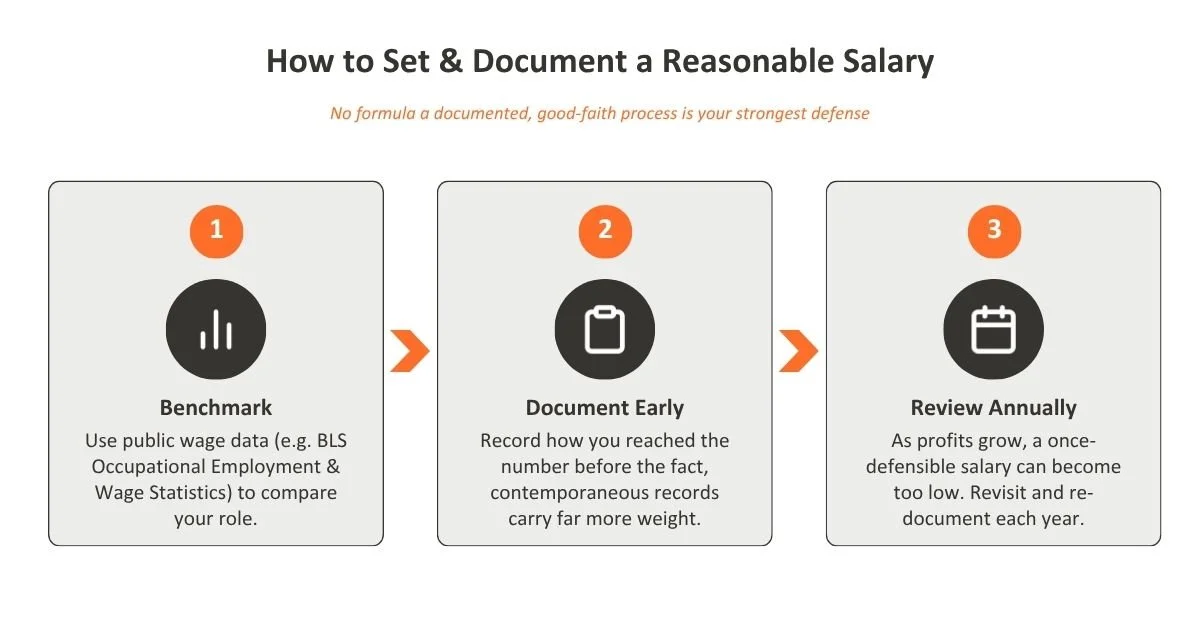
Since there's no fixed formula, the strongest defense is a documented, good-faith process. Publicly available wage data, such as the Bureau of Labor Statistics Occupational Employment and Wage Statistics survey, is a common starting point for benchmarking a role against comparable positions in your industry and region. Whatever data you use, the important part is doing this before the fact and keeping records of how you arrived at the number, since documentation created after an audit begins carries far less weight than records kept contemporaneously. Reasonable compensation also isn't a set-it-and-forget-it number. As a business grows and profits increase, a salary that was defensible in year one can become unreasonably low by year three if it doesn't scale with the business. Revisiting the number annually, and documenting that review, is part of what makes the number defensible if it's ever questioned.
A Simple Example
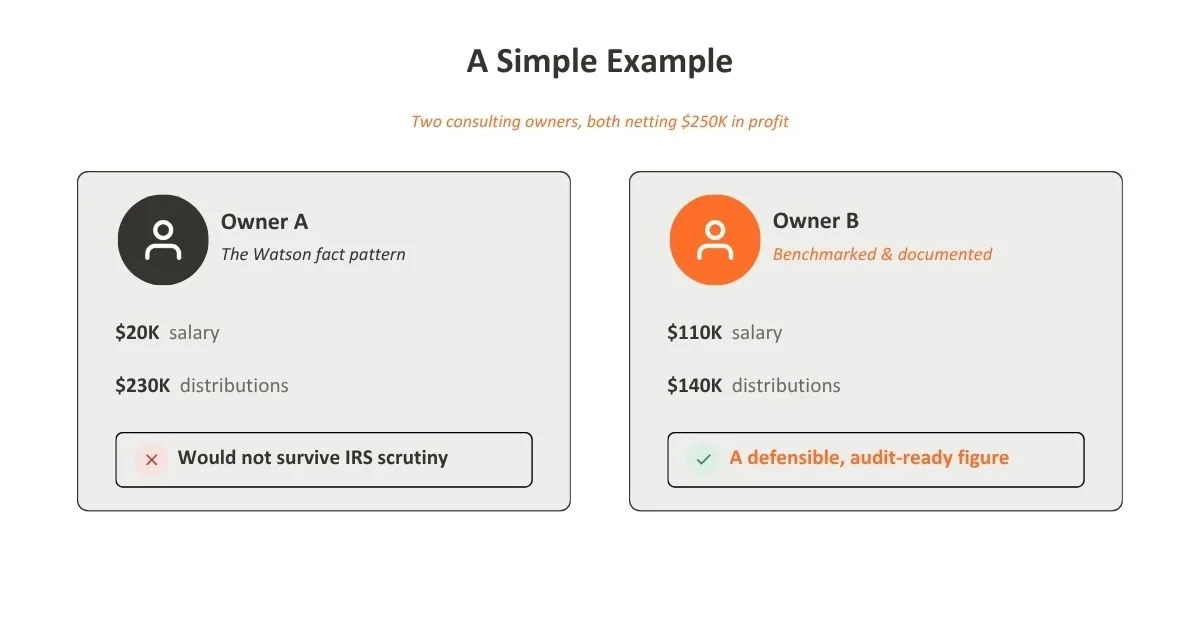
Consider two S corp owners, both running a consulting business that nets 250,000 dollars in profit for the year. The first pays themselves a 20,000 dollar salary and takes the remaining 230,000 dollars as distributions. The second researches comparable consulting salaries in their area, lands on 110,000 dollars as a defensible figure for their role and time commitment, and takes the remaining 140,000 dollars as distributions. Both owners are using the same basic strategy, salary plus distributions, but only one of them has a number that would survive scrutiny if the IRS asked. The first is a textbook version of the Watson fact pattern.
Frequently Asked Questions
-
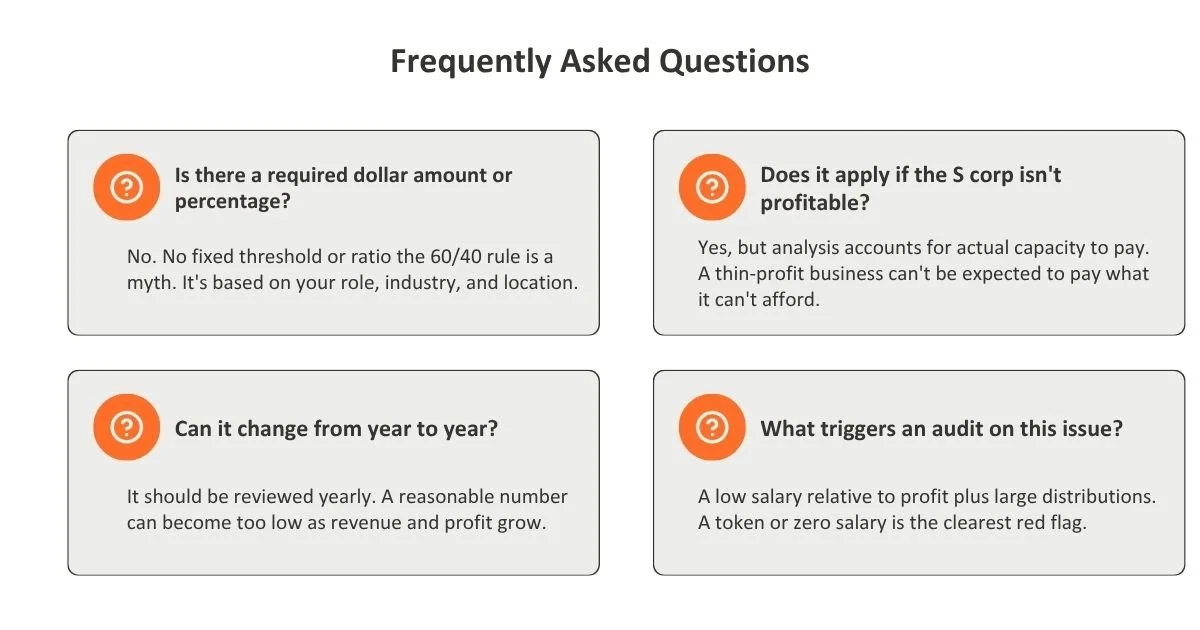
No. There's no fixed dollar threshold or salary-to-distribution ratio, including the commonly cited but incorrect 60/40 rule. Reasonable compensation is based on the specific facts of the owner's role, industry, and location.
-
Yes, though the analysis accounts for the business's actual financial capacity to pay. A business with thin or no profit generally can't be expected to pay a salary it can't afford, but that's a different situation from a highly profitable business paying an artificially low salary specifically to avoid payroll tax.
-
It should be reviewed every year. A number that was reasonable when the business was smaller can become unreasonably low as revenue and profit grow, which is exactly the pattern that played out in the Watson case over time.
-
A salary that's low relative to the company's profit, combined with large distributions, is the classic pattern the IRS looks for. A salary of zero or a token amount alongside substantial distributions is the clearest red flag.
Setting the right salary for your S corp is part tax strategy, part audit protection. A tax professional can help you land on a number that's actually defensible, not just convenient.