Depreciation Recapture: What Real Estate Investors Owe When They Sell
You sell a rental property, run the numbers on capital gains tax, and think you know what you owe. Then your accountant mentions depreciation recapture, and suddenly part of your gain is taxed at a rate you weren't expecting. This catches a lot of real estate investors off guard, and it shouldn't. Here's what depreciation recapture actually is, how it's calculated, and what it means the next time you sell.

What Is Depreciation Recapture?
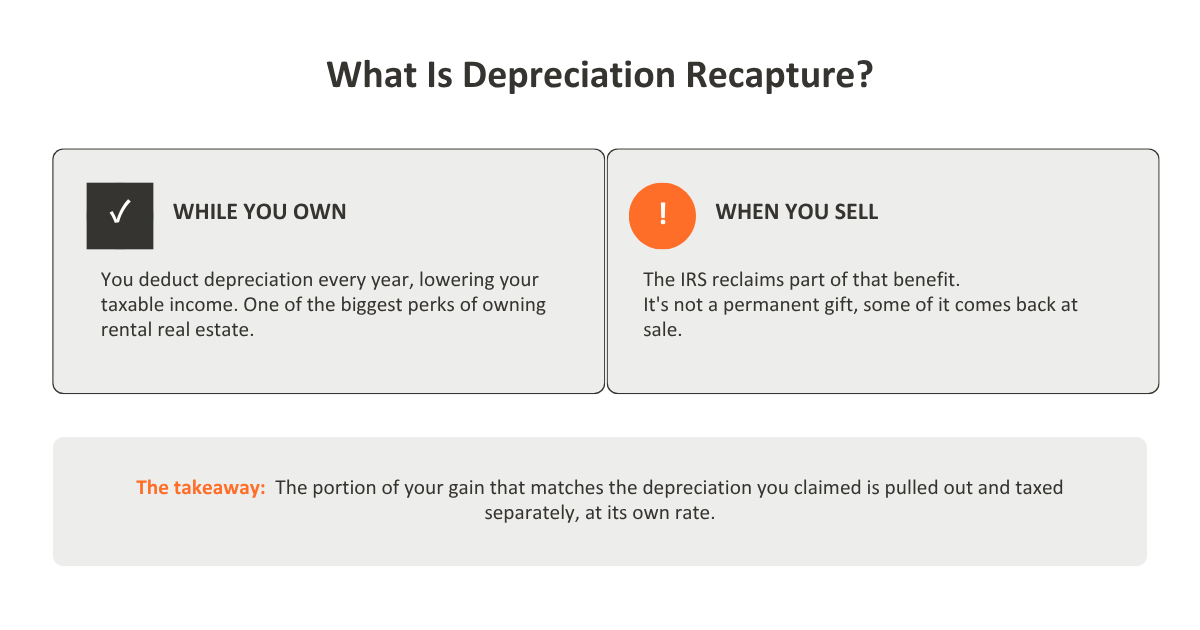
Every year you own a rental property, you get to deduct depreciation on your tax return. That deduction lowers your taxable income year after year, one of the biggest perks of owning real estate. But depreciation isn't a permanent gift. When you sell the property, the IRS wants some of that benefit back. That's depreciation recapture. The portion of your gain that matches the depreciation you claimed gets pulled out and taxed separately from the rest of your profit, at a rate written specifically for this purpose.
How Depreciation Recapture Is Calculated
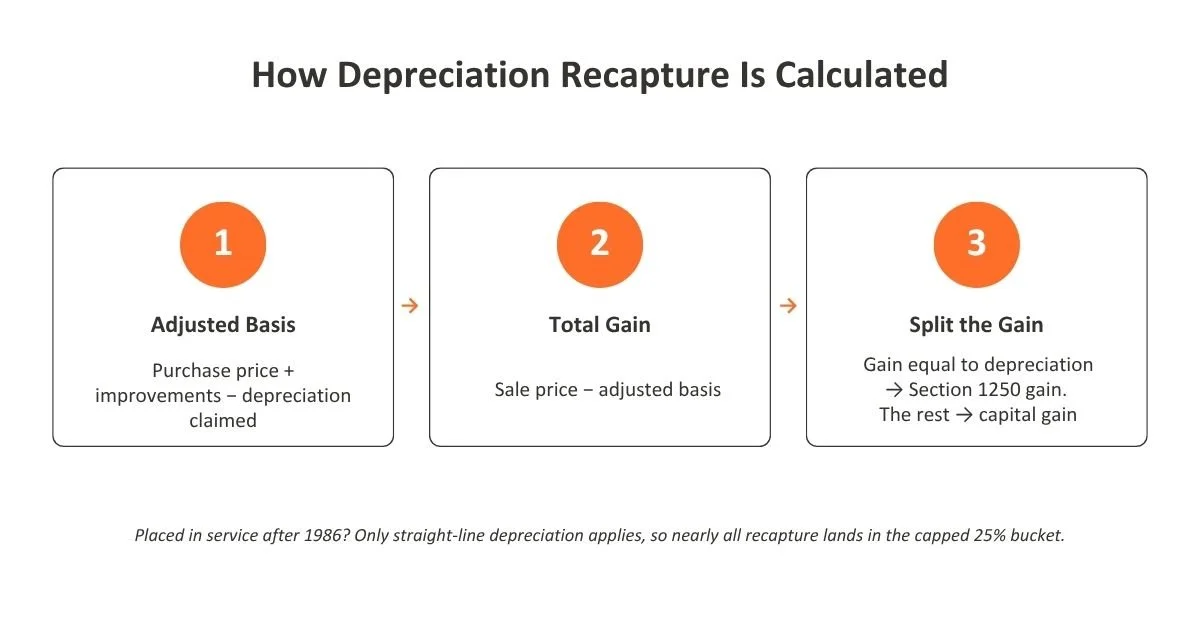
Start with your adjusted basis: your original purchase price plus improvements, minus the total depreciation you've claimed. Subtract that adjusted basis from your sale price, and you get your total gain. From there, the gain splits into pieces. The amount of gain that equals your accumulated depreciation becomes what the IRS calls unrecaptured Section 1250 gain. Any gain beyond that, the part with nothing to do with depreciation, is taxed as a standard long-term capital gain. For most residential and commercial property placed in service after 1986, only straight-line depreciation is allowed, so nearly all of the recaptured amount falls into this 25 percent capped bucket rather than being taxed as ordinary income outright.
The Tax Rate on Recaptured Depreciation (Section 1250 Property)
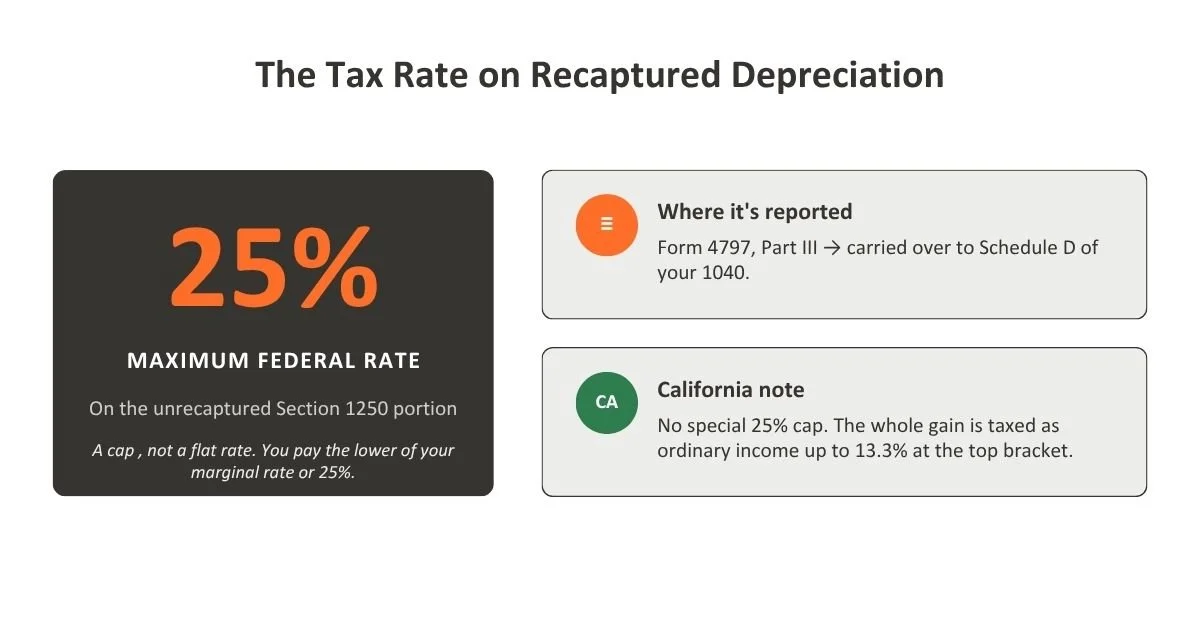
Rental buildings, commercial property, and other depreciable real estate fall under Section 1250 of the tax code. When you sell at a gain, the unrecaptured Section 1250 portion is taxed at a maximum federal rate of 25 percent. That 25 percent is a cap, not a flat rate everyone pays. The actual rate applied is whichever is lower: your ordinary marginal tax rate or 25 percent. Investors in a high tax bracket usually hit that cap, meaning the recaptured portion ends up taxed higher than the rest of the gain. Investors in a lower bracket may see the recaptured amount taxed closer to their regular rate. This gets reported on Form 4797, with the unrecaptured Section 1250 calculation worked out in Part III, then carried over to Schedule D of your 1040. One thing worth flagging for California investors: the state doesn't offer a special 25 percent cap the way the federal system does. California generally follows the federal rules for computing the recapture amount, but taxes the entire gain, recaptured portion included, as ordinary income at the state's regular rates, up to 13.3 percent at the top bracket.
Recaptured Depreciation vs. Capital Gains: How They're Taxed Differently
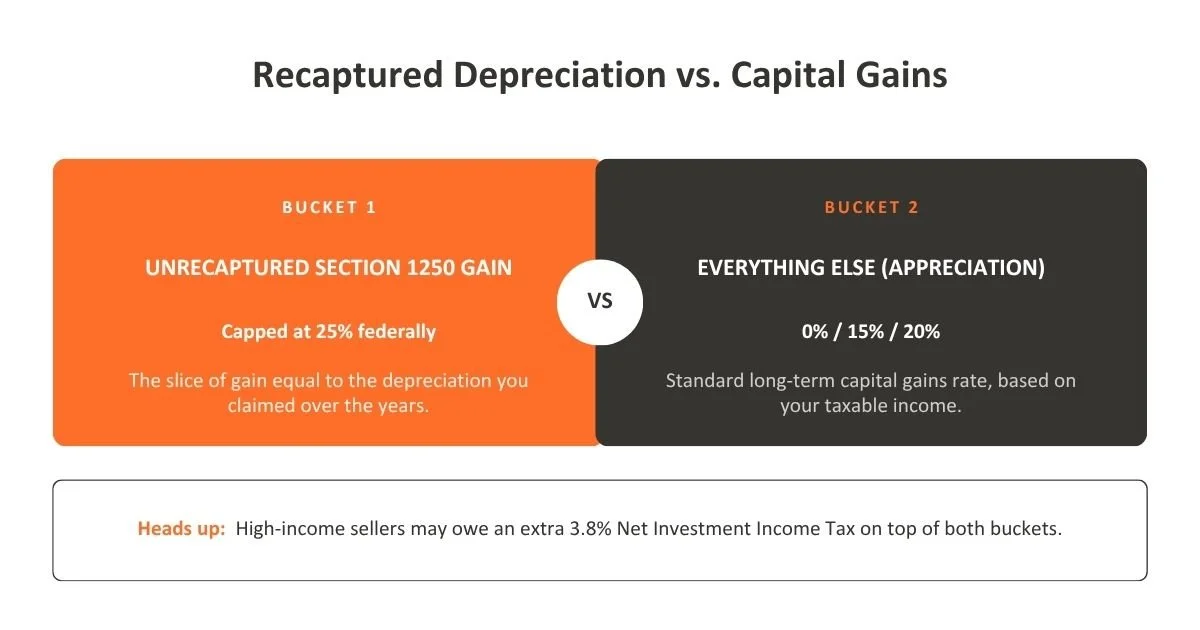
Think of your total gain on sale as two separate buckets, not one number. The first bucket is the unrecaptured Section 1250 gain, capped at 25 percent federally. The second bucket is everything else, taxed at the regular long-term capital gains rates: 0, 15, or 20 percent depending on your taxable income. For 2026, the 15 percent rate applies once taxable income passes 48,350 dollars for single filers and 96,700 dollars for married couples filing jointly, with the 20 percent rate kicking in above 533,400 dollars single and 600,050 dollars joint. High-income sellers should also factor in the 3.8 percent Net Investment Income Tax, which can apply on top of both buckets depending on total income for the year.
Can You Avoid or Defer Depreciation Recapture?
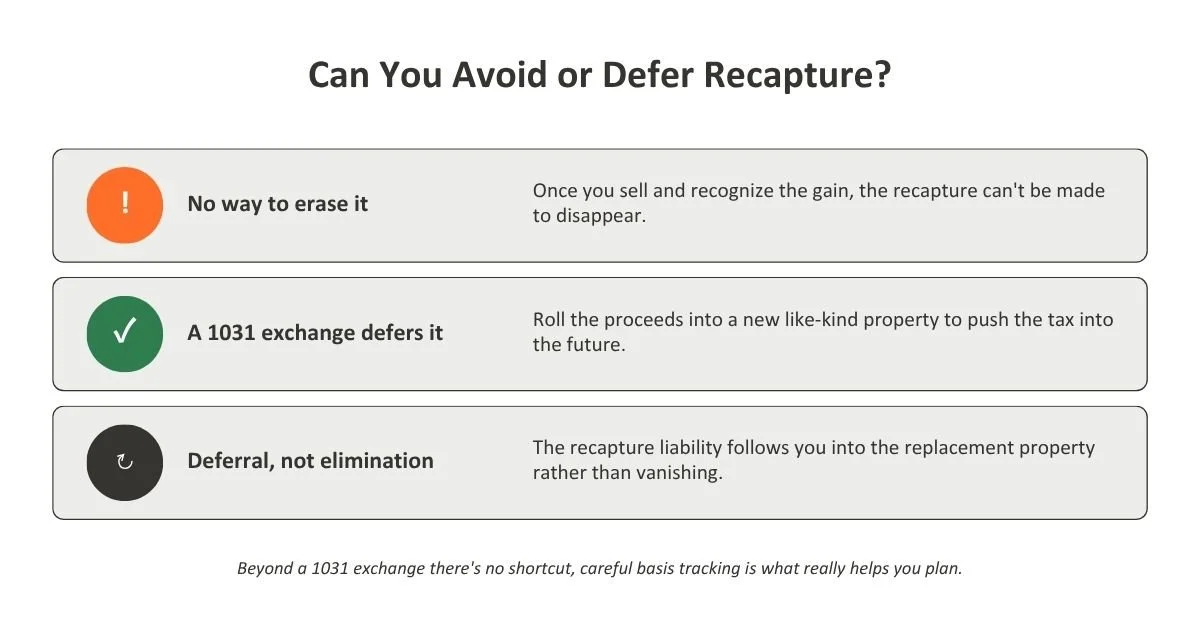
There's no way to make depreciation recapture disappear once you sell and recognize the gain. There is, however, a well-established way to defer it: a 1031 exchange. Rolling the proceeds from a sale into a new like-kind property lets you push both the capital gains tax and the depreciation recapture into the future instead of paying it now. That's deferral, not elimination. The recapture liability generally follows you into the replacement property rather than disappearing. We walk through exactly how that timeline works in our 1031 exchange guide. Beyond a 1031 exchange, there isn't a shortcut. Careful basis tracking and knowing your numbers before you list the property are what actually help you plan for what you'll owe.
A Simple Example
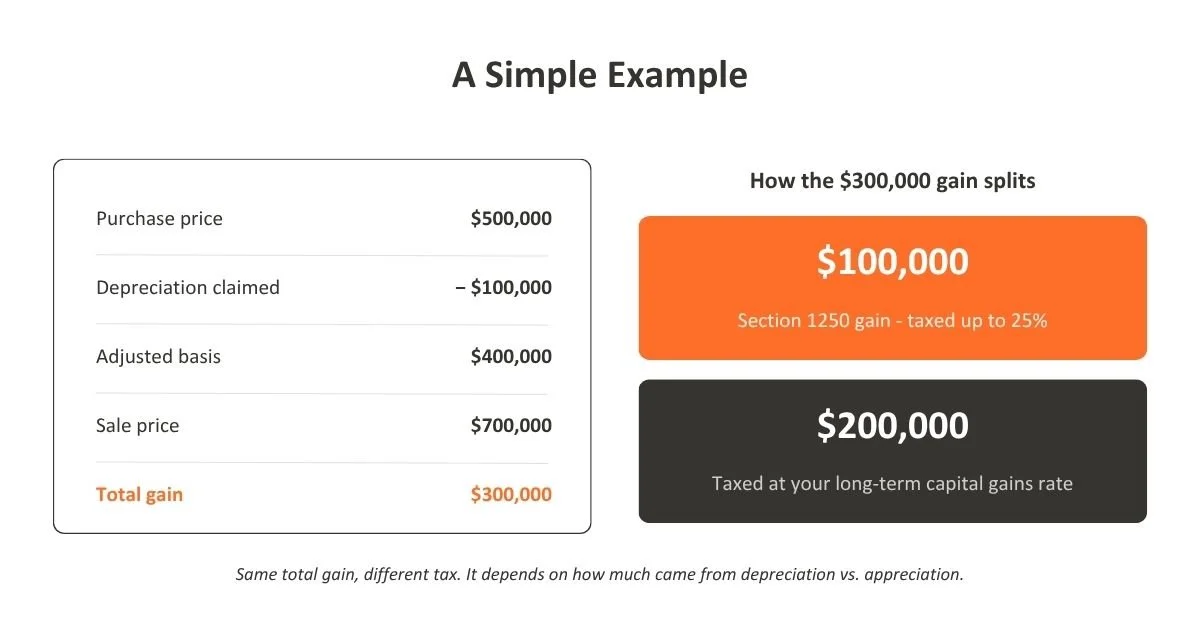
Say you bought a rental property for 500,000 dollars and claimed 100,000 dollars in depreciation over the years you owned it. Your adjusted basis is now 400,000 dollars. You sell for 700,000 dollars, for a total gain of 300,000 dollars. The first 100,000 dollars of that gain, matching your accumulated depreciation, is unrecaptured Section 1250 gain, taxed at up to 25 percent. The remaining 200,000 dollars is taxed at your regular long-term capital gains rate. That's why two investors with the same total gain can owe noticeably different amounts, depending on how much of that gain came from depreciation versus appreciation.
Frequently Asked Questions
-
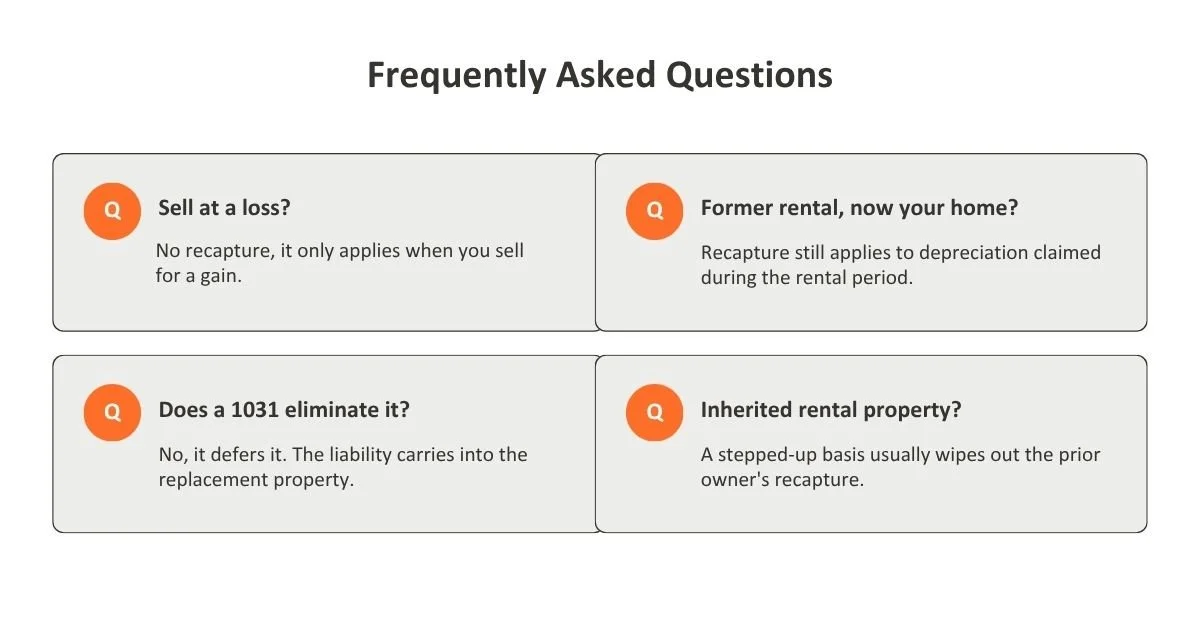
No. Depreciation recapture only applies when you sell for a gain. If the sale results in a loss, there's no recapture to calculate.
-
The depreciation recapture rules still apply to any depreciation you claimed while the property was a rental, even after it becomes your primary residence. The Section 121 home sale exclusion can shelter some of the gain, but generally not the portion tied to depreciation claimed during the rental period. This is a nuanced area worth reviewing with a tax professional before you sell.
-
Just defer it. The recapture liability carries forward into the replacement property rather than being erased. H3: What happens to depreciation recapture if I inherit a rental property? Heirs generally receive a stepped-up basis on inherited property, which means the depreciation recapture and capital gains liability built up during the original owner's lifetime typically doesn't carry over to the person who inherits it.
Depreciation recapture is one of the easiest numbers to get wrong when estimating what a sale will actually net you. Before you list a rental property, talk to a tax professional who can run the real numbers on your specific situation.