
Stock Options and Equity Compensation Tax Preparation
Stock compensation can create both wage income and investment income during different stages of the same transaction.
Restricted stock units, employee stock options, employee stock purchase plans, and other equity awards may affect Form W 2, Form 1099 B, Form 3921, Form 3922, Form 8949, Schedule D, and the alternative minimum tax calculation.
I prepare federal and state income tax returns for employees and former employees who receive equity compensation.
I review the employer tax documents, brokerage statements, award records, exercise information, and stock sales together. This helps identify compensation already reported as wages and cost basis adjustments that may be needed when the shares are sold.
Stock Compensation Tax Preparation Summary
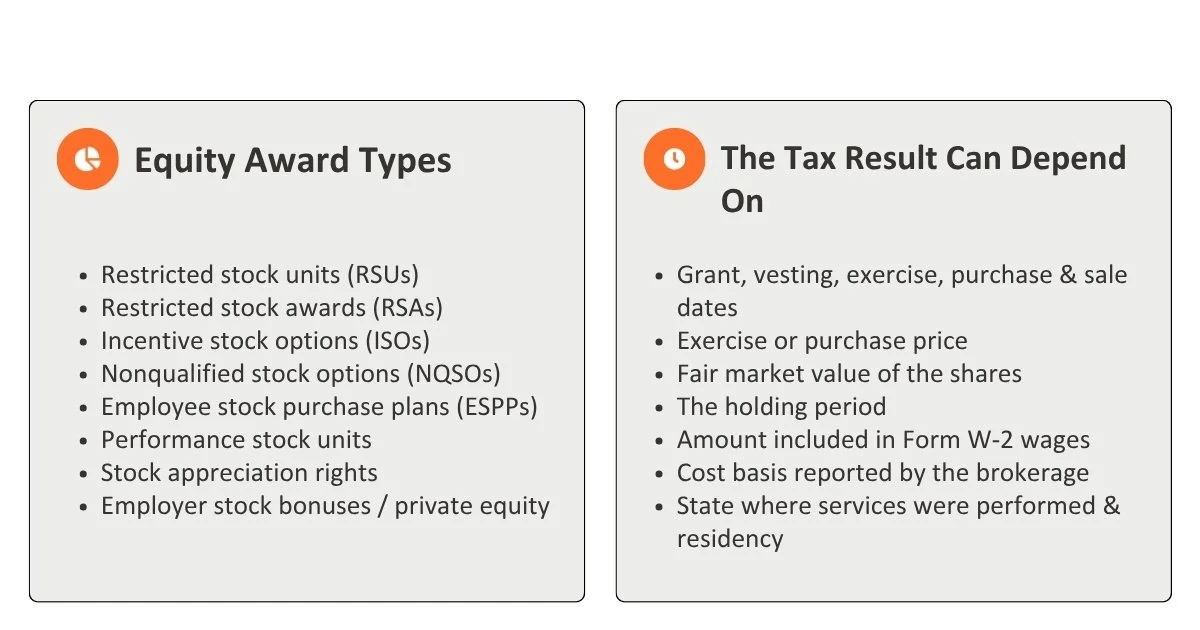
Employee equity compensation may include:
Restricted stock units
Restricted stock awards
Incentive stock options
Nonqualified stock options
Employee stock purchase plans
Performance stock units
Stock appreciation rights
Employer stock bonuses
Private company equity
Each type of award follows its own tax rules.
The tax result can depend on:
The grant date
The vesting date
The exercise date
The purchase date
The sale date
The exercise or purchase price
The fair market value of the shares
The holding period
The amount included in Form W 2 wages
The cost basis reported by the brokerage
The state where services were performed
The employee’s state of residence
The stock compensation documents should be reviewed before the Form 1099 B transactions are entered on the tax return.
Restricted Stock Unit Tax Reporting
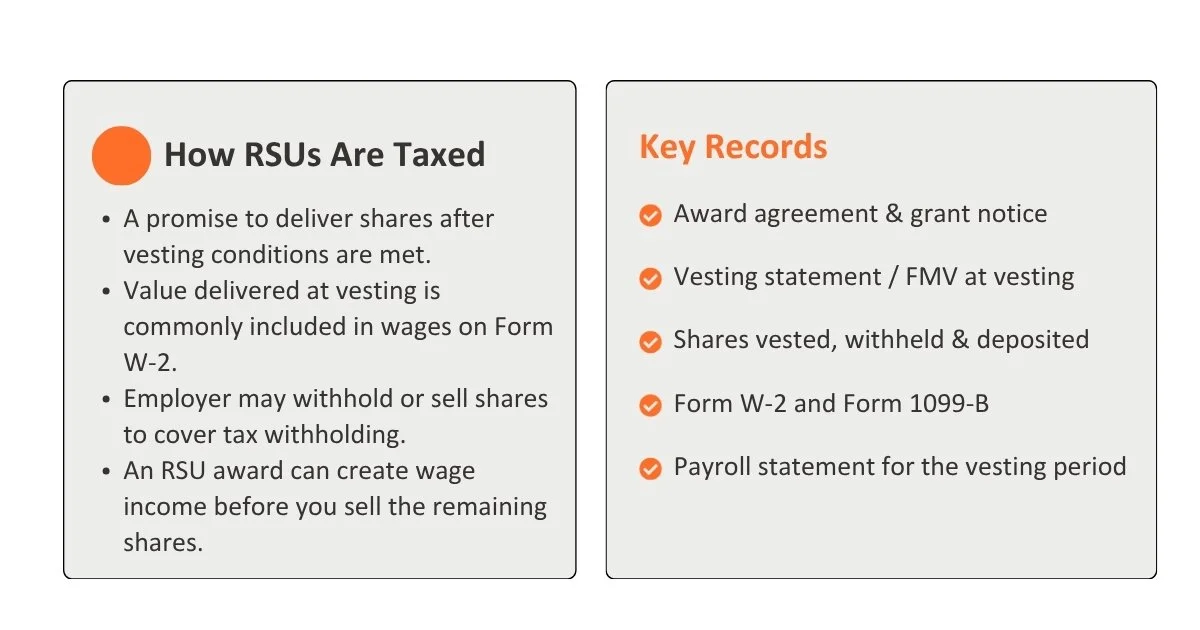
Restricted stock units generally represent a promise to deliver company stock or cash after specified vesting conditions are met.
The value of shares delivered at vesting or settlement is commonly included in the employee’s wages and reported on Form W 2.
The employer may withhold shares or sell part of the award to cover payroll and income tax withholding.
Important records include:
The original award agreement
The grant notice
The vesting statement
The fair market value at vesting
The number of shares vested
The number of shares withheld for taxes
The number of shares deposited into the brokerage account
Form W 2
Form 1099 B
The payroll statement for the vesting period
A restricted stock unit award can create wage income before the employee sells the remaining shares.
Restricted Stock Units Reported on Form W 2
The taxable value of vested or settled restricted stock units is commonly included in Form W 2 wages.
Federal and state income tax may be withheld. Social Security and Medicare taxes may also apply.
The exact amount and reporting can depend on the award terms and settlement date.
The Form W 2 and the vesting statement should be compared to confirm that the stock compensation was included in wages.
Shares Withheld or Sold to Cover Taxes
Employers often withhold shares or arrange a sale to cover payroll and income tax withholding.
The transaction may still appear on Form 1099 B.
The shares withheld or sold are not an additional tax deduction. They are a method of funding the withholding generated by the award.
The withholding should appear on Form W 2 or another applicable tax form. The related stock sale must still be reviewed for capital gain or loss reporting.
Selling Restricted Stock Unit Shares
When restricted stock unit shares are sold, the sale is generally reported through the brokerage account.
The capital gain or loss is based on the difference between the sale proceeds and the adjusted cost basis.
The cost basis generally includes the value already treated as compensation income, along with applicable purchase or transaction costs.
If the brokerage statement reports only a zero or incomplete basis, using that amount without adjustment can cause the compensation to be taxed again as capital gain.
Nonqualified Stock Option Tax Reporting
A nonqualified stock option gives an employee the right to purchase company stock at a specified exercise price.
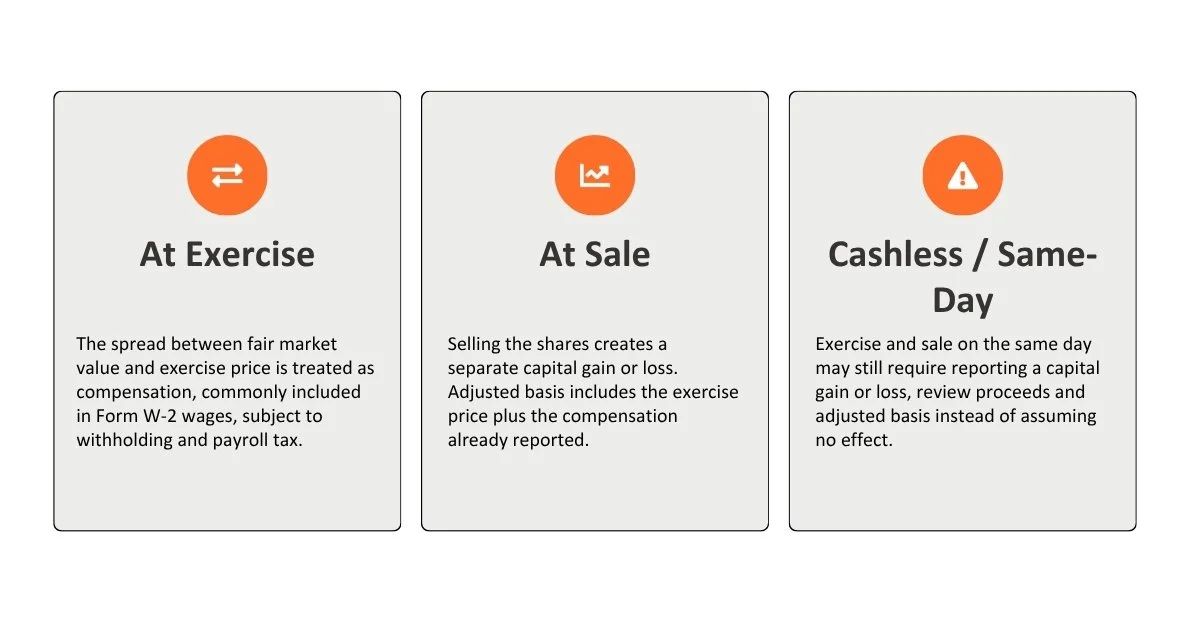
For many employee nonqualified stock options, the difference between the stock’s fair market value and the exercise price is treated as compensation when the option is exercised.
This amount is commonly included in Form W 2 wages.
The later sale of the shares can create a separate capital gain or loss.
Exercising a Nonqualified Stock Option
At exercise, the compensation amount is generally based on the difference between:
The fair market value of the shares on the exercise date
The exercise price paid for the shares
The resulting compensation is commonly subject to federal and state income tax withholding and payroll tax.
The exercise statement and Form W 2 should be reviewed together.
Selling Nonqualified Stock Option Shares
When shares acquired through a nonqualified stock option are sold, the adjusted basis generally includes:
The exercise price paid
The compensation included in income
Applicable transaction costs
A brokerage may report only the exercise price or another incomplete basis.
If the wage income is not included in the basis, part of the same economic income can be reported once as compensation and again as capital gain.
The Form W 2, exercise confirmation, and Form 1099 B should be reconciled.
Cashless Exercise and Same Day Sale
A cashless exercise allows shares to be exercised and sold without the employee paying the full exercise cost with separate funds.
The transaction may include:
Option exercise
Compensation income
Stock sale proceeds
Exercise costs
Brokerage fees
Federal withholding
State withholding
Payroll taxes
Even when the exercise and sale occur on the same day, a capital gain or loss may need to be reported.
The sale proceeds and adjusted basis should be reviewed instead of assuming the transaction has no tax return effect.
Incentive Stock Option Tax Reporting
Incentive stock options can receive different federal tax treatment from nonqualified stock options when the applicable requirements are met.
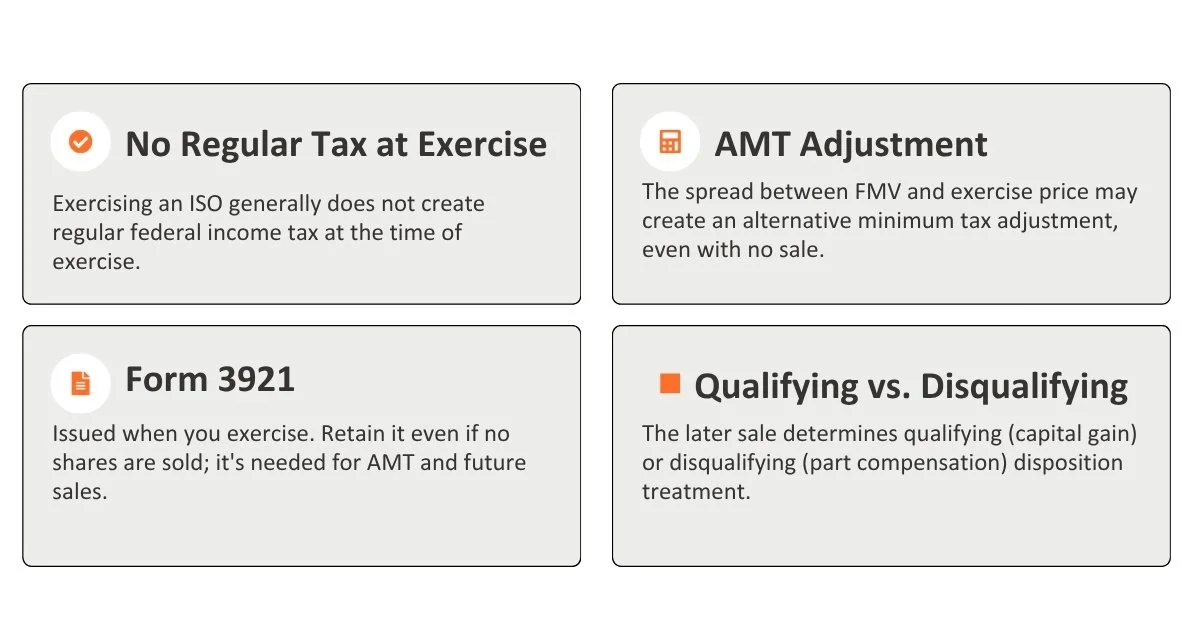
Exercising an incentive stock option generally does not create regular federal income tax at exercise. However, the difference between the fair market value and exercise price may create an alternative minimum tax adjustment.
The later sale of the shares determines whether the transaction receives qualifying or disqualifying disposition treatment.
Form 3921
An employer generally issues Form 3921 when an employee exercises an incentive stock option.
Form 3921 may show:
The grant date
The exercise date
The exercise price per share
The fair market value per share on the exercise date
The number of shares transferred
Form 3921 should be retained even when no shares were sold during the year.
The information may be needed for the alternative minimum tax calculation and the future sale of the shares.
Alternative Minimum Tax and Incentive Stock Options
The difference between the fair market value of the incentive stock option shares and the exercise price may create an adjustment for alternative minimum tax purposes.
The adjustment can apply even when the employee did not sell the shares and did not receive cash from the transaction.
The actual alternative minimum tax result depends on the complete return, including income, deductions, exemptions, and other adjustments.
A prior alternative minimum tax may create a credit that can be used in a later year, subject to federal limitations.
Form 3921, exercise records, year end share ownership, and any same year sales should be reviewed.
Qualifying Disposition of Incentive Stock Option Shares
A sale may receive qualifying disposition treatment when the required holding periods are met.
The holding period generally considers:
The date the option was granted
The date the option was exercised
The date the shares were sold
When the requirements are met, the gain is generally treated as capital gain rather than wage income.
The complete transaction should be reviewed because other rules can affect the result.
Disqualifying Disposition of Incentive Stock Option Shares
A disqualifying disposition occurs when the shares are sold before the required holding periods are met.
Part of the income may be treated as compensation. Any remaining gain or loss may receive capital treatment.
The employer may report the compensation on Form W 2, but the employee should not assume the brokerage basis includes that wage income.
Form W 2, Form 3921, the sale confirmation, and Form 1099 B should be reviewed together.
Employee Stock Purchase Plan Tax Reporting
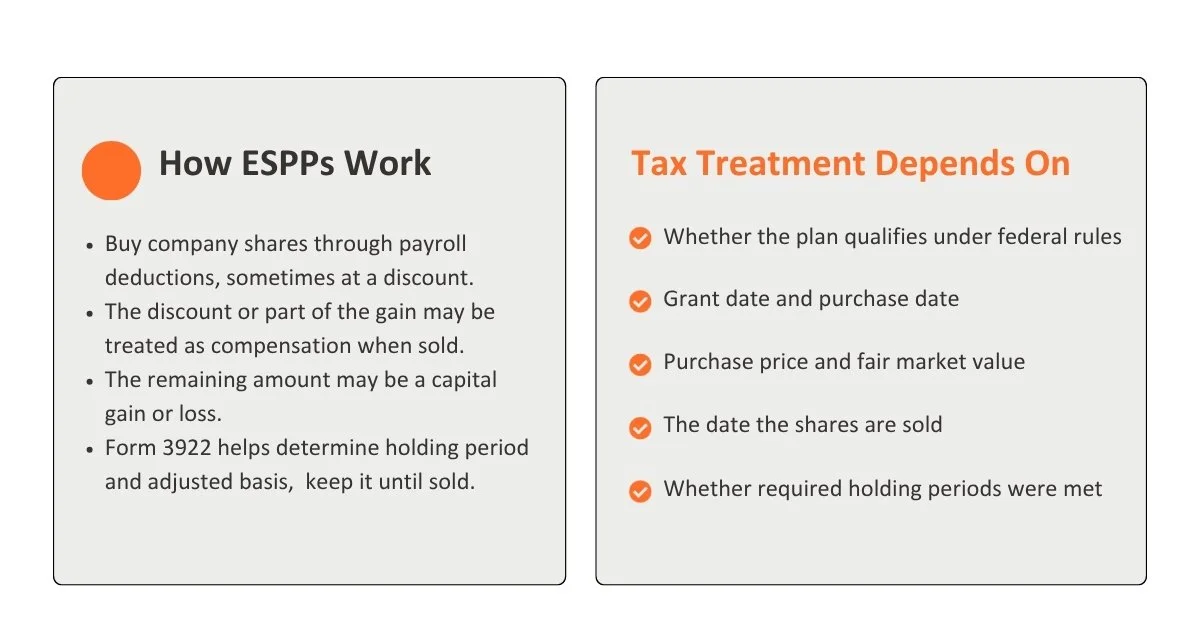
An employee stock purchase plan may allow employees to purchase company shares through payroll deductions, sometimes at a discount.
The tax treatment generally depends on:
Whether the plan qualifies under the applicable federal rules
The grant date
The purchase date
The purchase price
The fair market value
The date the shares are sold
Whether the required holding periods were met
The discount or part of the gain may be treated as compensation income when the shares are sold. The remaining amount may be a capital gain or loss.
Form 3922
Form 3922 provides information about stock acquired through certain employee stock purchase plans.
The form may show:
The grant date
The purchase date
The fair market value on the grant date
The fair market value on the purchase date
The price paid per share
The number of shares transferred
Form 3922 helps determine the holding period and adjusted basis.
The employee should retain Form 3922 until the related shares are sold and reported.
Qualifying Employee Stock Purchase Plan Disposition
A sale may receive qualifying disposition treatment when the applicable holding periods are met.
Part of the discount may be treated as compensation income. The remaining result may be a capital gain or loss.
The calculation depends on the grant date value, purchase price, sale price, and plan terms.
Disqualifying Employee Stock Purchase Plan Disposition
A sale before the required holding period is met generally creates a disqualifying disposition.
The discount measured under the applicable rules may be treated as compensation income. The remaining gain or loss may receive capital treatment.
The compensation amount may appear on Form W 2, but the brokerage basis may not reflect it.
Restricted Stock Awards and Section 83 Elections
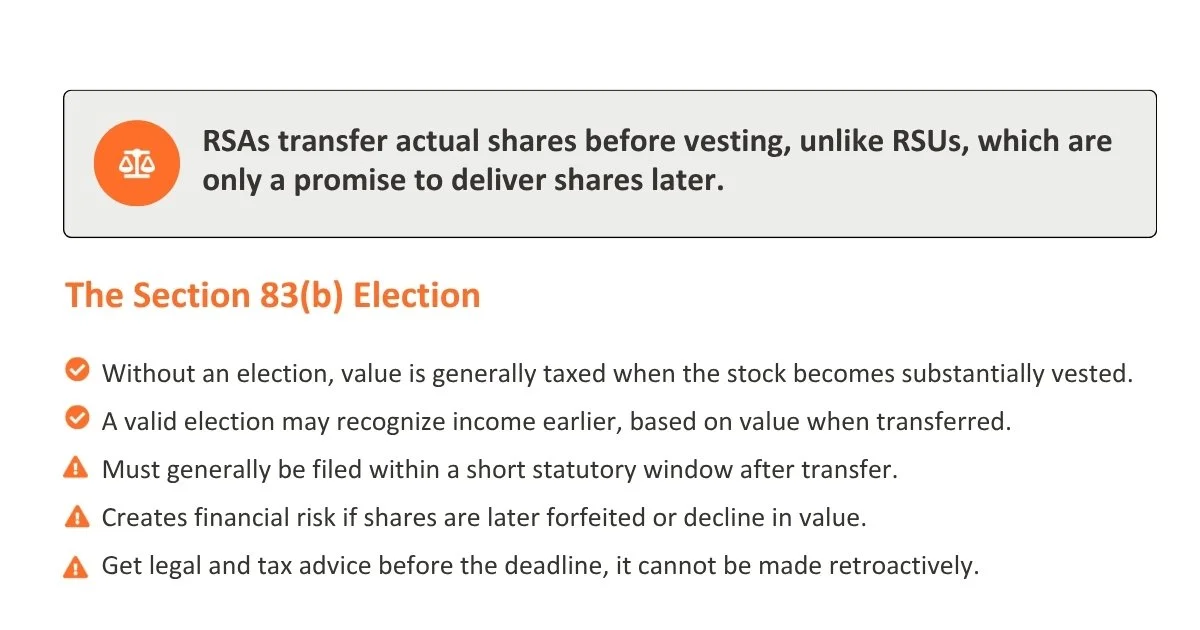
Restricted stock awards differ from restricted stock units because actual shares may be transferred before the shares fully vest.
Without a valid election, the value of restricted stock is generally included in income when the stock becomes substantially vested.
A qualifying Section 83 election may allow income to be recognized earlier, based on the property’s value when transferred.
The election generally must be filed within a short statutory period after the property is transferred. It can also create financial risk if the shares are later forfeited or decline in value.
Section 83 elections generally apply to transferred property and do not ordinarily apply to standard restricted stock units that are only a promise to deliver shares later.
A taxpayer considering the election should obtain legal and tax advice before the deadline. Tax return preparation after the deadline cannot create a timely election retroactively.
Stock Compensation and Form W 2
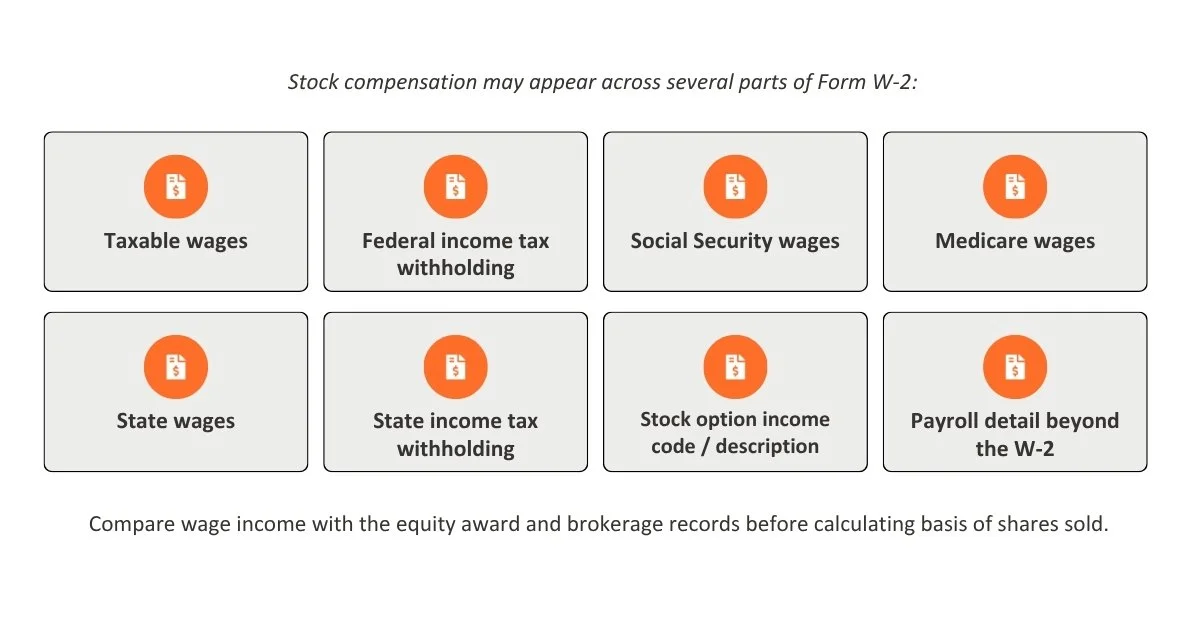
Stock compensation may appear in several parts of Form W 2.
Possible reporting includes:
Taxable wages
Federal income tax withholding
Social Security wages
Medicare wages
State wages
State income tax withholding
A code or description related to stock option income
The payroll statement may contain more detail than Form W 2.
The amount reported as wage income should be compared with the equity award and brokerage records before calculating the basis of shares sold.
Stock Compensation and Form 1099 B
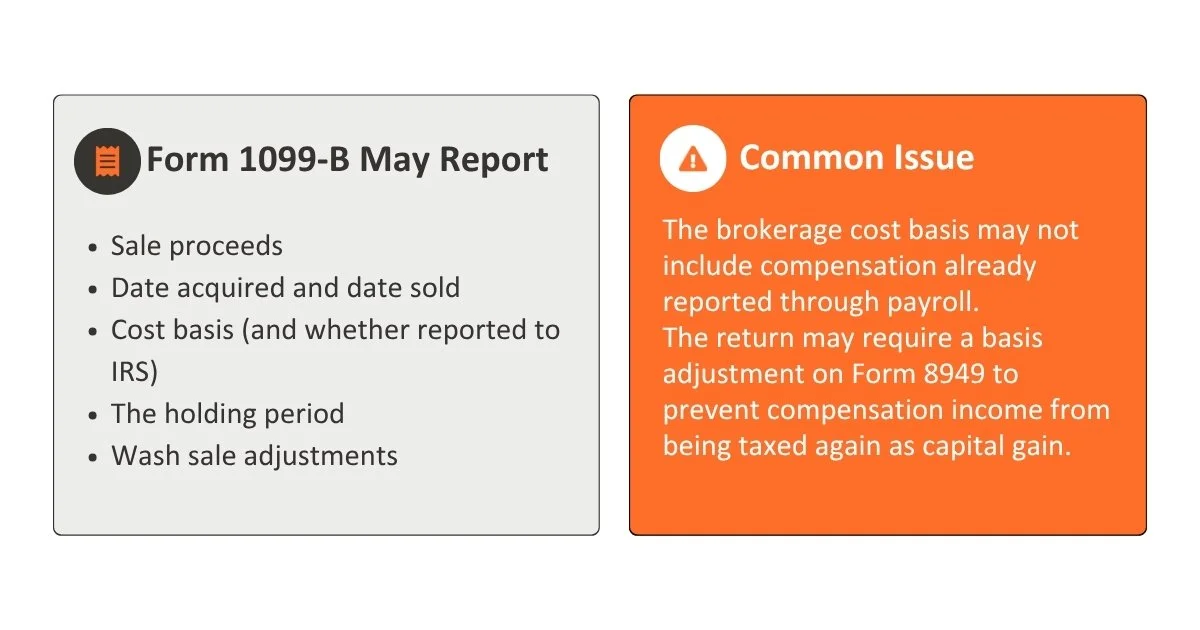
Form 1099 B generally reports proceeds from the sale of shares.
It may also report:
The date acquired
The date sold
Sale proceeds
Cost basis
Whether the basis was reported to the IRS
The holding period
Wash sale adjustments
The cost basis reported by the brokerage may not include compensation already reported through payroll.
This is one of the most common issues with employee stock sales.
The tax return may require a basis adjustment on Form 8949 to prevent compensation income from being reported again as capital gain.
Preventing the Same Stock Income From Being Reported Twice
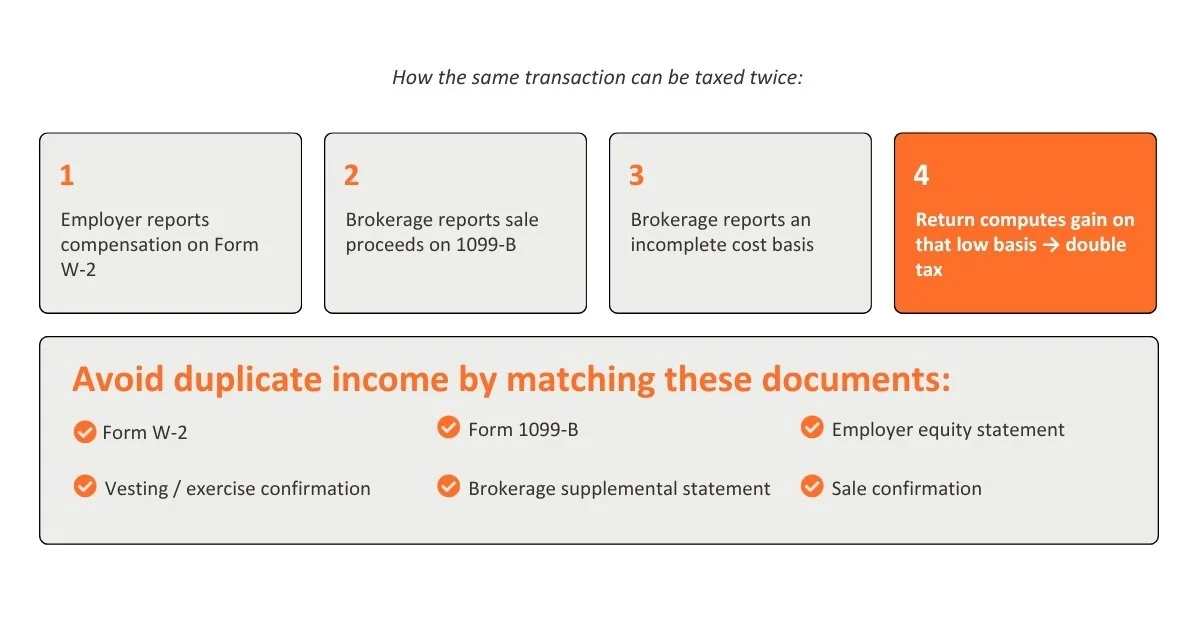
The same equity transaction can appear on several documents.
For example:
The employer reports compensation on Form W 2
The brokerage reports sale proceeds on Form 1099 B
The brokerage reports an incomplete cost basis
The tax return calculates a gain using that incomplete basis
Without an adjustment, income already included in wages can be included again as capital gain.
Avoiding duplicate income requires matching:
Form W 2
Form 1099 B
The employer’s equity statement
The vesting or exercise confirmation
The brokerage supplemental statement
The sale confirmation
The correct adjustment depends on the award and transaction. The brokerage basis should not be changed without supporting records.
Short Term and Long Term Capital Gains
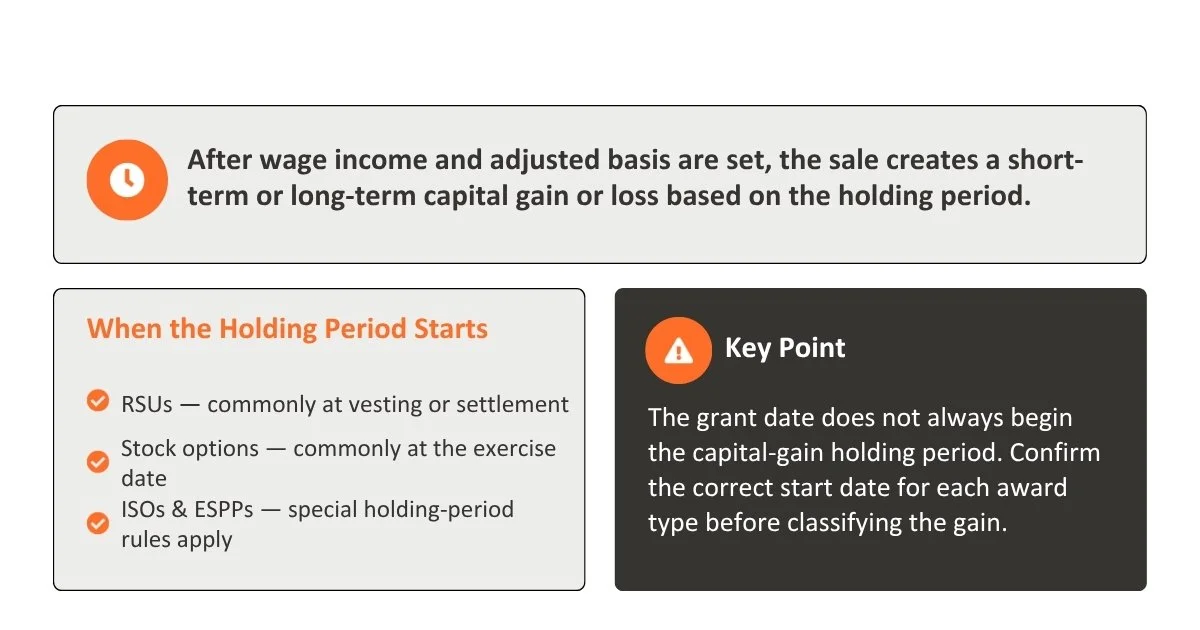
After the wage income and adjusted basis are determined, the sale may create a short term or long term capital gain or loss.
The holding period generally begins when the employee owns the shares for federal tax purposes.
For restricted stock units, this is commonly connected to vesting or settlement.
For stock options, it is commonly connected to the exercise date.
Special holding period rules apply to incentive stock options and employee stock purchase plans.
The grant date does not always begin the capital gain holding period.
Estimated Taxes and Equity Compensation
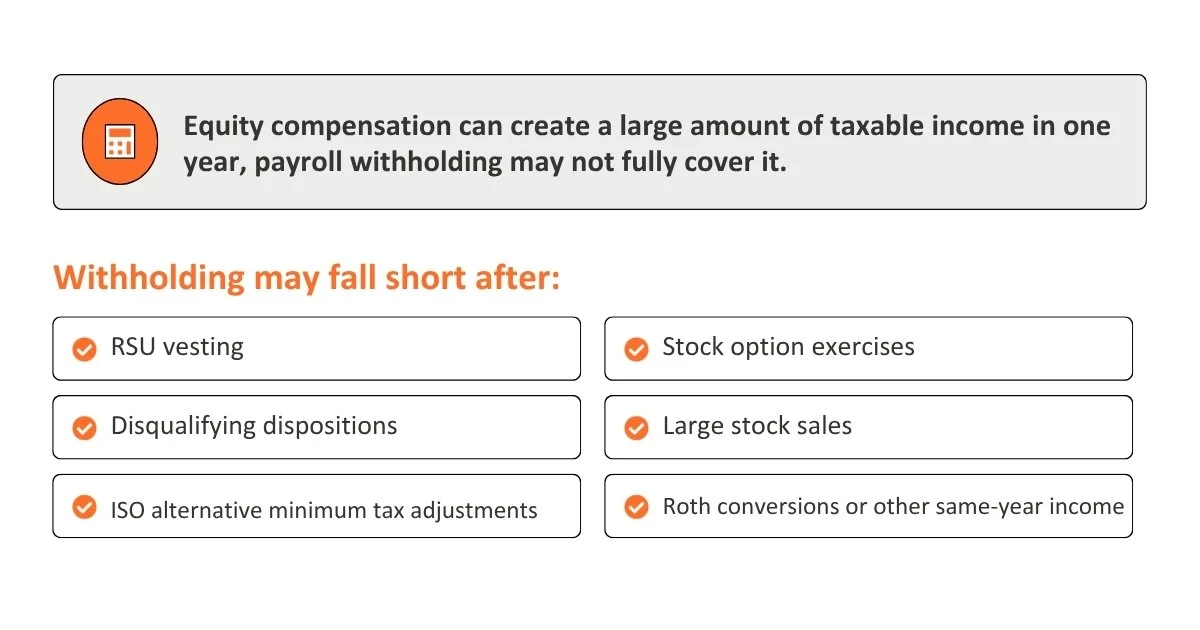
Equity compensation can create a large amount of taxable income during one year.
Payroll withholding may not fully cover the federal or state tax resulting from:
Restricted stock unit vesting
Stock option exercises
Disqualifying dispositions
Large stock sales
Incentive stock option alternative minimum tax adjustments
Roth conversions or other income occurring during the same year
The withholding method used by the employer does not guarantee that the full tax liability has been paid.
Estimated tax payments may need to be considered after reviewing total income, prior year tax, current withholding, and applicable payment rules.
Stock Compensation After Moving to Another State
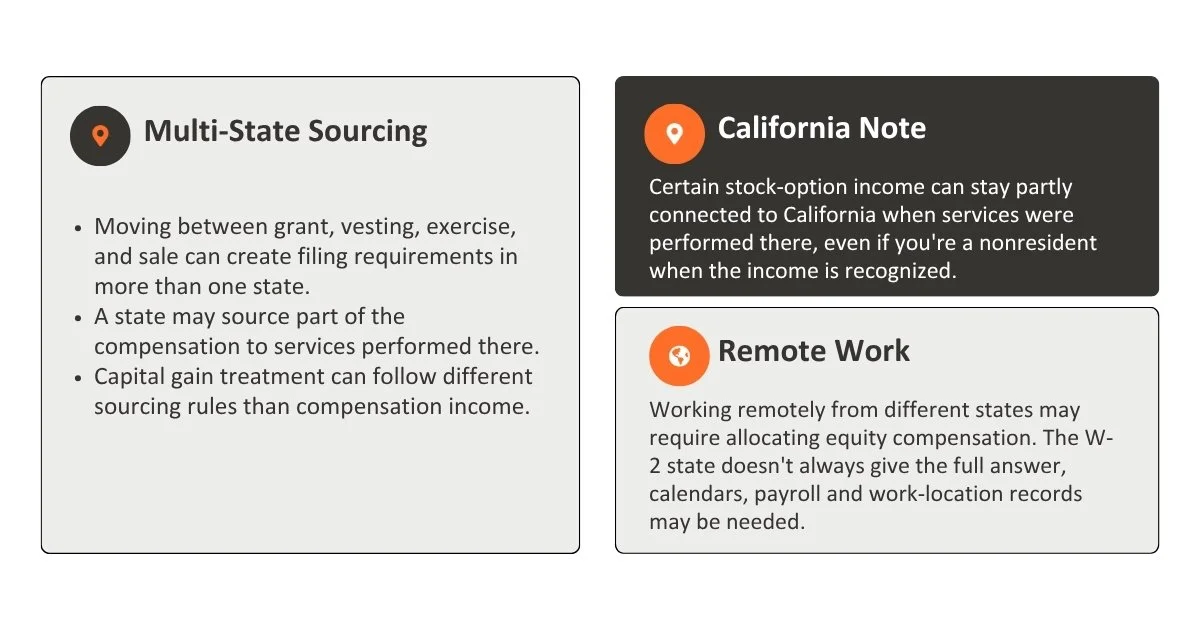
Moving during the period between grant, vesting, exercise, and sale can create income tax filing requirements in more than one state.
A state may source part of the compensation based on services performed there during the applicable work period.
The result can depend on:
The award type
The grant date
The vesting date
The exercise date
The sale date
The employee’s work locations
The employee’s residency dates
The employer’s payroll reporting
State sourcing rules
For California, compensation from certain stock options may remain partly connected to California when services were performed in California during the relevant period, even if the employee is a nonresident when the income is recognized.
Capital gain treatment can follow different sourcing rules from compensation income.
Remote Work and Equity Compensation
Employees who work remotely from different states may need to allocate equity compensation among the states where services were performed.
The employer’s address and the state shown on Form W 2 do not always provide the complete answer.
Calendars, payroll records, travel records, vesting schedules, and work location information may be needed.
Former Employees With Stock Compensation
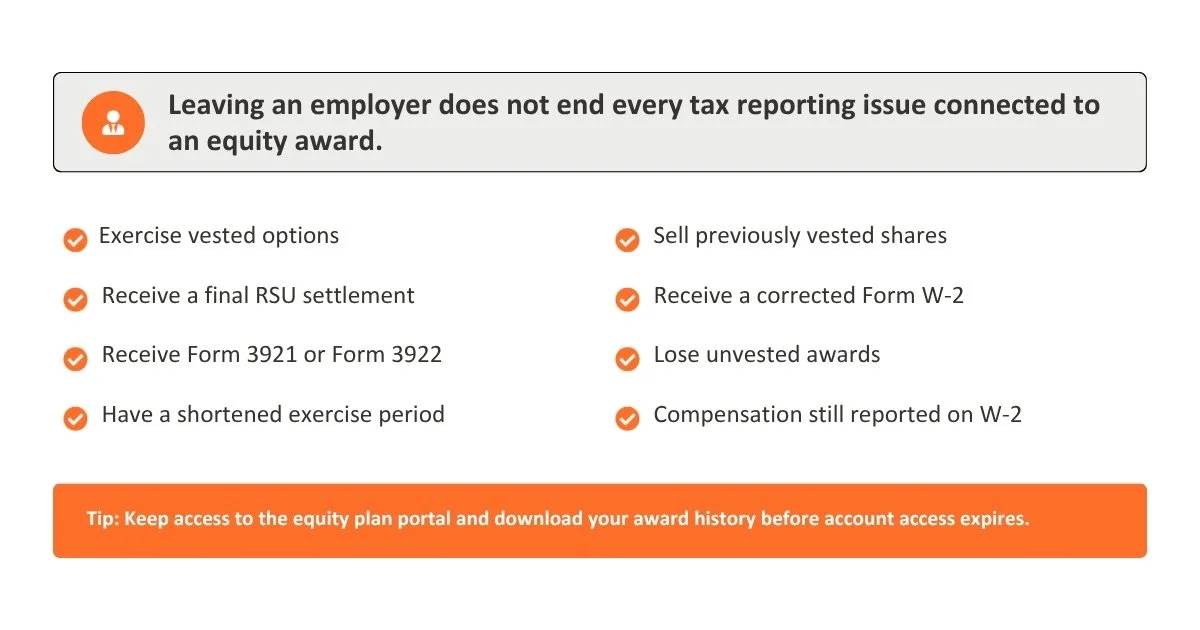
Leaving an employer does not end every tax reporting issue connected to an equity award.
A former employee may later:
Exercise vested options
Sell previously vested shares
Receive a final restricted stock unit settlement
Receive a corrected Form W 2
Receive Form 3921 or Form 3922
Lose unvested awards
Have a shortened option exercise period
The former employer may still report compensation income on Form W 2.
The employee should keep access to the equity plan portal and download the award history before account access expires.
Private Company Stock Compensation
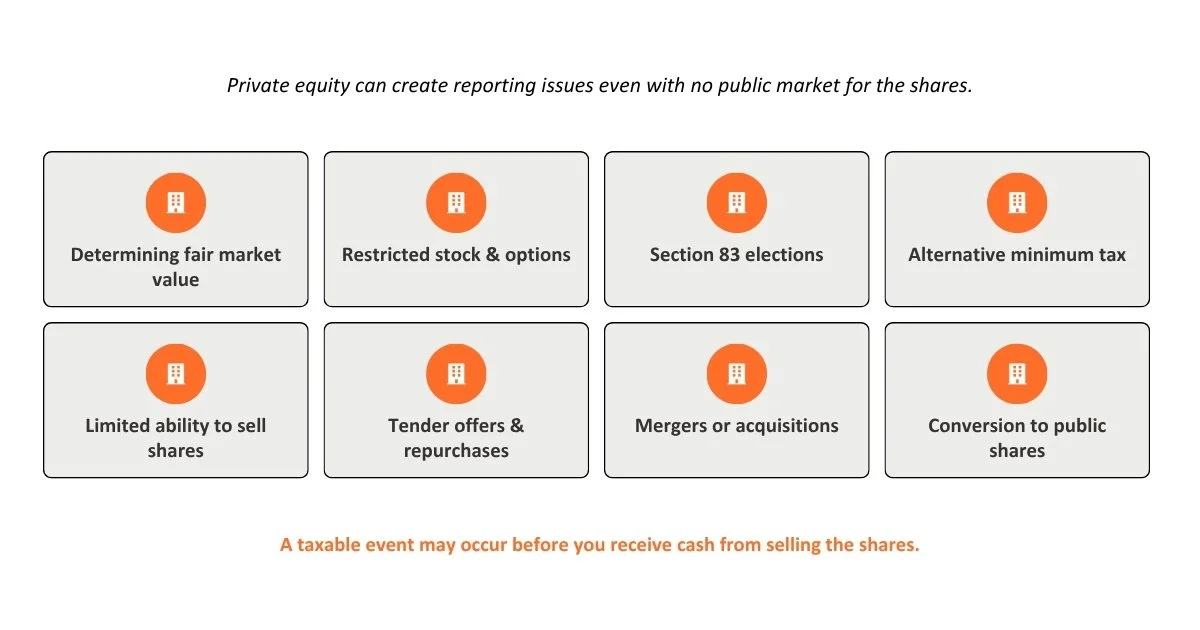
Private company equity can create reporting issues even when there is no public market for the shares.
Possible concerns include:
Determining fair market value
Restricted stock
Stock options
Section 83 elections
Alternative minimum tax
Limited ability to sell the shares
Tender offers
Company repurchases
Mergers or acquisitions
Conversion into public company shares
A taxable event may occur before the employee has received cash from selling the shares.
Award agreements, valuation statements, exercise documents, and company transaction records should be retained.
Documents Needed for Stock Compensation Tax Preparation
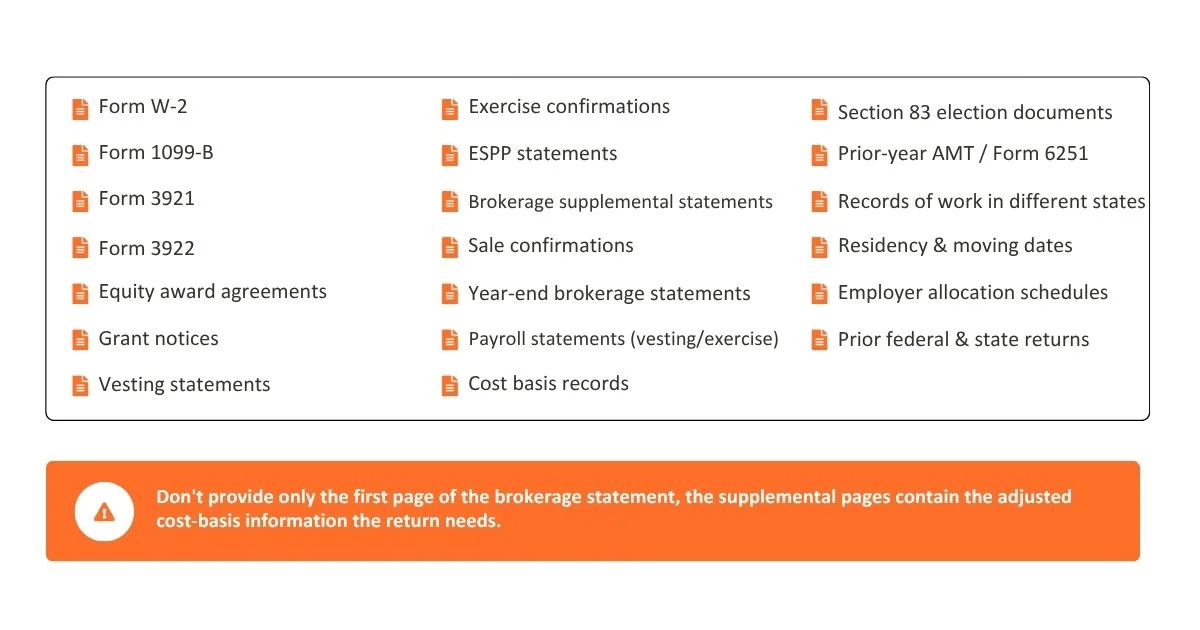
Please provide the complete documents for each equity award and stock transaction.
Common documents include:
Form W 2
Form 1099 B
Form 3921
Form 3922
Equity award agreements
Grant notices
Vesting statements
Exercise confirmations
Employee stock purchase statements
Brokerage supplemental statements
Sale confirmations
Year end brokerage statements
Payroll statements from vesting or exercise periods
Cost basis records
Section 83 election documents
Alternative minimum tax forms from prior years
Prior Forms 6251
Prior minimum tax credit forms
Records of work performed in different states
Residency and moving dates
Employer allocation schedules
Corrected tax forms
Prior year federal and state income tax returns
Do not provide only the first page of the brokerage statement. The supplemental pages may contain the adjusted cost basis information needed for the tax return.
Our Stock Compensation Tax Return Preparation Process
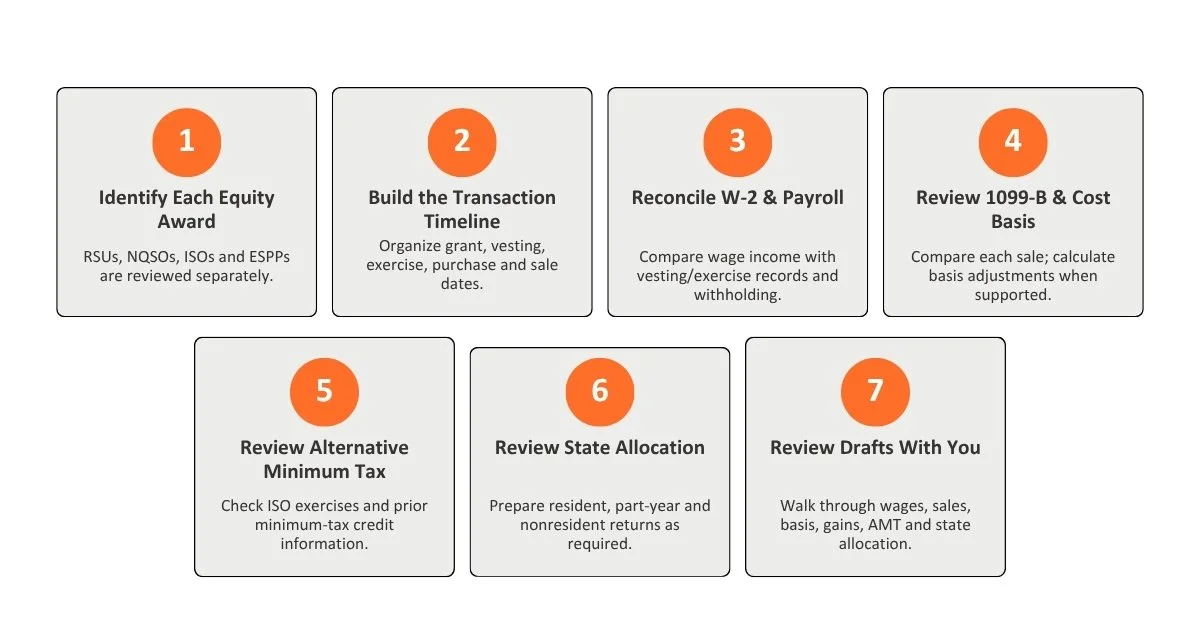
Step 1, Identify Each Equity Award
I begin by identifying the type of equity compensation received.
Restricted stock units, nonqualified stock options, incentive stock options, and employee stock purchase plans are reviewed separately.
Step 2, Build the Transaction Timeline
We organize the grant, vesting, exercise, purchase, and sale dates.
The timeline helps determine when compensation income occurred and whether special holding periods were met.
Step 3, Reconcile Form W 2 and Payroll Records
The compensation included in wages is compared with the vesting or exercise records.
Federal and state withholding is also reviewed.
Step 4, Review Form 1099 B and Cost Basis
Each stock sale is compared with the employer and brokerage information.
Basis adjustments are calculated when supported by the records.
Step 5, Review Alternative Minimum Tax
Incentive stock option exercises and prior minimum tax credit information are reviewed when applicable.
The actual alternative minimum tax result is calculated as part of the complete federal return.
Step 6, Review State Income Tax Allocation
Work locations, residency dates, and employer reporting are reviewed when the employee lived or worked in more than one state.
Resident, part year resident, and nonresident state returns are prepared when required.
Step 7, Review the Drafted Returns With You
You will receive the drafted federal and state returns for review before filing.
We explain the wage income, stock sales, basis adjustments, capital gains, alternative minimum tax, and state allocation shown on the returns.
Common Stock Compensation Tax Return Mistakes
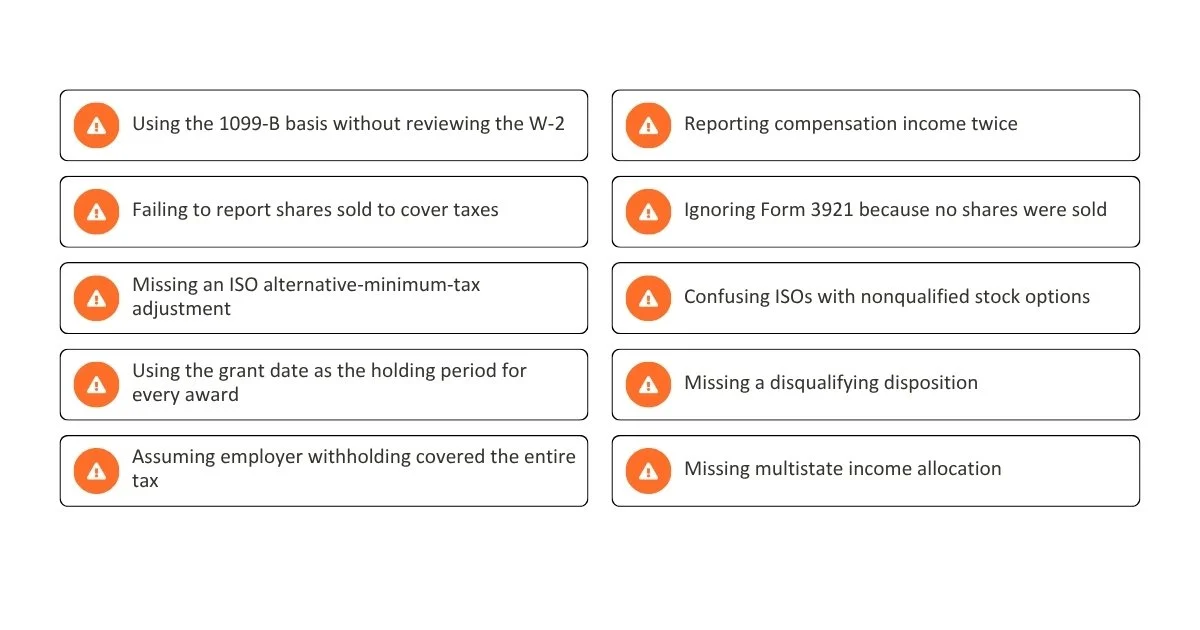
Common stock compensation reporting problems include:
Using the Form 1099 B basis without reviewing Form W 2
Reporting compensation income twice
Failing to report shares sold to cover taxes
Ignoring Form 3921 because no shares were sold
Failing to calculate an incentive stock option alternative minimum tax adjustment
Confusing incentive stock options with nonqualified stock options
Using the grant date as the holding period date for every award
Missing a disqualifying disposition
Failing to retain Form 3922
Reporting every employee stock purchase plan sale the same way
Ignoring stock compensation after leaving the employer
Missing multistate income allocation
Assuming employer withholding covered the entire tax
Failing to track a prior minimum tax credit
Losing access to the employer’s equity portal
Complete employer and brokerage records help prevent these problems.
Stock Compensation Tax Preparation From Orange County
Orange Coast Tax prepares federal and state income tax returns for employees, executives, and former employees with equity compensation.
We assist taxpayers in Orange County and throughout the United States with restricted stock units, stock options, employee stock purchase plans, stock sales, alternative minimum tax, and multistate reporting.
Our secure client portal allows you to upload Forms W 2, 1099 B, 3921, 3922, equity statements, and supporting records.
Stock Options and Equity Compensation Tax FAQs
-
Restricted stock units generally are not taxed merely because they are granted.
Income is commonly recognized when the award vests and settles, but the award terms and any special rules must be reviewed.
-
The vesting can create wage income, and the later sale creates a separate investment transaction.
Form W 2 reports the compensation. Form 1099 B reports the sale. The adjusted basis is needed to calculate the correct capital gain or loss.
-
For many employee nonqualified stock options, the difference between fair market value and the exercise price is treated as compensation at exercise.
The later sale can create a separate capital gain or loss.
-
An incentive stock option exercise generally does not create regular federal income tax at exercise.
However, the exercise may create an alternative minimum tax adjustment.
-
A disqualifying disposition generally occurs when incentive stock option or employee stock purchase plan shares are sold before the applicable holding period is met.
Part of the income may be treated as compensation, with the remaining amount treated as a capital gain or loss.
-
The brokerage basis may not include compensation already reported through payroll.
Employer statements and brokerage supplemental information should be reviewed before adjusting the basis.
-
Yes.
A sale used to fund withholding is still a stock transaction that may need to be reported on Form 8949 and Schedule D.
-
Yes.
The exercise may create an alternative minimum tax adjustment even when the employee continues to hold the shares and receives no sale proceeds.
-
Not necessarily.
California may tax part of the compensation when services connected to the award were performed in California. The award type, work period, residence, and transaction dates must be reviewed.
-
Yes.
We prepare federal and state returns involving restricted stock units, nonqualified stock options, incentive stock options, employee stock purchase plans, and related stock sales.
Get Help Preparing Your Stock Compensation Tax Return
Stock compensation tax preparation requires the employer and brokerage records to be reviewed together.
I can review your equity awards, Form W 2 income, stock sales, cost basis, holding periods, alternative minimum tax, and state income allocation.
Provide the complete award, payroll, and brokerage documents, and we will identify the additional information needed to prepare your federal and state income tax returns.