
Cryptocurrency and Digital Asset Tax Return Preparation
Cryptocurrency tax reporting involves more than reporting money transferred from an exchange to a bank account.
Selling cryptocurrency, exchanging one digital asset for another, purchasing goods or services, receiving staking rewards, mining, and accepting digital assets as payment can create reportable income or taxable transactions.
I prepare federal and state income tax returns involving cryptocurrency and other digital assets.
I review exchange records, wallet activity, transaction reports, cost basis information, and applicable tax forms to identify income, sales, exchanges, transfers, and other activity.
The goal is to distinguish reportable transactions from transfers between your own accounts and calculate the related income, capital gains, and losses using the available records.
Cryptocurrency Tax Preparation Summary
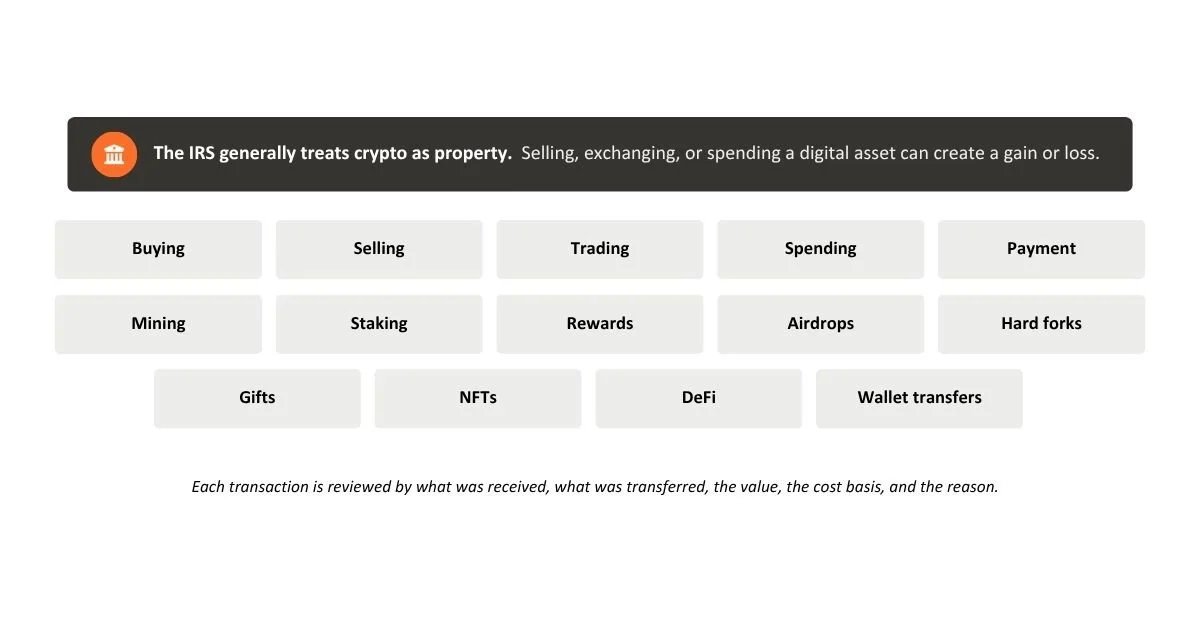
The IRS generally treats cryptocurrency and other digital assets as property for federal income tax purposes.
This means that selling, exchanging, or spending a digital asset can create a gain or loss.
Digital asset activity can include:
Buying cryptocurrency
Selling cryptocurrency
Trading one digital asset for another
Using cryptocurrency to purchase goods or services
Receiving cryptocurrency as payment
Mining
Staking
Receiving rewards
Receiving an airdrop
Receiving assets through a hard fork
Giving cryptocurrency as a gift
Receiving cryptocurrency as a gift
Transferring assets between wallets
Receiving nonfungible tokens
Selling nonfungible tokens
Participating in decentralized finance activity
Each transaction must be reviewed based on what was received, what was transferred, the value at the time, the cost basis, and the reason for the transaction.
The Digital Asset Question on Your Tax Return
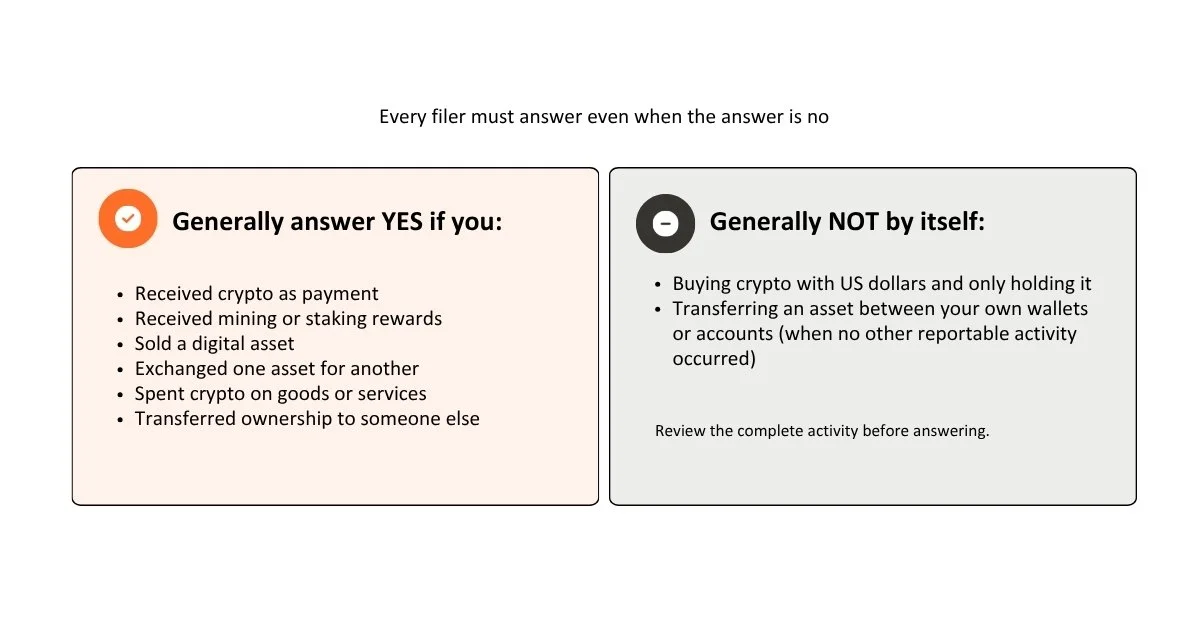
Federal individual income tax returns include a question asking about certain digital asset activity during the year.
Every taxpayer filing the applicable federal return must answer the question, even when the answer is no.
The appropriate answer depends on the taxpayer’s actual activity.
A taxpayer may generally need to answer yes when the taxpayer:
Received a digital asset as payment
Received mining or staking rewards
Received an award or reward
Sold a digital asset
Exchanged one digital asset for another
Used a digital asset to purchase goods or services
Transferred ownership of a digital asset
Received certain assets through a hard fork or similar event
Purchasing a digital asset with United States dollars and only holding it generally does not by itself require a yes answer under current IRS instructions.
Transferring a digital asset between wallets or accounts owned by the same taxpayer generally does not by itself require a yes answer when no other reportable digital asset activity occurred.
The complete activity should be reviewed before the question is answered.
Selling Cryptocurrency for United States Dollars
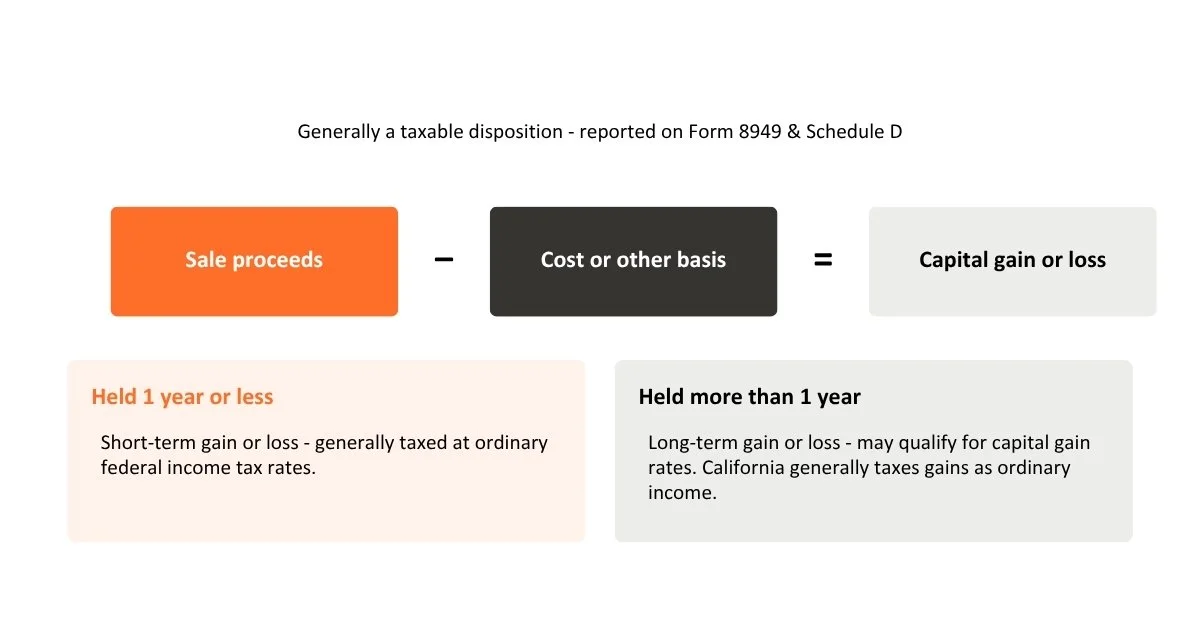
Selling cryptocurrency for United States dollars or another real currency is generally a taxable disposition.
The gain or loss is generally calculated using:
The sale proceeds
The cost or other basis
Transaction fees
The date acquired
The date sold
The asset identification method supported by the records
When the digital asset was held as a capital asset, the sale is generally reported on Form 8949 and Schedule D.
The result may be a short term or long term capital gain or loss depending on the holding period.
Short Term Cryptocurrency Gains and Losses
A digital asset held for one year or less generally creates a short term capital gain or loss when sold.
Net short term capital gains are generally taxed at ordinary federal income tax rates.
Long Term Cryptocurrency Gains and Losses
A digital asset held for more than one year generally creates a long term capital gain or loss when sold.
Net long term capital gains may qualify for federal capital gain tax rates. The actual rate depends on taxable income, filing status, asset type, and other information on the return.
State tax treatment may differ. California generally taxes capital gains as ordinary income.
Exchanging One Cryptocurrency for Another
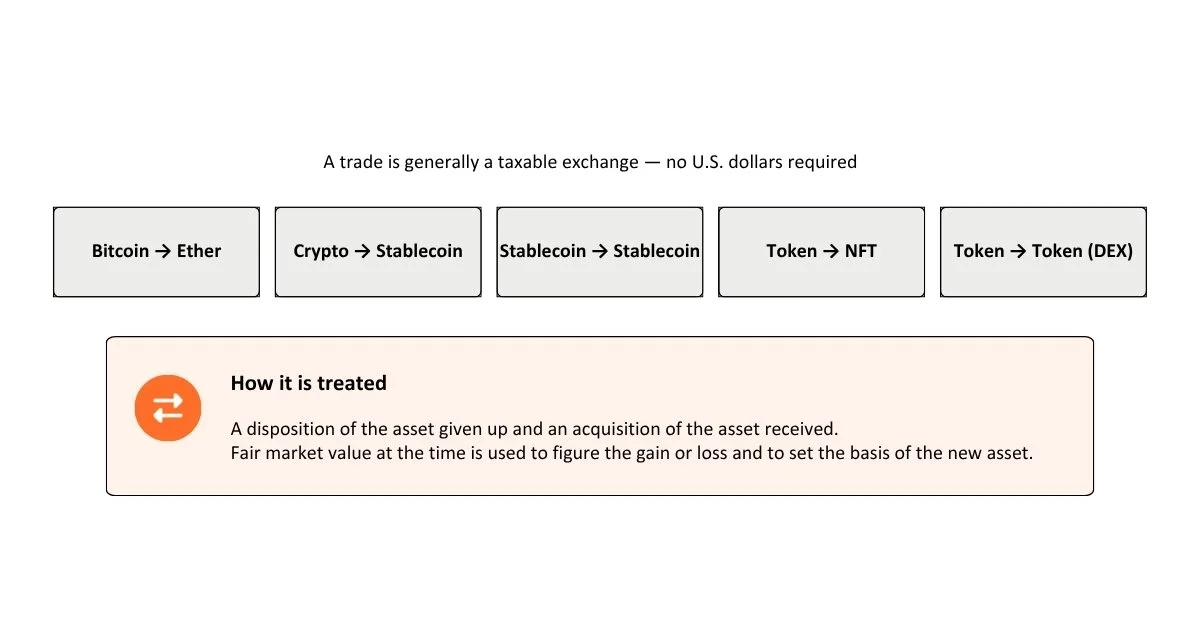
Trading one digital asset for another is generally a taxable exchange.
This can apply when exchanging:
Bitcoin for Ether
Cryptocurrency for a stablecoin
One stablecoin for another
A digital asset for a nonfungible token
A token for another token through a decentralized exchange
The transaction is generally treated as a disposition of the asset given up and an acquisition of the asset received.
The fair market value at the time of the exchange is used to calculate the gain or loss and establish the basis of the new asset.
A transaction does not need to involve United States dollars to be reportable.
Using Cryptocurrency to Purchase Goods or Services
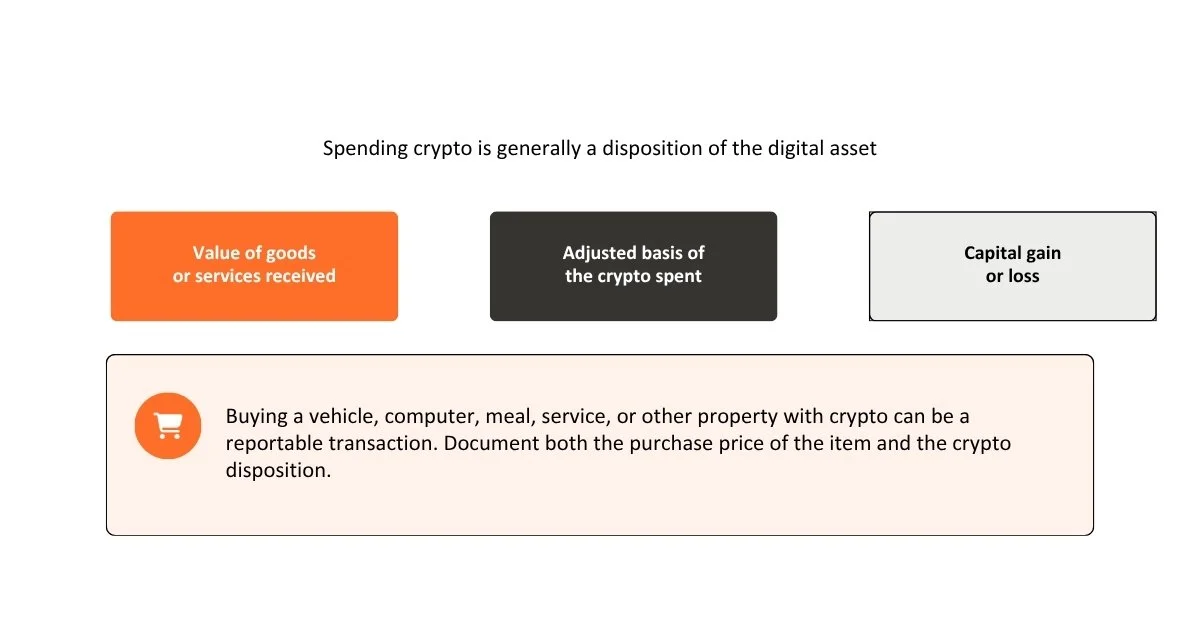
Using cryptocurrency to purchase goods or services is generally treated as a disposition of the digital asset.
The taxpayer may have a capital gain or loss based on the difference between:
The value of the goods or services received
The adjusted basis of the digital asset spent
For example, using cryptocurrency to purchase a vehicle, computer, meal, service, or other property can create a reportable transaction.
The purchase price of the item and the cryptocurrency disposition should both be documented.
Receiving Cryptocurrency as Payment
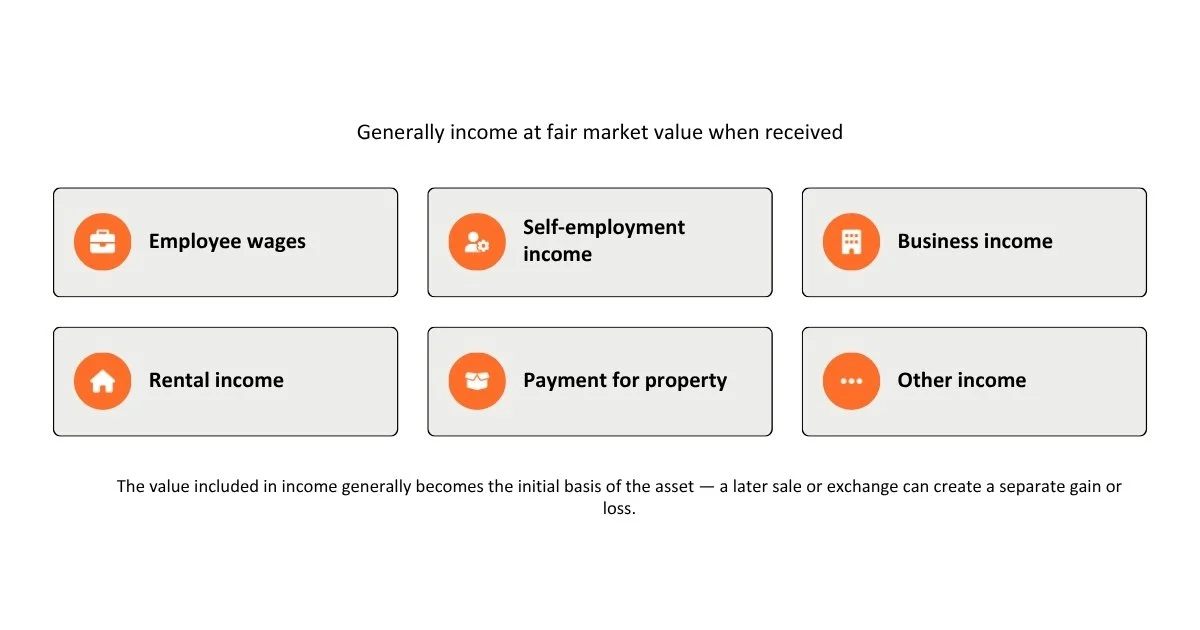
Cryptocurrency received in exchange for services or property is generally income.
The income amount is commonly based on the fair market value of the digital asset when it is received.
The reporting depends on why the payment was received.
Possible treatment includes:
Employee wages
Self employment income
Business income
Rental income
Payment for property
Other income
The value included in income generally becomes the initial basis of the digital asset. A later sale or exchange can create a separate capital gain or loss.
Cryptocurrency Received by an Employee
Digital assets received as compensation for employment are generally treated as wages.
The employer may be responsible for payroll tax reporting and withholding. The employee should provide Form W 2 and records showing the type, amount, date, and value of the assets received.
Cryptocurrency Received by a Business or Independent Contractor
Digital assets received for business services are generally included in business income based on their value when received.
The income may be subject to income tax and self employment tax.
A later sale or exchange of the digital asset is a separate transaction that may create a capital gain or loss.
Cryptocurrency Mining Income
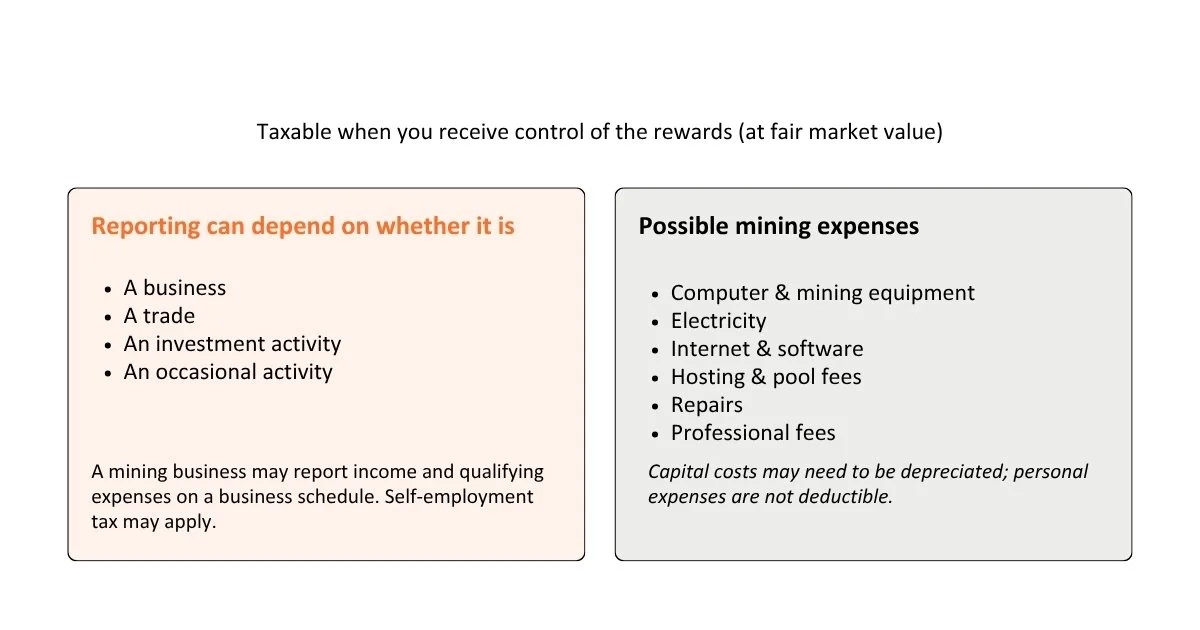
Digital assets received from mining may create taxable income when the taxpayer receives control of the rewards.
The income amount is generally based on the fair market value when received.
The reporting can depend on whether the activity is:
A business
A trade
An investment activity
An occasional activity
A mining business may report income and qualifying expenses on a business schedule. Self employment tax may apply when the activity rises to the level of a trade or business.
Possible mining expenses can include:
Computer equipment
Specialized mining equipment
Electricity
Internet expenses
Software
Hosting fees
Pool fees
Repairs
Professional fees
Personal expenses are not deductible. Equipment and other capital costs may need to be depreciated rather than deducted immediately.
Cryptocurrency Staking and Reward Income
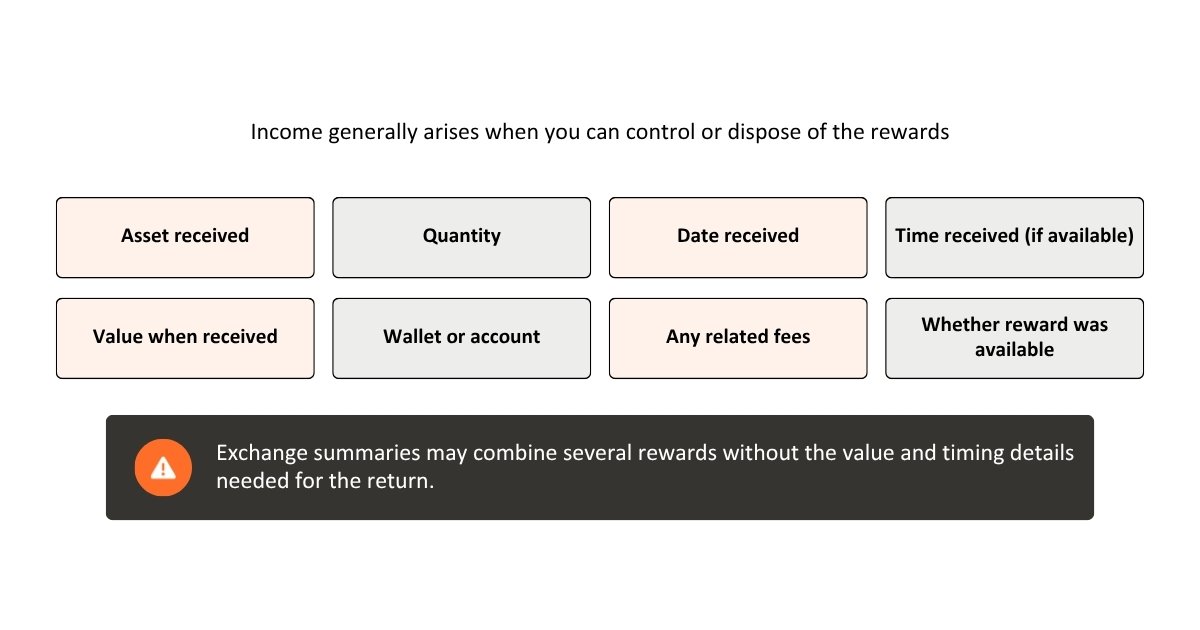
Digital assets received from staking or similar reward activity may create taxable income.
The income amount generally depends on the value of the assets when the taxpayer has the ability to control or dispose of them.
The value included in income generally becomes the basis of the reward units. A later sale or exchange can create a separate gain or loss.
Staking records should include:
The asset received
The quantity
The date received
The time received when available
The value when received
The wallet or account
Any related fees
Whether the reward was immediately available
Exchange summaries may combine several rewards without providing the value and timing information needed for the tax return.
Airdrops and Hard Forks
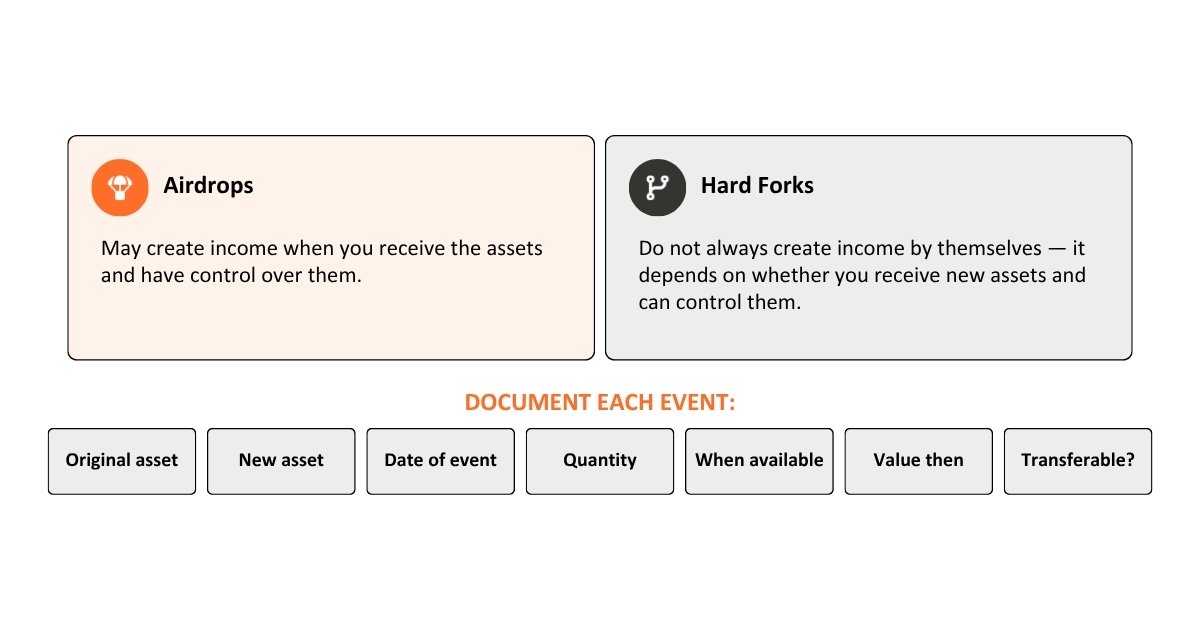
An airdrop may create income when the taxpayer receives digital assets and has control over them.
A hard fork does not always create taxable income by itself. The result generally depends on whether the taxpayer receives new digital assets and can exercise control over them.
The following should be documented:
The original asset
The new asset
The date of the event
The quantity received
When the asset became available
The value at that time
Whether the taxpayer could transfer or sell the asset
Not every unsolicited token has an easily established value or accessible market. The specific facts should be reviewed.
Transfers Between Your Own Wallets
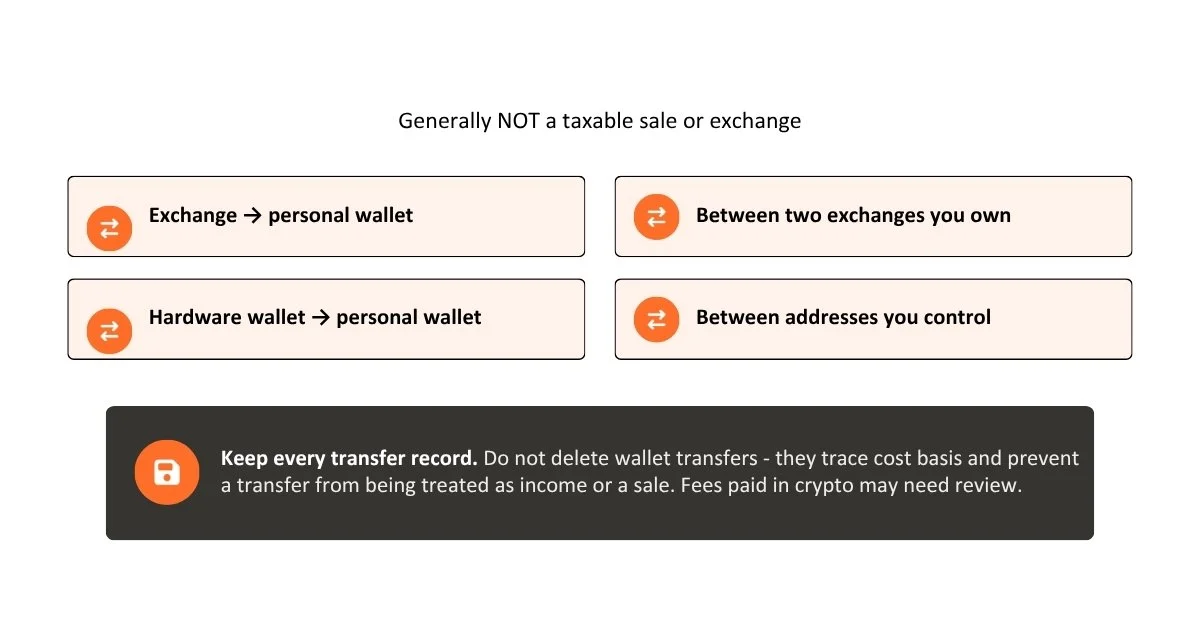
Transferring cryptocurrency from one wallet or account you own to another wallet or account you also own is generally not a taxable sale or exchange.
Examples can include:
Moving cryptocurrency from an exchange to a personal wallet
Moving assets between two exchanges owned by the same taxpayer
Moving assets from a hardware wallet to another personal wallet
Moving assets between addresses controlled by the same taxpayer
A transfer can still create transaction fees. When fees are paid using a digital asset, the tax treatment of those fees and the units used to pay them may require review.
Wallet transfers should not be deleted from the transaction history. They are needed to trace cost basis and prevent the transfer from being incorrectly treated as income or a sale.
Why Wallet Transfers Are Often Misclassified
Tax software may treat an outgoing transfer as a sale when it cannot find the receiving wallet.
It may also treat the incoming side as new income when it cannot find the sending wallet.
Every exchange, wallet, and address should be included in the transaction history so transfers can be matched.
Unmatched transfers should be reviewed before the tax report is accepted.
Cryptocurrency Cost Basis
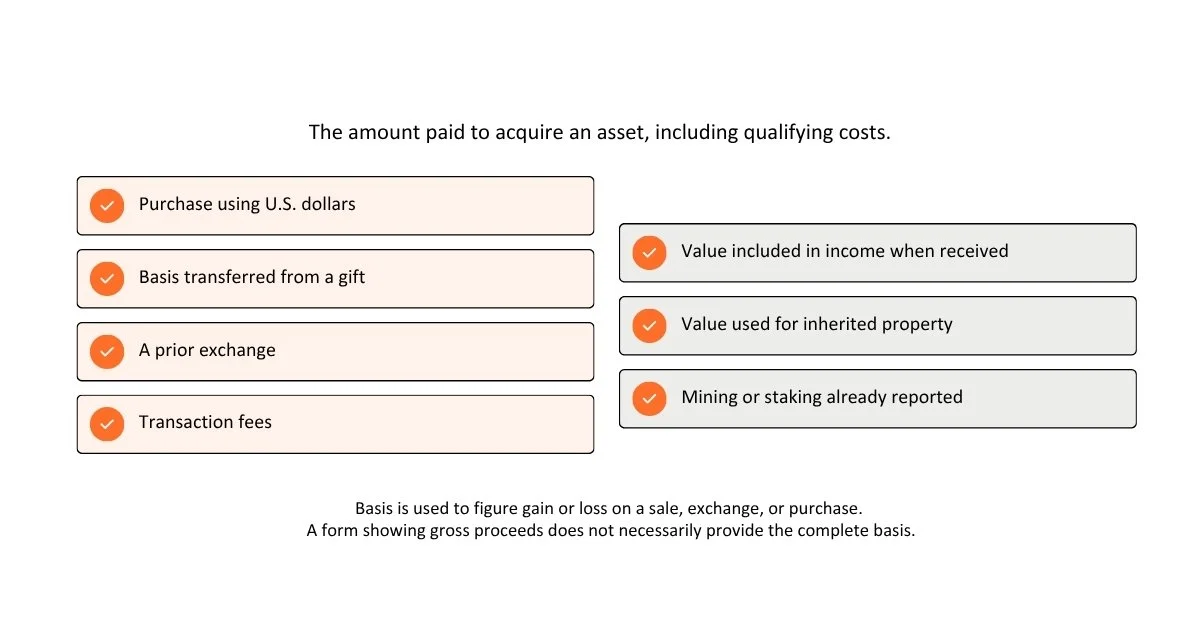
Cost basis is generally the amount paid to acquire a digital asset, including qualifying acquisition costs.
Basis may come from:
A purchase using United States dollars
The value included in income when the asset was received
The basis transferred from gifted property
The value used for inherited property
A prior exchange
Mining or staking income already reported
Transaction fees
The basis is used to calculate the gain or loss when the asset is sold, exchanged, or spent.
A tax form showing gross proceeds does not necessarily provide the complete basis.
Missing Cryptocurrency Cost Basis
Cost basis may be missing when:
Assets were transferred between exchanges
An exchange closed
The taxpayer used a decentralized exchange
Assets were held in a personal wallet
The original purchase occurred several years earlier
The taxpayer received assets as a gift
Transaction histories are incomplete
The taxpayer used several email addresses or accounts
A missing basis should not automatically be entered as zero.
Bank records, exchange statements, wallet history, confirmation emails, blockchain records, and prior tax reports may help establish the basis.
Digital Asset Identification Methods
The tax result can depend on which units are treated as sold or transferred.
Current federal rules require the taxpayer to use an identification method supported by the records and applicable guidance.
The taxpayer should maintain records showing:
The specific digital asset
The acquisition date
The acquisition time when relevant
The quantity
The basis
The wallet or account
The date and time of disposition
The proceeds or value received
A tax software setting should not be changed from year to year without reviewing the prior reporting and current identification records.
Form 1099 DA and Digital Asset Reporting
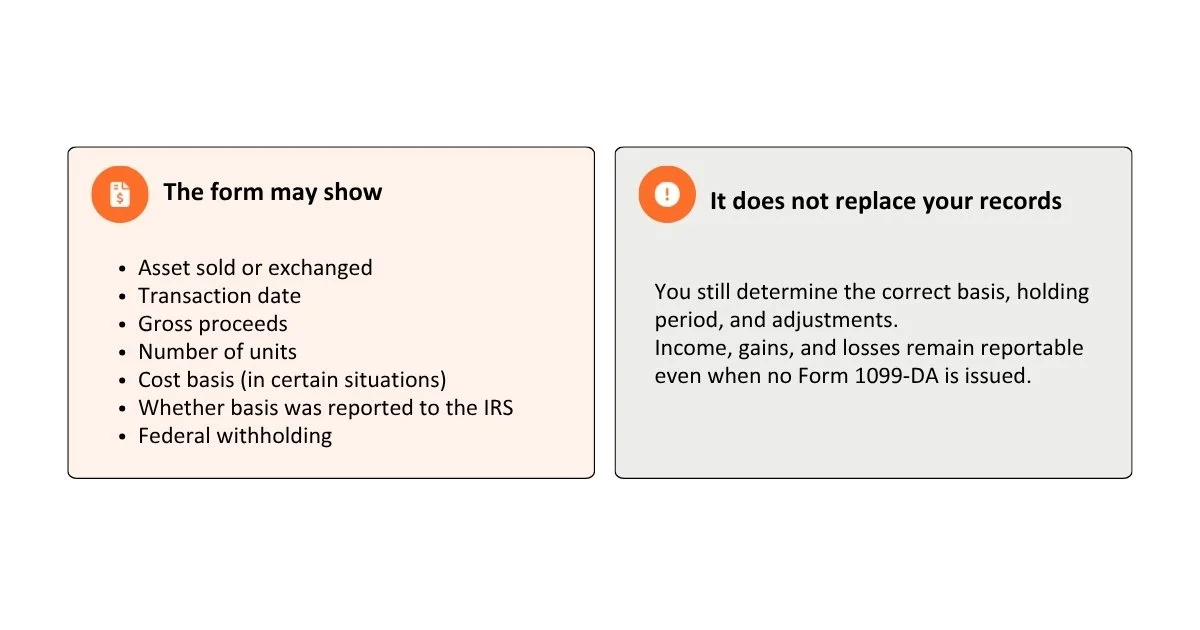
Form 1099 DA reports proceeds from certain digital asset transactions handled by a broker.
Depending on the transaction and reporting year, the form may show:
The digital asset sold or exchanged
The transaction date
Gross proceeds
The number of units
Cost basis in certain situations
Whether the basis was reported to the IRS
Federal withholding
A Form 1099 DA does not replace the taxpayer’s own transaction records.
The taxpayer must still determine the correct basis, holding period, and adjustments.
Digital asset income, gains, and losses remain reportable even when no Form 1099 DA is issued.
Incorrect Form 1099 DA Information
If Form 1099 DA contains incorrect information, the taxpayer should contact the issuer and request a corrected form.
The taxpayer should retain:
The original form
The corrected form
Correspondence with the issuer
Transaction statements
Wallet records
Supporting basis information
The return should report the transaction using the information supported by the available records.
Other Cryptocurrency Tax Forms
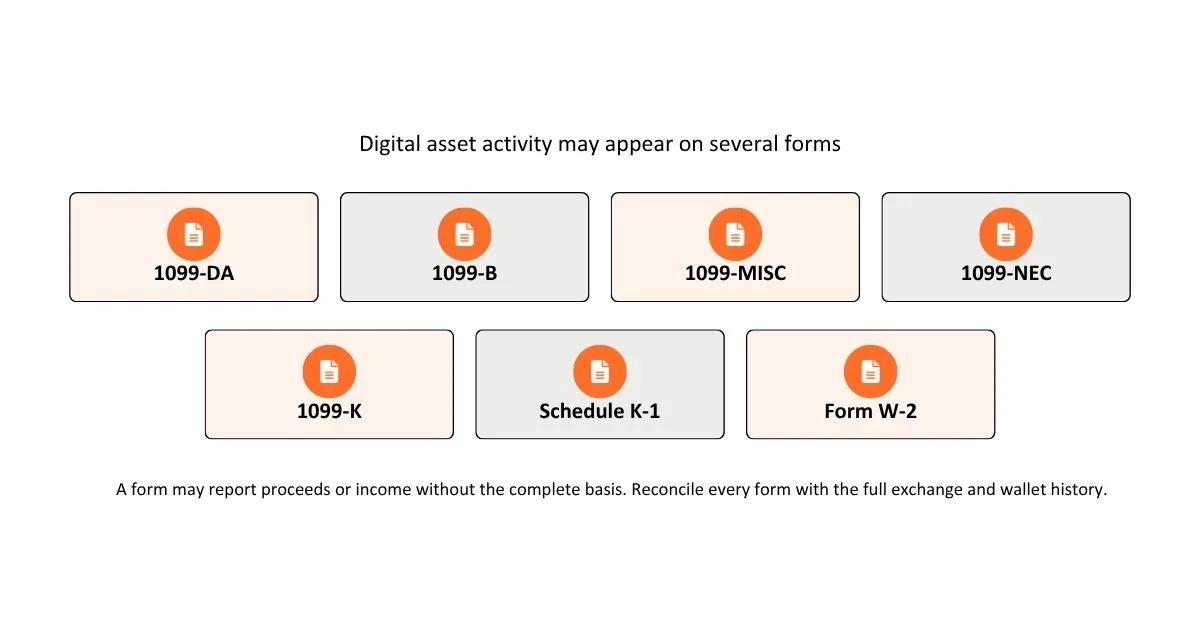
Digital asset activity may appear on several tax forms.
Possible forms include:
Form 1099 DA
Form 1099 B
Form 1099 MISC
Form 1099 NEC
Form 1099 K
Schedule K 1
Form W 2
A tax form may report proceeds or income without providing the complete cost basis.
Receiving more than one form does not always mean there are separate taxable transactions. The forms should be reconciled with the complete exchange and wallet history.
Cryptocurrency Gifts
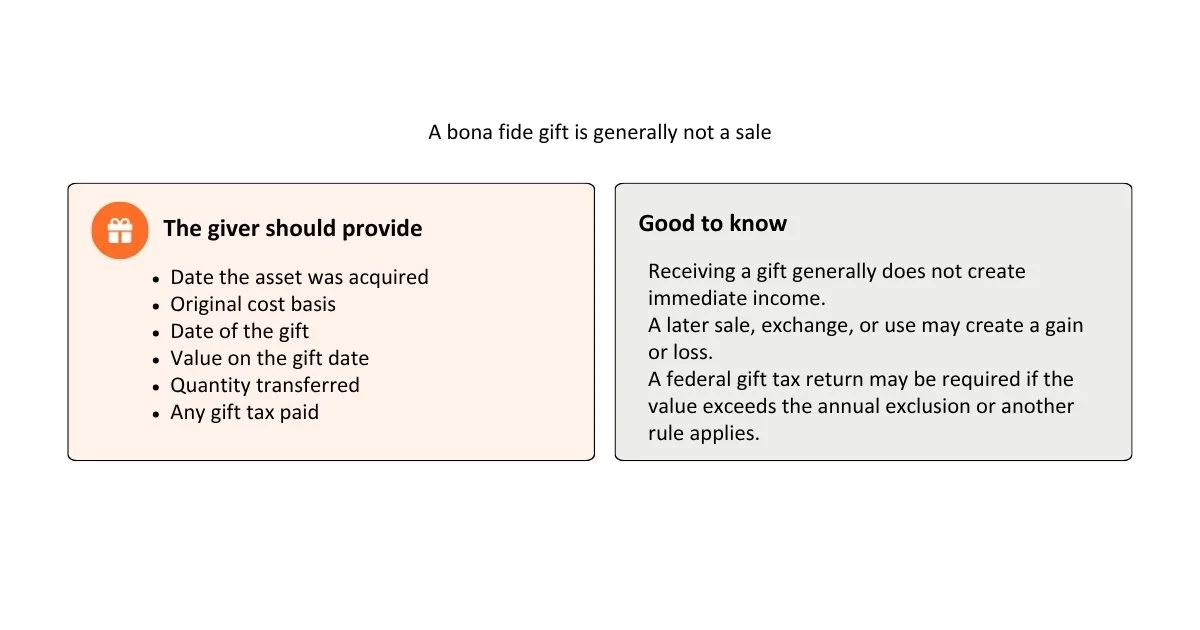
Giving cryptocurrency to another person is generally not a sale when it is a bona fide gift.
However, a federal gift tax return may be required when the value of the gift exceeds the applicable annual exclusion or when another reporting rule applies.
The person making the gift should provide the recipient with:
The date the digital asset was acquired
The original cost basis
The date of the gift
The value on the gift date
The quantity transferred
Any gift tax paid
The recipient’s basis can depend on the donor’s basis, the value on the gift date, and whether a later disposition creates a gain or loss.
Receiving a bona fide gift generally does not create immediate income. A later sale, exchange, or use may create a reportable gain or loss.
Donating Cryptocurrency to Charity
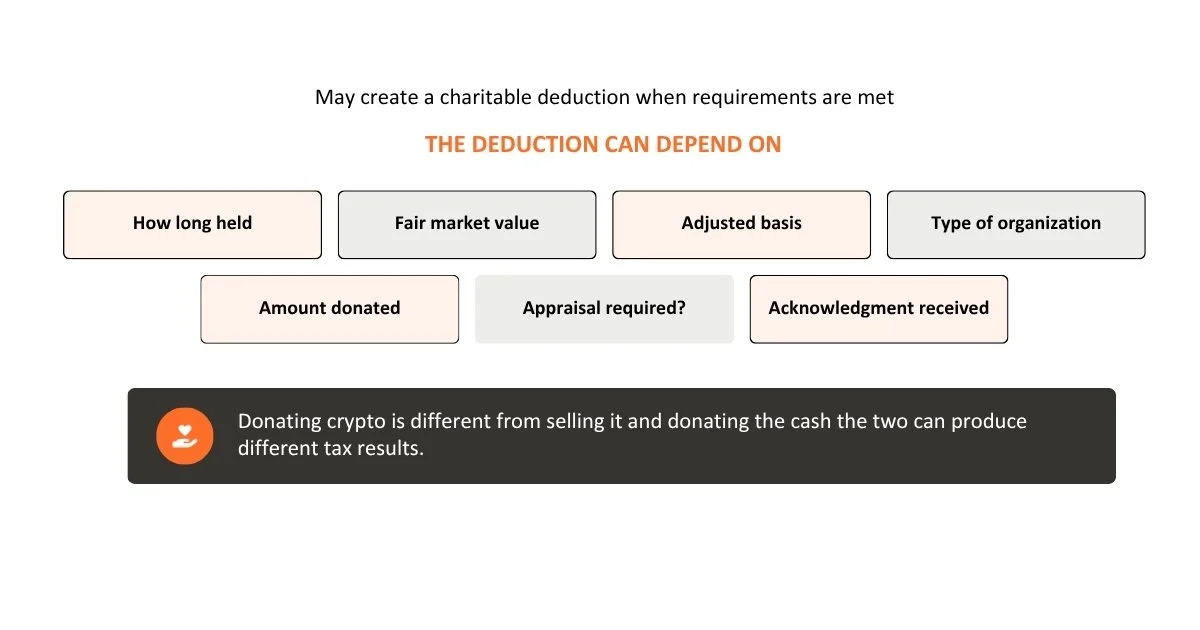
Donating cryptocurrency to a qualifying charitable organization may create a charitable contribution deduction when the requirements are met.
The deduction can depend on:
How long the asset was held
The fair market value
The adjusted basis
The type of charitable organization
The amount donated
Whether an appraisal is required
The acknowledgment received
Additional forms may be required for noncash charitable contributions.
The charitable organization’s receipt alone may not satisfy every documentation requirement.
A donation is different from selling the cryptocurrency and donating the cash. The two transactions can produce different tax results.
Inherited Cryptocurrency
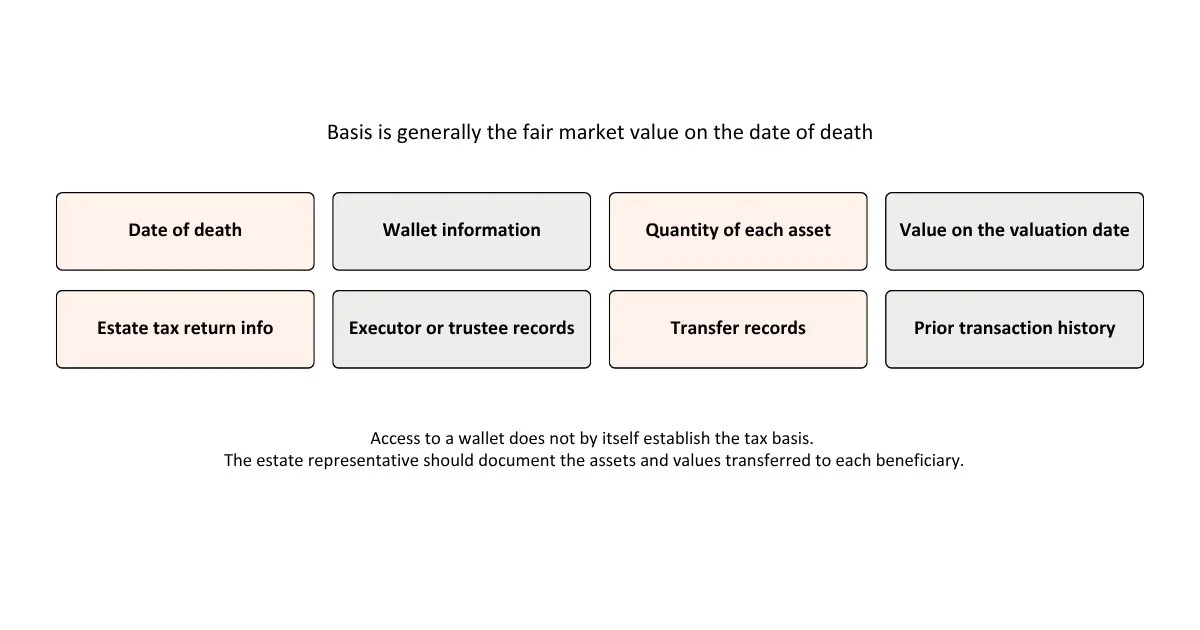
The basis of inherited digital assets is generally connected to their fair market value on the date of the owner’s death. An alternate valuation date or other rule may apply in some estates.
The beneficiary may need:
The date of death
Wallet information
The quantity of each asset
The value on the applicable valuation date
Estate tax return information
Executor or trustee records
Transfer records
Prior transaction history
Access to a wallet does not by itself establish the tax basis.
The estate representative should document the digital assets and values transferred to each beneficiary.
Lost, Stolen, Frozen, or Worthless Digital Assets
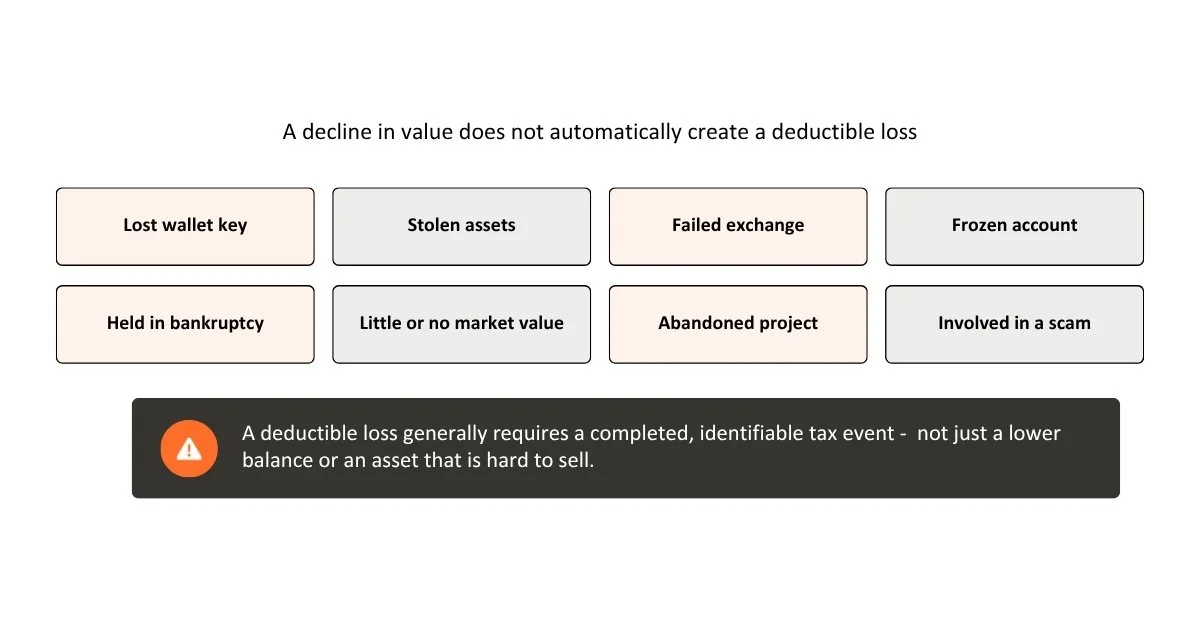
A decline in value does not automatically create a deductible tax loss.
A deductible loss generally requires a completed and identifiable tax event supported by the applicable law and records.
Additional review is needed when:
A wallet key was lost
Digital assets were stolen
An exchange failed
An account is frozen
Assets are held in bankruptcy
Tokens have little or no market value
A project was abandoned
The taxpayer was involved in a scam
The tax treatment can depend on whether the asset was sold, abandoned, transferred, recovered, or remains subject to a claim.
Do not report a loss solely because an account balance declined or the asset became difficult to sell.
Nonfungible Token Tax Reporting
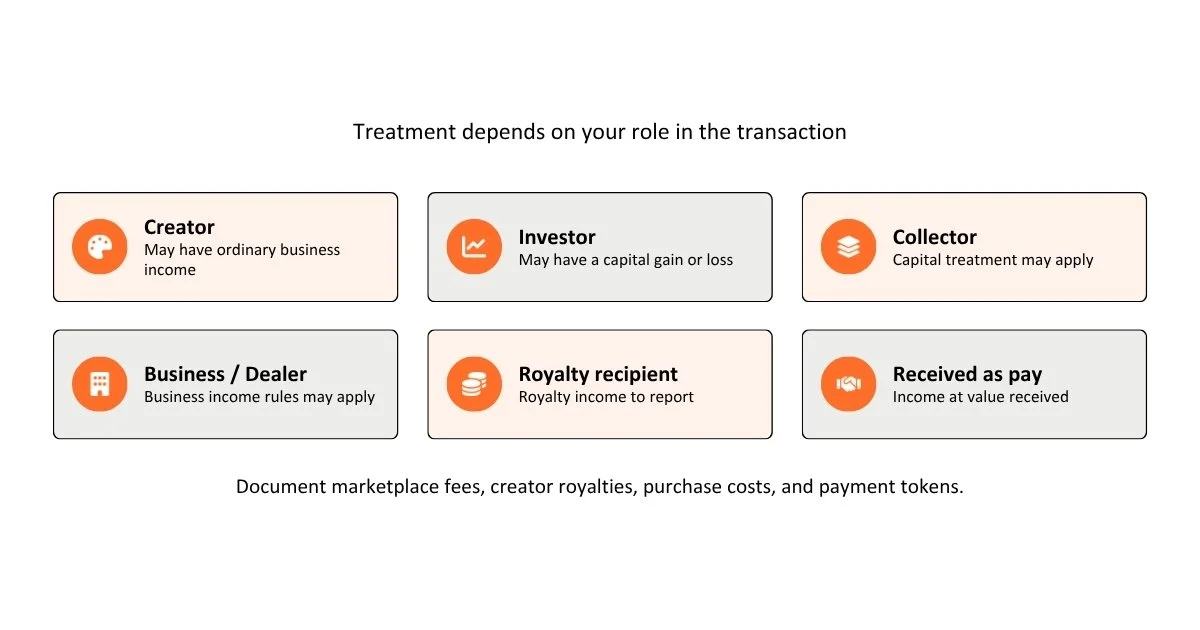
Creating, buying, selling, or exchanging a nonfungible token may create income or a capital transaction.
The tax treatment can depend on whether the taxpayer is:
The creator
An investor
A collector
A business
A dealer
A royalty recipient
A person receiving the token as compensation
A creator may have ordinary business income. An investor may have a capital gain or loss. Some nonfungible tokens may be subject to additional rules based on the rights or property represented.
Marketplace fees, creator royalties, purchase costs, and payment tokens should be documented.
Decentralized Finance Transactions
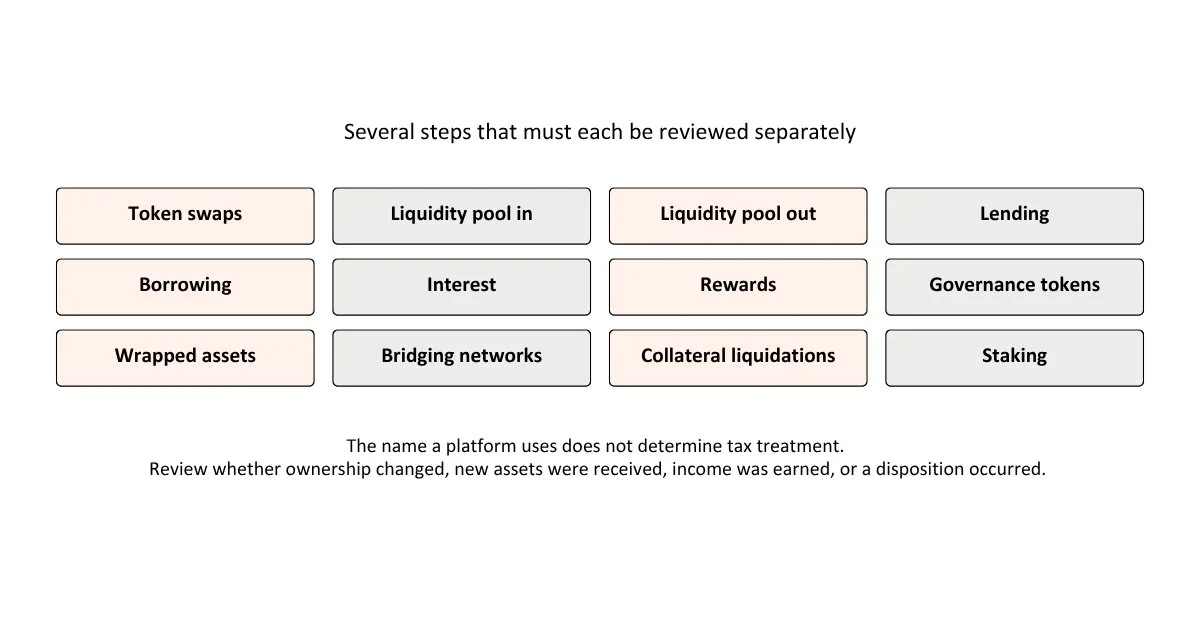
Decentralized finance activity can involve several steps that must be reviewed separately.
Possible transactions include:
Token swaps
Liquidity pool contributions
Liquidity pool withdrawals
Lending
Borrowing
Interest
Rewards
Governance tokens
Wrapped assets
Bridging assets between networks
Collateral liquidations
The name used by a platform does not determine the federal tax treatment.
The transaction must be reviewed to determine whether ownership changed, new assets were received, income was earned, or a taxable disposition occurred.
Cryptocurrency Used in a Business
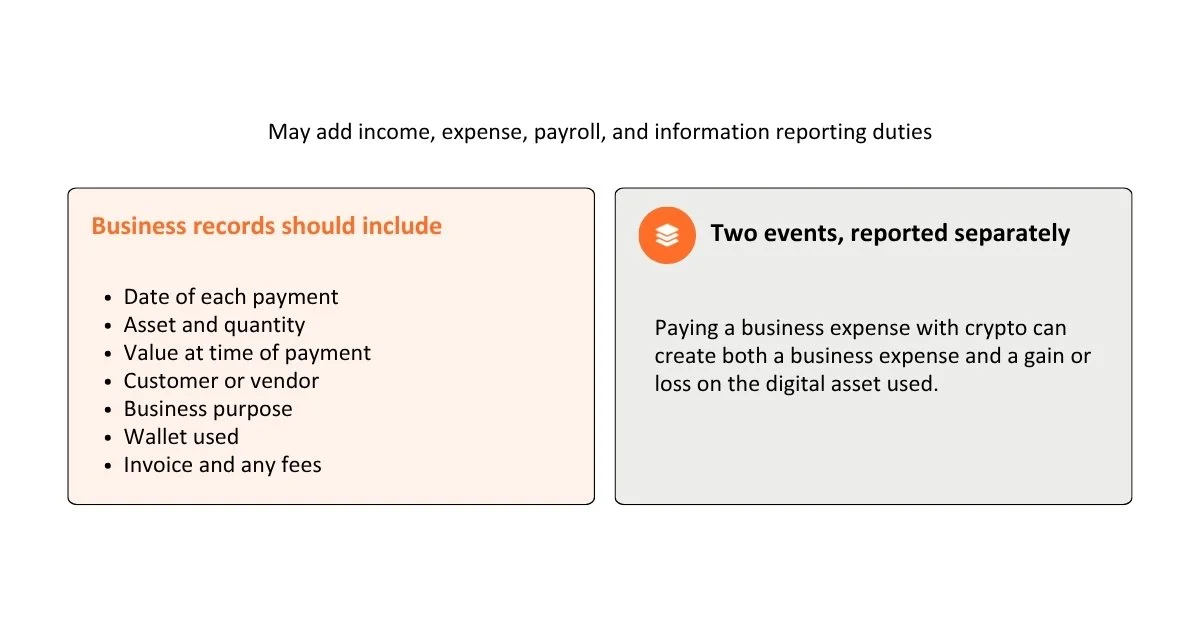
A business that receives or pays digital assets may have additional income, expense, payroll, and information reporting requirements.
Business records should include:
The date of each payment
The asset and quantity
The value at the time of payment
The customer or vendor
The business purpose
The wallet used
The invoice
Any related fees
Paying a business expense with cryptocurrency can create both a business expense and a gain or loss on the digital asset used.
The expense and the disposition should be reported separately.
Foreign Cryptocurrency Exchanges and Accounts
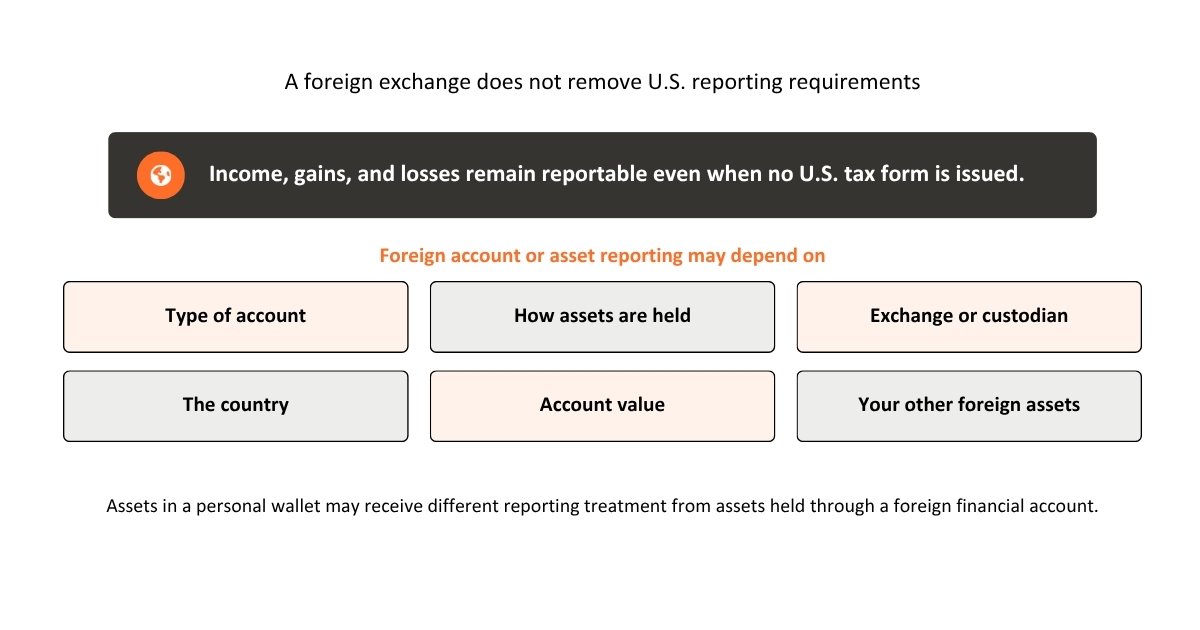
Using a foreign digital asset exchange does not remove the federal income tax reporting requirement.
Income, gains, and losses remain reportable even when the exchange does not issue a United States tax form.
Foreign account or asset reporting may also require review depending on:
The type of account
How the assets are held
The exchange or custodian
The country
The account value
The taxpayer’s other foreign assets
The current reporting rules
Digital assets held directly in a personal wallet may receive different information reporting treatment from assets held through a foreign financial account.
State Income Tax on Cryptocurrency
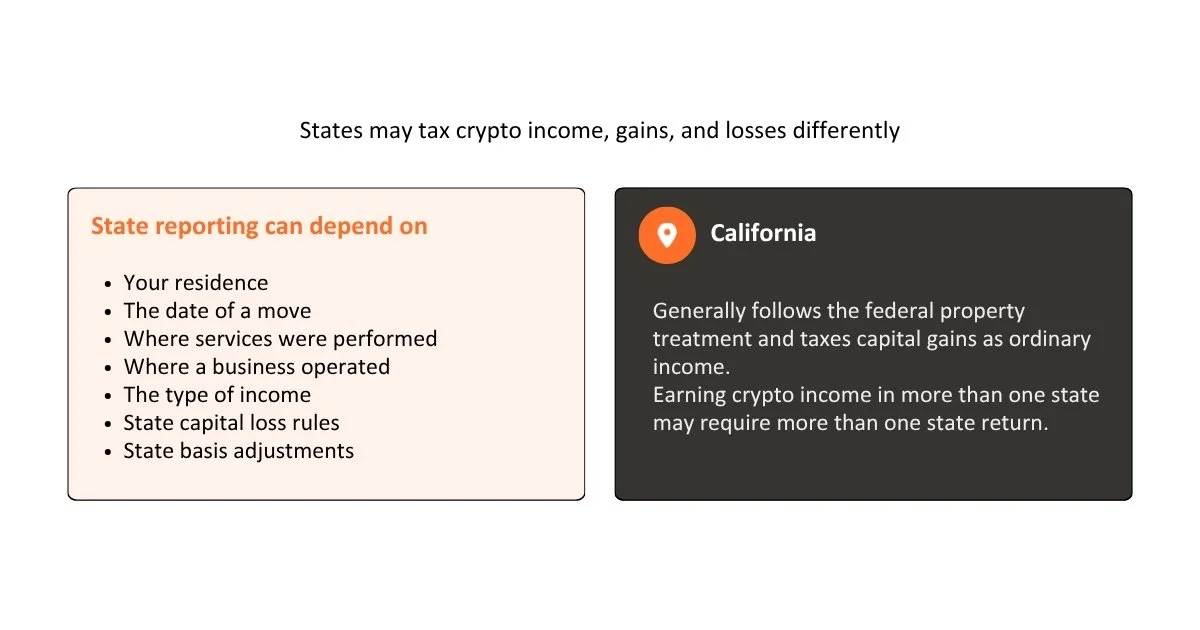
States may tax cryptocurrency income, gains, and losses differently.
State reporting can depend on:
The taxpayer’s residence
The date of a move
Where services were performed
Where a business operated
The type of income
State capital loss rules
State basis adjustments
California generally follows the federal property treatment for many digital asset transactions and taxes capital gains as ordinary income.
Taxpayers who moved or earned digital asset income while living or working in different states may need more than one state return.
Documents Needed for Cryptocurrency Tax Preparation
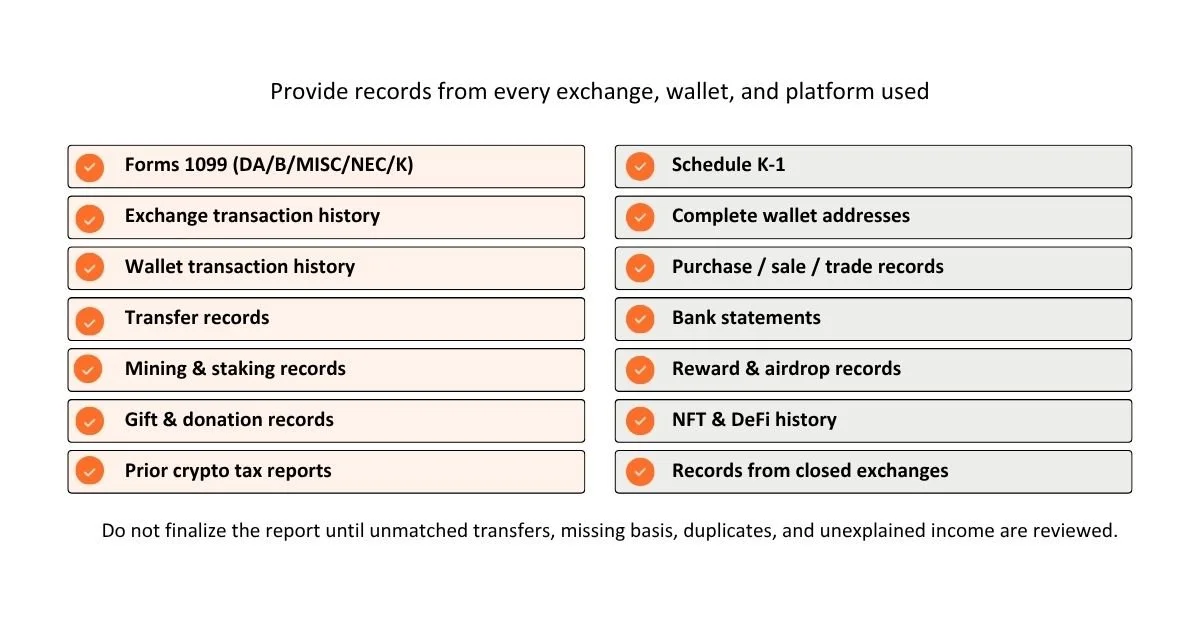
Please provide records from every exchange, wallet, and digital asset platform used during the year.
Common records include:
Form 1099 DA
Form 1099 B
Form 1099 MISC
Form 1099 NEC
Form 1099 K
Schedule K 1
Exchange transaction history
Complete wallet addresses
Wallet transaction history
Purchase records
Sale records
Trade records
Transfer records
Bank statements
Mining records
Staking records
Reward statements
Airdrop records
Hard fork information
Gift records
Donation records
Nonfungible token records
Decentralized finance transaction history
Prior year cryptocurrency tax reports
Prior year federal and state tax returns
Records from closed exchanges
Records showing assets transferred between your own accounts
A summary generated by tax software should be provided with the underlying transaction records.
The tax report should not be finalized until unmatched transfers, missing basis, duplicate transactions, and unexplained income are reviewed.
Our Cryptocurrency Tax Return Preparation Process
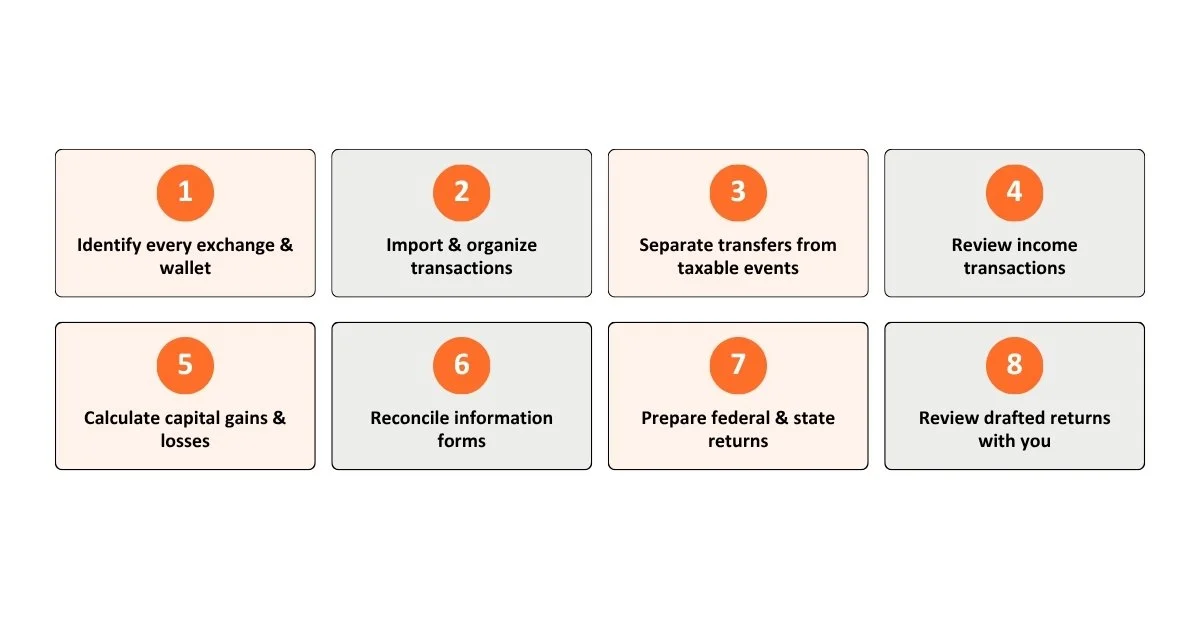
Step 1, Identify Every Exchange and Wallet
I begin by identifying the exchanges, wallets, addresses, and platforms used during the year.
This helps create a complete transaction history and match transfers between accounts.
Step 2, Import and Organize the Transactions
Exchange files, wallet history, and tax forms are organized.
Duplicate transactions, missing dates, missing values, and unsupported entries are identified for review.
Step 3, Separate Transfers From Taxable Transactions
Transfers between accounts owned by the same taxpayer are matched when supported by the records.
Sales, exchanges, payments, rewards, gifts, and other transactions are classified separately.
Step 4, Review Income Transactions
Mining, staking, business payments, compensation, rewards, and airdrops are reviewed to determine the income amount and applicable tax schedule.
Step 5, Calculate Capital Gains and Losses
Sales, exchanges, and purchases made with digital assets are calculated using the available basis, holding period, proceeds, and transaction records.
Step 6, Reconcile Information Reporting Forms
Forms 1099 DA and other tax documents are compared with the transaction report.
Differences in proceeds, basis, and income are reviewed before filing.
Step 7, Prepare the Federal and State Returns
Digital asset income and transactions are reported on the applicable federal forms and schedules.
Related state returns and adjustments are prepared when required.
Step 8, Review the Drafted Returns With You
You will receive the drafted returns for review before filing.
We explain the digital asset income, gains, losses, and any transactions that require additional records.
Common Cryptocurrency Tax Return Mistakes
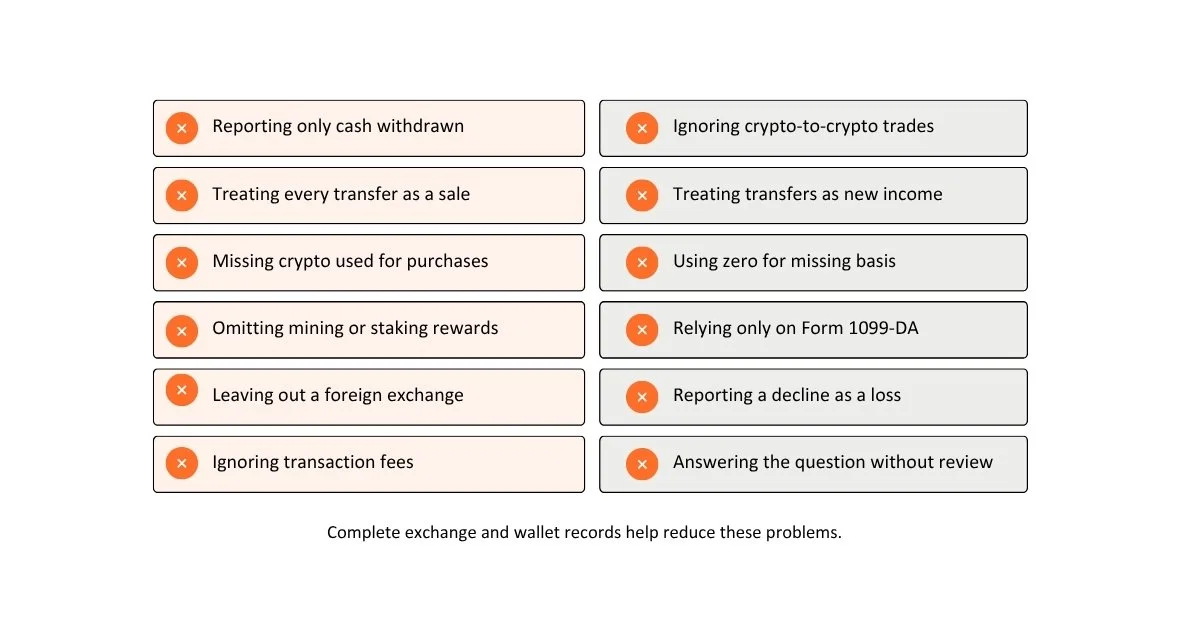
Common digital asset reporting problems include:
Reporting only cash withdrawn from an exchange
Ignoring exchanges between different digital assets
Treating every wallet transfer as a sale
Treating incoming transfers as new income
Failing to report cryptocurrency used for purchases
Using zero when cost basis is missing
Omitting mining or staking rewards
Relying only on Form 1099 DA
Failing to include a foreign exchange
Leaving out a closed wallet or platform
Reporting a decline in value as a deductible loss
Failing to track gifted or inherited basis
Using a tax software report without reviewing errors
Ignoring transaction fees
Failing to report business payments made with digital assets
Answering the federal digital asset question without reviewing the actual activity
Complete exchange and wallet records help reduce these problems.
Cryptocurrency Tax Preparation From Orange County
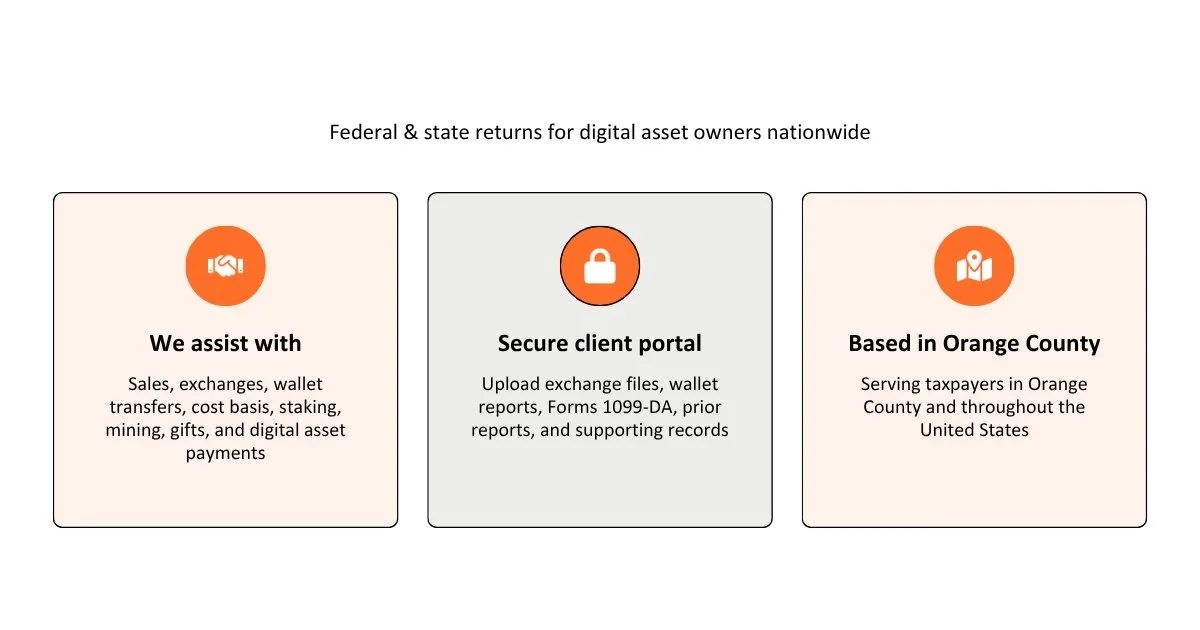
Orange Coast Tax prepares federal and state income tax returns for digital asset owners in Orange County and throughout the United States.
We assist taxpayers with cryptocurrency sales, exchanges, wallet transfers, cost basis, staking, mining, gifts, digital asset payments, and other reportable activity.
Our secure client portal allows you to upload exchange files, wallet reports, Forms 1099 DA, prior tax reports, and supporting records.
Cryptocurrency and Digital Asset Tax FAQs
-
Digital asset income and transactions may be taxable.
The tax result depends on whether the asset was purchased, received, sold, exchanged, spent, transferred, mined, staked, gifted, or inherited.
-
Possibly.
Exchanging one digital asset for another or using cryptocurrency to buy goods or services can create a taxable transaction even when no cash was received.
-
A transfer between wallets or accounts owned by the same taxpayer is generally not a taxable sale or exchange.
The transfer records should be retained to trace cost basis and show common ownership.
-
Yes.
Taxable digital asset income, gains, and losses must be reported even when no information form was issued.
-
You must determine the basis using your exchange, wallet, purchase, income, gift, inheritance, and prior transaction records.
A missing basis should not automatically be entered as zero.
-
Digital assets received through staking may create taxable income when the taxpayer receives control over the rewards.
The value included in income generally becomes the basis for a later sale or exchange.
-
A completed sale or exchange may create a capital loss when the digital asset was held as a capital asset.
A decline in value, frozen account, failed exchange, theft, or worthless token does not automatically create a deductible loss.
-
Receiving a bona fide gift generally does not create immediate income.
A later sale or exchange may create a gain or loss. The recipient needs the donor’s basis and acquisition records.
-
Yes, but the deduction and documentation requirements depend on the asset, holding period, value, recipient, and appraisal rules.
The charitable organization should qualify under the applicable federal requirements.
-
Yes.
We prepare federal and state income tax returns involving multiple exchanges, wallets, staking platforms, mining activity, and digital asset transactions.
Complete transaction records from every account are required.
Get Help Preparing Your Cryptocurrency Tax Return
Cryptocurrency tax preparation requires more than a year end account balance or a single exchange summary.
I can review your sales, exchanges, payments, wallet transfers, mining, staking, rewards, cost basis, gifts, and other digital asset activity.
Provide the complete records from every exchange, wallet, and platform, and we will identify the additional information needed to prepare your federal and state income tax returns.