
Retirement Income Tax Return Preparation
Retirement can change where your income comes from, but it does not always make the tax return simpler.
Social Security benefits, pensions, annuities, retirement account withdrawals, investments, required minimum distributions, and part time work may receive different federal and state tax treatment.
I prepare federal and state income tax returns for retirees and taxpayers approaching retirement. I review each income source, the related tax documents, and any federal and state differences before preparing the return.
The goal is to report the income correctly, identify any nontaxable amounts, and review whether current withholding or estimated payments are appropriate.
Retirement Income Tax Preparation Summary
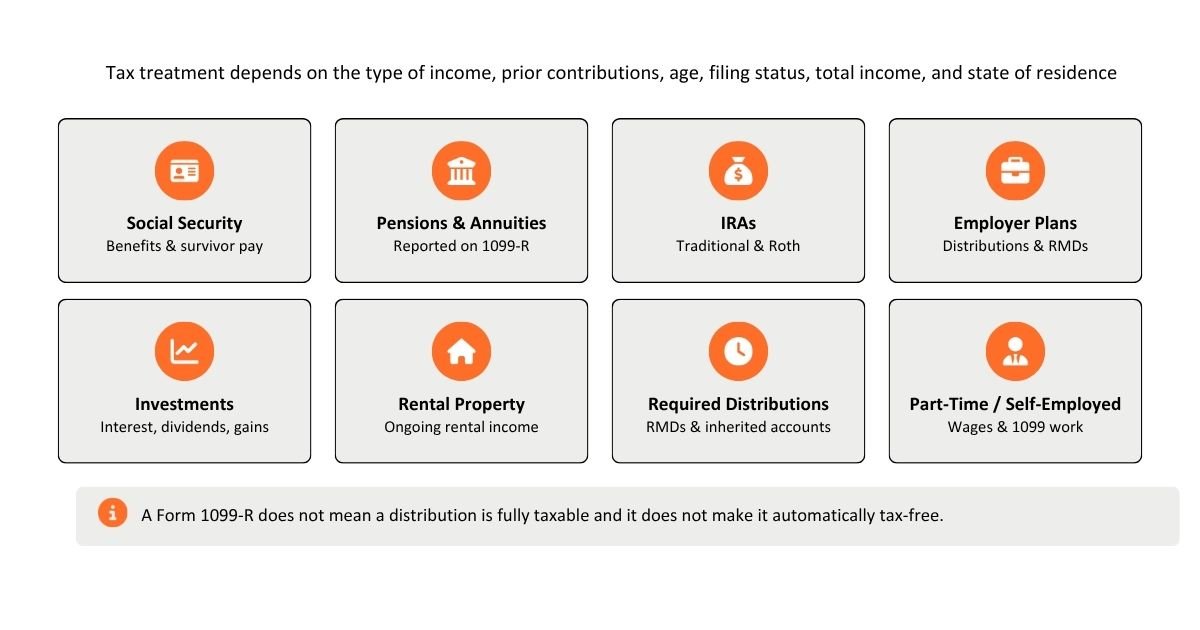
Retirement income can come from several sources.
Common sources include:
Social Security benefits
Pension payments
Annuity payments
Traditional IRA distributions
Roth IRA distributions
Employer retirement plan distributions
Required minimum distributions
Inherited retirement accounts
Investment income
Capital gains
Rental property income
Part time employment
Self employment
Interest and dividends
The tax treatment depends on the type of income, prior contributions, age, filing status, total income, state of residence, and how the distribution was made.
A Form 1099 R does not necessarily mean the entire distribution is taxable. It also does not mean the distribution is automatically tax free.
Social Security Benefits and Federal Income Tax
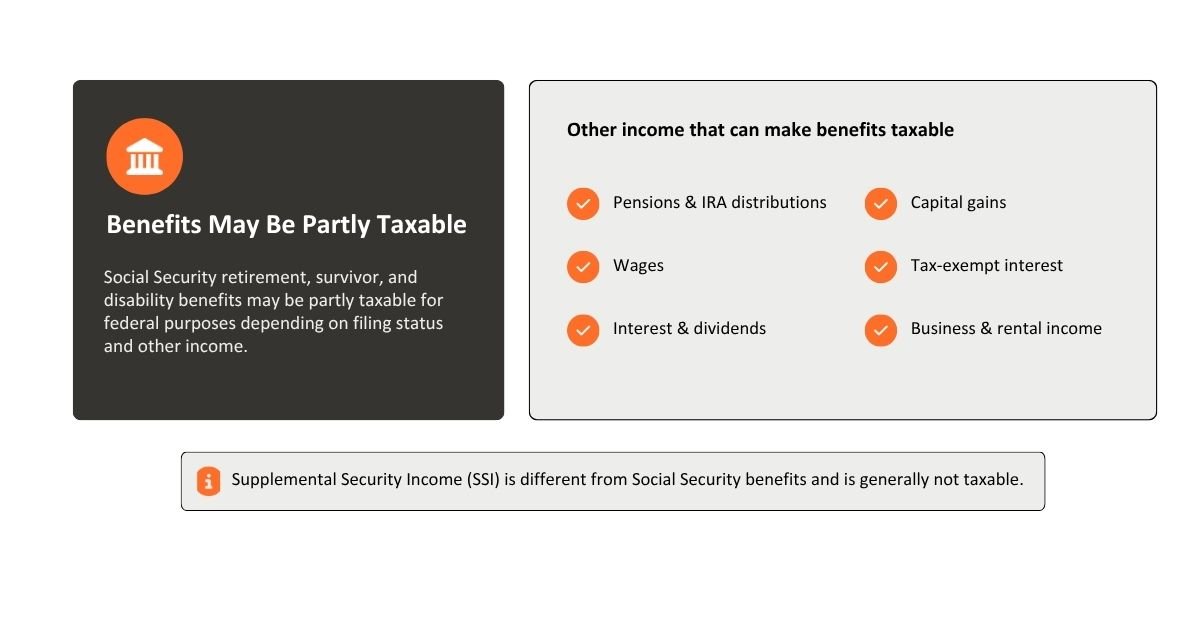
Social Security retirement, survivor, and disability benefits may be partly taxable for federal income tax purposes.
The taxable amount depends on filing status and other income reported on the return.
Other income can include:
Pensions
IRA distributions
Wages
Interest
Dividends
Capital gains
Tax exempt interest
Business income
Rental income
Social Security benefits may become partly taxable when the taxpayer has income from other sources.
Supplemental Security Income is different from Social Security retirement or disability benefits and is generally not taxable.
Form SSA 1099
The Social Security Administration generally issues Form SSA 1099 showing the benefits paid during the year.
The form may include:
Total benefits paid
Benefits repaid
Medicare premiums deducted
Attorney fees
Benefits connected to an earlier year
The complete form should be provided, including any statement showing a lump sum payment for a prior year.
Lump Sum Social Security Payments
A taxpayer may receive Social Security benefits during one year that relate to an earlier year.
A special federal calculation may reduce the taxable amount in some situations. The prior year information and the breakdown provided by the Social Security Administration should be reviewed.
The entire payment should not automatically be treated as though it relates only to the current year.
California Tax Treatment of Social Security Benefits
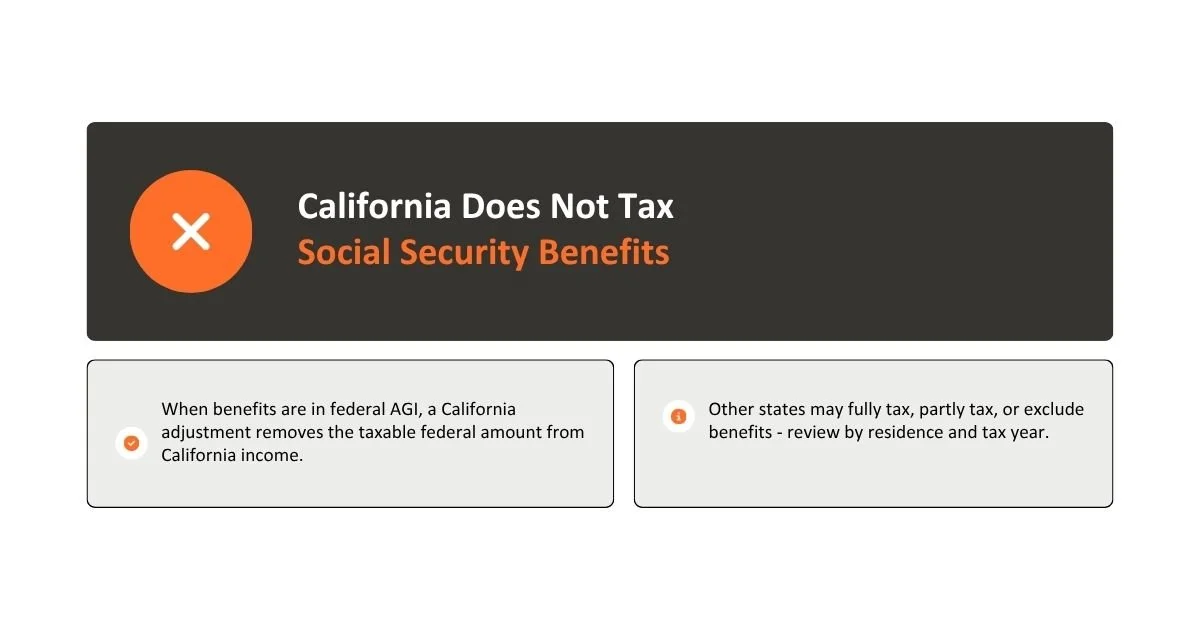
California does not tax Social Security benefits.
When Social Security income is included in federal adjusted gross income, a California adjustment is generally made to remove the taxable federal amount from California income.
Other states may fully tax, partly tax, or exclude Social Security benefits. State treatment should be reviewed based on the taxpayer’s residence and the applicable tax year.
Pension and Annuity Income
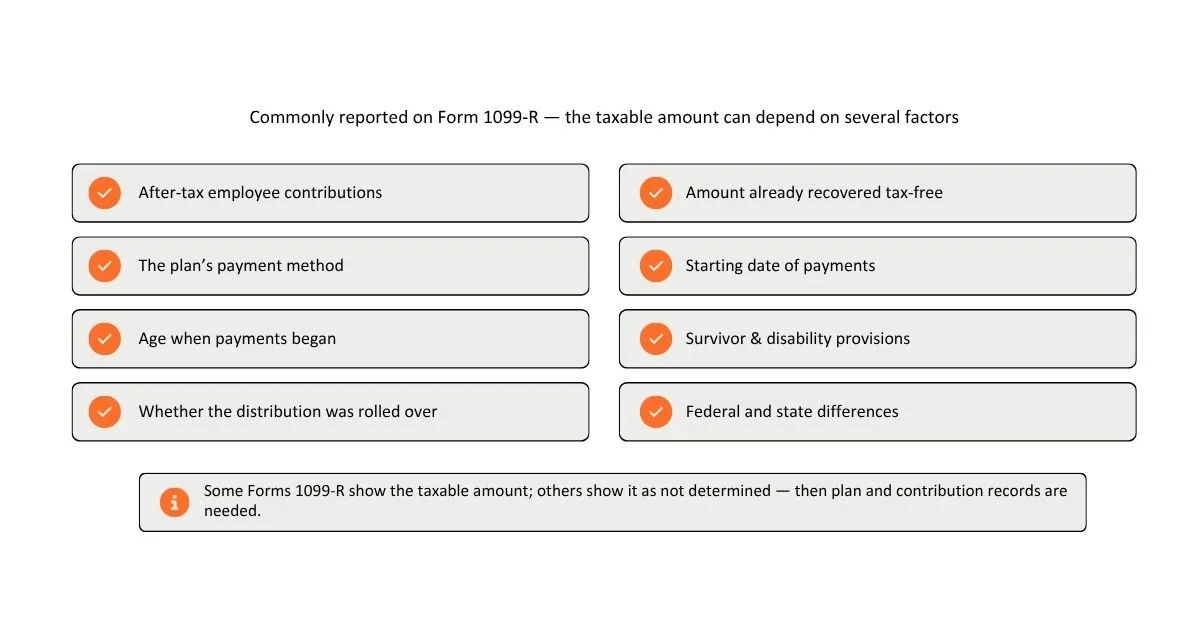
Pension and annuity payments are commonly reported on Form 1099 R.
The taxable amount may depend on:
Whether the employee made after tax contributions
The amount already recovered tax free
The plan’s payment method
The taxpayer’s starting date
The taxpayer’s age when payments began
Survivor benefits
Disability provisions
Whether the distribution was rolled over
Federal and state differences
Some Forms 1099 R show the taxable amount. Others indicate that the taxable amount has not been determined.
When the taxable amount is not provided, additional plan and contribution records may be needed.
After Tax Pension Contributions
A taxpayer who contributed after tax money to a pension or annuity may be able to recover part of those contributions without including that amount in taxable income.
The tax free portion is generally calculated over the expected payment period using the applicable federal rules.
Prior year returns and pension records should be reviewed to determine how much basis has already been recovered.
Survivor Pension Benefits
A surviving spouse or other beneficiary may receive pension or annuity benefits after the original participant dies.
The taxable amount can depend on the plan, beneficiary election, prior after tax contributions, and how the original participant’s payments were calculated.
The beneficiary should provide the plan documents and prior tax information when available.
Traditional IRA Distributions
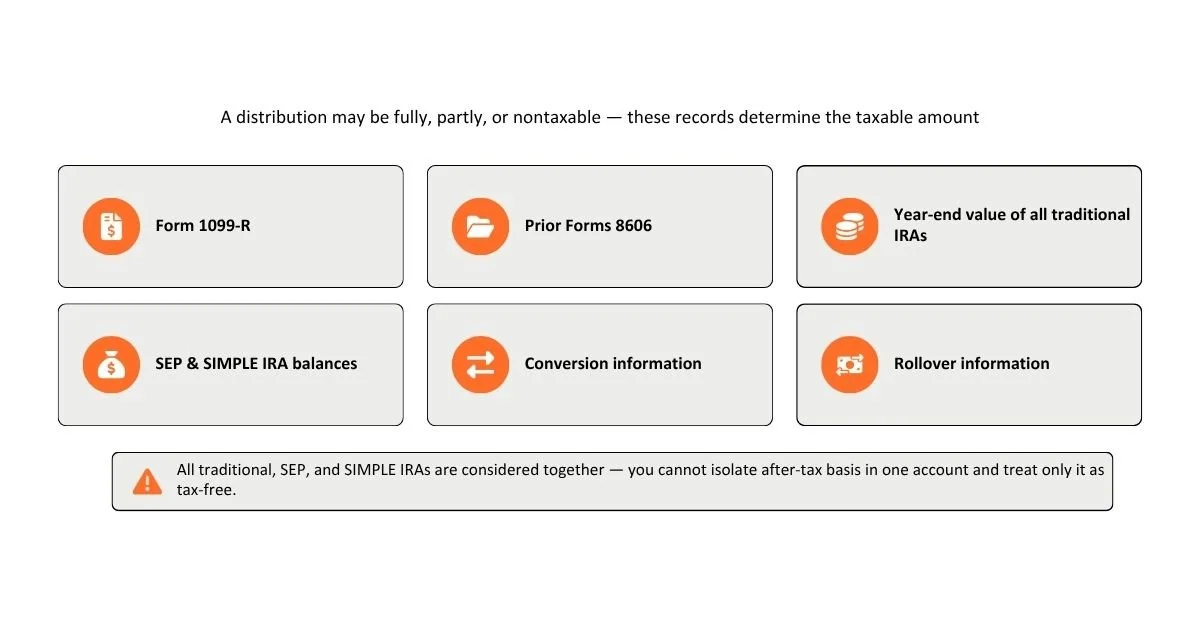
Amounts distributed from a traditional IRA are commonly reported on Form 1099 R.
A distribution may be fully taxable, partly taxable, or nontaxable depending on whether the taxpayer has basis from nondeductible contributions.
The calculation may require:
Form 1099 R
Prior Forms 8606
The year end value of all traditional IRAs
SEP IRA balances
SIMPLE IRA balances
Conversion information
Rollover information
Nondeductible contribution records
The tax calculation generally considers all traditional, SEP, and SIMPLE IRAs together. A taxpayer cannot usually isolate after tax basis inside one IRA and treat only that account as tax free.
Form 8606 and Nondeductible IRA Contributions
Form 8606 is used to track basis from nondeductible traditional IRA contributions and report certain IRA distributions and Roth conversions.
Failing to maintain Form 8606 can result in after tax contributions being taxed again when they are distributed.
Prior year Forms 8606 should be retained as long as basis remains in the retirement accounts.
IRA Rollovers
A properly completed rollover may allow a retirement distribution to remain tax deferred.
The tax reporting depends on:
The type of retirement account
Whether the rollover was direct or indirect
When the rollover was completed
Whether tax was withheld
Whether the distribution was eligible for rollover
Whether another rollover occurred during the applicable period
Required minimum distributions generally are not eligible for rollover.
A Form 1099 R may still need to be reported even when the full amount was rolled over.
Roth IRA Distributions
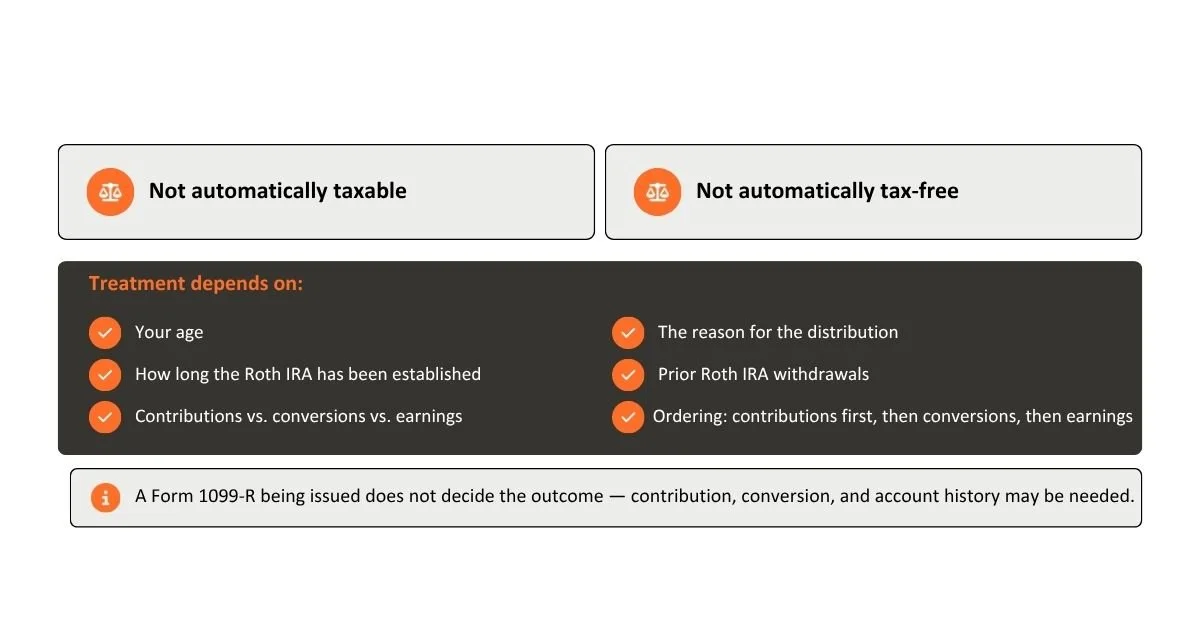
Roth IRA contributions are not deductible when made, but qualified Roth IRA distributions may be tax free.
The treatment can depend on:
The taxpayer’s age
How long the Roth IRA has been established
Whether the distribution consists of contributions, conversions, or earnings
The reason for the distribution
Prior Roth IRA withdrawals
A distribution from a Roth IRA is not automatically taxable merely because Form 1099 R was issued.
It is also not automatically tax free. Contribution, conversion, and account history may be needed.
Roth IRA Contributions, Conversions, and Earnings
Roth IRA distributions generally follow ordering rules.
Regular contributions are generally treated as distributed first, followed by conversion amounts and then earnings.
Different rules can apply to conversion amounts and earnings. Early distributions may require additional reporting even when part of the withdrawal is not included in income.
Prior contribution and conversion records should be retained.
Roth Conversions
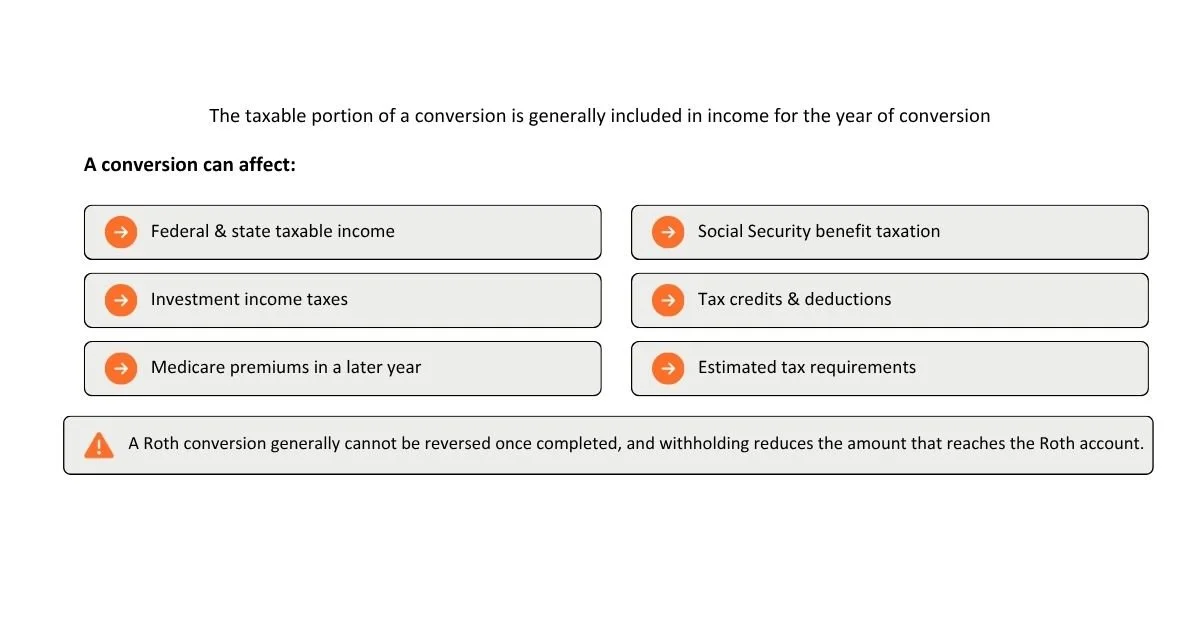
A Roth conversion moves funds from a traditional retirement account into a Roth IRA.
The taxable portion of the conversion is generally included in income for the year of conversion.
A conversion can affect:
Federal taxable income
State taxable income
Social Security benefit taxation
Investment income taxes
Tax credits and deductions
Medicare premiums in a later year
Estimated tax requirements
The financial institution may withhold tax from the conversion, but withholding reduces the amount reaching the Roth account.
A Roth conversion cannot generally be reversed after it is completed. The complete tax effect should be reviewed before and after the transaction.
Required Minimum Distributions
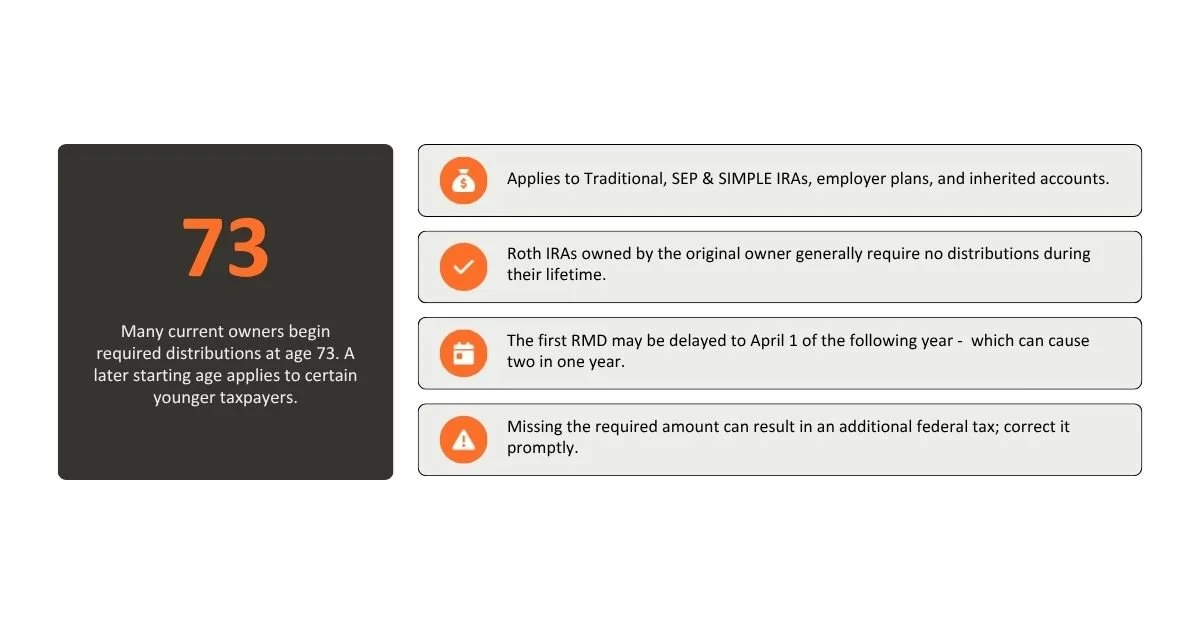
Required minimum distributions generally require retirement account owners to withdraw a minimum amount after reaching the applicable starting age.
The starting age depends on the taxpayer’s birth year. Many current retirement account owners begin required distributions at age 73. A later starting age applies to certain younger taxpayers under current law.
Required minimum distribution rules can apply to:
Traditional IRAs
SEP IRAs
SIMPLE IRAs
Employer retirement plans
Inherited retirement accounts
Roth accounts within employer plans follow current federal rules that may differ from traditional plan accounts. Roth IRAs owned by the original owner generally do not require distributions during the owner’s lifetime.
Calculating a Required Minimum Distribution
An IRA required minimum distribution is generally calculated using:
The prior year end account balance
The taxpayer’s age
The applicable federal life expectancy table
Beneficiary information in certain cases
Each IRA has its own required minimum distribution calculation. An IRA owner may generally take the combined IRA requirement from one or more IRAs.
Different aggregation rules apply to employer retirement plans.
The account custodian’s calculation should be reviewed when there were rollovers, transfers, corrections, or unusual account changes.
The First Required Minimum Distribution
A taxpayer may generally delay the first required minimum distribution until April 1 of the following year.
Delaying the first distribution can cause two required distributions to be received during the same calendar year.
Receiving two distributions in one year may increase taxable income and affect other parts of the return.
Missing a Required Minimum Distribution
Failing to take the required amount can result in an additional federal tax.
The amount of the additional tax and possible reduction can depend on when the error is corrected and whether the applicable requirements are met.
A missed distribution should be addressed promptly. The account records, required amount, actual distributions, and correction date should be reviewed before the related tax form is prepared.
Qualified Charitable Distributions
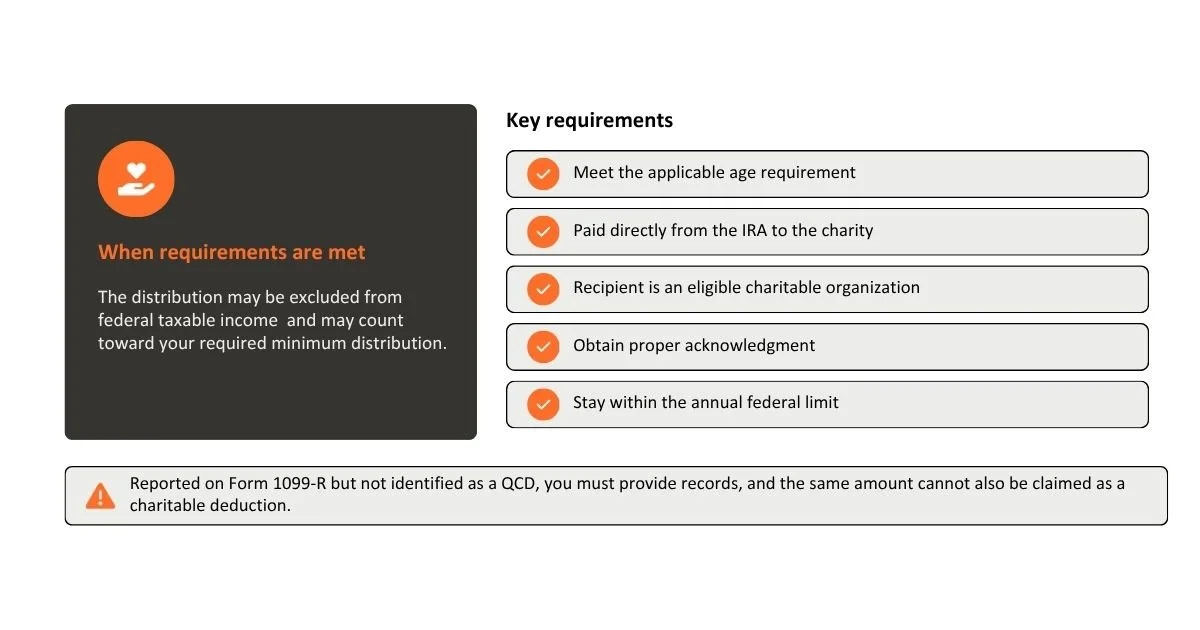
A qualified charitable distribution allows an eligible IRA owner to direct funds from an IRA to a qualifying charitable organization.
When the requirements are met, the distribution may be excluded from federal taxable income and may count toward the taxpayer’s required minimum distribution.
Important requirements include:
The taxpayer must meet the applicable age requirement
The payment must be made directly from the IRA to the qualifying organization
The recipient must be an eligible charitable organization
The taxpayer must obtain proper acknowledgment
The annual exclusion is subject to a federal limit
The distribution must otherwise meet the federal requirements
A qualified charitable distribution is reported on Form 1099 R, but the form generally does not identify it as a qualified charitable distribution.
The taxpayer must provide the distribution and charitable acknowledgment records.
The same amount cannot generally be excluded as a qualified charitable distribution and also claimed as a charitable deduction.
Early Retirement Account Distributions
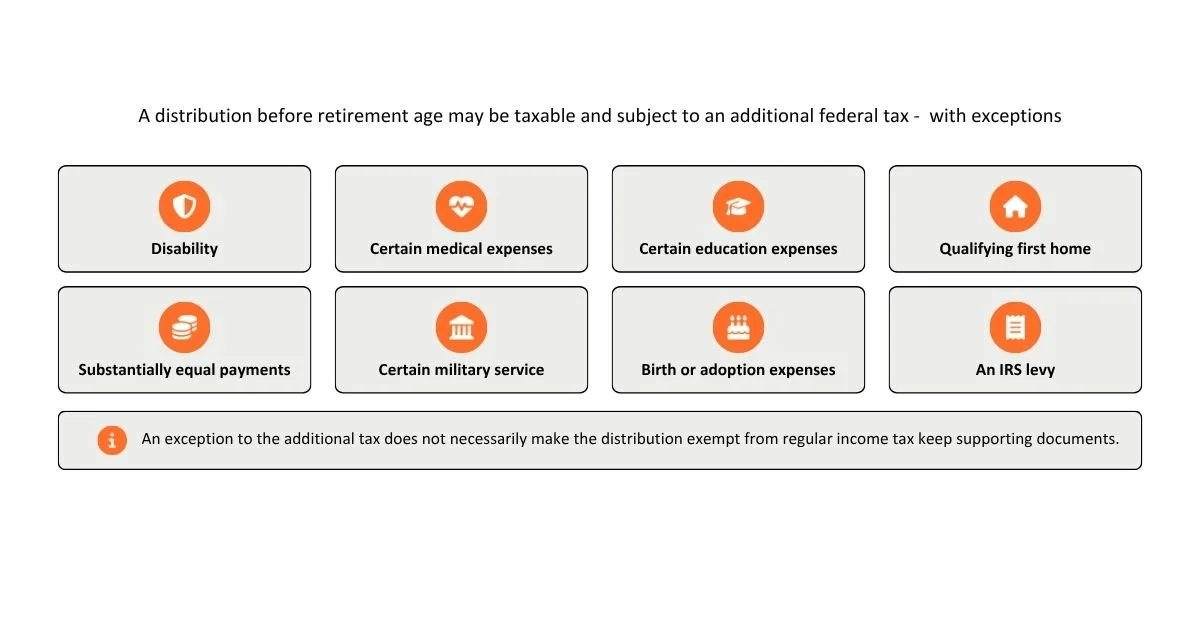
A distribution received before the applicable retirement age may be included in income and may also be subject to an additional federal tax.
Federal law provides exceptions for certain distributions. The exceptions depend on the type of retirement account and the reason the funds were withdrawn.
Possible exceptions can involve:
Disability
Certain medical expenses
Certain education expenses
A qualifying first home purchase
A series of substantially equal payments
Certain military service
Certain birth or adoption expenses
An IRS levy
Other situations provided by federal law
An exception to the additional tax does not necessarily make the distribution exempt from regular income tax.
Supporting documents should be retained for any exception claimed.
Inherited IRA and Retirement Account Distributions
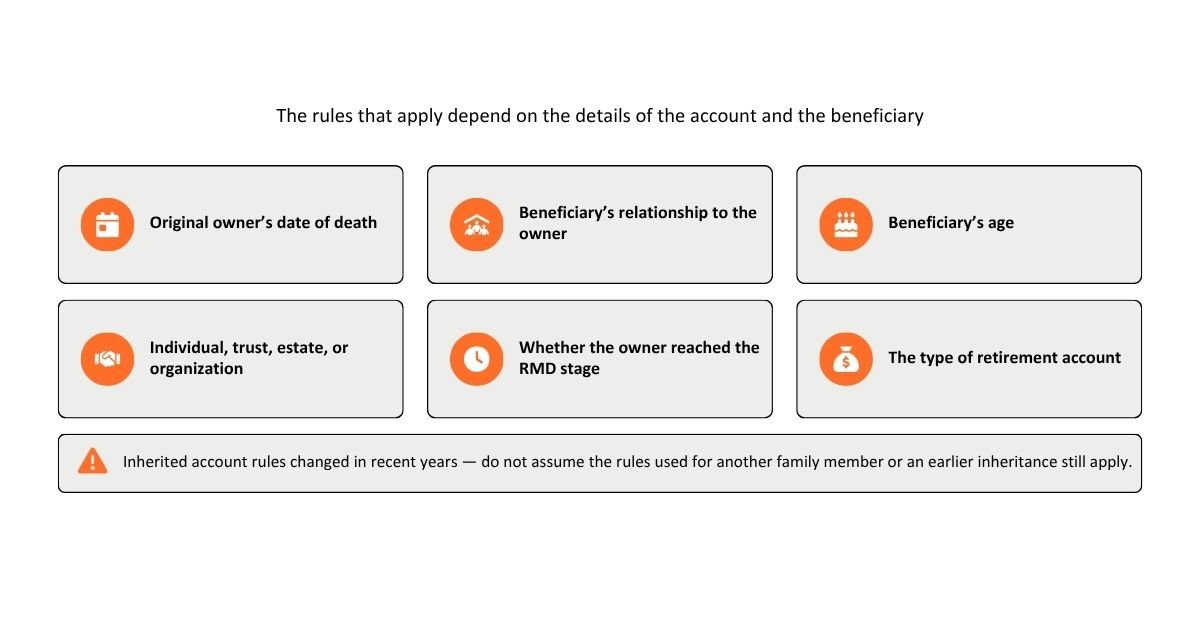
Inherited retirement accounts follow rules that depend on:
The original owner’s date of death
The beneficiary’s relationship to the owner
The beneficiary’s age
Whether the beneficiary is an individual, trust, estate, or organization
Whether the original owner had reached the required distribution stage
The type of retirement account
Whether the beneficiary qualifies for special treatment
Some beneficiaries may be subject to a required distribution period. Others may be required to empty the account within a specified number of years. Annual distributions may also apply in certain situations.
Inherited retirement account rules have changed in recent years. The beneficiary should not assume that the rules used for another family member or an earlier inheritance still apply.
Retirement Income and Investment Income
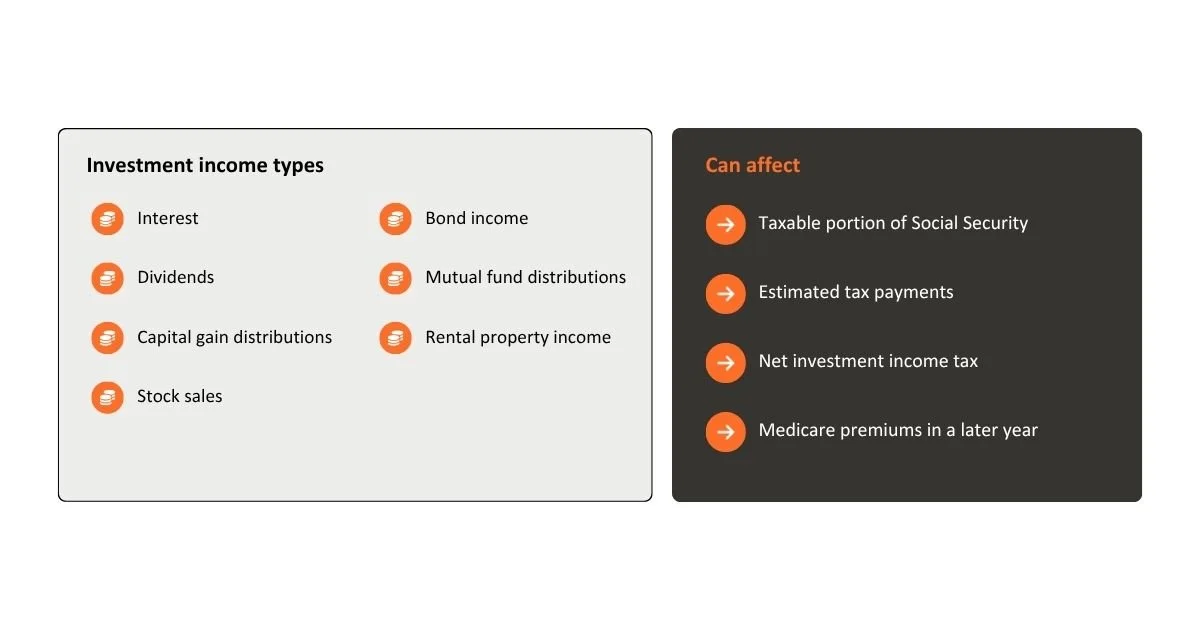
Retirees may receive investment income in addition to retirement plan distributions.
This can include:
Interest
Dividends
Capital gain distributions
Stock sales
Bond income
Mutual fund distributions
Rental property income
Investment income can affect the taxable portion of Social Security benefits, estimated tax payments, net investment income tax, and Medicare premiums in a later year.
Working During Retirement
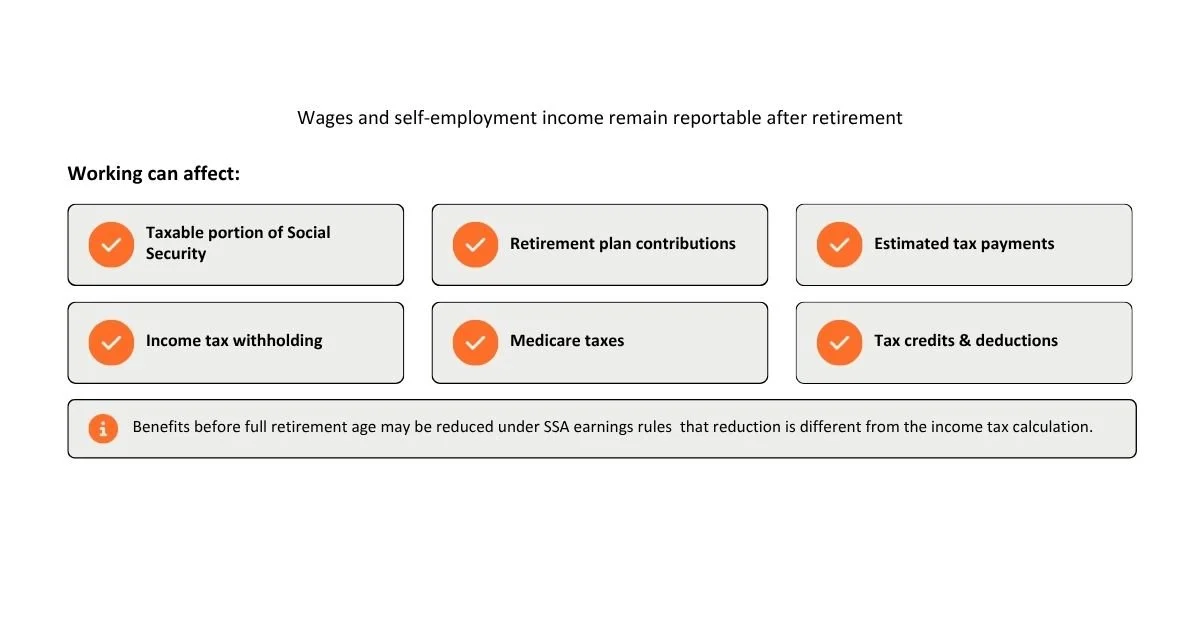
Wages and self employment income remain reportable after retirement.
Working during retirement can affect:
The taxable portion of Social Security benefits
Retirement plan contributions
Estimated tax payments
Income tax withholding
Medicare taxes
Tax credits and deductions
Social Security benefit payments before full retirement age may also be affected by earnings rules administered by the Social Security Administration.
A reduction in current Social Security payments under those rules is different from the federal income tax calculation.
Federal Tax Withholding From Retirement Income
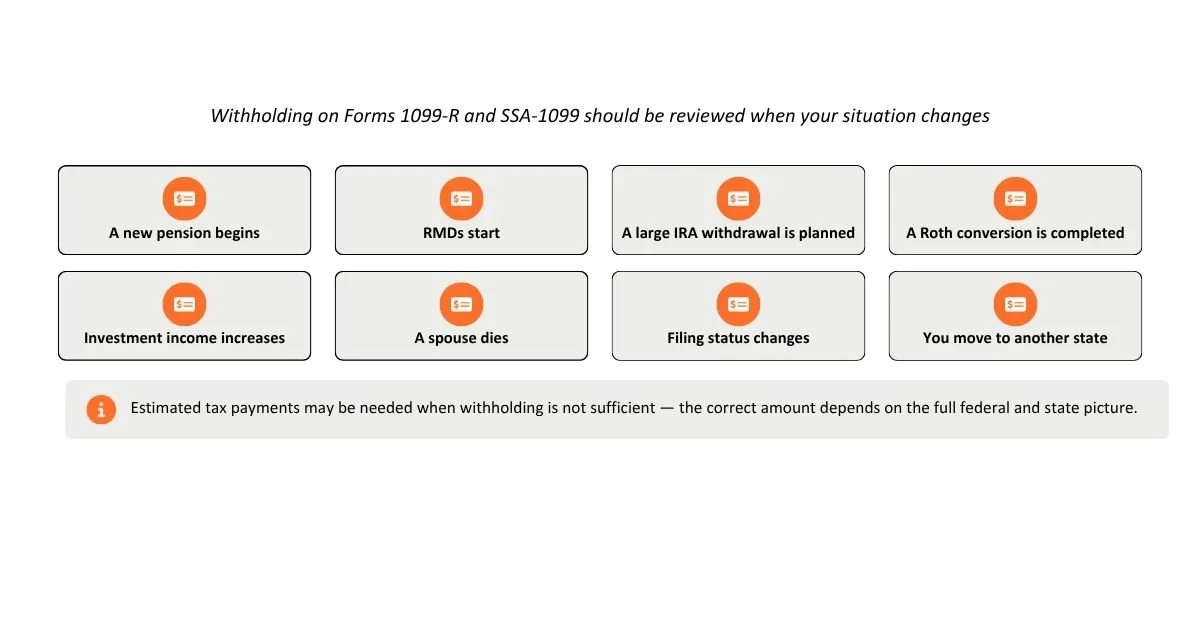
Federal income tax may be withheld from pensions, annuities, IRA distributions, and Social Security benefits.
The withholding shown on Forms 1099 R and SSA 1099 should be included with the tax return.
A retiree may need to review withholding when:
A new pension begins
Required minimum distributions start
A large IRA withdrawal is planned
A Roth conversion is completed
Investment income increases
A spouse dies
Filing status changes
The taxpayer moves to another state
Estimated tax payments may be needed when withholding is not sufficient.
The correct amount depends on the complete federal and state tax situation.
Medicare Premiums and Tax Return Income

Income reported on the federal tax return can affect income related Medicare premiums in a later year.
A large retirement distribution, Roth conversion, capital gain, or other income increase may raise the income used for the Medicare premium calculation.
Certain life changing events may support a request for reconsideration through the Social Security Administration.
Tax return preparation does not determine the final Medicare premium, but the possible effect should be considered when reviewing significant retirement income transactions.
State Income Tax on Retirement Income
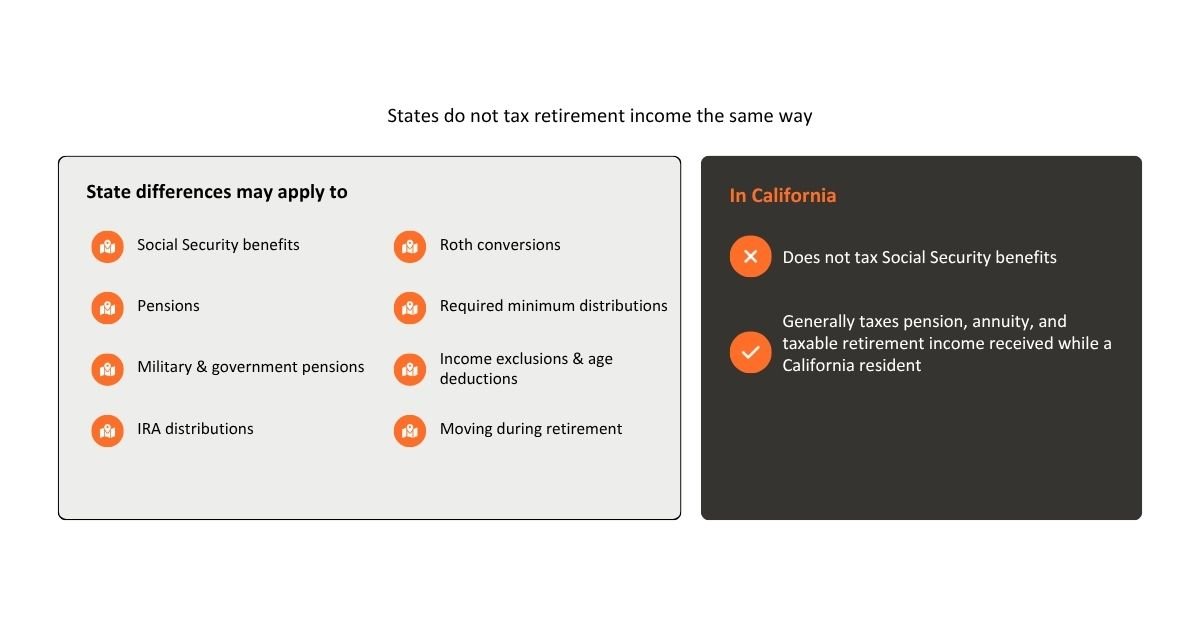
States do not tax retirement income in the same way.
State differences may apply to:
Social Security benefits
Pensions
Military retirement pay
Government pensions
IRA distributions
Roth conversions
Required minimum distributions
Retirement income exclusions
Age based deductions
Moving during retirement
California does not tax Social Security benefits. However, California generally taxes pension, annuity, and taxable retirement account income received while the taxpayer is a California resident.
Federal law generally limits a state’s ability to tax certain qualified retirement income received by a nonresident, but residency and the character of the payment must still be reviewed.
Moving to Another State During Retirement
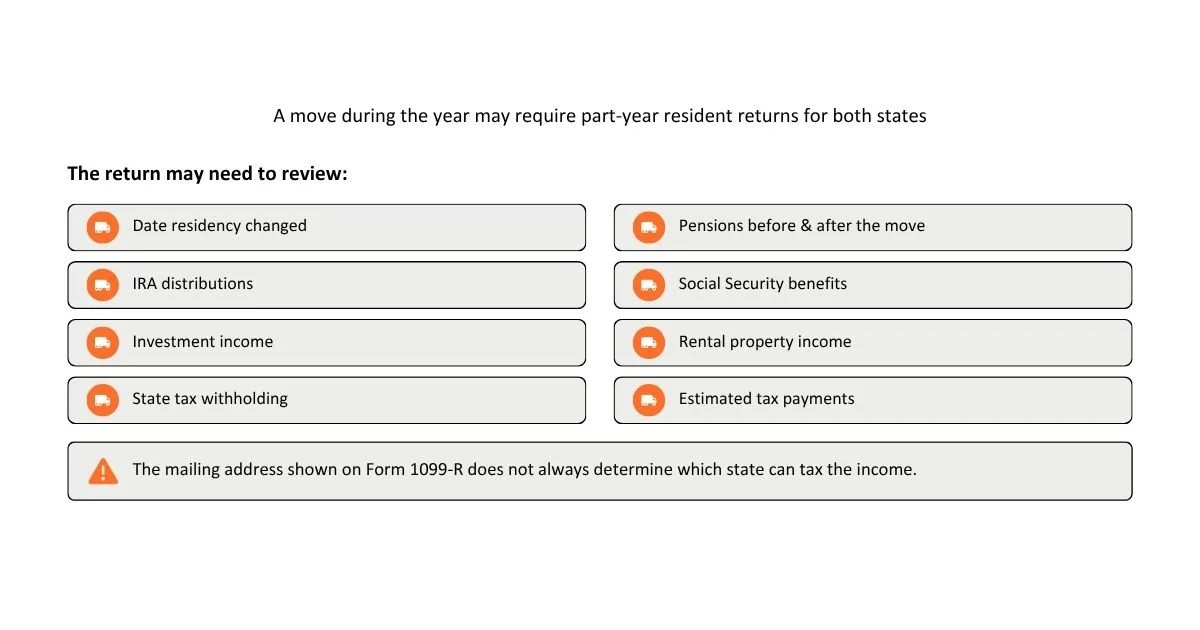
A retiree who moves during the year may need part year resident returns for the state left and the new state of residence.
The return may need to review:
The date residency changed
Pension payments received before and after the move
IRA distributions
Social Security benefits
Investment income
Rental property income
State tax withholding
Estimated tax payments
The tax treatment can depend on when income was received and whether it is connected to a particular state.
The mailing address shown on Form 1099 R does not always determine which state can tax the income.
Documents Needed for Retirement Tax Preparation
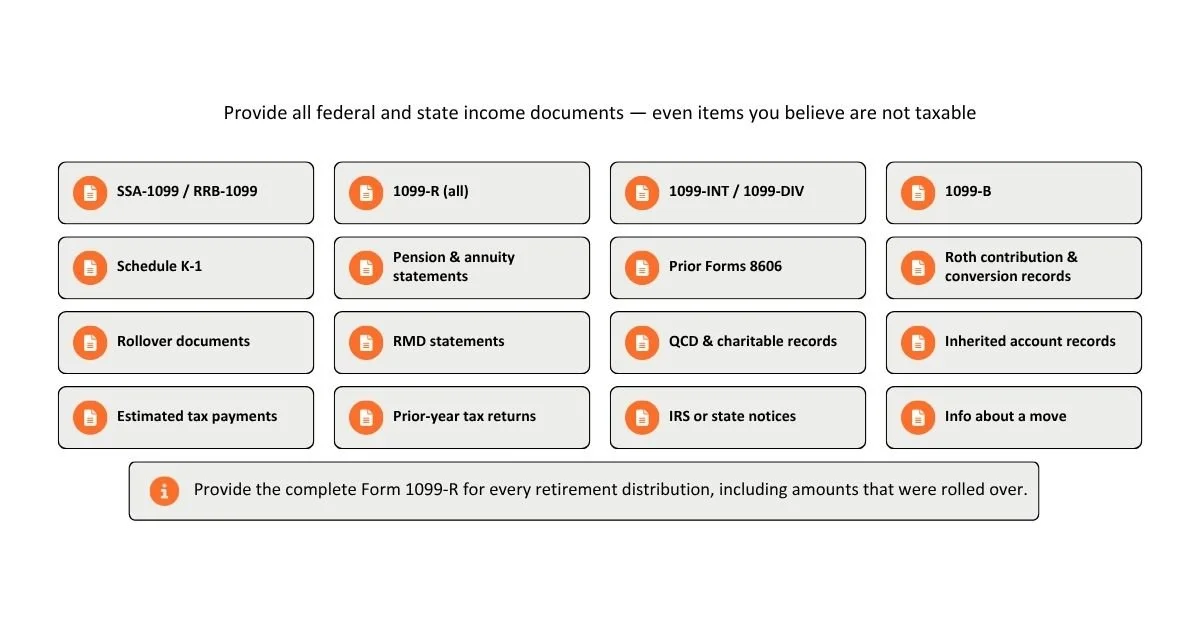
Please provide all federal and state income documents, even when you believe an item is not taxable.
Common documents include:
Form SSA 1099
Form RRB 1099
Form 1099 R
Form 1099 INT
Form 1099 DIV
Form 1099 B
Schedule K 1
Pension statements
Annuity statements
IRA contribution records
Prior Forms 8606
Roth IRA contribution records
Roth conversion records
Rollover documents
Required minimum distribution statements
Qualified charitable distribution records
Charitable acknowledgments
Inherited retirement account records
Federal and state estimated tax payments
Property tax and mortgage interest statements
Health savings account forms
Prior year federal and state tax returns
Information about a move to another state
Notices from the IRS or a state tax agency
The complete Form 1099 R should be provided for every retirement distribution, including amounts that were rolled over.
Our Retirement Income Tax Return Preparation Process

Step 1, Review Every Retirement Income Source
I begin by identifying Social Security benefits, pensions, annuities, retirement account distributions, investments, and other income.
Each tax document is reviewed for federal and state reporting.
Step 2, Determine the Taxable Amount
We review whether each distribution is fully taxable, partly taxable, or nontaxable.
After tax contributions, IRA basis, Roth history, rollovers, and qualified charitable distributions are considered when supported by the records.
Step 3, Review Required Minimum Distributions
We compare the required amount with the distributions received when required minimum distribution rules apply.
Any missed or incomplete distribution is identified for further review.
Step 4, Review Federal and State Differences
Social Security, pensions, retirement accounts, investment income, and residency are reviewed for applicable state adjustments.
Part year or nonresident state returns are prepared when required.
Step 5, Review Withholding and Estimated Payments
Federal and state withholding and estimated tax payments are matched to the return.
We review whether the current payment pattern should be reconsidered for the next tax year.
Step 6, Review the Drafted Returns With You
You will receive the drafted federal and state returns for review before filing.
We explain how the retirement income was reported and identify any records needed to complete the filing.
Common Retirement Tax Return Mistakes
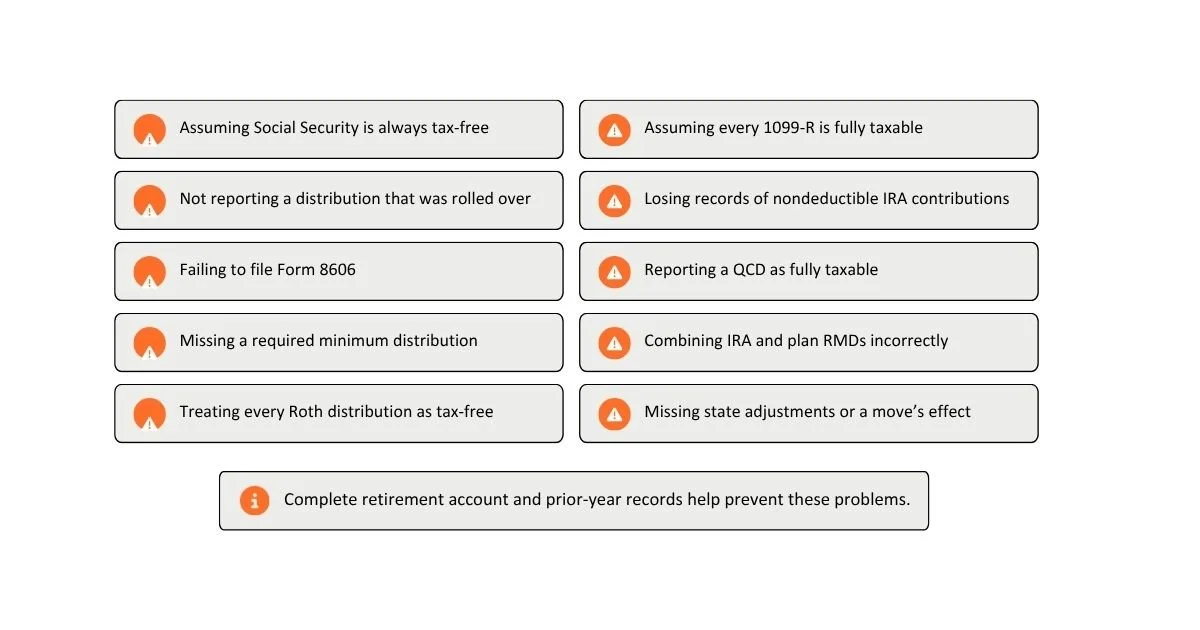
Common retirement income reporting problems include:
Assuming Social Security is always tax free
Assuming every Form 1099 R is fully taxable
Failing to report a retirement distribution that was rolled over
Losing records of nondeductible IRA contributions
Failing to file Form 8606
Reporting a qualified charitable distribution as fully taxable
Claiming the same charitable amount twice
Missing a required minimum distribution
Combining IRA and employer plan distribution requirements incorrectly
Treating every Roth IRA distribution as automatically tax free
Failing to review an early distribution exception
Missing state adjustments for Social Security or retirement income
Ignoring the effect of a move to another state
Overlooking the tax effect of a large Roth conversion or capital gain
Complete retirement account and prior year records help prevent these problems.
Retirement Income Tax Preparation From Orange County
Orange Coast Tax prepares federal and state income tax returns for retirees in Orange County and throughout the United States.
We assist taxpayers with Social Security, pensions, annuities, IRA withdrawals, Roth distributions, required minimum distributions, inherited retirement accounts, investments, and multistate filings.
Our secure client portal allows you to upload retirement tax forms, investment statements, prior returns, and supporting records.
Retirement Income Tax Return FAQs
-
Social Security benefits may be partly taxable for federal income tax purposes depending on filing status and other income.
California does not tax Social Security benefits. Other states may apply different rules.
-
It depends.
A pension may be fully taxable or partly taxable. After tax employee contributions may allow part of each payment to be excluded from income.
-
No.
A traditional IRA distribution may be fully or partly taxable depending on nondeductible contributions and other basis. A qualified Roth IRA distribution may be tax free.
The account and contribution history should be reviewed.
-
Yes.
A Form 1099 R distribution generally must still be reported even when an eligible amount was properly rolled over and is not currently taxable.
-
California generally taxes pension and taxable retirement account income received by a California resident.
California does not tax Social Security benefits.
-
The starting age depends on the taxpayer’s birth year and the type of retirement account.
Many current retirement account owners begin required distributions at age 73. A later starting age applies to certain younger taxpayers under current law.
-
An IRA owner may generally calculate the requirement for each IRA and take the combined amount from one or more IRAs.
Different aggregation rules apply to employer retirement plans.
-
The distribution appears on Form 1099 R, but the form generally does not identify it as a qualified charitable distribution.
The taxpayer must provide records showing that the payment was made directly to an eligible organization.
-
The taxable portion of a Roth conversion is generally included in income for the year of conversion.
Nondeductible IRA basis and other retirement account information may affect the taxable amount.
-
Yes.
Orange Coast Tax prepares federal and state income tax returns for retirees throughout the United States. State treatment will depend on the taxpayer’s residence and income sources.
Get Help Preparing Your Retirement Income Tax Return
Retirement tax preparation should account for each income source and the different federal and state rules that may apply.
I can review your Social Security benefits, pensions, annuities, IRA distributions, Roth accounts, required minimum distributions, investments, withholding, and state filing requirements.
Provide your retirement and investment tax documents, and we will identify the additional records needed to prepare your federal and state income tax returns.