
Amended Tax Return Preparation for Federal and State Returns
Finding an error after filing your income tax return does not always mean you are stuck with it.
An amended tax return allows you to report information that was missing, incomplete, or incorrectly reported on the original return. The amendment may involve income, deductions, tax credits, dependents, filing status, business activity, rental property, investments, or another tax item.
I prepare federal and state amended income tax returns after reviewing the original filing and the information supporting the requested changes.
An amendment does not automatically create a refund. Depending on the correction, it may result in an additional refund, an additional balance, or no change in the tax due.
When You May Need to Amend a Tax Return

You Received a Corrected Form W 2 or Form 1099
An employer, bank, brokerage, payment processor, or other payer may issue a corrected tax form after you filed.
The corrected form should be compared with the amount reported on the original return. An amended return may be needed if the correction changes income, withholding, deductions, credits, or tax.
Income Was Missing From the Original Return
A tax document may arrive after filing, or an income item may have been overlooked.
Examples include:
Form W 2 wages
Interest income
Dividend income
Stock or investment sales
Self employment income
Payment processor income
Rental income
Retirement distributions
Unemployment compensation
Schedule K 1 income
Foreign income
Adding income can affect more than one line of the return. It may also change deductions, credits, additional taxes, or state income tax.
A Deduction or Tax Credit Was Overlooked
An amendment may be appropriate when a taxpayer qualified for a deduction or credit that was not claimed on the original return.
Possible examples include:
Education related tax benefits
Dependent care expenses
Retirement contribution deductions
Health savings account deductions
Business expenses
Rental property expenses
Foreign tax credits
Energy related credits
The eligibility rules and supporting documents must be reviewed before adding a deduction or credit.
A missing deduction or credit does not automatically mean that an amendment will result in a refund.
Your Filing Status Was Incorrect
Filing status can affect tax rates, deductions, credits, and eligibility for other tax benefits.
An amendment may be needed when the original return used an incorrect filing status. However, federal rules can limit certain filing status changes after the original filing deadline.
Marital status, household expenses, dependent information, and the date of the requested change must be reviewed before amending the filing status.
Dependent Information Changed
A return may need to be amended when a qualifying dependent was omitted, reported incorrectly, or claimed on another return.
Adding or removing a dependent can affect:
Child related tax credits
Dependent care benefits
Education credits
Head of household filing status
Premium tax credits
Other federal or state tax benefits
Dependency issues should be reviewed carefully when more than one taxpayer claims the same person.
Investment Cost Basis Was Missing or Incorrect
Brokerage statements do not always report complete or accurate cost basis information.
If the original return used an incorrect basis, the reported capital gain or loss may also be incorrect. An amendment may require revised Form 8949 and Schedule D.
Purchase records, brokerage statements, reinvested dividends, stock compensation records, and information about inherited or gifted property may be needed to calculate the adjusted basis.
Business or Rental Property Information Was Incorrect
An amendment may be needed when income, expenses, assets, depreciation, or other information was omitted from a business or rental property schedule.
Correcting Schedule C, Schedule E, depreciation, or a pass through activity can affect:
Federal income tax
Self employment tax
Passive activity losses
Qualified business income calculations
State income tax
Carryovers to later tax years
Changes to depreciation or suspended losses may also affect returns filed after the amended year.
A Schedule K 1 Was Received or Corrected
Partnerships, S corporations, estates, and trusts may issue a Schedule K 1 after an individual return has already been filed.
A new or corrected Schedule K 1 can affect income, deductions, credits, basis, passive activity losses, and state filing requirements.
The related federal and state information should be reviewed before preparing the amendment.
The IRS Changed Your Federal Tax Return
An IRS examination, document matching notice, or other federal adjustment may also affect your state income tax return.
Some states require taxpayers to report a final federal change within a specific period. California generally requires certain federal changes to be reported within six months, although the applicable procedure and refund period depend on the result.
The final IRS notice, examination report, or adjustment letter should be reviewed before preparing the state amendment.
When an Amended Tax Return May Not Be Necessary

Not every mistake requires Form 1040 X.
The IRS may correct certain math errors or request a missing form while processing the original return. If the IRS or state tax agency has already issued a notice, the notice should be reviewed before an amendment is filed.
Filing an amended return while the tax agency is already correcting the same issue can create duplicate adjustments or processing delays.
An amendment may not be needed when:
The IRS corrected a simple math error
The IRS requested a missing document through a notice
The original return has not been accepted or processed
The change does not affect the tax return
A corrected return can still be filed before the original deadline
The issue should be handled by responding to a tax notice
I review the original return, account status, and any tax agency correspondence before deciding which filing or response is appropriate.
Federal Form 1040 X Explained
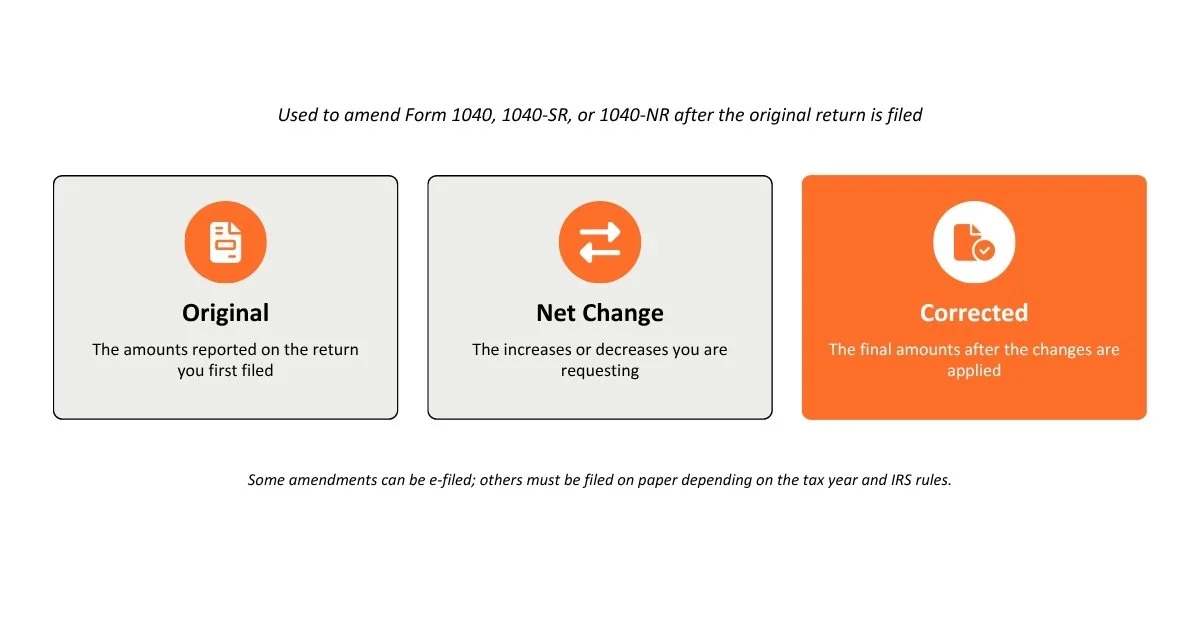
Form 1040 X is used to amend an individual federal income tax return after the original return has been filed.
The form compares:
The amounts reported on the original return
The net increases or decreases being requested
The corrected amounts after the changes
The amendment must include a clear explanation and any new or changed forms and schedules.
Form 1040 X may be used to amend Form 1040, Form 1040 SR, or Form 1040 NR. Some amendments can be filed electronically, while others must be filed on paper.
Electronic filing availability depends on the tax year, the original filing method, the type of return, and current IRS electronic filing rules.
Amending a California Income Tax Return

California individual income tax returns are generally amended by filing a complete California return for the affected year, marking it as amended, and attaching Schedule X.
Schedule X explains the changes and calculates the additional tax or refund resulting from the amendment.
An amended California return may be needed when:
The federal amended return affects California income or tax
The IRS changes the federal return
California income was omitted
California deductions or credits were incorrect
Residency or income allocation was reported incorrectly
State withholding or estimated payments were missing
A federal amendment does not automatically amend the California return. The California filing must be separately prepared and submitted when required.
Amending Other State Income Tax Returns

Each state has its own amended return forms, filing procedures, deadlines, and documentation requirements.
Some states require a complete corrected return. Others require an amended return schedule, explanation, or copy of the federal amendment.
A federal change may affect more than one state when the original filing involved:
A move during the tax year
A resident and nonresident return
Income earned in another state
Rental property in another state
Business or pass through income
A credit for taxes paid to another state
The federal and state amendments should be coordinated so the income, tax, payments, and credits are reported consistently.
An Amended Return Can Produce Different Results

An amended tax return does not always produce a larger refund.
The correction may result in one of three general outcomes.
The Amendment Shows an Additional Refund
An additional refund may be available when the amendment reduces tax or adds a payment, deduction, or credit.
Refund claims are subject to filing deadlines and limitations.
For federal purposes, a claim for refund generally must be filed within three years after the original return was filed or within two years after the tax was paid, whichever period ends later. Special rules and exceptions may apply.
State refund claim periods can be different.
The Amendment Shows an Additional Balance
An amendment may increase the amount of tax owed when income was omitted, a deduction was overstated, or a credit was claimed incorrectly.
Interest and possible penalties may apply when additional tax was not paid by the original payment deadline.
Paying the additional tax sooner may reduce further interest, but the amount and payment options should be reviewed before submission.
The Amendment Does Not Change the Tax
Some corrections change tax forms or carryover information without changing the tax for the amended year.
For example, a correction may affect basis, depreciation, passive losses, or another amount carried to a future return.
These amendments can still be important because the corrected information may affect a later tax year.
Documents Needed to Prepare an Amended Tax Return

The amendment must begin with the return that was actually filed.
Please provide:
The complete original federal income tax return
The complete original state income tax returns
Any previously amended returns for the same year
Forms W 2
Forms 1099
Schedule K 1 forms
Corrected tax documents
IRS or state tax notices
Documents supporting new deductions or credits
Dependent information
Business income and expense records
Rental property records
Brokerage statements
Cost basis records
Proof of federal and state tax payments
The reason you believe the return needs to be changed
Returns filed after the amended year may also be needed when the change affects carryovers, depreciation, basis, or another continuing tax item.
Our Amended Tax Return Preparation Process

Step 1, Review the Original Tax Return
I begin by reviewing the complete federal and state returns that were filed.
This establishes the original amounts and helps identify every schedule affected by the proposed change.
Step 2, Review the New or Corrected Information
We compare the new documents with the original return.
This step determines whether an amendment is needed and whether the change affects federal, state, or later year returns.
Step 3, Recalculate the Affected Tax Items
The affected income, deductions, credits, taxes, and payments are recalculated.
A change to one item may affect several parts of the return, so the amendment should not be based only on the document that triggered the review.
Step 4, Prepare the Federal and State Amendments
We prepare Form 1040 X and the affected forms and schedules when a federal amendment is required.
Related state amended returns are prepared when the federal change or a separate state issue affects those filings.
Step 5, Review the Results With You
You will receive the drafted amended returns for review.
We explain the reason for the amendment, the changes made, and whether the return shows an additional refund, balance, or no change in tax.
Step 6, Sign and Submit the Amended Returns
After you approve the returns, you will sign the required authorization forms.
Eligible amended returns may be filed electronically. Other amendments may need to be printed, signed, and mailed.
Step 7, Monitor the Amended Return
Amended returns require additional processing time because the tax agency must review the requested changes.
Federal amended return status may generally be checked using the IRS Where’s My Amended Return tool after the return enters the IRS system.
State tracking options vary by state.
Common Amended Tax Return Mistakes
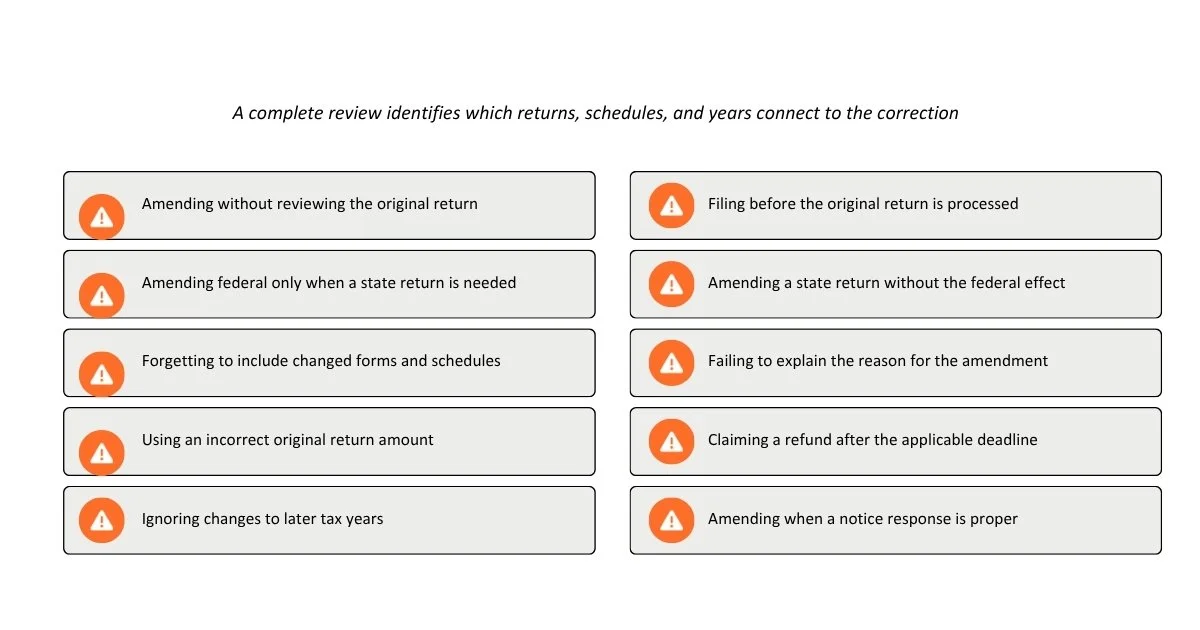
Common problems include:
Preparing the amendment without reviewing the original return
Filing before the original return has been processed
Amending only the federal return when a state amendment is also required
Amending a state return without considering the federal effect
Forgetting to include changed forms and schedules
Failing to explain the reason for the amendment
Using an incorrect original return amount
Claiming a refund after the applicable deadline
Ignoring changes to later tax years
Filing an amendment when a tax notice response is the proper procedure
Sending a second amendment before the first amendment is processed
A complete review helps identify which returns, schedules, and tax years are connected to the correction.
Amended Tax Return Preparation From Orange County

Orange Coast Tax prepares federal and state amended income tax returns for clients in Orange County and throughout the United States.
Our secure client portal allows you to upload the original returns, corrected tax documents, notices, and supporting records.
You can also use the portal to review the drafted amendments, sign filing authorizations, receive updates, and access the completed returns.
Frequently Asked Questions
-
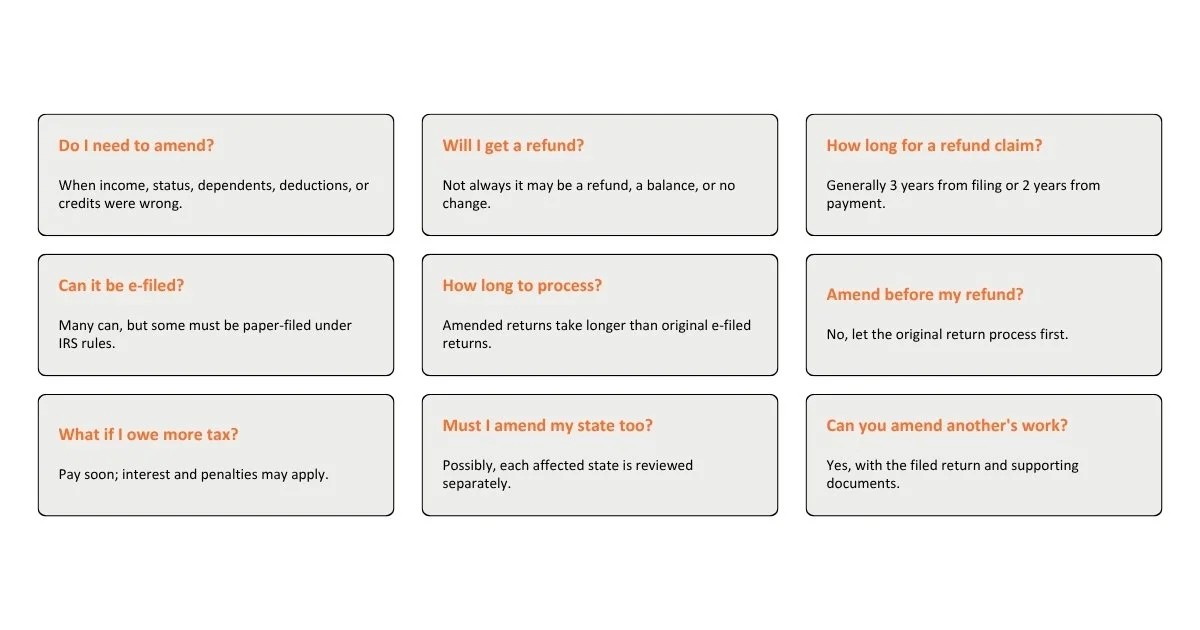
You may need to amend when income, filing status, dependents, deductions, credits, or other tax information was omitted or reported incorrectly.
A review should be completed before filing because some errors are corrected by the tax agency or handled by responding to a notice.
-
Not necessarily.
An amendment may produce an additional refund, an additional balance, or no change in tax. The result depends on the correction and how it affects the complete return.
-
For federal purposes, a refund claim generally must be filed within three years after the original return was filed or within two years after the tax was paid, whichever period ends later.
Special rules and exceptions may apply. State refund deadlines can be different.
-
Many federal amended individual income tax returns can be filed electronically, but eligibility depends on the tax year, return type, original filing method, and current IRS rules.
Some amended returns must still be filed on paper. State electronic filing rules vary.
-
Amended returns generally take longer to process than original electronically filed returns.
Processing time depends on the tax agency, tax year, filing method, amendment details, supporting documents, and whether the return requires additional review.
-
The original return should generally be processed before an amended return is submitted.
Filing the amendment too soon can create processing problems. The status of the original return should be reviewed first.
-
The additional tax should be reviewed and paid as soon as practical.
Interest and possible penalties may apply from the original payment deadline. Filing an extension for the original return does not extend the time to pay the tax.
-
Possibly.
A state amendment may be required when the federal change affects state income, deductions, credits, tax, or another reported amount. Each affected state should be reviewed separately.
-
Yes.
I will need the complete return that was filed, all affected tax documents, and an explanation of the requested changes.
The review does not assume that the original preparer made an error. The purpose is to determine whether the filed return should be changed based on the available information.
Get Help Correcting a Federal or State Tax Return
If you believe a previously filed return contains missing or incorrect information, I can review the original filing and the documents supporting the change.
We will determine whether an amendment is appropriate, which federal and state returns are affected, and whether later tax years also need to be reviewed.