
United States Nonresident Income Tax Return Preparation
Living outside the United States does not always mean you have no United States income tax filing requirement.
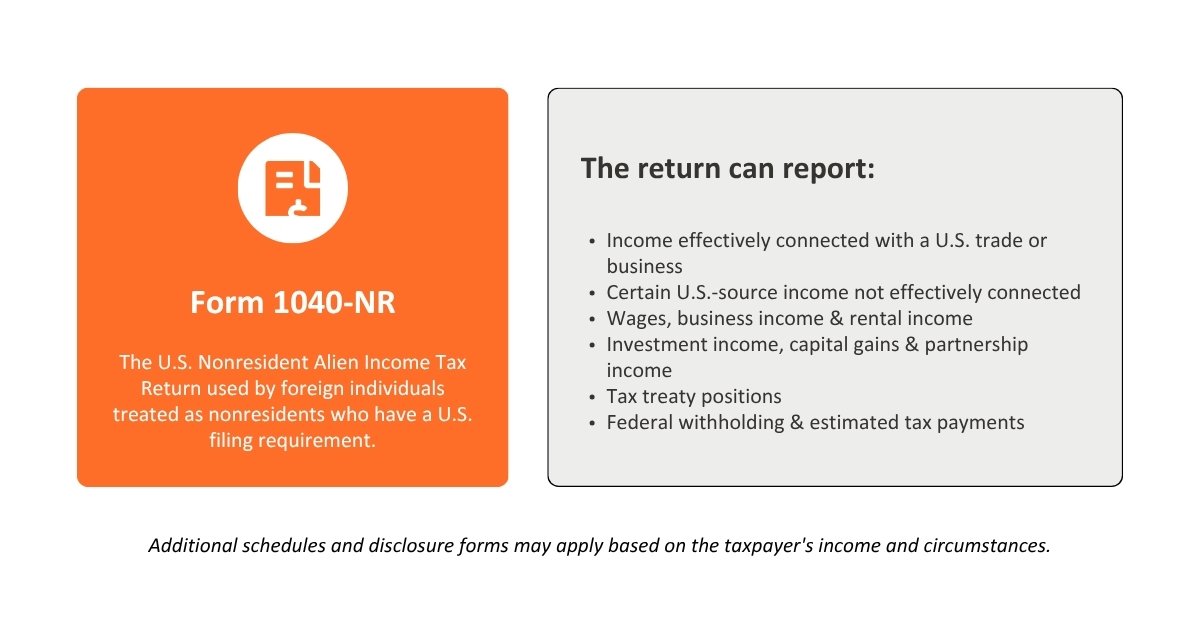
Foreign individuals may need to file Form 1040 NR when they work, operate a business, own rental property, sell United States real estate, receive partnership income, or have other income connected to the United States.
I prepare federal and state income tax returns for nonresident individuals with United States income and filing requirements.
The first step is determining whether the taxpayer is treated as a resident or nonresident for federal income tax purposes. We can then identify the income, deductions, withholding, treaty provisions, and state returns that require review.
Nonresident Income Tax Preparation Summary
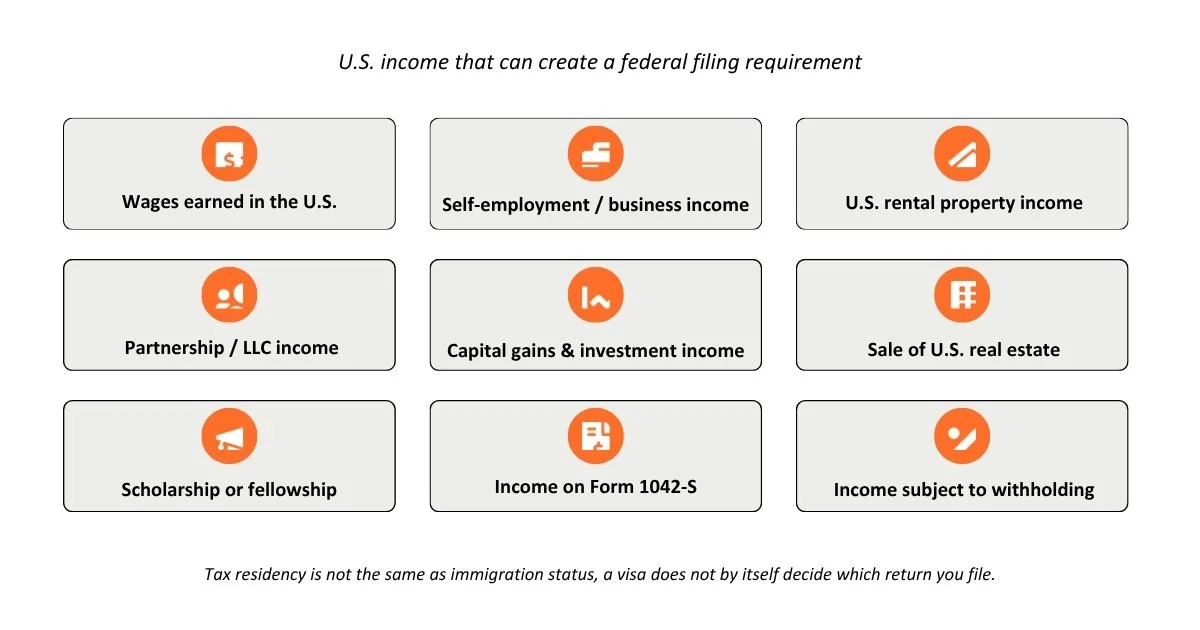
A nonresident individual may have a United States filing requirement after receiving:
Wages for services performed in the United States
Self employment or business income
Rental income from United States property
Income from a partnership or limited liability company
Capital gains connected to United States activity
Income from selling United States real estate
Scholarship or fellowship income
Pension or retirement income
Royalties
Dividends
Interest
Gambling winnings
Income reported on Form 1042 S
Income subject to federal withholding
The filing requirement and tax calculation depend on the type and source of the income.
Tax residency under federal income tax law is different from immigration status. A visa classification does not by itself determine which income tax return should be filed.
Form 1040 NR Explained
An individual’s federal income tax residency is generally determined under the green card test or the substantial presence test.
A taxpayer who meets one of these tests may be treated as a resident for federal income tax purposes unless an exception or treaty position applies.
A taxpayer who does not meet either test is generally treated as a nonresident.
The analysis may also involve:
The first year of United States residency
The final year of United States residency
Dual status tax years
Exempt individual rules
Closer connection rules
Tax treaty residency provisions
Spouse related elections
Federal tax residency should be determined before the return is prepared.
Determining Federal Tax Residency
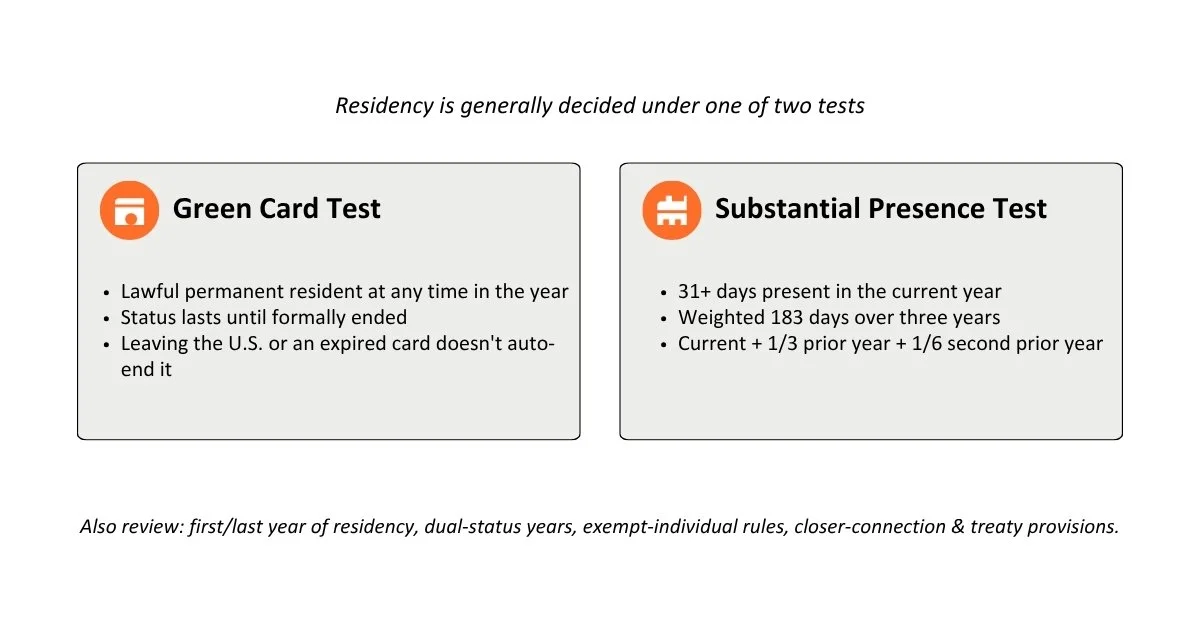
An individual’s federal income tax residency is generally determined under the green card test or the substantial presence test.
A taxpayer who meets one of these tests may be treated as a resident for federal income tax purposes unless an exception or treaty position applies.
A taxpayer who does not meet either test is generally treated as a nonresident.
The analysis may also involve:
The first year of United States residency
The final year of United States residency
Dual status tax years
Exempt individual rules
Closer connection rules
Tax treaty residency provisions
Spouse related elections
Federal tax residency should be determined before the return is prepared.
The Green Card Test
An individual generally meets the green card test when the person was a lawful permanent resident of the United States at any time during the calendar year, subject to the applicable starting and ending rules.
A green card holder may remain a United States tax resident until the status is formally abandoned, revoked, or otherwise terminated under the applicable rules.
Leaving the United States or allowing a physical card to expire does not necessarily end federal tax residency.
Immigration advice should be obtained from a qualified immigration attorney when needed.
The Substantial Presence Test
The substantial presence test generally considers the number of days an individual was physically present in the United States during a three year period.
The test generally requires:
At least 31 days of presence during the current year
A weighted total of at least 183 days during the current year and two preceding years
The calculation generally counts:
All qualifying days in the current year
One third of qualifying days in the first preceding year
One sixth of qualifying days in the second preceding year
Certain days may be excluded under specific federal rules.
Travel dates, visa status, and the reason for presence should be documented.
Exempt Individuals and Excluded Days
The term exempt individual does not necessarily mean the person is exempt from federal income tax.
It generally means certain days of physical presence may be excluded when calculating the substantial presence test.
The rules may apply to certain:
Students
Teachers
Trainees
Professional athletes
Foreign government related individuals
Individuals unable to leave because of a qualifying medical condition
The category, visa, number of prior years, and required forms must be reviewed.
Form 8843
Form 8843 is used by certain foreign individuals to explain why days of presence are excluded from the substantial presence test.
The form may be required even when the individual has no income and is not required to file Form 1040 NR.
When Form 1040 NR is required, Form 8843 is generally attached to the return.
Students, teachers, and trainees should not assume their school or program files Form 8843 for them.
Closer Connection Exception
An individual who meets the day count requirements may still qualify for a closer connection exception in certain circumstances.
The exception generally requires a closer connection to a foreign country and compliance with specific presence, tax home, immigration, and filing requirements.
Form 8840 may be required by the applicable deadline.
The exception is not available in every situation and should not be claimed without reviewing all requirements.
Dual Status Income Tax Returns
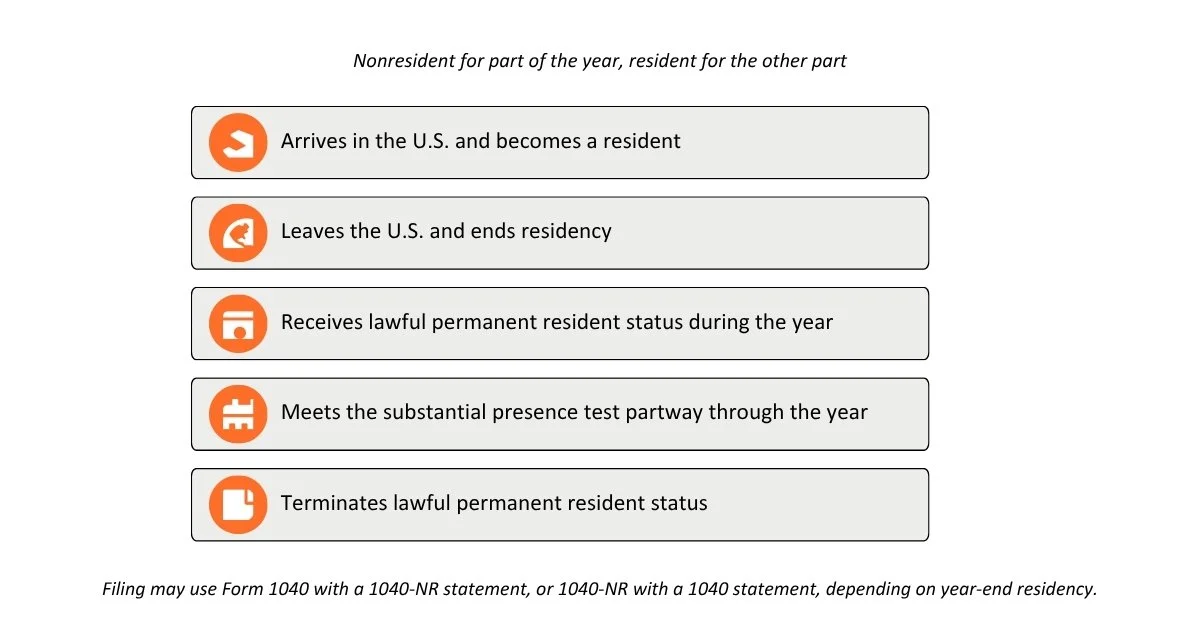
A person can be a nonresident during part of the year and a resident during another part of the same year.
This is commonly called a dual status tax year.
A dual status return may occur when someone:
Arrives in the United States and becomes a resident
Leaves the United States and ends residency
Receives lawful permanent resident status during the year
Meets the substantial presence test partway through the year
Terminates lawful permanent resident status
A dual status filing is different from a standard joint or resident return.
The taxpayer may need Form 1040 with a Form 1040 NR statement, or Form 1040 NR with a Form 1040 statement, depending on residency at the end of the year.
Income, deductions, filing status, and tax credits may be limited or divided between the resident and nonresident periods.
United States Source Income
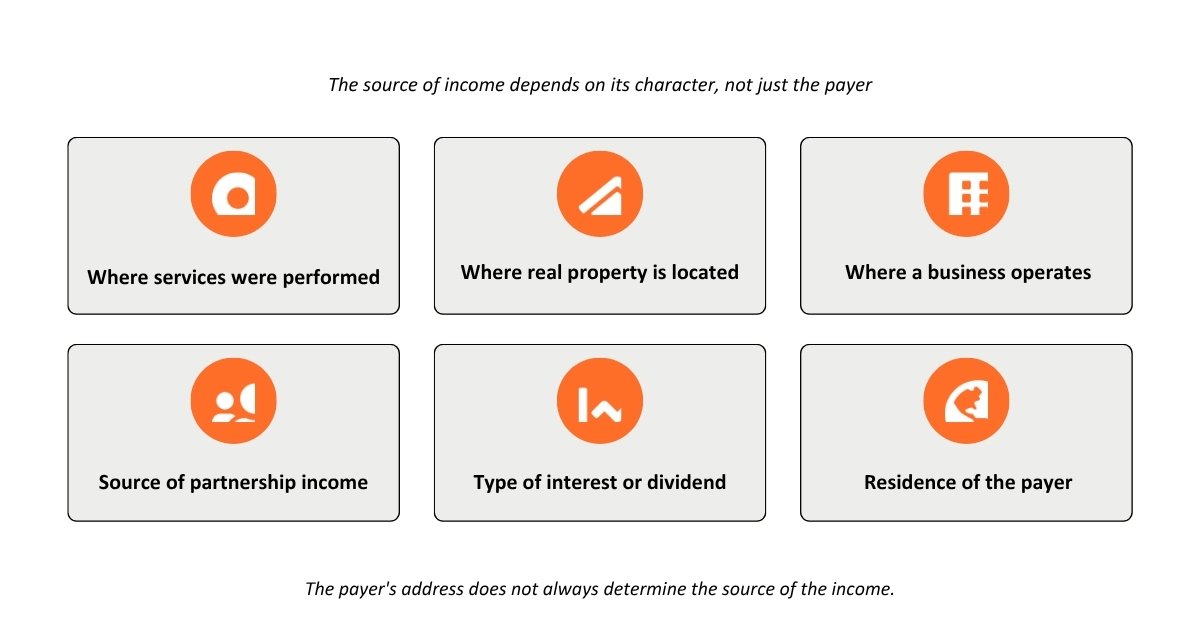
A nonresident is generally taxed on certain income from United States sources and income effectively connected with a United States trade or business.
The source of income depends on its character.
Possible sourcing factors include:
Where services were physically performed
Where real property is located
Where a business operates
The residence of the payer
The type of interest or dividend
Where property was used
Where inventory was produced or sold
The source of partnership income
The taxpayer’s presence in the United States
The payer’s address does not always determine the source of the income.
Effectively Connected Income
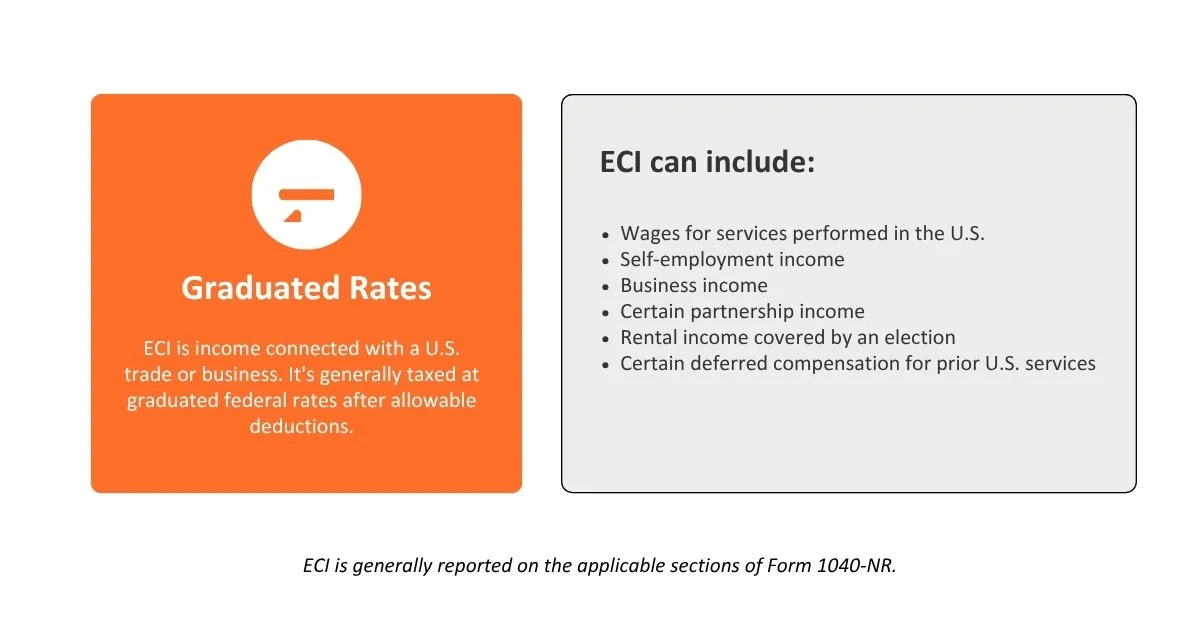
Effectively connected income generally includes income connected with the conduct of a trade or business in the United States.
This can include:
Wages for services performed in the United States
Self employment income
Business income
Certain partnership income
Rental income covered by an election
Certain deferred compensation connected to prior United States services
Effectively connected taxable income is generally taxed using graduated federal income tax rates after allowable deductions.
The income is generally reported on the applicable sections of Form 1040 NR.
Fixed or Determinable Annual or Periodic Income
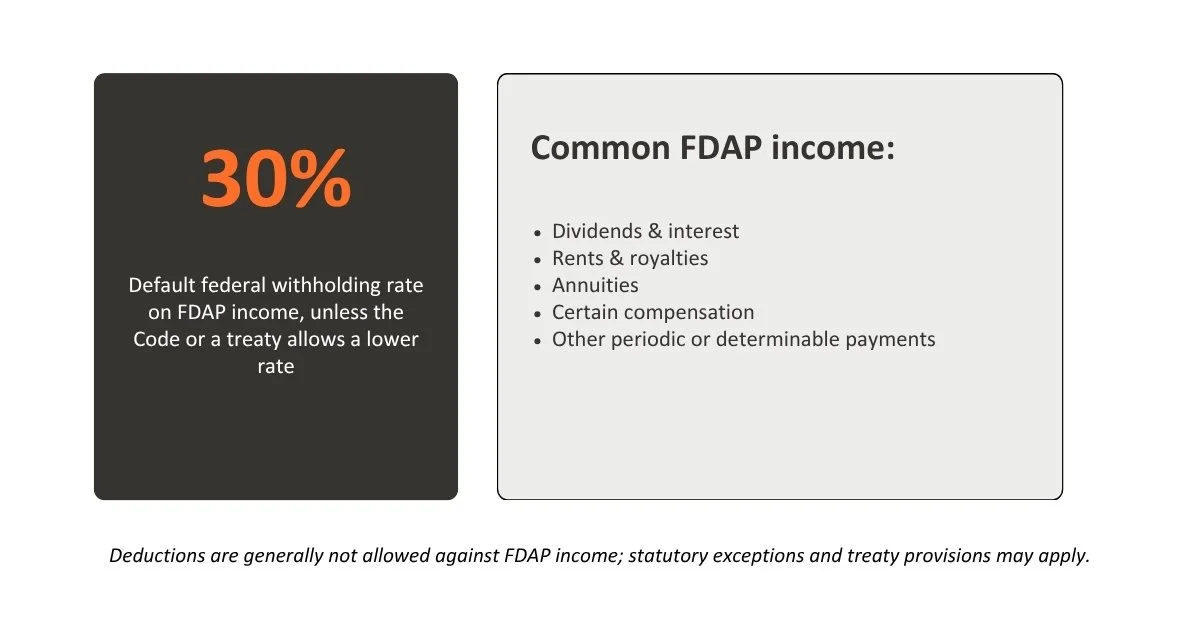
Certain United States source income that is not effectively connected with a United States trade or business may be treated as fixed or determinable annual or periodic income.
Possible examples include:
Dividends
Interest
Rents
Royalties
Annuities
Certain compensation
Other periodic or determinable payments
This income may be subject to federal withholding at 30 percent or a lower rate when an Internal Revenue Code provision or applicable income tax treaty allows it.
Deductions generally are not allowed against income taxed under these rules.
Not every dividend, interest payment, or capital gain received by a nonresident is taxed the same way. Statutory exceptions and treaty provisions may apply.
Wages for Services Performed in the United States
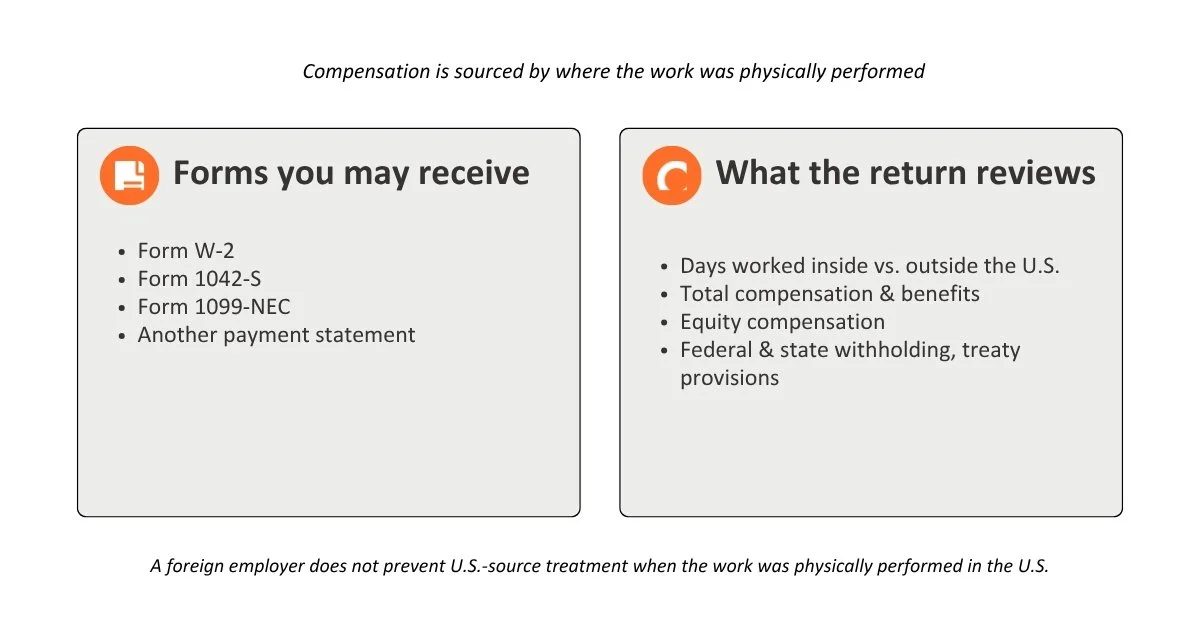
Compensation is generally sourced based on where the services were physically performed.
A nonresident who works in the United States may receive:
Form W 2
Form 1042 S
Form 1099 NEC
Another payment statement
The tax return may need to review:
Days worked inside the United States
Days worked outside the United States
Total compensation
Employer provided benefits
Equity compensation
Federal tax withholding
State tax withholding
Tax treaty provisions
A foreign employer does not automatically prevent wages from being United States source income when the work was physically performed in the United States.
Self Employment and Business Income
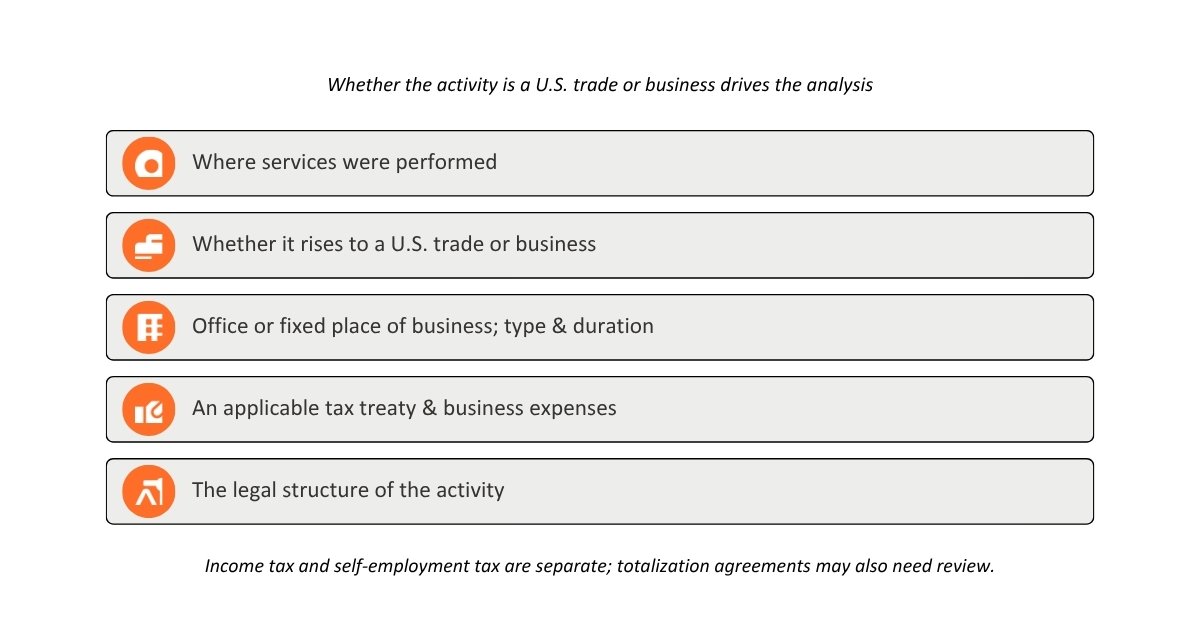
A foreign individual who operates a business or performs independent services in the United States may have effectively connected income.
The analysis can depend on:
Where services were performed
Whether the activity rises to the level of a United States trade or business
The type and duration of the activity
The location of an office or fixed place of business
An applicable tax treaty
Business expenses
The legal structure
Income tax and self employment tax are separate issues. A nonresident may be exempt from federal self employment tax in some circumstances, but the income may still be subject to federal income tax.
Social Security totalization agreements may also require review.
United States Rental Property Income
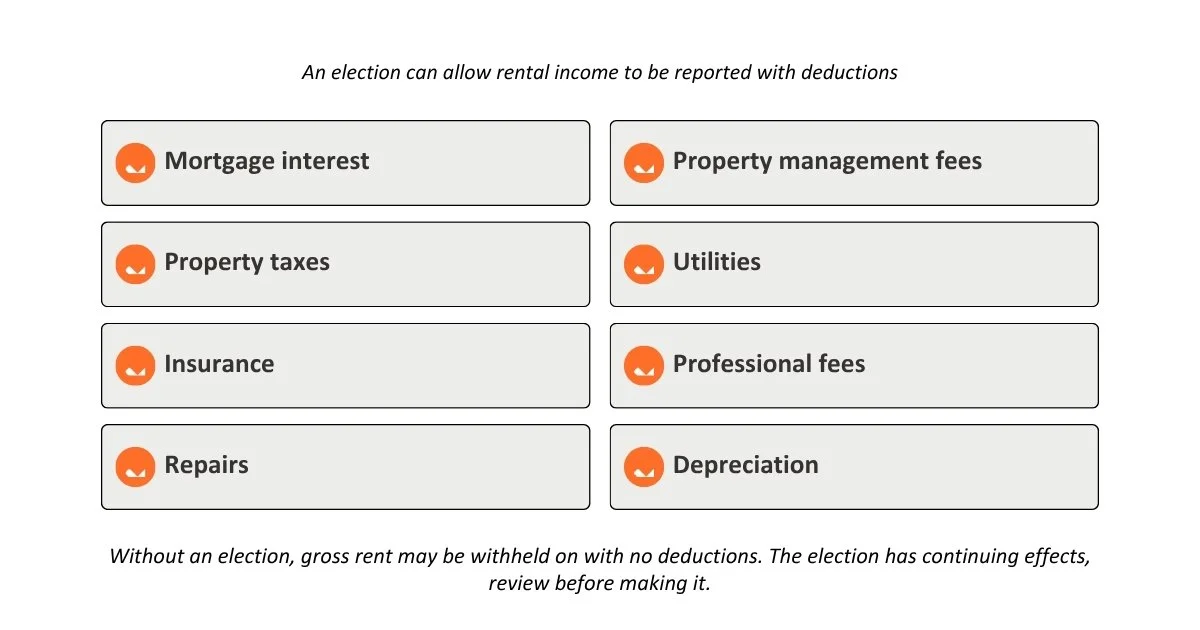
A nonresident who owns rental property located in the United States may have a federal and state filing requirement.
Without an applicable election, gross rental income may be subject to withholding without deductions.
A qualifying nonresident property owner may elect to treat the rental income as effectively connected with a United States trade or business.
When a valid election applies, the taxpayer may generally report rental income and allowable expenses on the applicable return schedule.
Possible rental expenses include:
Mortgage interest
Property taxes
Insurance
Repairs
Property management fees
Utilities
Professional fees
Depreciation
Travel subject to applicable rules
The election has continuing effects and should not be made without reviewing the current and future tax consequences.
Rental Property Depreciation for Nonresidents
The building portion of qualifying rental property may be depreciated over the applicable recovery period.
Land is not depreciated.
The calculation may depend on:
The purchase price
The allocation between land and building
The placed in service date
Capital improvements
Prior depreciation
Personal use
The depreciation method required for the taxpayer and property
A nonresident taxpayer may be required to use a depreciation system or recovery period different from the one commonly used by a United States resident in certain circumstances.
The complete acquisition and tax history should be reviewed.
Sale of United States Real Property
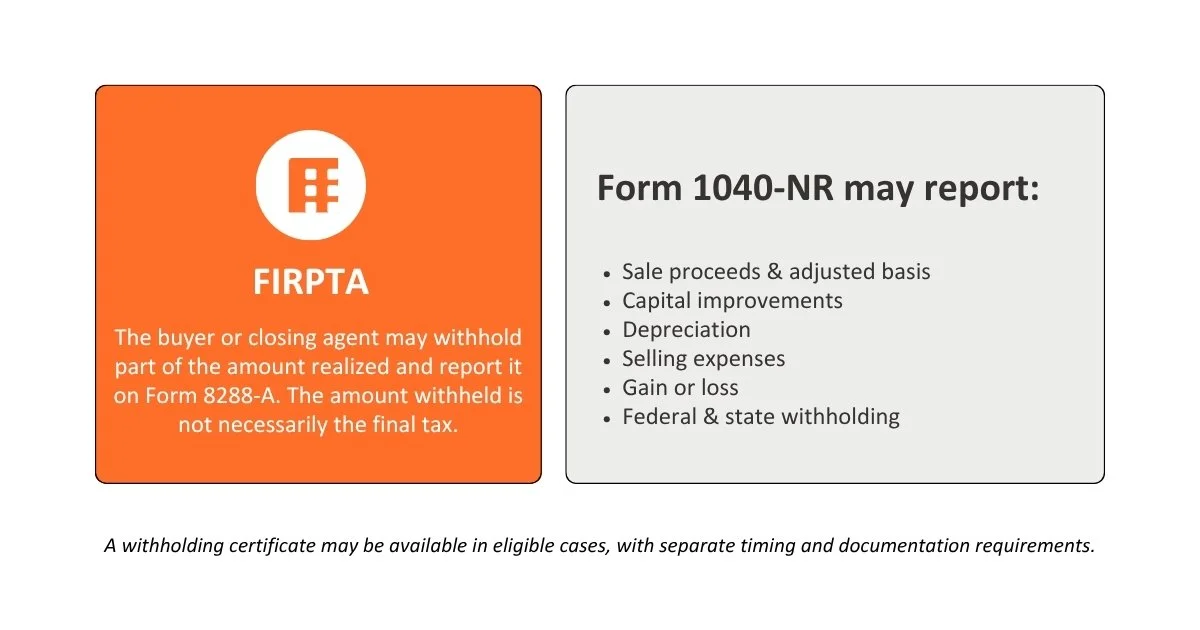
A foreign person who sells United States real property may be subject to federal income tax and federal withholding under the rules commonly known as FIRPTA.
The buyer or closing agent may withhold part of the amount realized and report the withholding on Form 8288 A.
The amount withheld is not necessarily the final income tax.
The taxpayer may need Form 1040 NR to report:
The sale proceeds
Adjusted basis
Capital improvements
Depreciation
Selling expenses
Gain or loss
Federal tax withholding
State tax withholding
A taxpayer may also apply for a withholding certificate in an eligible situation, but the application has separate timing and documentation requirements.
The closing statement, purchase records, improvement records, depreciation schedules, and withholding forms should be retained.
Partnership and Limited Liability Company Income
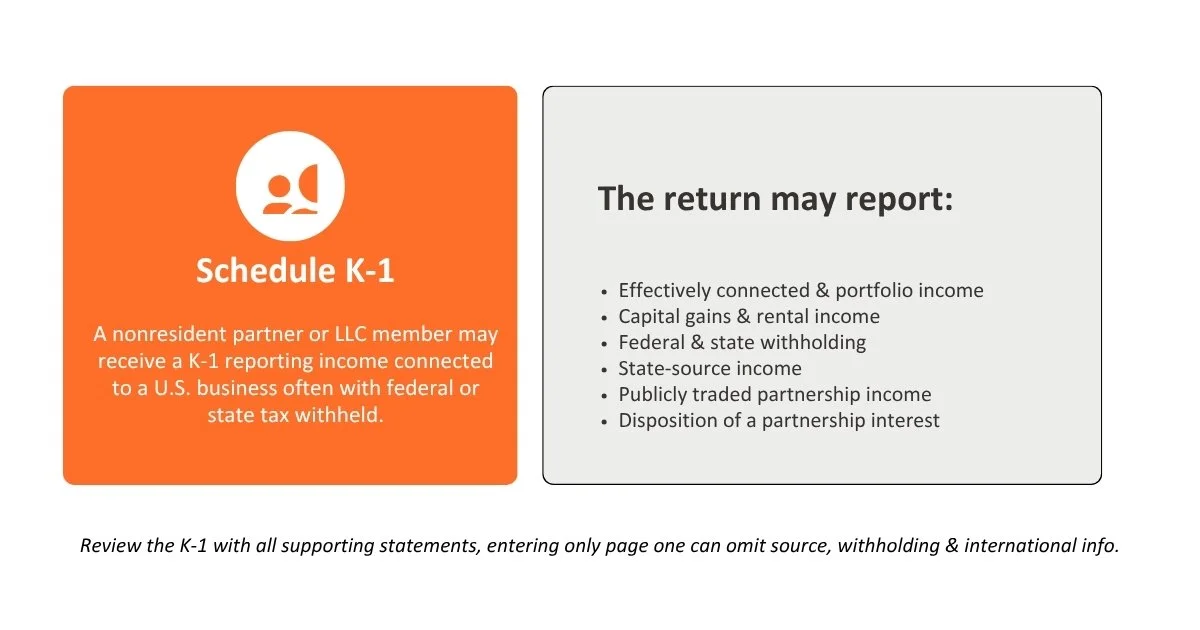
A nonresident partner or limited liability company member may receive Schedule K 1 reporting income connected to a United States business.
The partnership may also withhold federal or state tax on behalf of the foreign partner.
The individual return may need to report:
Effectively connected income
Portfolio income
Capital gains
Rental income
Federal withholding
State source income
State withholding
Publicly traded partnership income
Disposition of a partnership interest
Schedule K 1 should be reviewed with all supporting statements. Entering only the first page can omit source, withholding, and international tax information.
United States Investment Income
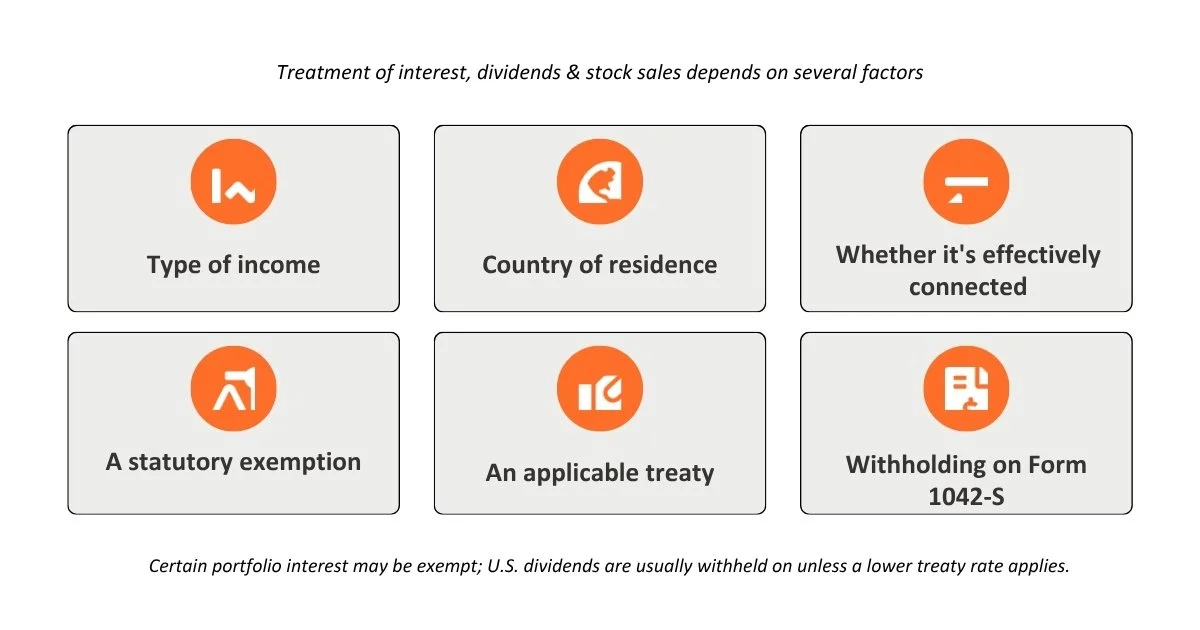
A nonresident may receive United States interest, dividends, stock sale proceeds, or other investment income.
The tax treatment can depend on:
The type of income
The payer
The taxpayer’s country of residence
Whether the income is effectively connected
An applicable statutory exemption
A tax treaty
The number of days present in the United States
Withholding shown on Form 1042 S or another tax form
Certain portfolio interest may be exempt from federal income tax when the requirements are met. United States dividends are commonly subject to withholding unless a lower treaty rate applies.
Capital gain treatment for nonresidents involves separate rules and should be reviewed using the taxpayer’s presence and activity.
Form 1042 S
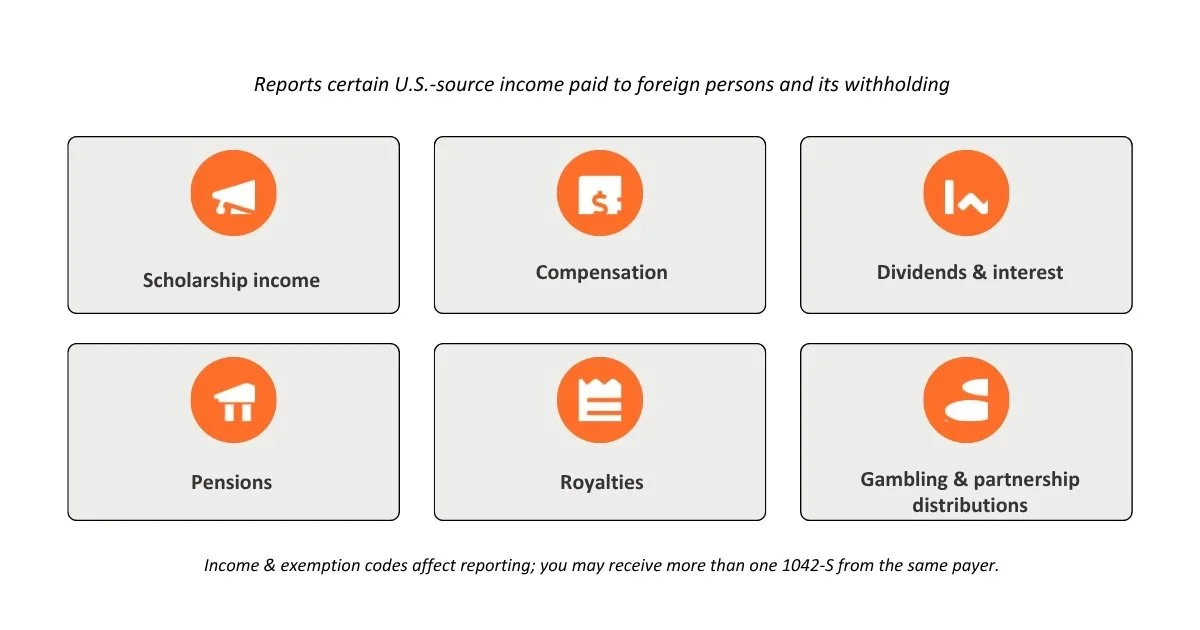
Form 1042 S reports certain United States source income paid to foreign persons and the related federal withholding.
The form may report:
Scholarship income
Compensation
Dividends
Interest
Pensions
Royalties
Gambling winnings
Partnership distributions
Other income
Form 1042 S includes income and exemption codes that affect how the payment is reported.
A taxpayer may receive more than one Form 1042 S from the same payer.
The complete forms should be provided, even when the taxpayer believes the income is exempt under a treaty.
Tax Treaty Benefits
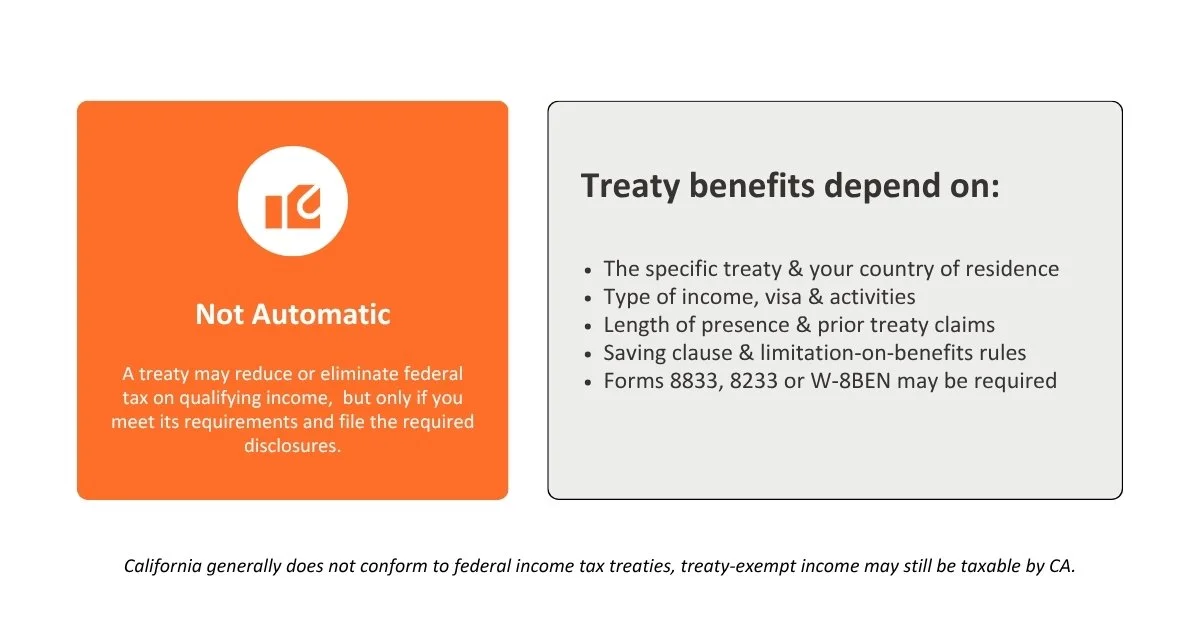
The United States has income tax treaties with many countries.
A treaty may reduce or eliminate federal tax on qualifying income, but the result depends on:
The specific treaty
The taxpayer’s country of residence
The type of income
The taxpayer’s visa and activities
The length of presence
Prior treaty claims
The saving clause
The limitation on benefits provisions
Required disclosures
Treaty benefits are not automatic.
The taxpayer must meet the applicable treaty requirements and provide the required forms or disclosures.
Form 8833 may be required for certain treaty based return positions. Other treaty claims may use Form 8233, Form W 8 BEN, Form 1040 NR, or Form 1042 S reporting.
California Does Not Follow Every Federal Tax Treaty
A federal treaty exclusion does not necessarily apply to California income tax.
California generally does not conform to federal income tax treaties unless state law separately provides the exclusion.
Income excluded from the federal return under a treaty may need to be added back on the California return.
The federal and California filings should be prepared separately under the applicable rules.
Scholarships, Fellowships, Students, and Researchers
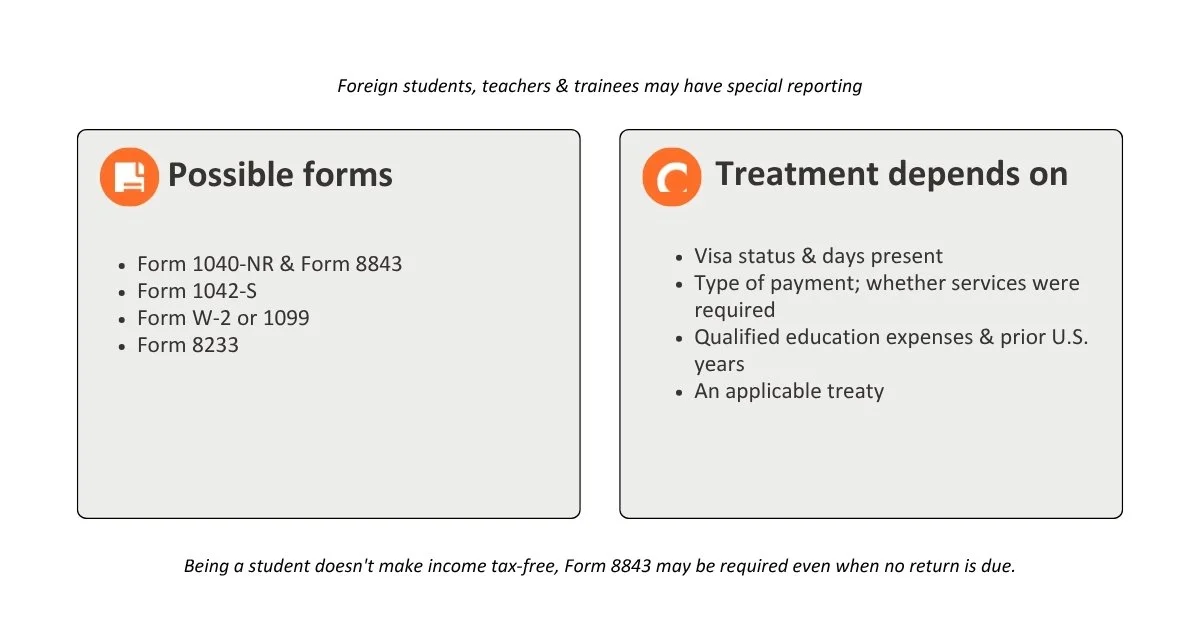
Foreign students, teachers, trainees, and researchers may have special federal tax reporting requirements.
Possible forms include:
Form 1040 NR
Form 8843
Form 1042 S
Form W 2
Form 1099
Form 8233
The tax treatment depends on:
Visa status
Days present in the United States
Type of payment
Whether services were required
Qualified education expenses
An applicable treaty
Prior years in the United States
Being a student or researcher does not automatically make all income tax free.
Form 8843 may still be required when no income tax return is due.
Individual Taxpayer Identification Numbers
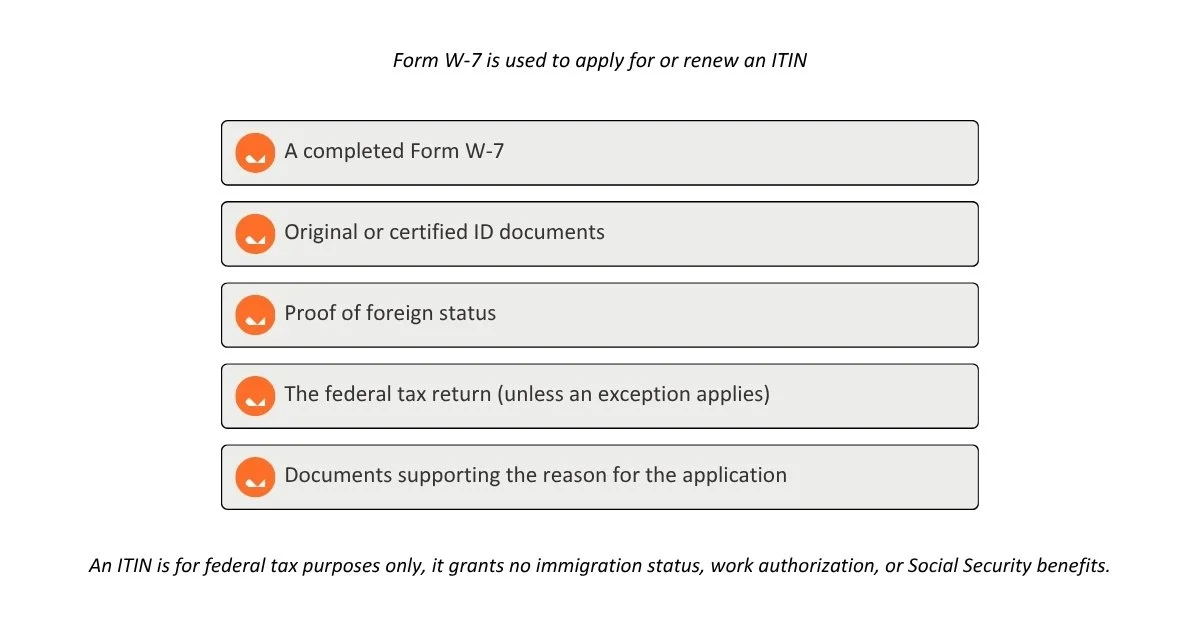
A nonresident who has a federal tax filing requirement but is not eligible for a Social Security number may need an Individual Taxpayer Identification Number.
Form W 7 is used to apply for or renew an Individual Taxpayer Identification Number.
The application generally requires:
A completed Form W 7
Original identification documents or acceptable certified copies
Proof of foreign status
The federal income tax return, unless an exception applies
Documents supporting the reason for the application
An Individual Taxpayer Identification Number is used for federal tax purposes. It does not provide immigration status, employment authorization, or eligibility for Social Security benefits.
Some applicants may use an IRS Taxpayer Assistance Center or an authorized acceptance agent rather than mailing original documents.
Federal Filing Status for Nonresidents
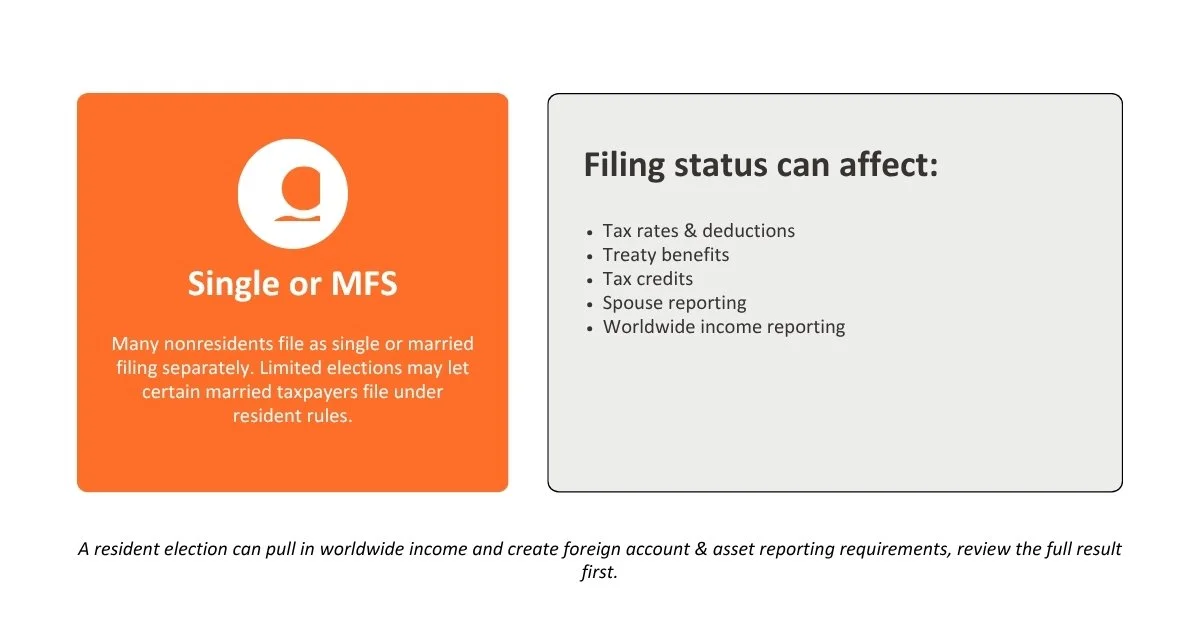
Nonresident filing status rules differ from the rules that apply to United States citizens and resident taxpayers.
Many nonresidents generally file as single or married filing separately.
Limited elections may allow certain married taxpayers to file under resident rules when the requirements are met.
Filing status can affect:
Tax rates
Deductions
Treaty benefits
Tax credits
Spouse reporting
Worldwide income reporting
An election to file as a resident can bring worldwide income into the United States tax calculation and may create foreign account and asset reporting requirements.
The complete result should be reviewed before an election is made.
Deductions and Tax Credits for Nonresidents
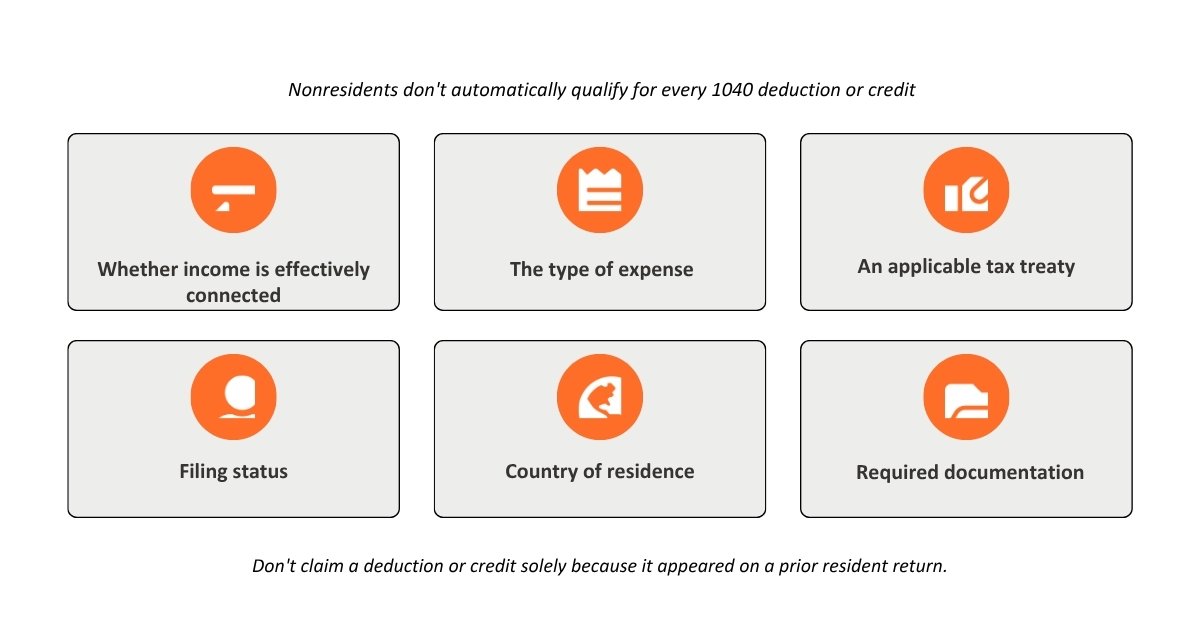
Nonresidents do not automatically qualify for every deduction and credit available on Form 1040.
Available deductions may depend on:
Whether income is effectively connected
The type of expense
An applicable tax treaty
The taxpayer’s filing status
The taxpayer’s country of residence
The required documentation
Tax credits may also be limited.
A deduction or credit should not be claimed solely because it appeared on a prior resident return.
California Nonresident Income Tax Returns

A nonresident with California source income may need to file Form 540 NR.
California source income can include:
Wages for services performed in California
Income from a California business
Rental income from California real property
Gain from selling California real property
Certain partnership or limited liability company income
Other income connected to California
California filing requirements are separate from the federal Form 1040 NR requirements.
A person can be a federal nonresident but still have a California filing requirement.
California generally does not follow federal income tax treaties, so treaty exempt federal income may remain taxable by California.
Other State Income Tax Returns
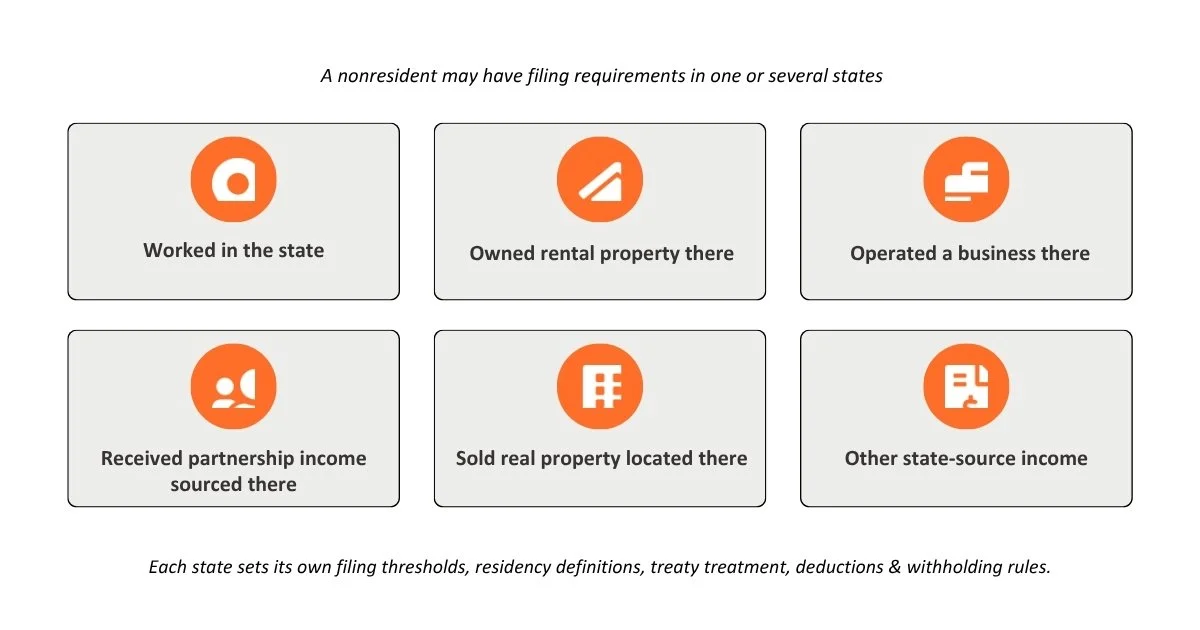
A nonresident may have filing requirements in one or several states.
A state return may be required when the individual:
Worked in the state
Owned rental property there
Operated a business there
Received partnership income sourced to the state
Sold real property located there
Received other state source income
Each state has its own filing thresholds, residency definitions, treaty treatment, deductions, and withholding rules.
Documents Needed for Nonresident Tax Return Preparation
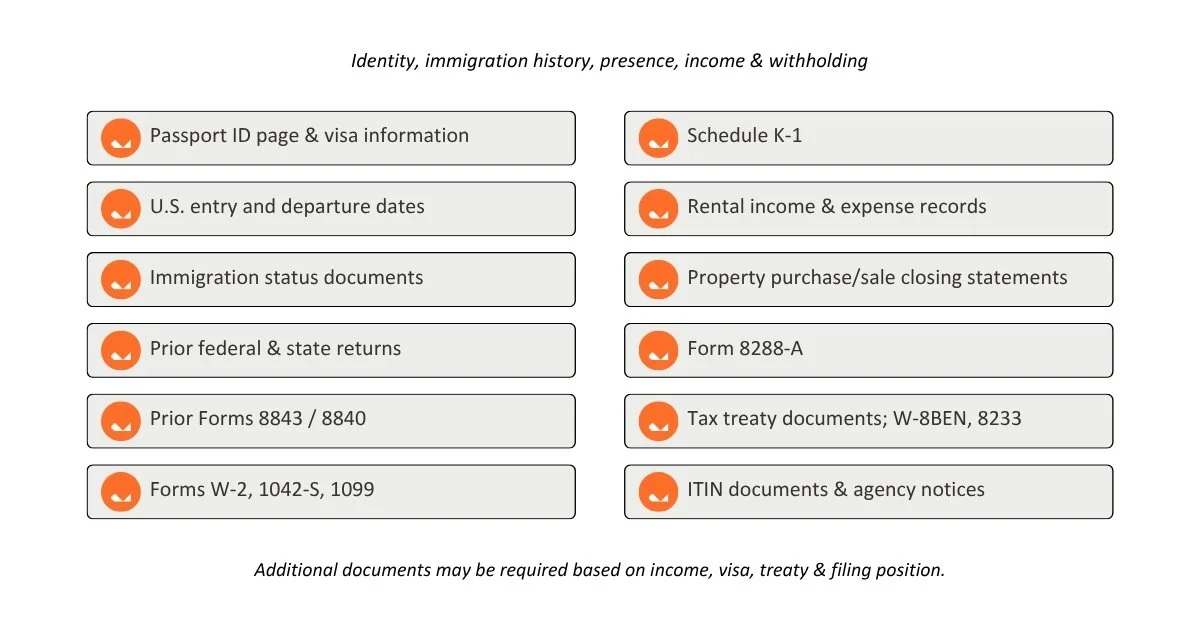
Please provide information concerning your identity, immigration history, physical presence, income, and tax withholding.
Common documents include:
Passport identification page
Visa information
United States entry and departure dates
Immigration status documents
Prior year federal and state tax returns
Prior Forms 8843
Prior Forms 8840
Forms W 2
Forms 1042 S
Forms 1099
Schedule K 1
Rental income and expense records
Property purchase and sale closing statements
Form 8288 A
Business income and expense records
Scholarship and fellowship statements
Pension and retirement statements
Tax treaty documents
Forms W 8 BEN
Forms 8233
Forms 3921 and 3922
Federal and state estimated tax payments
Individual Taxpayer Identification Number documents
Notices from the IRS or state tax agencies
Foreign address and country of tax residence
Spouse and dependent information
Information about worldwide income when a resident election or dual status return is being considered
Additional documents may be required based on the income, visa, treaty, and filing position.
Our Nonresident Tax Return Preparation Process
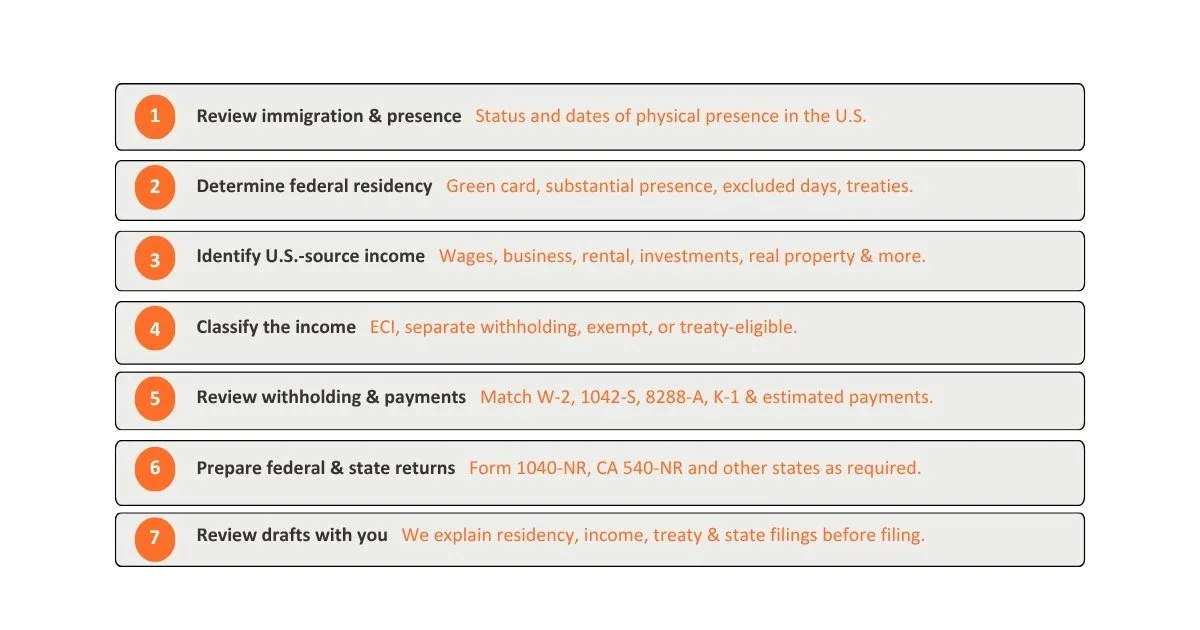
Step 1, Review Immigration and Presence Information
I begin by reviewing immigration status and the dates of physical presence in the United States.
This information is used for federal tax residency analysis. It is not an immigration law determination.
Step 2, Determine the Federal Tax Residency Status
We review the green card test, substantial presence test, excluded days, closer connection rules, and treaty provisions when applicable.
This determines whether Form 1040, Form 1040 NR, or a dual status filing may be required.
Step 3, Identify United States Source Income
Income documents and activities are reviewed to identify wages, business income, rental income, investments, partnership income, real property sales, and other United States source income.
Step 4, Classify the Income
We determine whether the income is effectively connected, subject to separate withholding rules, exempt under a federal provision, or potentially eligible for treaty treatment.
Step 5, Review Withholding and Tax Payments
Federal and state withholding shown on Forms W 2, 1042 S, 8288 A, Schedule K 1, and other documents is matched to the returns.
Estimated tax payments are also reviewed.
Step 6, Prepare the Federal and State Returns
Form 1040 NR and the applicable schedules and disclosures are prepared.
California Form 540 NR and other state returns are prepared when required.
Step 7, Review the Drafted Returns With You
You will receive the drafted returns for review before filing.
We explain the residency position, income reported, treaty treatment, withholding, and state filings.
Common Nonresident Tax Return Mistakes
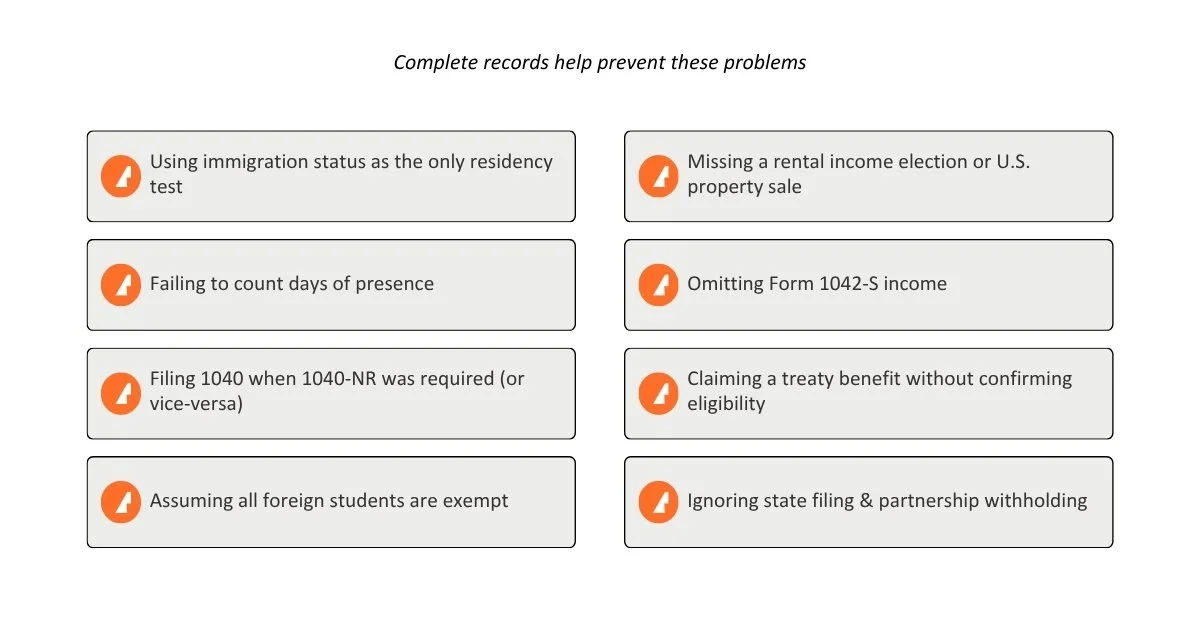
Common nonresident filing problems include:
Using immigration status as the only tax residency test
Failing to count days of presence
Failing to file Form 8843
Filing Form 1040 when Form 1040 NR was required
Filing Form 1040 NR when resident reporting was required
Ignoring dual status filing rules
Assuming all foreign students are exempt from tax
Failing to report United States rental property income
Missing a rental income election
Failing to report a United States real property sale
Omitting Form 1042 S income
Claiming a treaty benefit without confirming eligibility
Assuming California follows the federal treaty
Ignoring state income tax filing requirements
Failing to report partnership withholding
Applying for an Individual Taxpayer Identification Number without the required documents
Electing resident treatment without reviewing worldwide income reporting
Complete immigration, travel, income, and withholding records help prevent these problems.
Nonresident Tax Preparation From Orange County
Orange Coast Tax prepares federal and state income tax returns for nonresident individuals with United States income.
We assist taxpayers in the United States and abroad with Form 1040 NR, Form 8843, rental property, business income, investments, partnership income, real property sales, and state filings.
Our secure client portal allows you to upload income forms, travel records, rental documents, tax treaty information, and prior returns.
Nonresident Income Tax Return FAQs
-
Not by itself.
Visa status can affect the residency calculation, but federal tax residency generally requires review of the green card test, substantial presence test, excluded days, treaty rules, and other facts.
-
Form 1040 NR is the federal income tax return generally used by nonresident individuals with a United States filing requirement.
-
Possibly.
A return may be required to report the income, calculate the final tax, claim allowable deductions or treaty treatment, or request a refund of excess withholding.
A refund is not guaranteed.
-
It depends on the student’s income and circumstances.
A student may need Form 1040 NR and Form 8843. Form 8843 may be required even when no federal income tax return is due.
-
United States rental income may be taxable.
A qualifying election may allow the taxpayer to treat the rental income as effectively connected and report allowable expenses. The election and continuing consequences should be reviewed.
-
A nonresident who has a federal tax purpose and is not eligible for a Social Security number may need an Individual Taxpayer Identification Number.
Form W 7 and supporting identity and foreign status documents are generally required.
-
No.
Treaty treatment depends on the specific treaty, country, type of income, presence, visa, and other requirements. A disclosure form may also be required.
-
California generally does not conform to federal income tax treaties.
Income excluded from the federal return may remain taxable by California when it is California source income.
-
Possibly.
A California return may be required when a nonresident has California source income, such as California rental property, business income, services performed in California, or the sale of California real property.
-
Yes.
Our secure client portal allows clients outside the United States to provide documents, review the drafted returns, sign eligible forms, and receive completed tax documents.
Get Help Preparing Your Nonresident Income Tax Return
Nonresident tax preparation begins with determining the correct federal tax residency and identifying United States source income.
I can review your presence, income, withholding, rental property, business activity, investment income, treaty position, and state filing requirements.
Provide your travel, immigration, income, and withholding documents, and we will identify the additional information needed to prepare your federal and state income tax returns.