What to Do When Your CPA or Tax Preparer Retires or Passes Away

Losing the tax preparer who has handled your returns for years, sometimes decades, is unsettling even when you saw it coming. Whether your CPA has retired, sold the practice, or passed away, you are left holding two problems at once: finding someone new you can trust, and making sure years of records, depreciation schedules, and basis calculations do not disappear in the transition. Here is what to do in the first few weeks, what typically happens to a preparer's client files, how long you should hold on to your own copies, and how to evaluate whoever comes next.
First Steps When Your Preparer Is No Longer Available

If your preparer retired or sold the practice
- Ask directly whether the practice was sold, merged into another firm, or simply closed. This determines where your file physically goes.
- Request in writing that your complete file, prior-year returns, K-1s, depreciation schedules, and basis worksheets, be sent to you or forwarded to your new preparer.
- Get copies before the office closes for good. Once staff disperses, requests take longer or go unanswered.
If your preparer passed away
- Responsibility for returning client files typically falls to a surviving partner in the firm, or, if the preparer was a sole practitioner, to the executor of their estate.
You do not need to contact the IRS yourself to report the death. The IRS Return Preparer Office checks preparer records monthly and updates a deceased preparer's PTIN status automatically. Closing out the preparer's power-of-attorney authority (Form 2848 or 8821) requires a written request to the CAF unit from a surviving firm member or the estate's executor, not from clients.
Source: IRS.gov, Frequently Asked Questions: Deceased Tax Professionals.
- If a filing deadline is approaching and you have not lined up a new preparer, file for an extension yourself (federal Form 4868, California FTB Form 3519) rather than risk missing it while the estate is sorted out.

What Usually Happens to a Retiring or Deceased Preparer's Client List
Most solo and small-firm practices do not have an internal successor standing by. More often, the retiring preparer, or their surviving family, ends up selling the client list and practice goodwill to another local firm, sometimes within weeks, sometimes not for months. During that gap, files can sit untouched. Once a sale does happen, clients typically get a letter announcing the transfer, with no guarantee the new firm has experience with your specific situation, whether that is rental real estate, an S corporation, or crypto transactions. That is why it is worth being proactive rather than waiting to be reassigned: contact the old office directly, ask what is happening to the files, and request your own copies while someone is still there to provide them.
How Long to Keep Your Own Tax Records (California Adds a Wrinkle)

This is the moment people usually discover they only have two or three years of returns on hand. A few benchmarks worth knowing:
- IRS general rule: the standard window to assess additional tax is three years from filing. That window extends to six years if you omitted more than 25% of your income, and there is no limit at all if a return was never filed or was fraudulent.
Source: IRC §6501; IRS Topic 305, Recordkeeping.
- California is stricter on the front end: the FTB's statute of limitations to assess additional tax is four years, one year longer than the IRS, and like the IRS, there is no limit if a return was never filed.
Source: FTB.ca.gov, Keeping Your Tax Records.
- For rental property, investment real estate, or a business, keep depreciation schedules, cost basis records, and 1031 exchange documentation for as long as you own the asset, plus the standard lookback period after you sell.
Our standing recommendation for clients: keep a minimum of seven years of full returns and supporting documents, longer for property you still own. If a former preparer's office is closing, this is the moment to request everything. Preparers have their own file-retention obligations, and once those years pass, files are often destroyed as a matter of course.
Understanding Tax Preparer Credentials: CPA, EA, and CTEC
Not every "tax preparer" has the same training or authority, and the differences matter more once you are starting over with someone new.
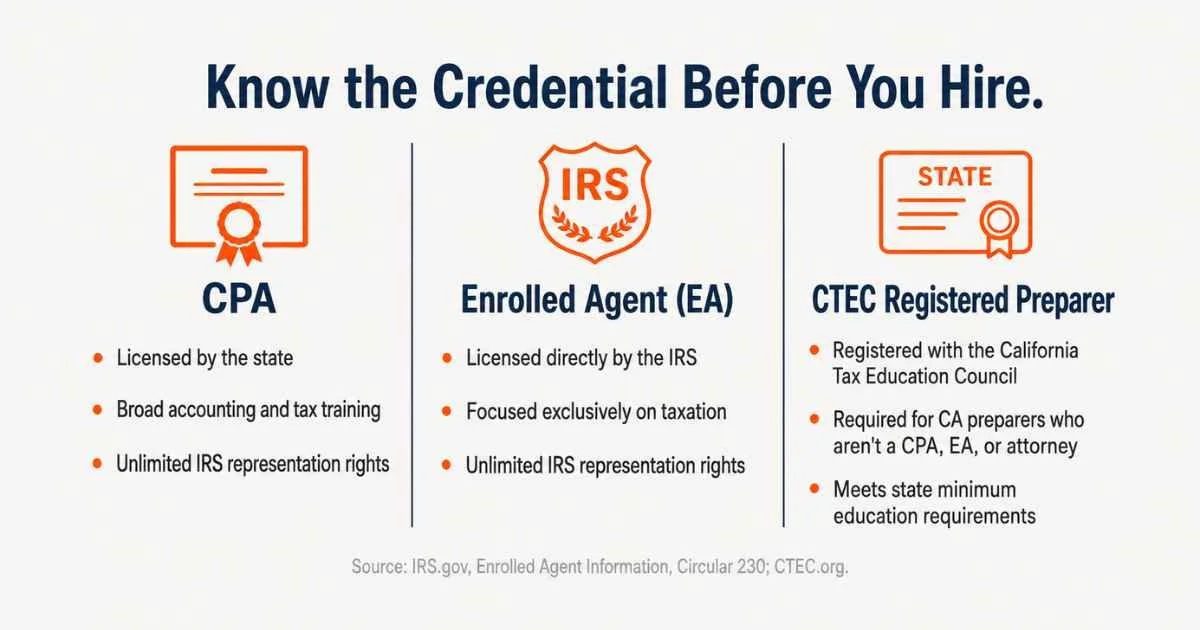
- CPA (Certified Public Accountant): licensed by the state, broad training across accounting and tax, can represent you before the IRS with no restrictions.
- EA (Enrolled Agent): licensed directly by the IRS rather than a state, and focused exclusively on taxation. Like a CPA, an EA has unlimited rights to represent you before the IRS in audits, appeals, and collections.
Source: IRS.gov, Enrolled Agent Information; Circular 230.
- CTEC-Registered Preparer: California requires anyone who prepares tax returns for compensation and is not a CPA, EA, or attorney to register with the California Tax Education Council, completing minimum education and bonding requirements the state sets and monitors.
Source: CTEC.org; Cal. Bus. & Prof. Code §22250 et seq. — VERIFY current code section before publish.
If you are comparing preparers, ask to see the credential, not just the title on a business card. A CTEC badge in California means the preparer has met the state's registration bar; it is worth confirming for anyone who is not already a CPA or EA.
Questions to Ask Before You Hire Your Next Preparer
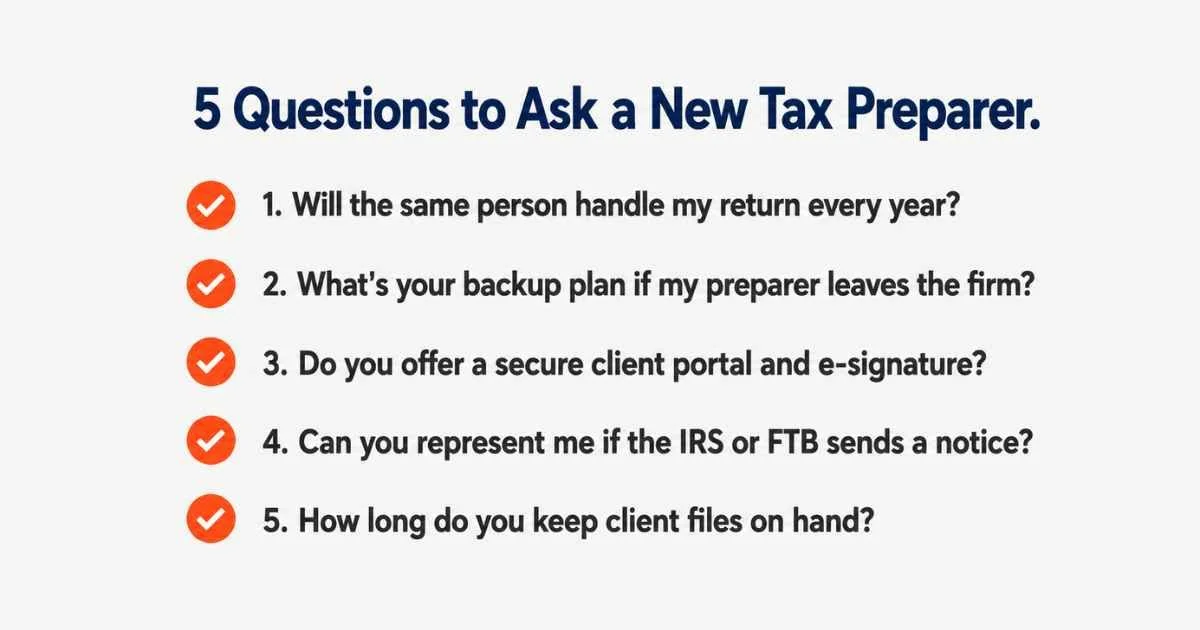
- Will the same person handle my return every year, or does it rotate between staff?
- What happens to my file if my preparer retires, gets sick, or leaves the firm? Is there a backup preparer who already knows my situation?
- Do you offer a secure client portal and e-signature, or will I be emailing PDFs of my Social Security number back and forth?
- Can you represent me directly if the IRS or California FTB sends a notice, or would I need to hire someone else for that?
- How long do you keep client files, and can I get a copy any time I need one?
Why Orange County Families and Business Owners Choose Orange Coast Tax After a Transition

Losing a preparer to retirement or death exposes a real risk: a one-person practice is a single point of failure. Orange Coast Tax is built around a bench of three credentialed preparers, Sergio Melendez (JD, EA), Jeff Pachuilo (EA), and Jennifer Kimberly (CTEC), so your file is never tied to just one person's calendar. Sergio, who leads the firm, has decades of practice ahead of him and has built the team specifically so continuity does not depend on any single individual. Every client works through a secure client portal with e-signature, so records move in and out of the firm safely, and every returning client's history stays organized and accessible rather than living in a filing cabinet that might one day sit in someone's garage. With offices in Laguna Niguel and Brea, clients across Orange County have a local team who can pick up a file mid-history and keep it moving without missing a deadline.
Frequently Asked Questions
-
No. You don't need to contact the IRS to report the death. The IRS Return Preparer Office checks preparer records monthly and automatically updates a deceased preparer's PTIN status. Closing out their power-of-attorney authority (Form 2848 or 8821) is handled by a surviving firm member or the estate's executor, not by clients.
-
The IRS can generally go back three years, six years if income was underreported by more than 25%, and California's FTB has four years. Neither limit applies if a return was never filed. Given those windows, we recommend keeping a minimum of seven years of full returns and supporting documents, longer if you still own real estate or other assets tied to depreciation or basis calculations.
-
A CPA is licensed by the state with broad training across accounting and tax. An Enrolled Agent (EA) is licensed directly by the IRS and focuses exclusively on taxation. Both have unlimited rights to represent you before the IRS. A CTEC-registered preparer is someone California requires to register with the California Tax Education Council if they aren't already a CPA, EA, or attorney, so it's worth confirming that registration if your new preparer doesn't hold one of the other two credentials.
-
Client files and goodwill are typically sold together to another local firm, sometimes within weeks of a preparer's retirement or death, sometimes not for months. You'll usually get a letter announcing the transfer, but there's no guarantee the new firm has experience with your specific situation. It's worth contacting the old office directly and requesting your own copies rather than waiting to be reassigned.
-
Bring whatever you have, even if it's incomplete: your last two to three years of filed returns, any K-1s, depreciation schedules, cost basis records for property you own, and prior correspondence with the IRS or FTB if any exists. A good preparer can tell you what's missing and help track it down from there.