Forming an LLC changes your legal liability protection. By default, it does nothing to your federal tax treatment. That surprises a lot of new single-member LLC owners, who assume the LLC itself becomes a separate tax entity the moment it's formed. The IRS doesn't see it that way. Here's what actually happens to your taxes when you form a single-member LLC, and what you still need to keep track of.
What Is a Single-Member LLC, Tax-Wise?
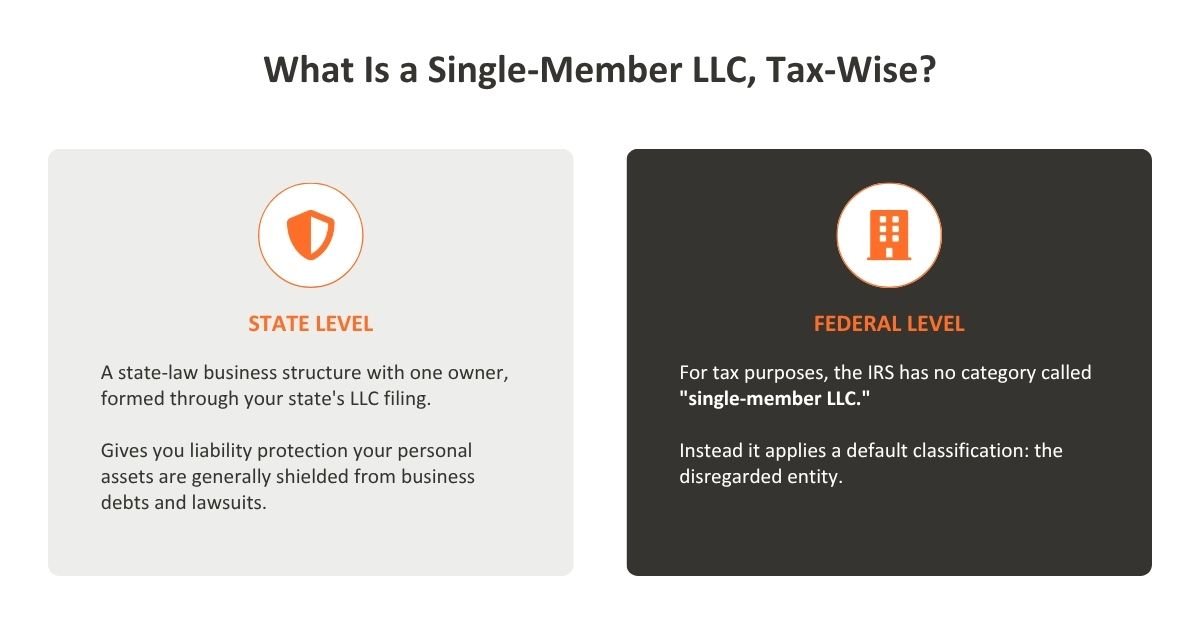
A single-member LLC is a state-law business structure, one owner, formed through your state's LLC filing process. It gives you liability protection, meaning your personal assets are generally shielded from business debts and lawsuits. But that protection exists at the state level. At the federal level, for tax purposes, the IRS doesn't have a category called "single-member LLC." Instead, it applies a default classification called a disregarded entity.
How Income Is Taxed
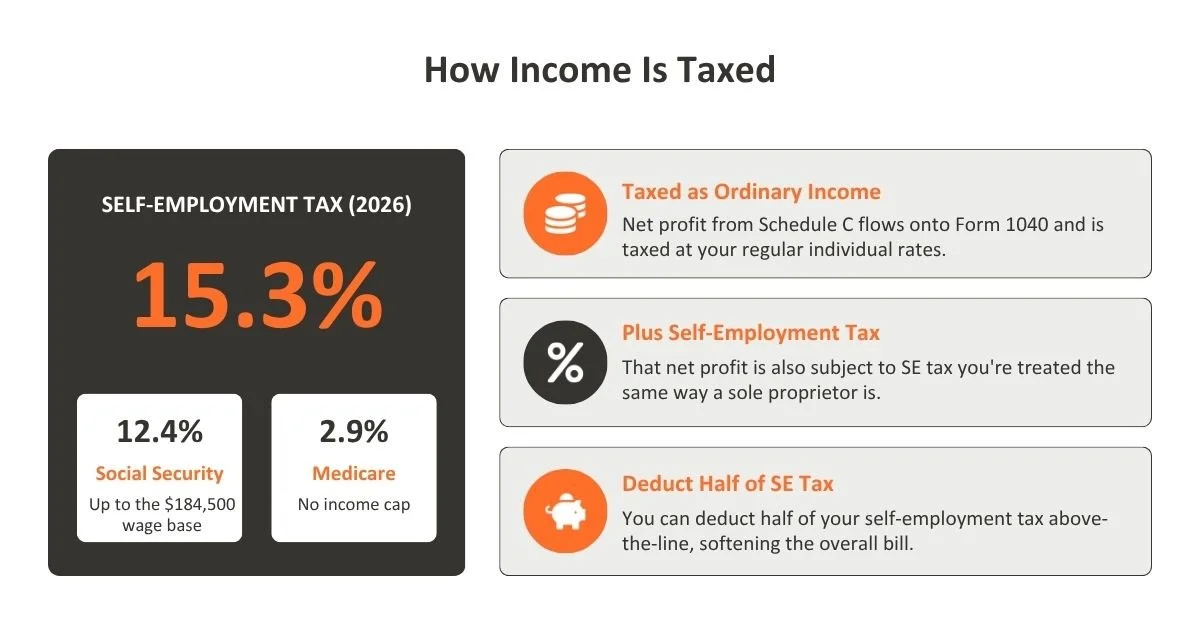
Your net profit from Schedule C flows onto your Form 1040 and gets taxed as ordinary income, at your regular individual tax rates. On top of income tax, that net profit is also subject to self-employment tax, which covers Social Security and Medicare, since as a single-member LLC owner you're treated the same way a sole proprietor is. Self-employment tax is 15.3 percent total for 2026, made up of 12.4 percent for Social Security, which applies up to the 2026 wage base of 184,500 dollars, and 2.9 percent for Medicare, which has no income cap. You can deduct half of your self-employment tax as an above-the-line deduction, which softens the impact somewhat on your overall tax bill.
Can a Single-Member LLC Elect a Different Tax Status?
Yes. The default disregarded entity treatment isn't mandatory. A single-member LLC can elect to be taxed as an S corporation or a C corporation instead, by filing the appropriate election with the IRS. This is a genuinely significant decision with real tax tradeoffs, particularly around self-employment tax savings once your profit reaches a certain level, and it deserves its own full explanation rather than a quick summary here. We cover exactly when that election makes sense in a dedicated post on electing S corp status for your single-member LLC.

State-Level Taxes: California Adds a Layer
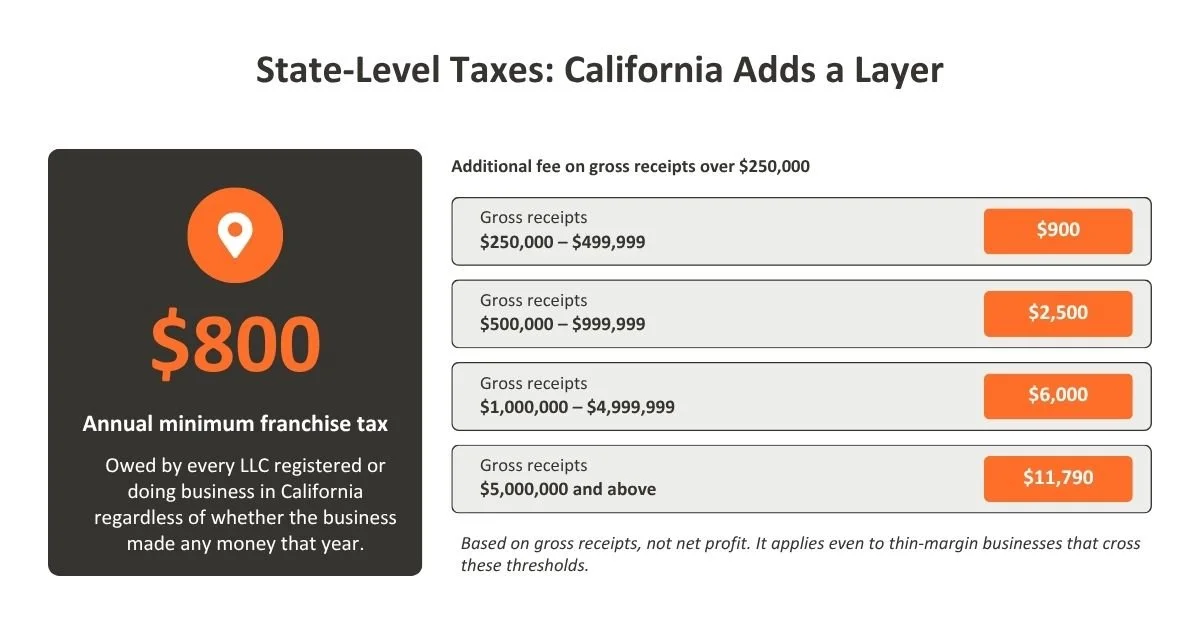
Federal disregarded entity treatment doesn't mean the state ignores your LLC too. California is a good example of where these diverge significantly. Every LLC registered or doing business in California owes an 800 dollar annual minimum franchise tax to the Franchise Tax Board, regardless of whether the business made any money that year. This applies even though the LLC is a disregarded entity for federal purposes.
On top of that 800 dollar minimum, California LLCs with gross receipts over 250,000 dollars owe an additional fee on a sliding scale: 900 dollars for receipts between 250,000 and 499,999 dollars, 2,500 dollars between 500,000 and 999,999 dollars, 6,000 dollars between 1,000,000 and 4,999,999 dollars, and 11,790 dollars at 5,000,000 dollars and above. This fee is based on gross receipts, not net profit, so it applies even to a business with thin margins if its revenue crosses these thresholds. We go into the full mechanics, deadlines, and filing forms in our dedicated post on California franchise tax for single-member LLCs.
What Records and Filings You Still Need
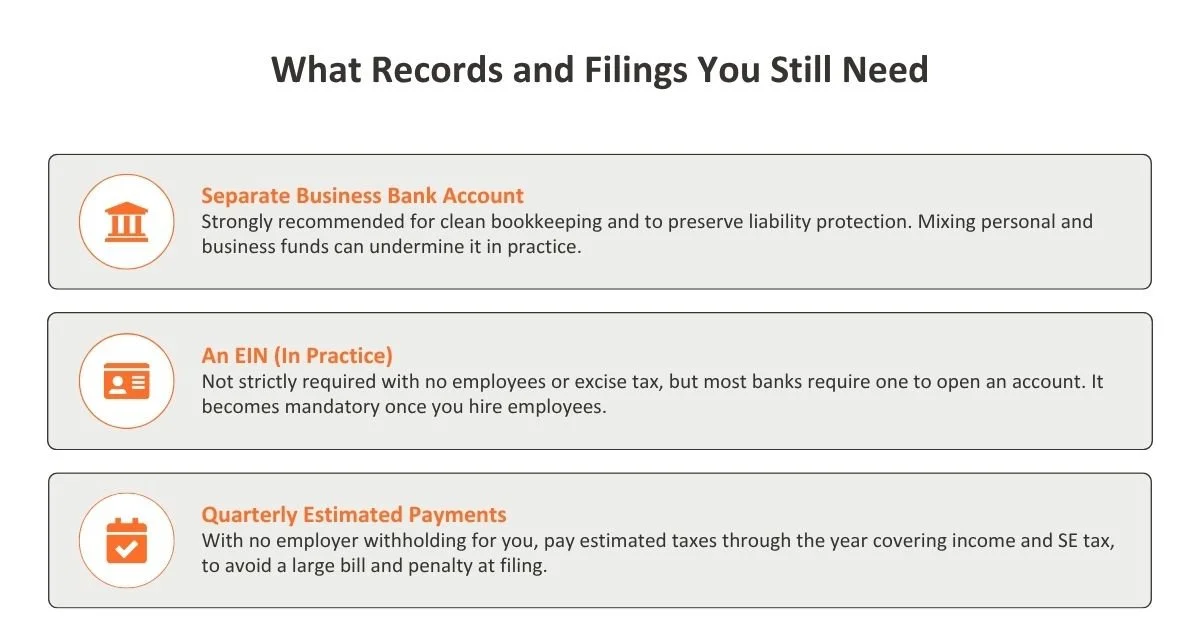
Being disregarded for federal tax purposes doesn't mean there's nothing to track. A separate business bank account is strongly recommended, both for clean bookkeeping and to preserve the liability protection your LLC is supposed to provide, mixing personal and business funds can undermine that protection in practice.
An EIN isn't strictly required for a single-member LLC with no employees and no excise tax obligations, you can technically use your Social Security number instead. In practice, though, most banks require an EIN to open a business account, and many owners prefer using one for privacy reasons rather than handing out their SSN. If you do hire employees, an EIN becomes mandatory.
Because there's no employer withholding your taxes for you, you'll generally need to make quarterly estimated tax payments throughout the year to cover both income tax and self-employment tax, rather than facing a large bill and potential penalty at filing time.
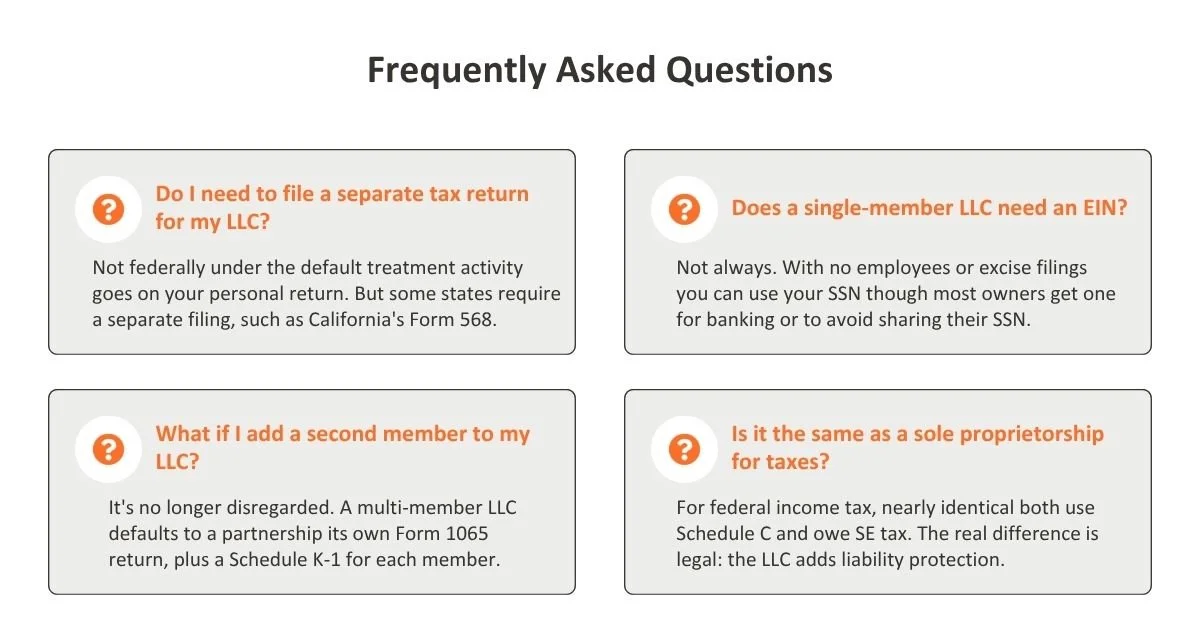
Frequently Asked Questions
-
Not at the federal level, if you're using the default disregarded entity treatment. Your business activity is reported on your personal return. California and some other states require a separate state-level filing, such as California's Form 568, even though the federal treatment stays pass-through.
-
Not always. If you have no employees and no excise tax filing requirements, you can use your Social Security number instead. Most owners get one anyway for banking purposes or to avoid sharing their SSN with clients and vendors.
-
Adding a second owner changes the default federal tax classification. A multi-member LLC is no longer disregarded, it's classified by default as a partnership, which requires its own separate tax return, Form 1065, and issues each member a Schedule K-1.
-
For federal income tax purposes, yes, nearly identical. Both report business income on Schedule C, and both are subject to self-employment tax the same way. The real difference is legal, not tax-related, an LLC provides liability protection that a sole proprietorship doesn't.
Understanding how your LLC is actually taxed, at both the federal and state levels, helps you avoid surprises at filing time. A tax professional can help you figure out whether the default disregarded treatment still makes sense for your business.