If you've heard that required minimum distributions start at 72, or that missing one costs you half the account, that information is out of date. The rules changed twice in recent years, first under the original SECURE Act, then again under SECURE 2.0, and a lot of retirees are still working off the old numbers. Here's what's actually current for 2026.

What Are Required Minimum Distributions?
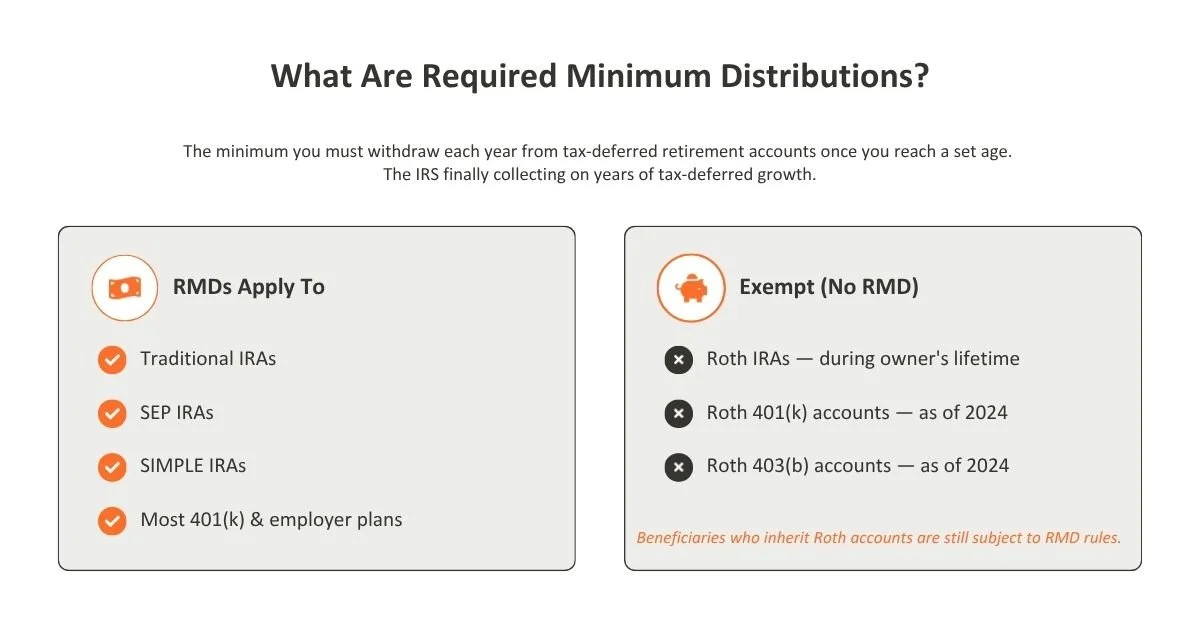
Required minimum distributions, RMDs, are the minimum amount you're required to withdraw each year from tax-deferred retirement accounts once you reach a certain age. The idea is straightforward: money in a traditional IRA or 401(k) grew tax-deferred for years, and the IRS eventually wants its share. RMDs apply to traditional IRAs, SEP IRAs, SIMPLE IRAs, and most employer-sponsored plans like 401(k)s. Roth IRAs are the notable exception, there's no RMD requirement on a Roth IRA during the original owner's lifetime, and as of 2024, that exemption now extends to Roth 401(k) and Roth 403(b) accounts too.
What Age Do RMDs Start?
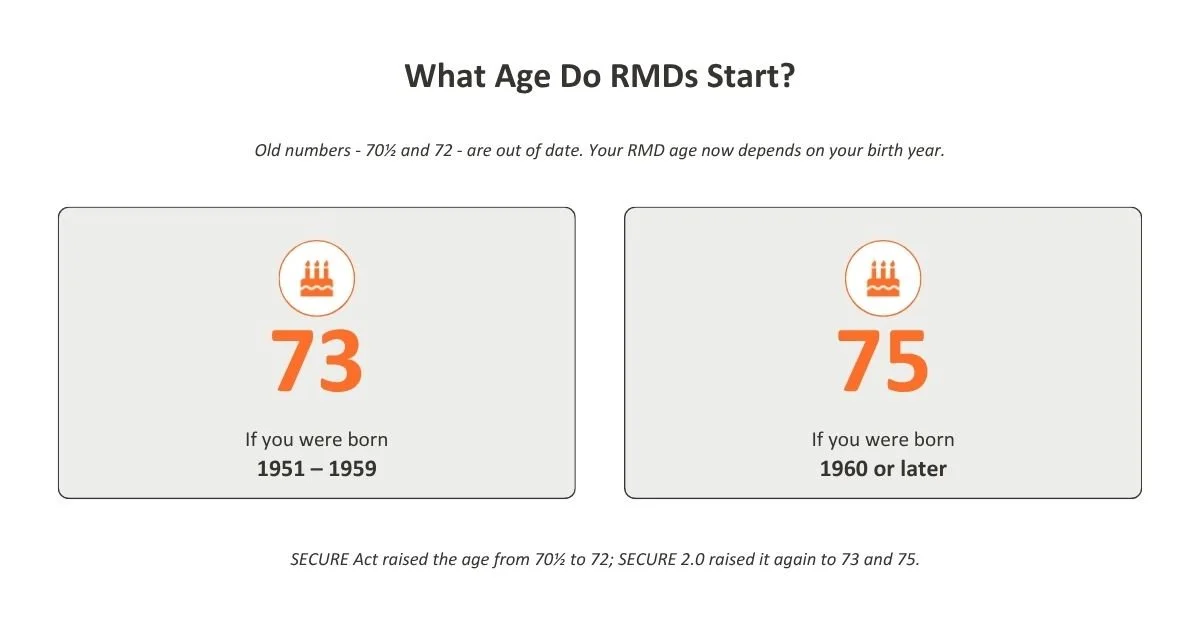
This is the part most likely to be stuck in people's heads at an outdated number. The original SECURE Act raised the RMD age from 70 and a half to 72 back in 2019. SECURE 2.0 raised it again, and the age that applies to you now depends on your birth year. If you were born between 1951 and 1959, your RMDs start at age 73. If you were born in 1960 or later, your RMDs start at age 75.
How to Calculate Your RMD
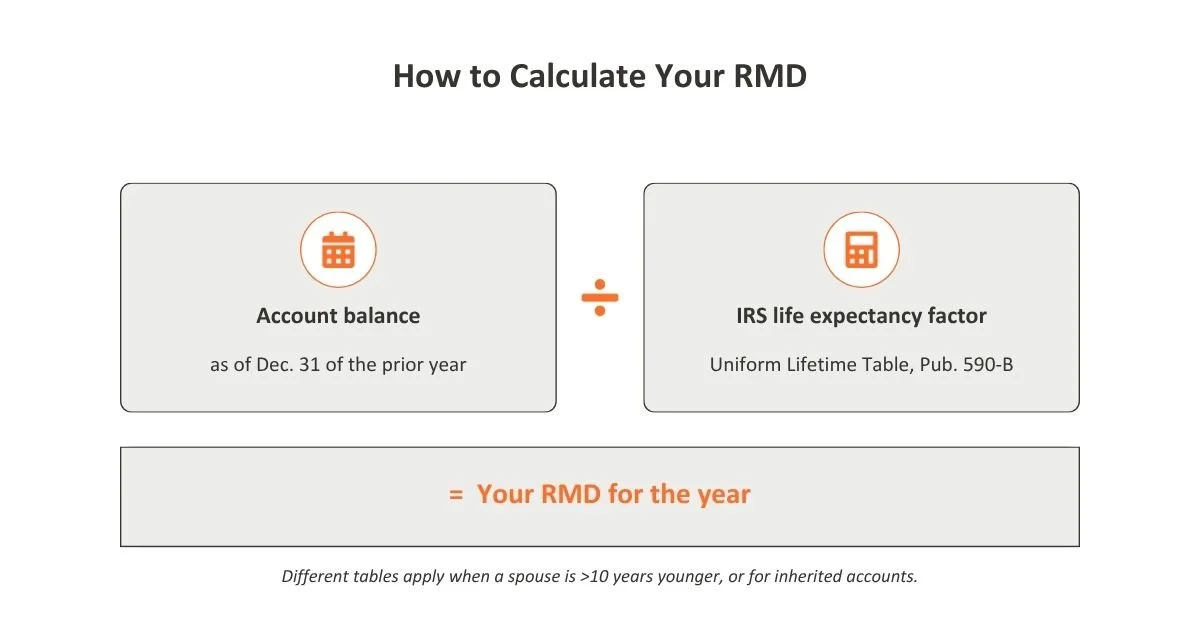
The calculation itself is simpler than it sounds. Take your retirement account balance as of December 31 of the prior year, and divide it by a life expectancy factor from the IRS Uniform Lifetime Table, found in IRS Publication 590-B. The result is your RMD for the year. A different table applies if your spouse is more than 10 years younger and is your sole beneficiary, and inherited accounts use a different table entirely, which is its own topic.
The Deadline: First RMD vs. Every Year After
Your very first RMD comes with a special rule: you can delay it until April 1 of the year after you reach your RMD age, rather than taking it by December 31 of the year you actually turn 73 or 75. Every RMD after that first one must be taken by December 31 each year, no extension available.

Here's the catch with delaying that first one: if you push it to April 1, you'll end up taking two RMDs in that same calendar year, the delayed first one and the regular second one. Both count as taxable income in that year, which can push you into a higher bracket than you'd land in otherwise. For that reason, many retirees choose to just take the first RMD in the year they actually reach RMD age, rather than delay and double up the following year.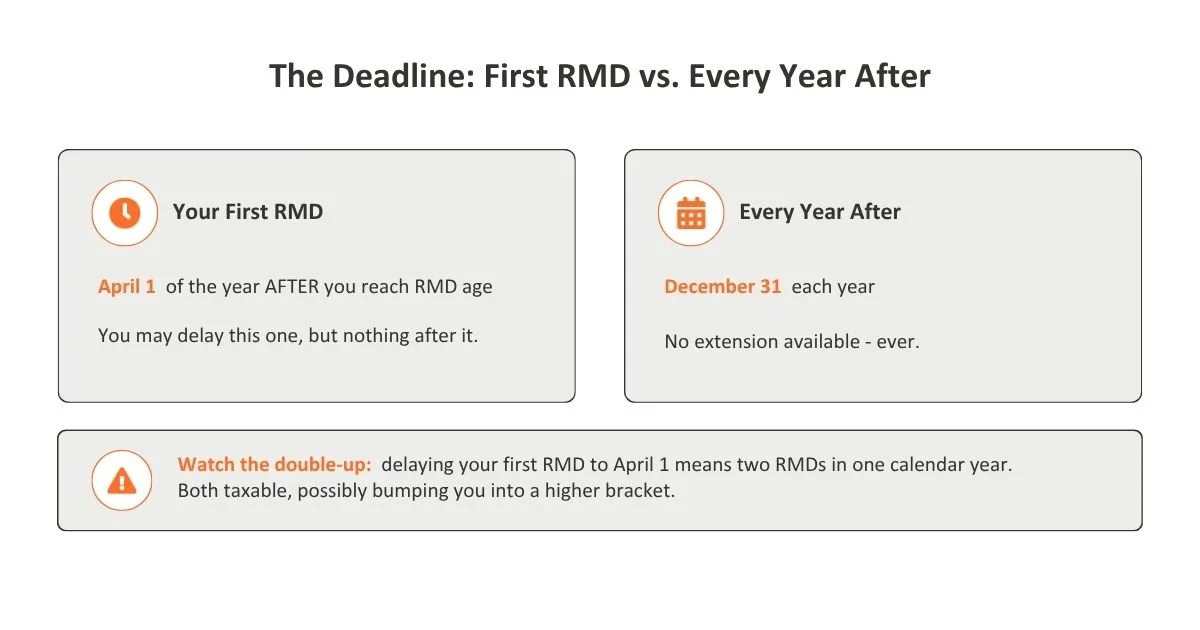
What Happens If You Miss an RMD
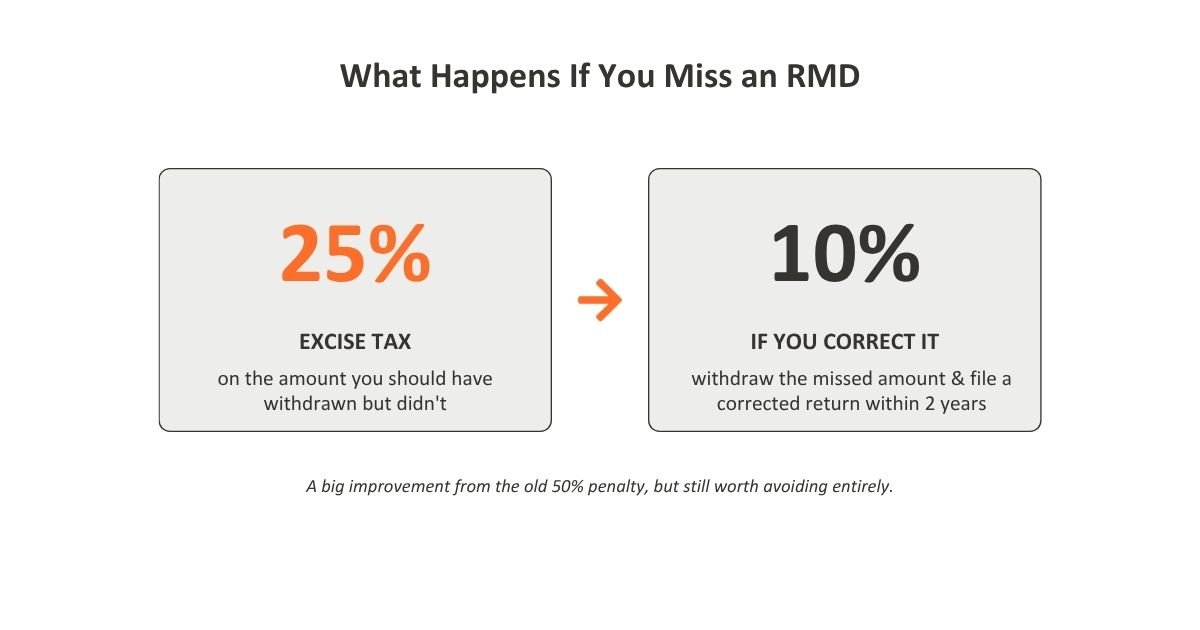
The penalty for missing an RMD dropped significantly under SECURE 2.0, though it's still real money. The excise tax on a missed RMD is 25 percent of the amount you should have withdrawn but didn't. That penalty drops to 10 percent if you correct the mistake, meaning you withdraw the missed amount and file a corrected return, within two years. This is a meaningful improvement from the 50 percent penalty that applied before SECURE 2.0, but it's still worth avoiding entirely by staying on top of the deadline.
If You Have Multiple Accounts
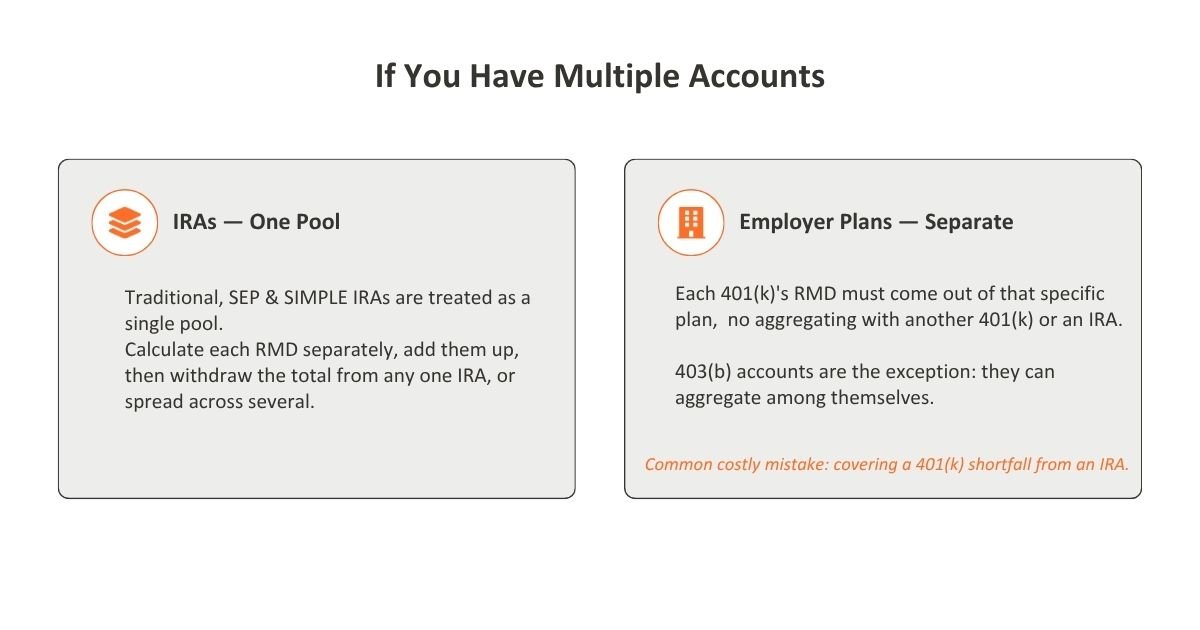
If you own more than one traditional IRA, the IRS treats them as a single pool for RMD purposes. You calculate the RMD for each IRA separately, add them together, and then withdraw the total from any one IRA, or spread across several, whichever you prefer. SEP and SIMPLE IRAs fall into that same pool. Employer plans work differently. A 401(k) generally cannot be aggregated with another 401(k), or with an IRA. Each 401(k) plan's RMD has to come out of that specific plan. 403(b) accounts are the one employer-plan exception that allows aggregation among themselves. Mixing this up, assuming you can cover a 401(k) shortfall by pulling extra from an IRA, is a common and costly mistake.
RMDs on Inherited Retirement Accounts
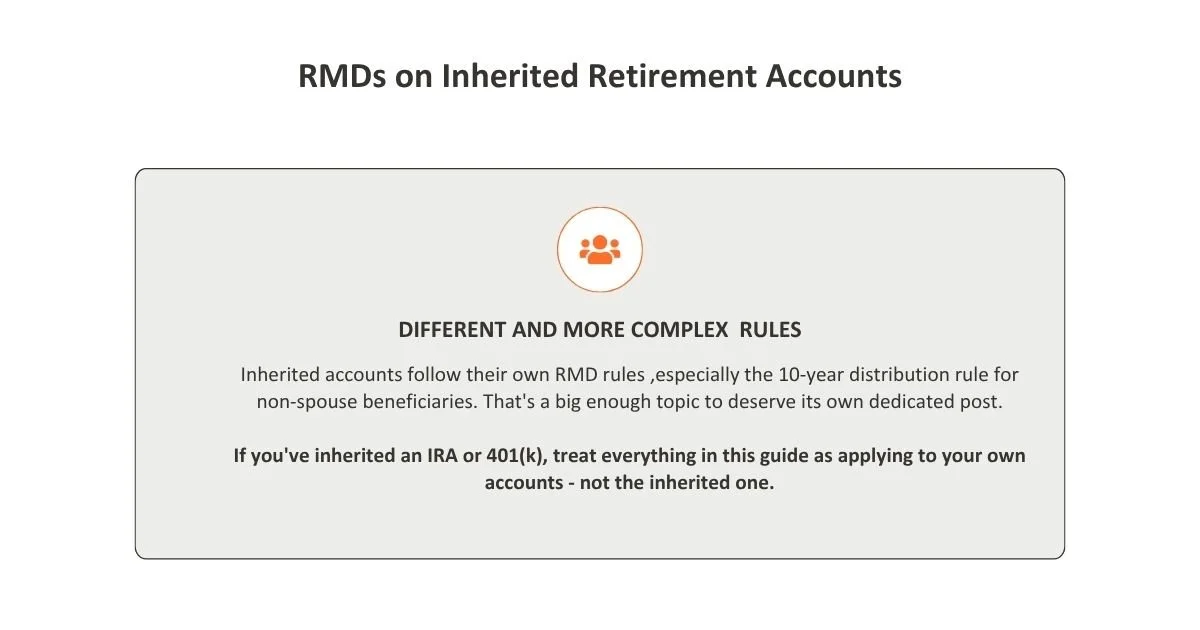
Inherited retirement accounts follow a different, more complex set of RMD rules than accounts you own yourself, particularly for non-spouse beneficiaries under the newer 10-year distribution rule. That's a big enough topic that it deserves its own dedicated post rather than a partial explanation here. If you've inherited an IRA or 401(k), treat the rules in this post as applying to your own accounts, not the inherited one.
Strategies to Manage Your RMD Tax Impact
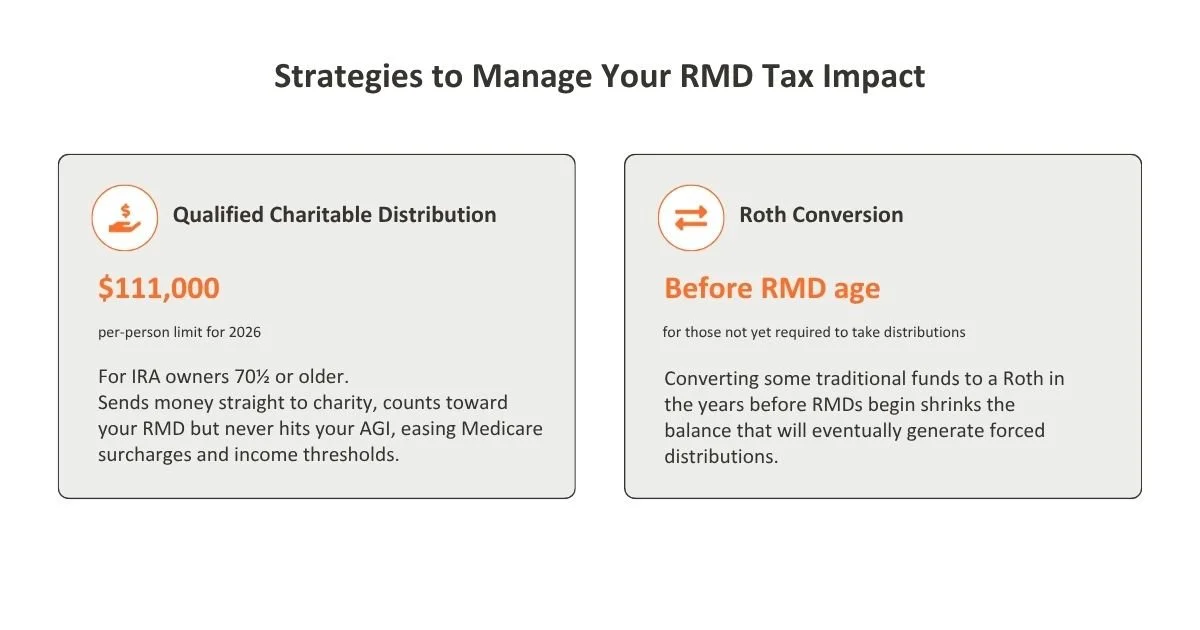
A couple of planning tools are worth knowing exist, even though the full mechanics deserve their own treatment. A Qualified Charitable Distribution lets IRA owners 70 and a half or older send money directly from their IRA to a qualifying charity, up to a set annual limit, 111,000 dollars per person for 2026. A QCD counts toward satisfying your RMD but doesn't show up in your adjusted gross income at all, which can help with Medicare premium surcharges and other income-based thresholds. We cover the full mechanics in our QCD guide. For those who haven't reached RMD age yet, converting some traditional retirement funds to a Roth IRA in the years before RMDs begin can shrink the balance that will eventually generate forced distributions. We walk through when that makes sense in our Roth conversion strategy guide.
Frequently Asked Questions
-
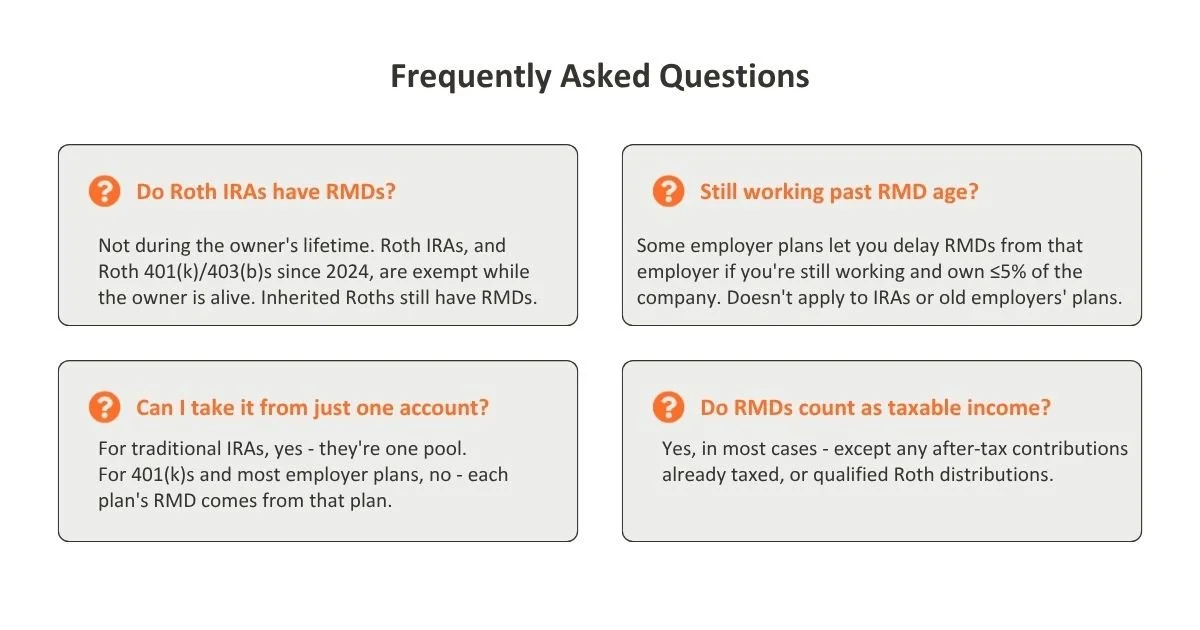
Not during the original owner's lifetime. Roth IRAs, and as of 2024, Roth 401(k) and Roth 403(b) accounts, are exempt from RMDs while the original account holder is alive. Beneficiaries who inherit Roth accounts are still subject to RMD rules.
-
Some employer plans allow you to delay RMDs from that specific employer's plan if you're still working and don't own more than 5 percent of the company, but this exception doesn't apply to IRAs or to plans from previous employers.
-
For traditional IRAs, yes, they're treated as one pool. For 401(k)s and most other employer plans, no, each plan's RMD generally has to come out of that specific plan.
-
Yes, in most cases. Withdrawals are included in your taxable income for the year, except for any portion that represents after-tax contributions you already paid tax on, or qualified Roth distributions.
RMD rules get more complicated the more accounts you have, and the penalties for getting the timing wrong are still real. A tax professional can help you map out exactly what you owe, from where, and by when.