How Cryptocurrency Is Taxed: Capital Gains vs. Ordinary Income
A lot of crypto investors assume taxes only come into play when they cash out to dollars. The IRS sees it differently. Since 2014, the IRS has treated cryptocurrency as property, not currency, which means the same tax principles that apply to selling stock or real estate apply to crypto too. That has real consequences for how often you're actually triggering a taxable event, and whether it counts as capital gains or ordinary income. Here's how it actually breaks down.

Crypto Is Property, Not Currency
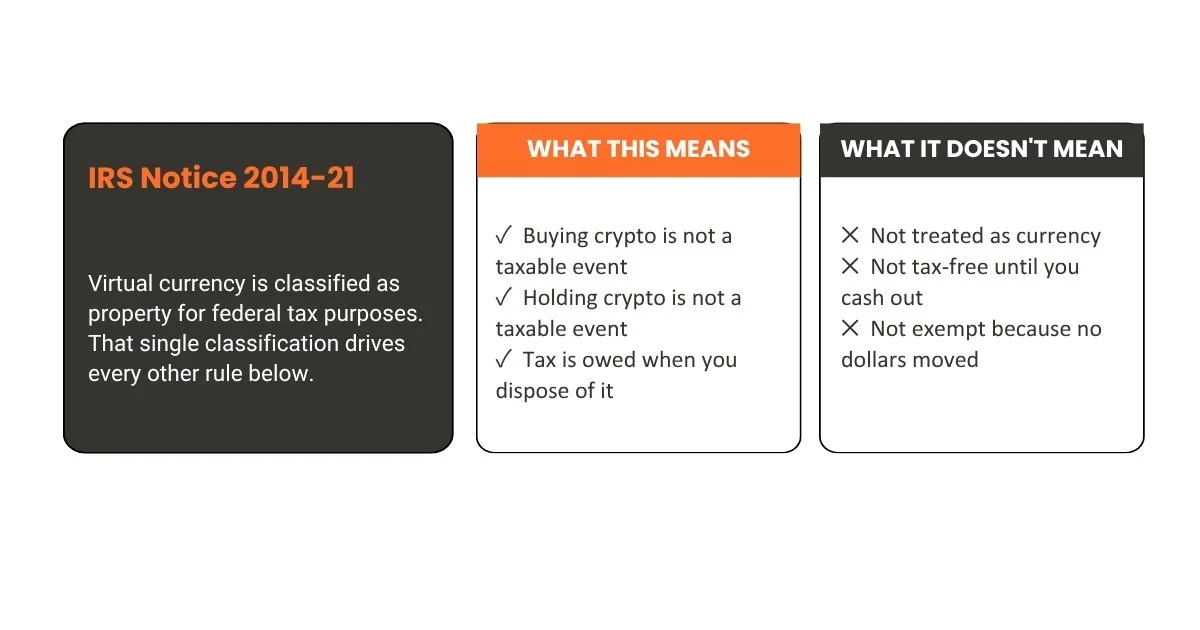
Under IRS Notice 2014-21, virtual currency is classified as property for federal tax purposes. This single classification is the foundation for everything else in this post. Because crypto is property, buying and holding it isn't a taxable event, you only owe tax when you dispose of it, meaning you sell, trade, spend, or otherwise get rid of it.
Capital Gains vs. Ordinary Income: The Core Distinction
Whether a crypto transaction produces capital gains or ordinary income depends on how you came to have the crypto and how long you held it.
Selling, trading, or spending crypto you already owned produces a capital gain or loss. If you held it for one year or less, that's a short-term capital gain, taxed at your ordinary income tax rate, which can run as high as 37 percent. If you held it for more than a year, it's a long-term capital gain, taxed at the more favorable 0, 15, or 20 percent rates depending on your income.
Receiving crypto as payment, or earning it through mining, staking, or similar activity, produces ordinary income instead, valued at the crypto's fair market value on the date you received it. That income gets taxed at your regular income tax rate right away, and then a separate capital gain or loss gets calculated later when you eventually sell that crypto, based on how its value has moved since you received it.

Crypto-to-Crypto Trades Are Still Taxable
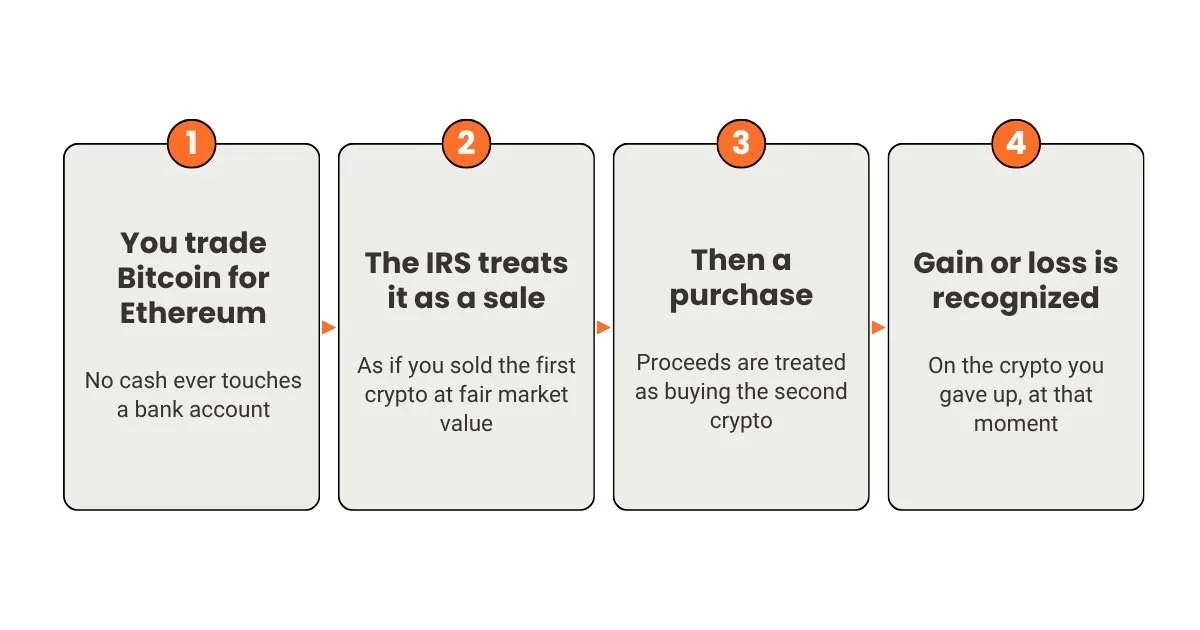
This trips up a lot of people. Trading one cryptocurrency for another, Bitcoin for Ethereum, for example, is a taxable event, even though no cash ever touched a bank account. The IRS treats it as if you sold the first crypto for its fair market value, then used the proceeds to buy the second. Any gain or loss on the crypto you gave up gets recognized at that moment.
How It Gets Reported
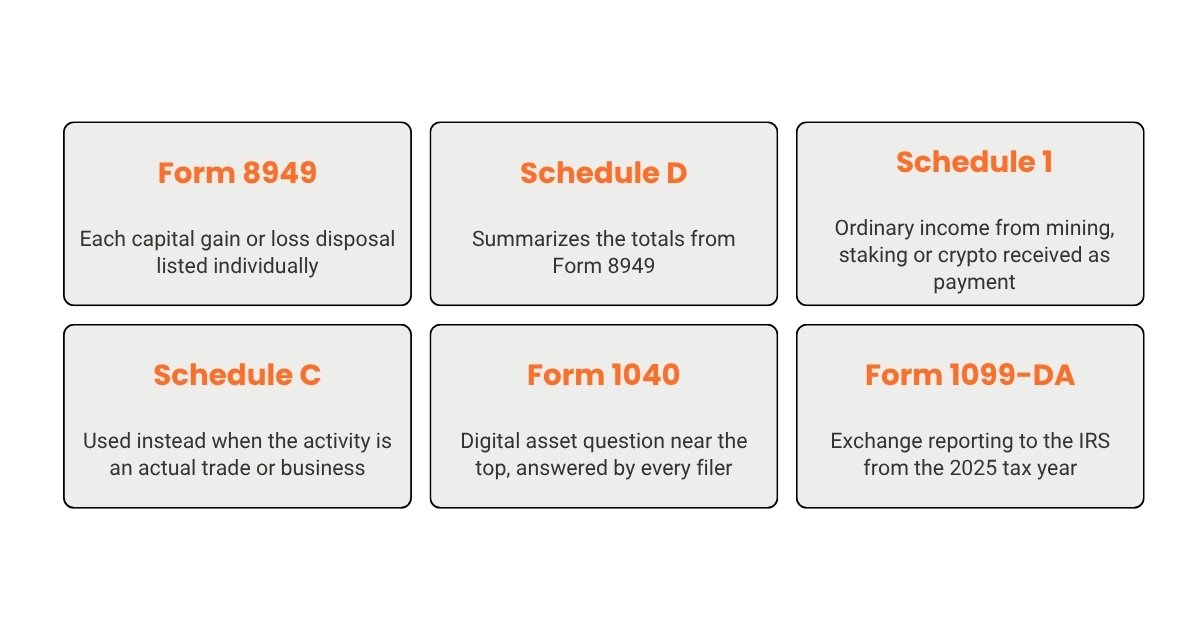
Capital gains and losses from crypto sales, trades, and spending go on Form 8949, with each disposal listed individually, then summarized on Schedule D of your Form 1040. Ordinary income from mining, staking rewards, or crypto received as payment generally goes on Schedule 1, or Schedule C if the activity rises to the level of an actual trade or business, such as professional mining operations.
Every Form 1040 filer has to answer a digital asset question near the top of the return, asking whether you received, sold, exchanged, or otherwise disposed of any digital assets during the year. This applies regardless of how small your crypto activity was for the year.
The IRS Now Gets Your Trading Data Directly
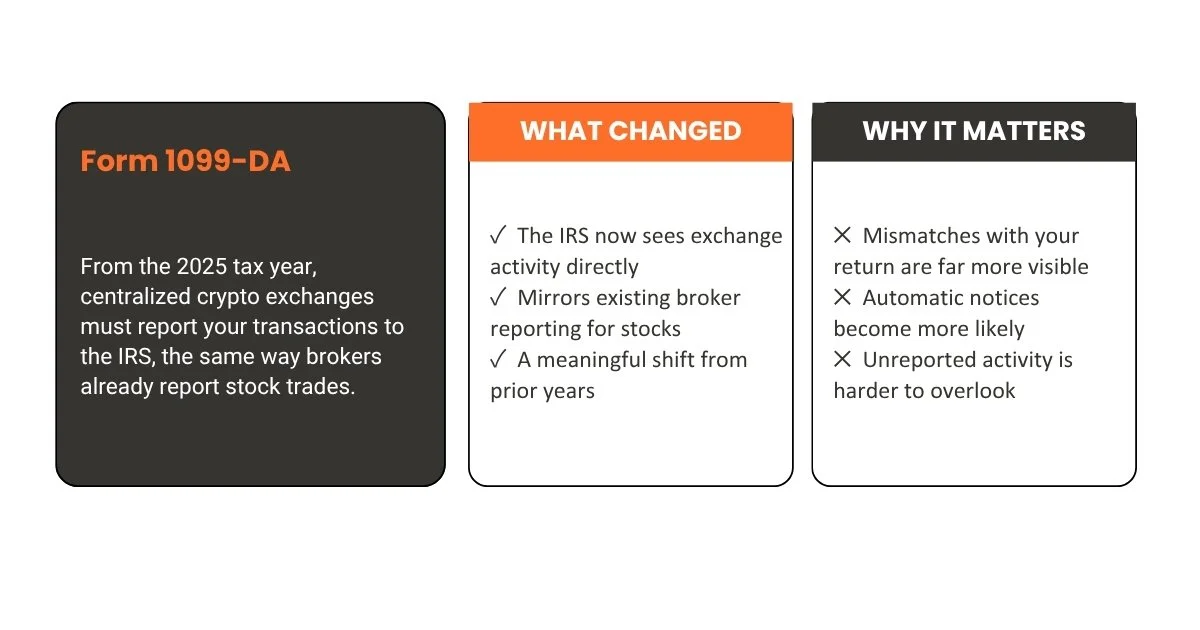
Starting with the 2025 tax year, centralized crypto exchanges are required to report your transactions to the IRS using Form 1099-DA, similar to how brokers already report stock trades. This is a meaningful shift, the IRS now has direct visibility into exchange activity that it didn't have in prior years, which makes mismatches between what you report and what the exchange reports far more likely to trigger an automatic notice.
A Note on the Wash Sale Rule
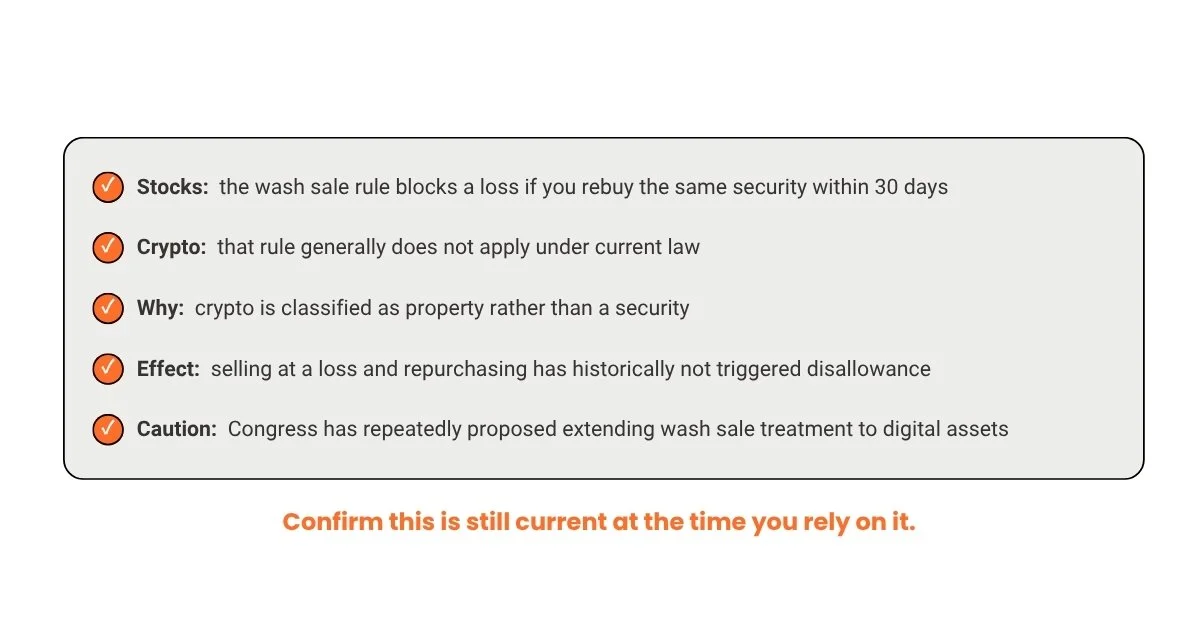
One planning detail worth knowing: the wash sale rule, which normally stops stock investors from claiming a loss if they buy back the same security within 30 days, generally does not apply to crypto under current law. Because crypto is classified as property rather than a security, selling at a loss and immediately repurchasing the same asset has historically not triggered the same disallowance that applies to stocks. That said, this is an area of active legislative attention, Congress has repeatedly proposed extending wash sale treatment to digital assets, so this is worth confirming as current at the time you're relying on it, rather than assuming it stays this way indefinitely.
Frequently Asked Questions
-
No. Buying and holding crypto isn't a taxable event on its own. Tax is triggered when you dispose of it, whether that's selling, trading, or spending it.
-
Spending crypto is treated as a disposal, the same as selling it for cash. You calculate gain or loss based on the crypto's value at the time of the purchase compared to what you originally paid for it.
-
Yes. Capital losses from crypto can offset capital gains, and up to 3,000 dollars of net losses can offset ordinary income each year, with any excess carrying forward to future years.
-
Yes. The digital asset question on Form 1040 must be answered by every filer, and reporting requirements apply regardless of how small the transaction or gain was.
Crypto tax reporting has gotten more complex as exchanges now report directly to the IRS. A tax professional can help you make sure your reporting matches what the IRS is already seeing.