If you freelance, contract, or run a small side business, the rules around which tax forms you'll actually receive changed meaningfully for 2026. Recent federal legislation raised the threshold for one form and reverted the threshold for another, in opposite directions from where things looked headed just a year ago. The practical result: most freelancers will get noticeably fewer 1099s starting in early 2027. What hasn't changed at all is that every dollar you earn is still taxable, whether a form shows up for it or not.

Two Different Forms, Two Different Issuers
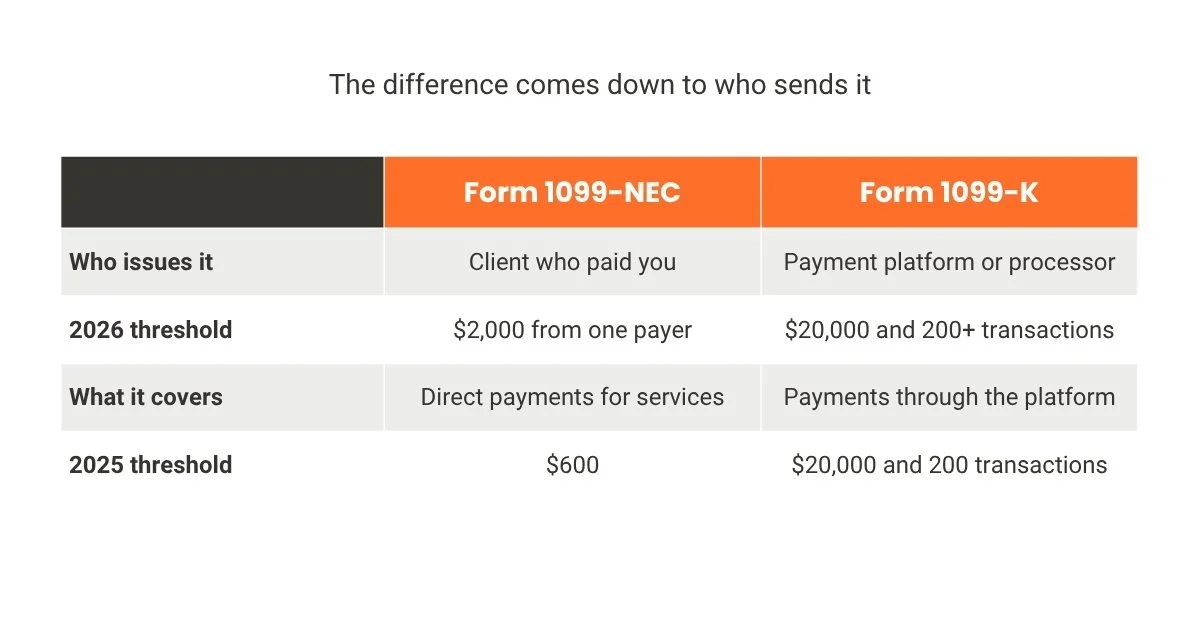
The core confusion between these two forms comes down to one thing: who sends them. Form 1099-NEC is issued by the business or client who paid you directly for services. Form 1099-K is issued by a payment processor or platform, PayPal, Venmo, Stripe, Square, and similar, based on payments that moved through their system, regardless of which specific client or customer sent the money.
The 1099-NEC Threshold Just Tripled
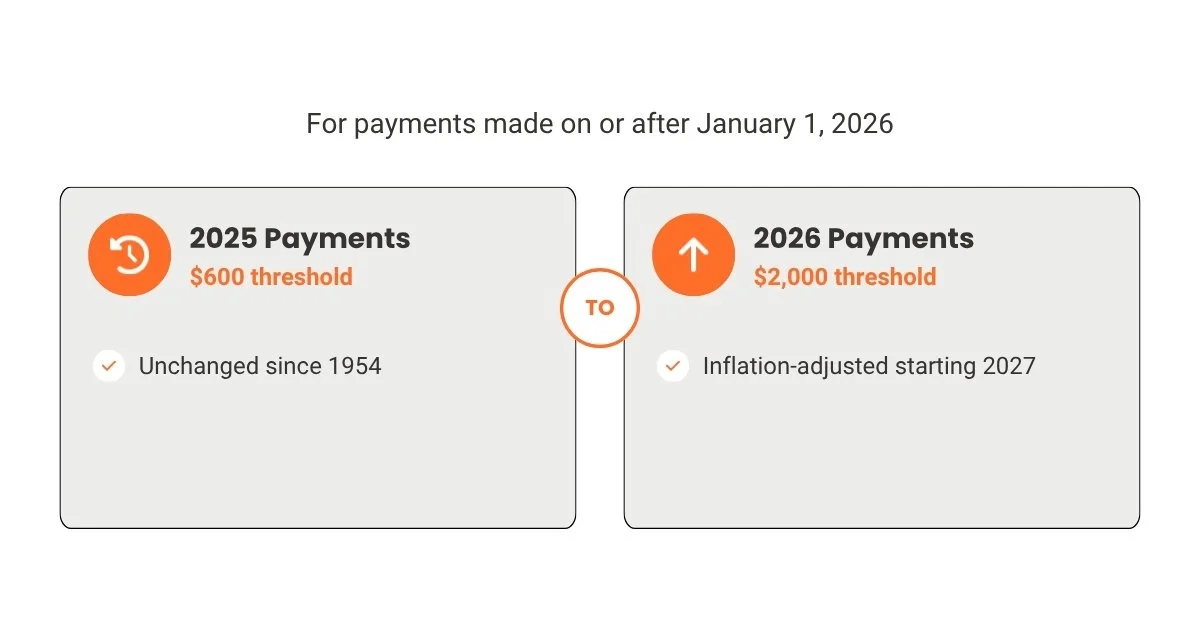
For payments made in 2025, the threshold for Form 1099-NEC was 600 dollars, a figure that had stood since 1954 without adjustment. Recent legislation, the One Big Beautiful Bill Act, raised that threshold to 2,000 dollars for payments made on or after January 1, 2026. A client now only has to send you a 1099-NEC if they paid you 2,000 dollars or more during the year, up from the old 600 dollar bar. Starting with 2027 payments, this threshold will also adjust for inflation each year, something the old 600 dollar figure never did.
The 1099-K Threshold Reverted, It Didn't Drop Further
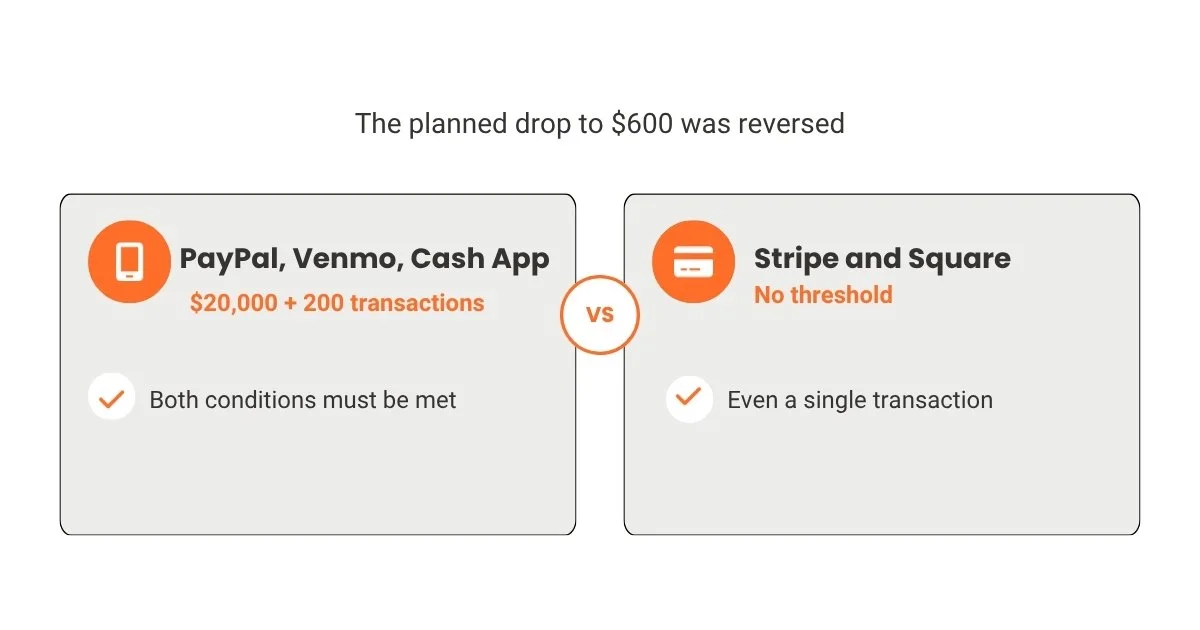
This is where a lot of outdated information is still circulating. For a while, the 1099-K threshold was scheduled to phase down dramatically, to 2,500 dollars for 2025 and eventually 600 dollars for 2026, with no transaction minimum at all. That planned phase-down has been reversed. Current law reinstates the original, much higher threshold: a Third-Party Settlement Organization like PayPal, Venmo, or Cash App only has to issue a 1099-K once you exceed both 20,000 dollars in payments and 200 separate transactions in a year. Both conditions have to be met, not just one. If a client paid you 50,000 dollars through Venmo across only 80 transactions, no 1099-K gets issued, since the transaction count didn't clear 200.
There's an important exception to this higher bar: payment card processors, specifically Stripe and Square, have no threshold at all for 1099-K purposes. If a client pays a single 1,200 dollar invoice through a Stripe-powered checkout, Stripe issues a 1099-K for that one transaction, even though it's nowhere near the TPSO threshold. The rules genuinely differ depending on which specific platform processed the payment.
Avoiding Double-Counted Income
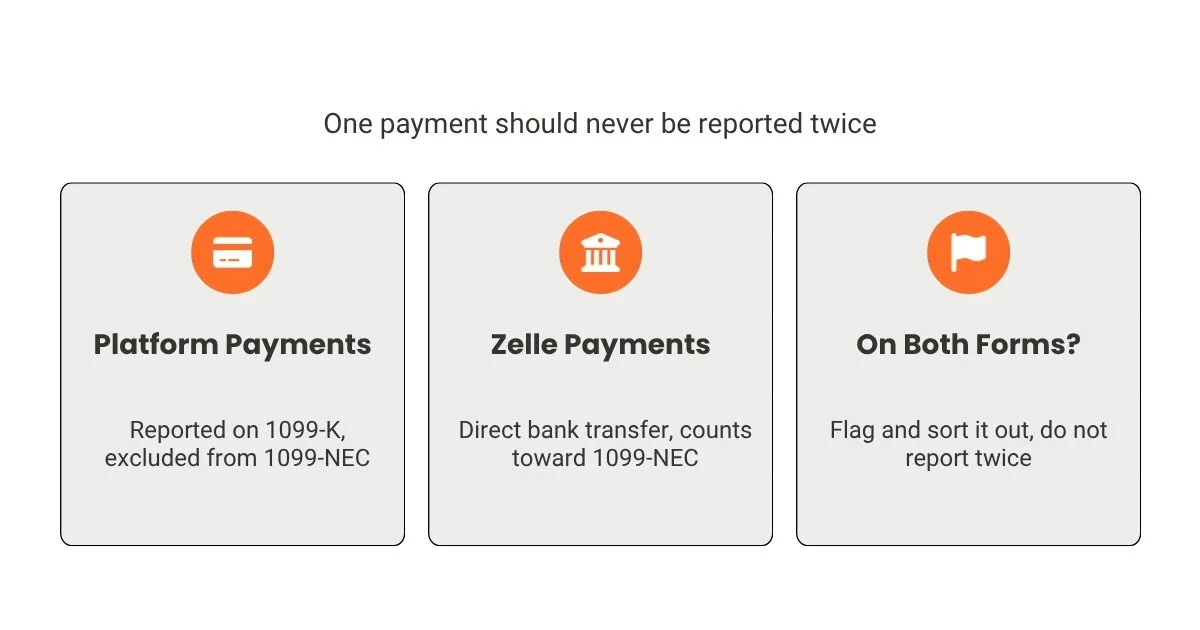
When a payment moves through a card processor or TPSO for goods or services, the business paying you generally should exclude that amount from their own 1099-NEC calculation, since the platform is already handling that reporting through the 1099-K. In practice this means a single payment might show up correctly on only one form, or on neither if it falls under both thresholds, but it should never be double-counted in a way that overstates your income. If you ever notice a client's 1099-NEC and a platform's 1099-K appear to both include the same payment, that's worth flagging and sorting out rather than reporting both.
One platform-specific wrinkle worth knowing: Zelle doesn't function as a Third-Party Settlement Organization the way PayPal or Venmo does, it's structured as a direct bank transfer. Payments received through Zelle for services generally get treated like a direct payment and should be included in a client's 1099-NEC calculation if the threshold is met, rather than excluded the way a TPSO-routed payment would be.
Fewer Forms Doesn't Mean Less Tax
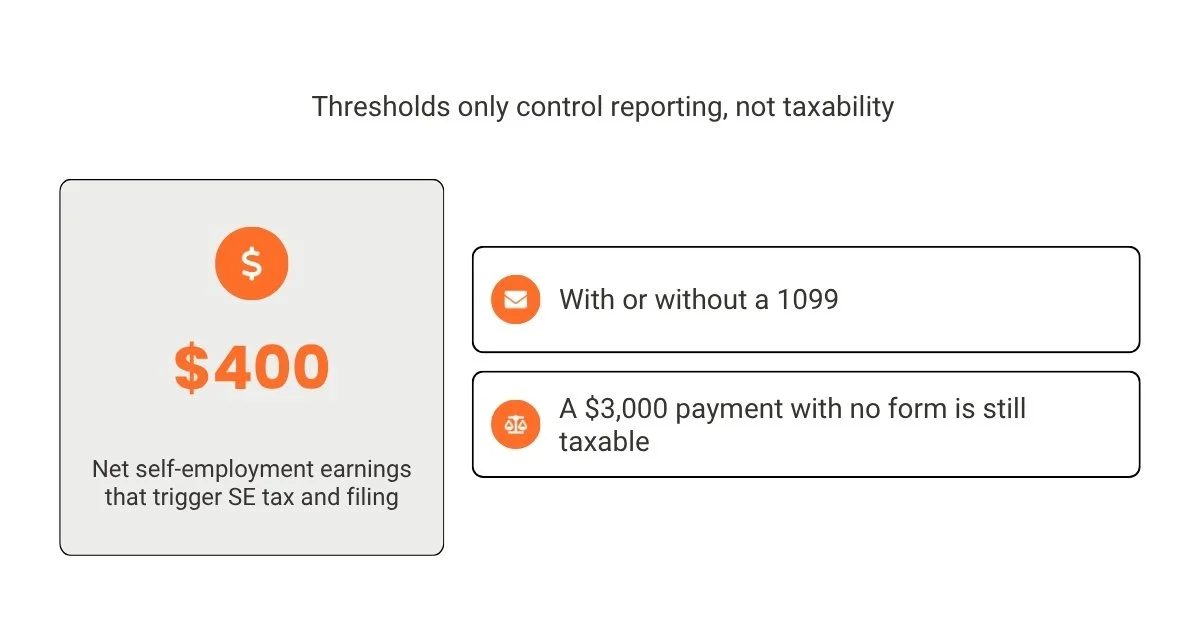
This is the point worth repeating clearly: the form thresholds only control when someone else is required to report your income to the IRS on your behalf. They have no bearing on whether that income is taxable. If your net self-employment earnings for the year reach 400 dollars or more, you owe self-employment tax and need to file, regardless of how many, or how few, 1099s land in your inbox. A 3,000 dollar payment from a client who never sends you a 1099-NEC, and that never crosses a platform's 1099-K threshold either, is exactly as taxable as if both forms had been issued.
What This Means for Your Recordkeeping
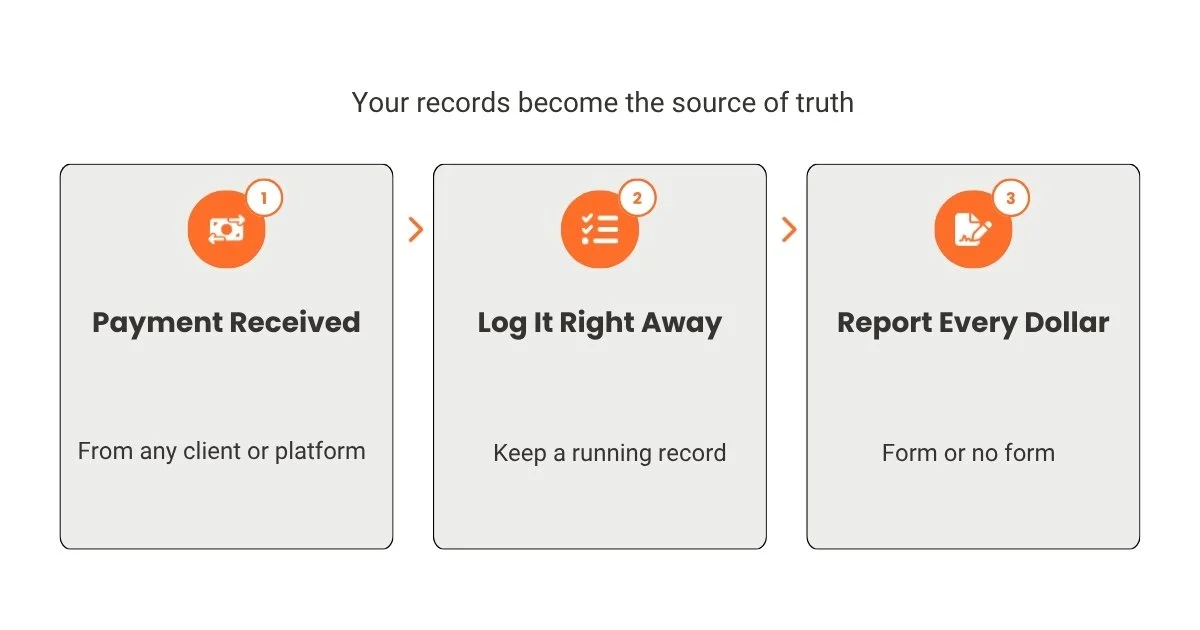
With fewer forms arriving starting in early 2027, your own records become the primary source of truth for your return, not a backup to what the IRS already has on file. Keep a running log of every payment received across all clients and platforms throughout the year, rather than waiting to see what forms show up in January and reconstructing income from there. This habit matters more now than it did under the old, lower thresholds, when far more of your income arrived pre-documented on a form.
Frequently Asked Questions
-
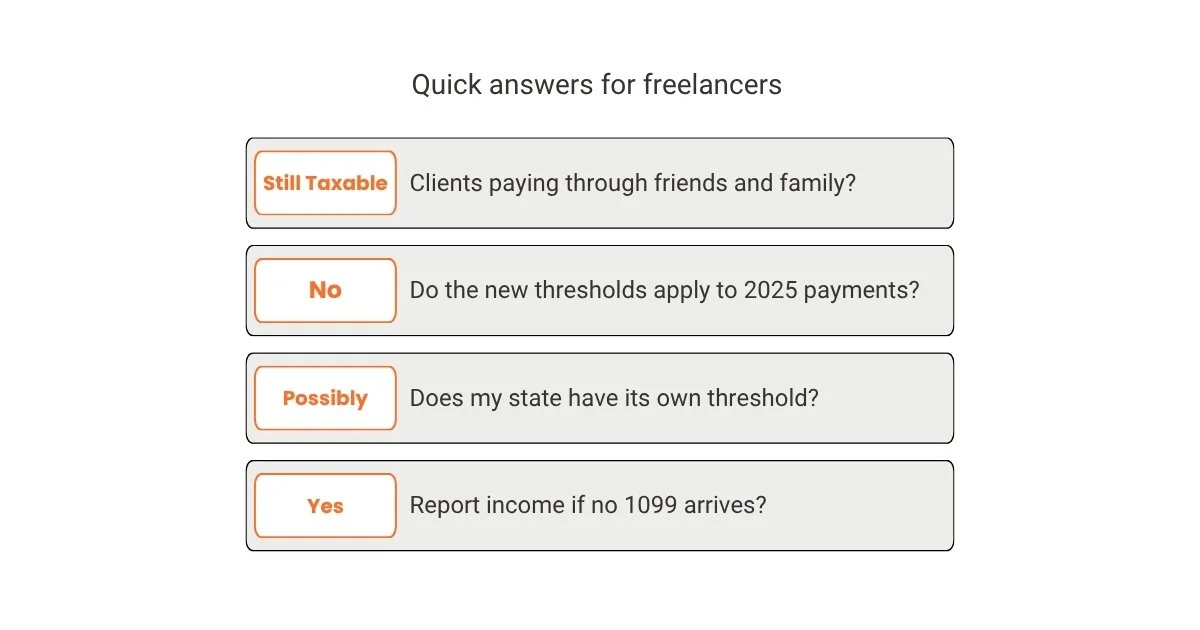
Friends and family payments aren't tracked as business transactions by the platform and generally won't factor into 1099-K reporting, but using that payment type for actual business income is against most platforms' terms of service, and it doesn't change whether the income is taxable to you. It's a compliance risk on the platform side, not a way to avoid reporting the income on your own return.
-
No. The higher 1099-NEC threshold of 2,000 dollars applies only to payments made on or after January 1, 2026, reported on returns filed in 2027. Payments made during 2025 still use the old 600 dollar threshold, reported on returns filed in early 2026.
-
Some states set their own reporting requirements independent of federal thresholds, and not every state participates in the IRS's combined federal and state filing program. This is worth confirming for your specific situation rather than assuming state rules automatically mirror the federal changes.
-
Yes, without exception. All self-employment income is reportable and taxable regardless of whether any form was issued. The forms exist to help the IRS cross-check reported income, they aren't what creates the obligation to report it in the first place.
With fewer 1099s landing in your inbox starting next filing season, your own income tracking matters more than ever. A tax professional can help you build a system that keeps every dollar accounted for, form or no form.