Inheriting a home that's appreciated for decades sounds like it should come with a large tax bill when you sell. In most cases, it doesn't, because of a rule called stepped-up basis. Understanding how it works, and a California-specific version of it that most national tax content doesn't cover, can make a real difference in what you actually owe when you sell an inherited property.
What Stepped-Up Basis Actually Means
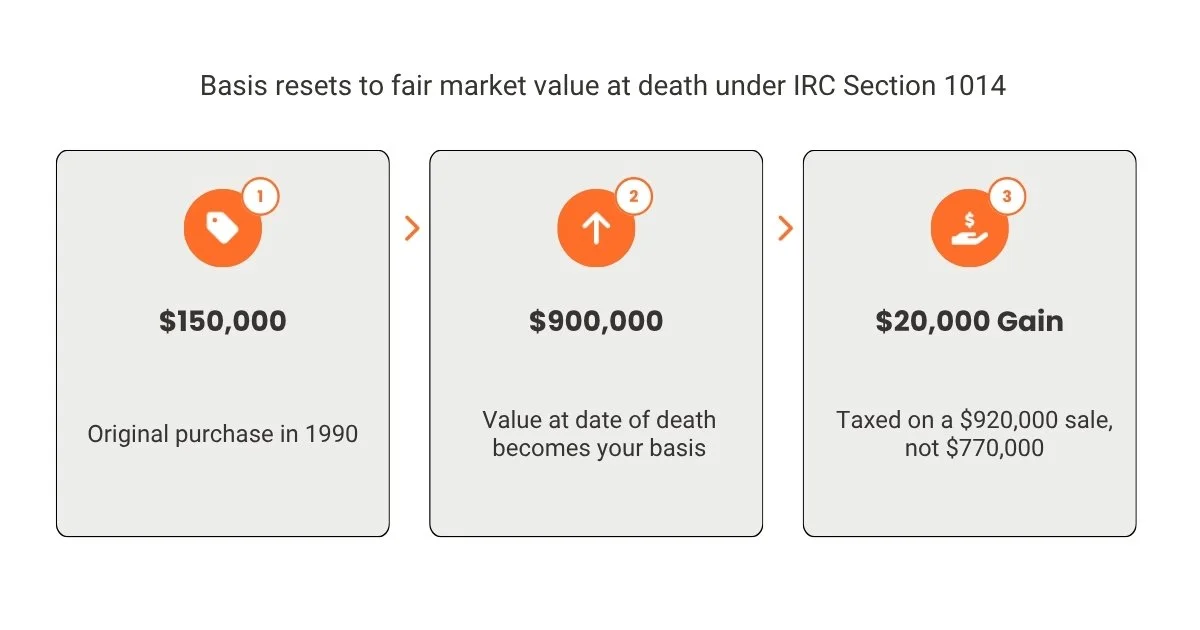
When you inherit property, your basis, the number used to calculate gain or loss when you eventually sell, resets to the property's fair market value on the date the original owner died. This is set out in IRC Section 1014. In effect, any appreciation that happened during the deceased owner's lifetime is never taxed. You only owe capital gains tax on appreciation that happens after you inherit it, from the date-of-death value forward.
Say a parent bought a home in 1990 for 150,000 dollars, and it was worth 900,000 dollars on the date they passed away. Under stepped-up basis, your basis in that home is 900,000 dollars, not 150,000 dollars. If you sell it shortly after for 920,000 dollars, you'd owe capital gains tax on roughly 20,000 dollars of gain, not 770,000 dollars.
The California Advantage: Double Step-Up for Community Property
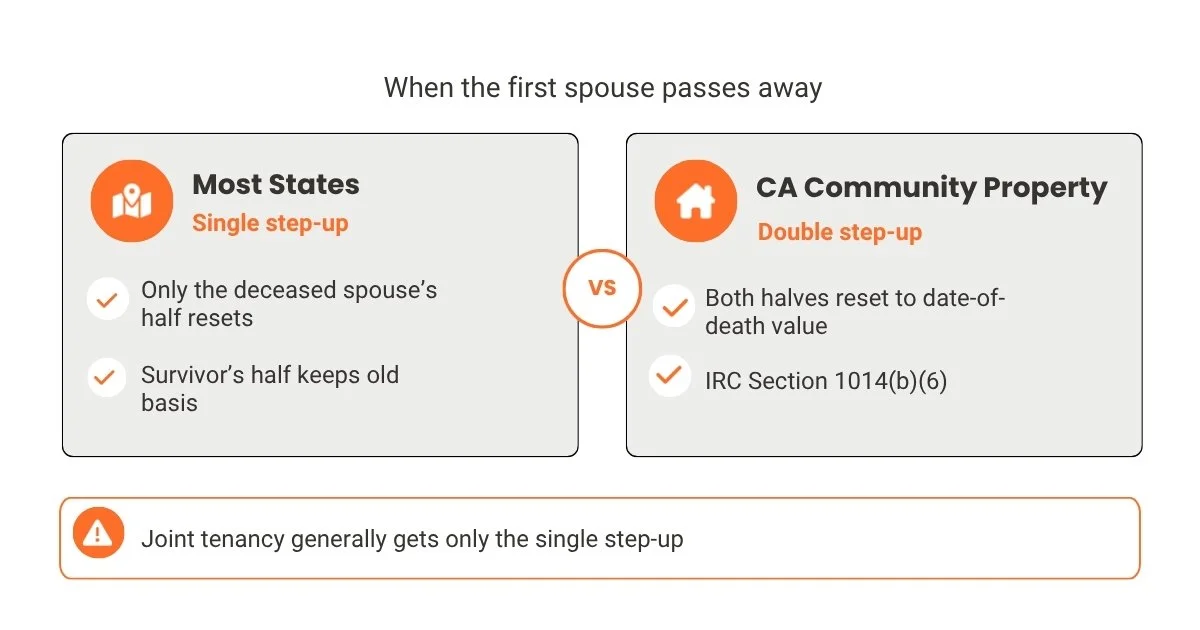
This is the part worth knowing specifically if you're in California. In most states, when a married couple owns property jointly and one spouse dies, only the deceased spouse's half of the property gets the stepped-up basis, the surviving spouse's half keeps its original, lower basis. California works differently.
Because California is a community property state, property that qualifies as community property gets a full basis reset on both halves, not just the half belonging to the spouse who passed away, when the first spouse dies. This is often called the double step-up, and it comes from IRC Section 1014(b)(6). For a long-held, highly appreciated home, this can mean the surviving spouse's basis resets entirely to the date-of-death value, potentially eliminating most or all built-in capital gains, well before the second spouse's death.
This benefit depends on the property actually qualifying as community property, and on how title is held. Property held as joint tenancy, rather than community property, generally only gets the single step-up on the deceased spouse's share, the same as in a non-community-property state. This is a detail worth confirming with a professional rather than assuming based on how long you've been married or how the property was acquired.
What Doesn't Get a Step-Up
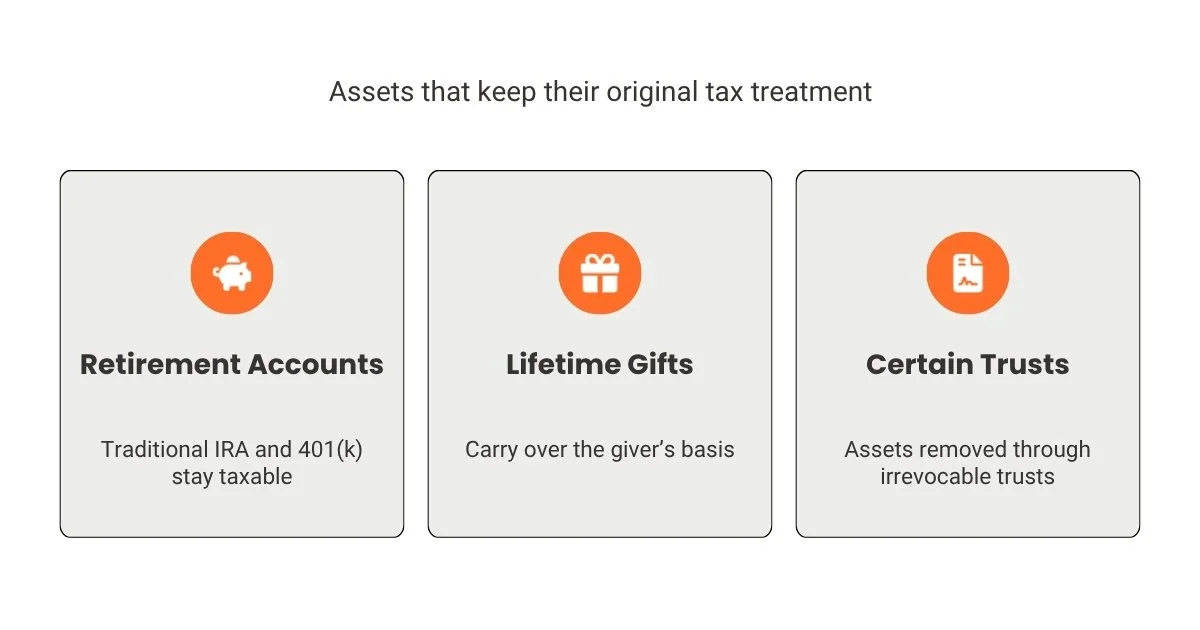
Not everything you inherit gets this treatment. Retirement accounts, traditional IRAs and 401(k)s, don't receive a stepped-up basis, since the original owner never paid income tax on those contributions or growth in the first place, distributions to a beneficiary remain fully taxable as ordinary income. Property that was gifted to you before the original owner's death, rather than inherited at death, doesn't get a step-up either, it carries over the giver's original basis instead. Assets already removed from someone's estate through certain irrevocable trust structures generally don't qualify for the step-up either.
A Detail Most People Miss: Automatic Long-Term Treatment
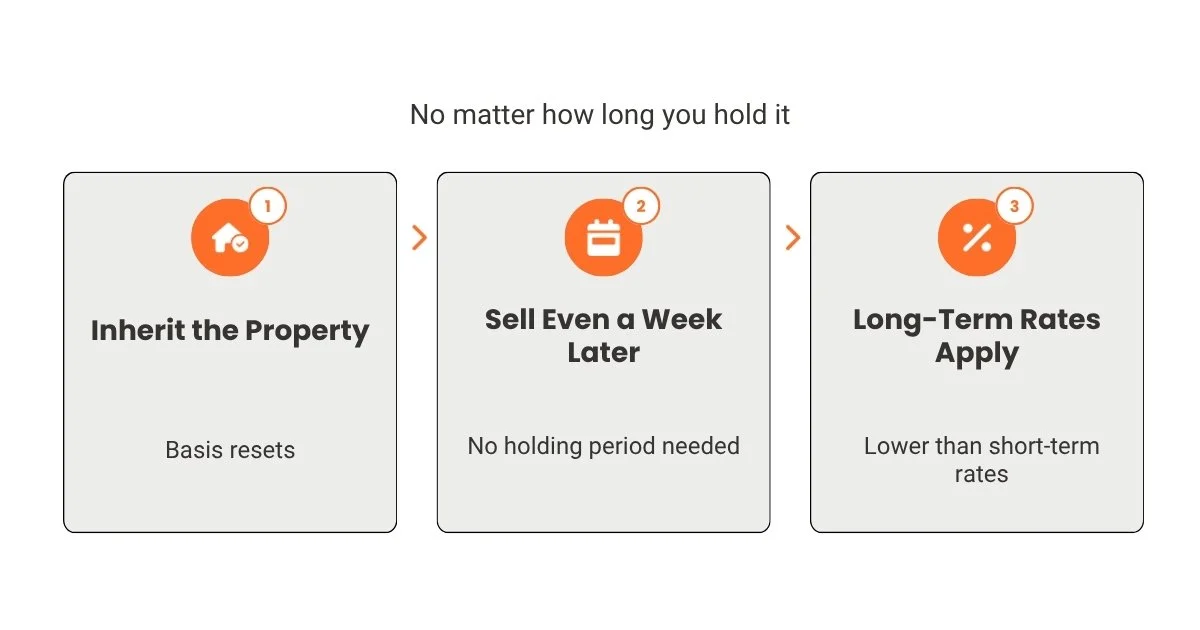
Whenever you do sell inherited property, the gain or loss is automatically treated as long-term, regardless of how long you personally held it before selling. Even if you sell an inherited home the week after you inherit it, it still qualifies for long-term capital gains rates rather than short-term rates, which can be significantly higher. This is a genuinely useful rule that a lot of people don't realize applies to them.
What If the Property Lost Value Instead?
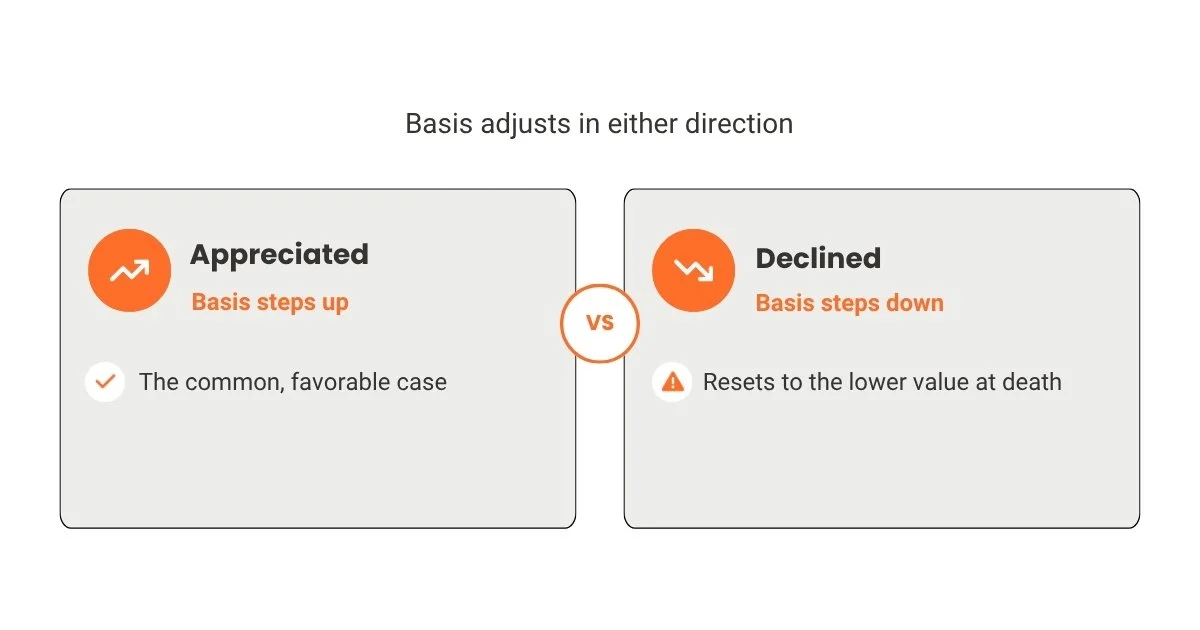
Basis adjusts to fair market value at death in either direction. If a property was actually worth less on the date of death than the original owner paid for it, your basis steps down to that lower value, not up. This is a less commonly discussed side of the same rule, and it means the stepped-up basis isn't automatically a benefit in every situation, just in the much more common case of appreciated property.
Frequently Asked Questions
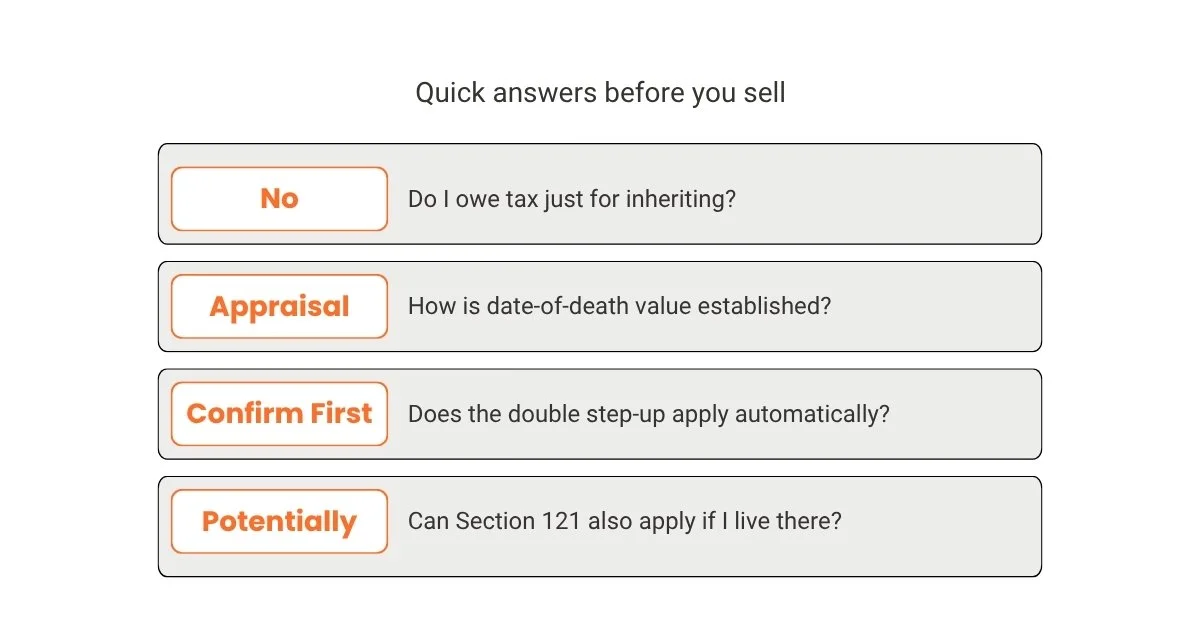
-
No. Inheriting property itself doesn't create a capital gains tax bill. Tax only comes into play if and when you sell, based on the difference between the sale price and your stepped-up basis.
-
A professional appraisal dated at or near the date of death is the standard way to establish this figure, and it's worth getting one even if you don't plan to sell right away, since it becomes much harder to reconstruct an accurate historical value years later.
-
It depends on how the property is titled and whether it genuinely qualifies as community property under California law. This isn't something to assume applies without confirmation, particularly if the property's title history is complicated or if it was owned before the marriage.
-
Potentially, yes. If you move into an inherited home as your primary residence and meet the ownership and use requirements, the Section 121 exclusion may apply on top of the stepped-up basis, though the two rules work differently and are worth discussing together with a tax professional.
Selling an inherited property, especially one you've owned as a couple for decades, involves basis rules that are easy to get wrong without the right documentation. A tax professional can help you establish the correct basis before you sell.