How to Choose the Right Business Entity for Tax Purposes
Most business owners pick their entity based on liability protection alone, then never revisit the decision from a tax perspective. That's backwards. Two businesses with identical revenue can end up paying wildly different total tax depending purely on entity structure. This post is a pillar overview tying together the entity-specific posts elsewhere on our blog, if you already know you're comparing two specific structures, our dedicated S corp vs. LLC and single-member LLC guides go deeper on those exact comparisons.

The Four Structures at a Glance
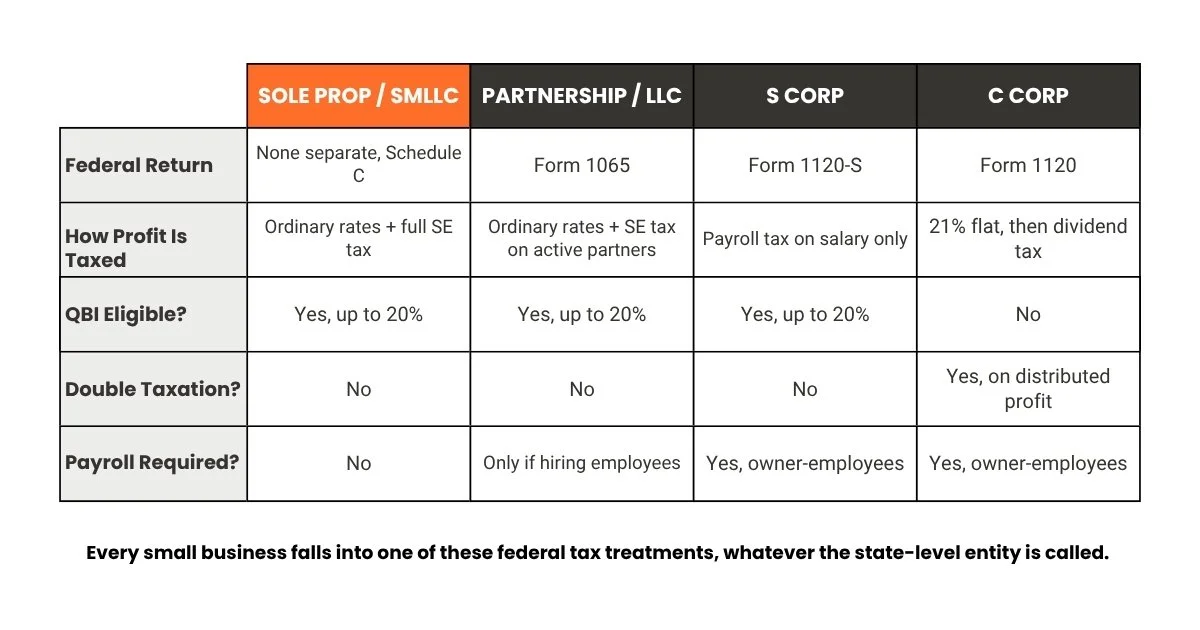
Every small business falls into one of these federal tax treatments, regardless of what the state-level legal entity is called.
Sole Proprietorship and Default Single-Member LLC
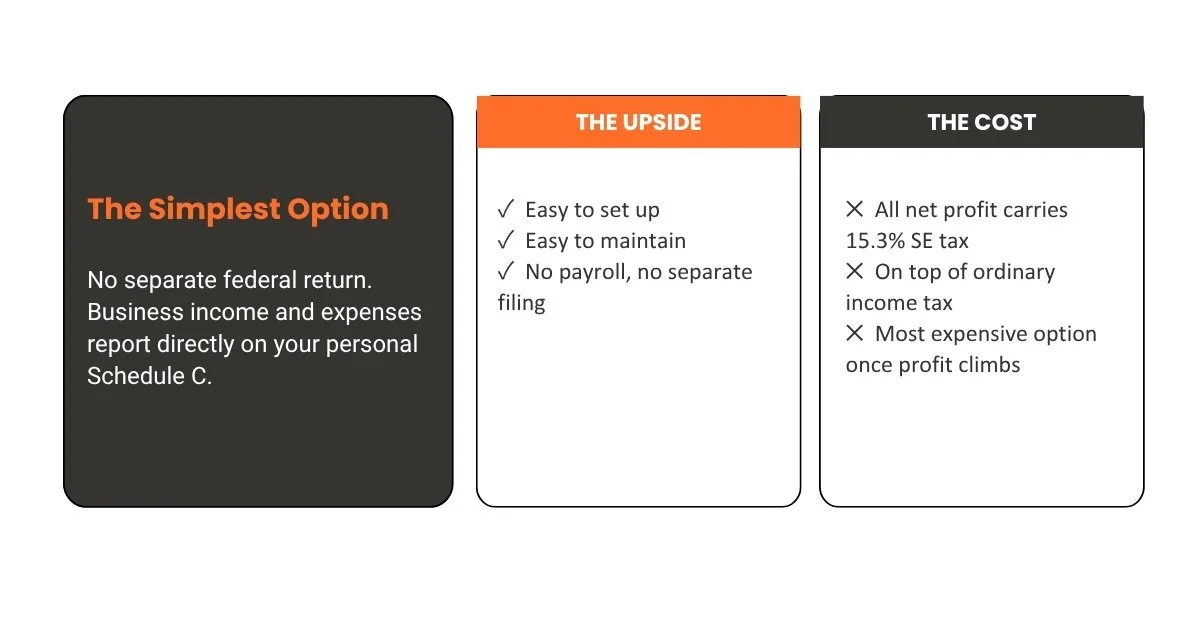
The simplest option. No separate federal return, business income and expenses report directly on your personal Schedule C. All net profit is subject to self-employment tax, 15.3 percent, on top of ordinary income tax. We cover this default treatment in full in our single-member LLC tax guide. This structure is easy to set up and maintain, but it's also the most expensive option once profit climbs, since every dollar carries the full SE tax burden with no way to split it.
Partnership and Default Multi-Member LLC
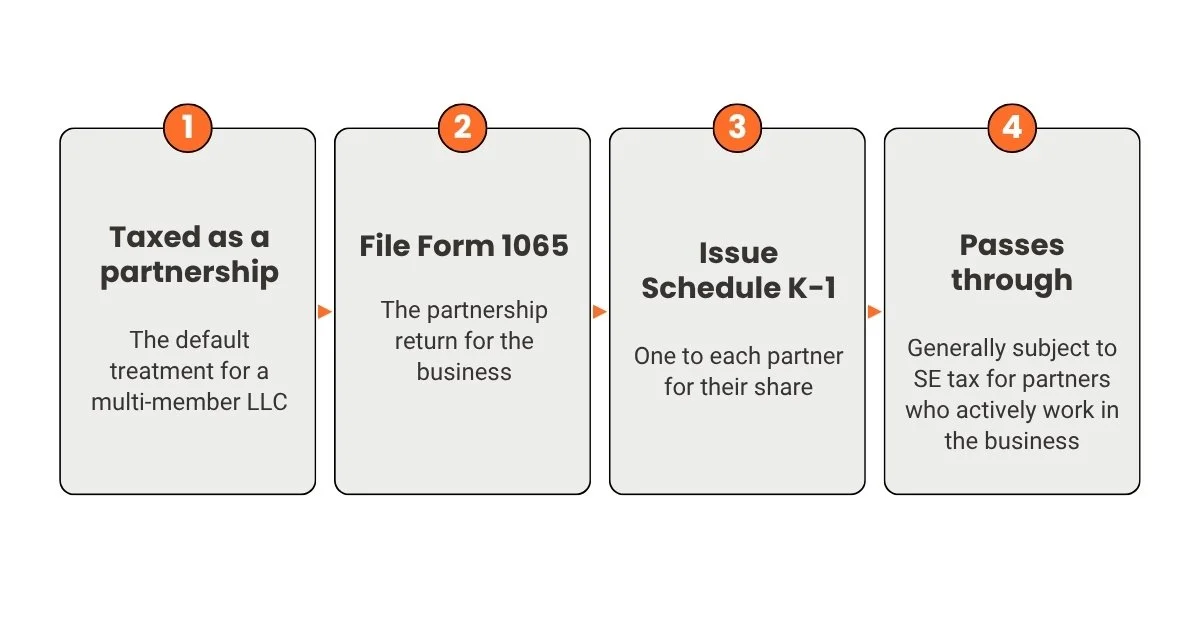
A multi-member LLC is taxed as a partnership by default, filing Form 1065 and issuing each partner a Schedule K-1. Income passes through to each partner's personal return and is generally subject to self-employment tax for partners who actively work in the business. Like the sole proprietor structure, a partnership can also elect S corp or C corp tax treatment instead.
S Corporation
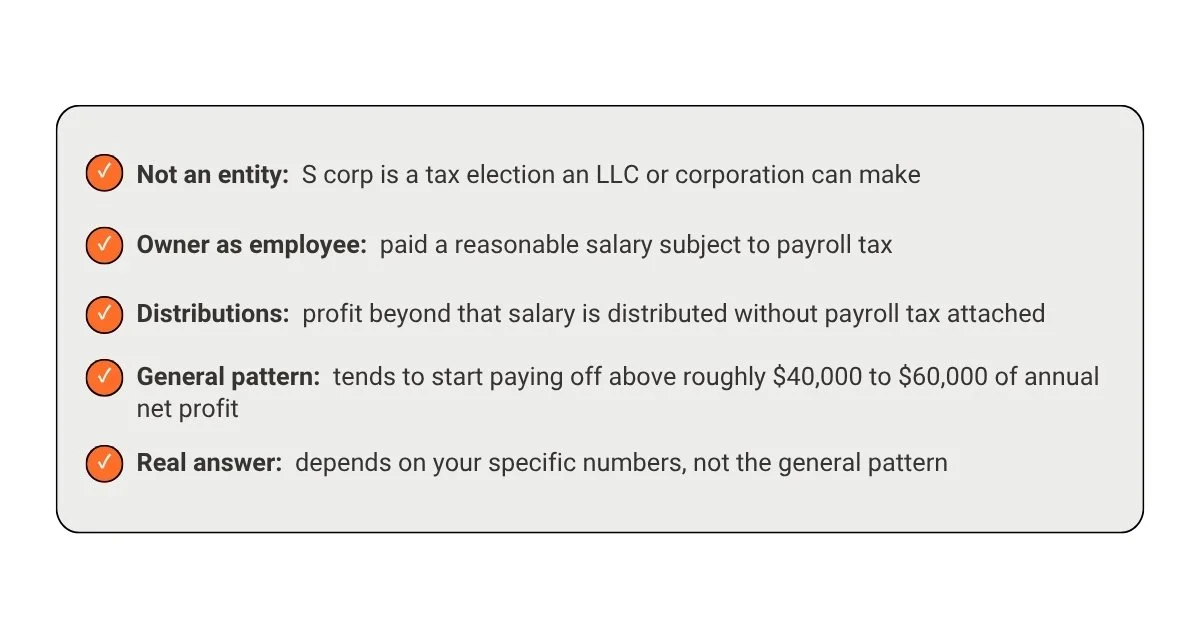
Not a legal entity on its own, S corp is a tax election that an LLC or corporation can make. Once elected, the owner becomes an employee, paid a reasonable salary subject to payroll tax, while profit beyond that salary is distributed without payroll tax attached. We cover the mechanics and the tradeoffs in our S corp vs. LLC guide and our reasonable compensation guide. As a general pattern, this election tends to start paying off once net profit runs somewhere above 40,000 to 60,000 dollars annually, though the real answer depends on your specific numbers.
C Corporation
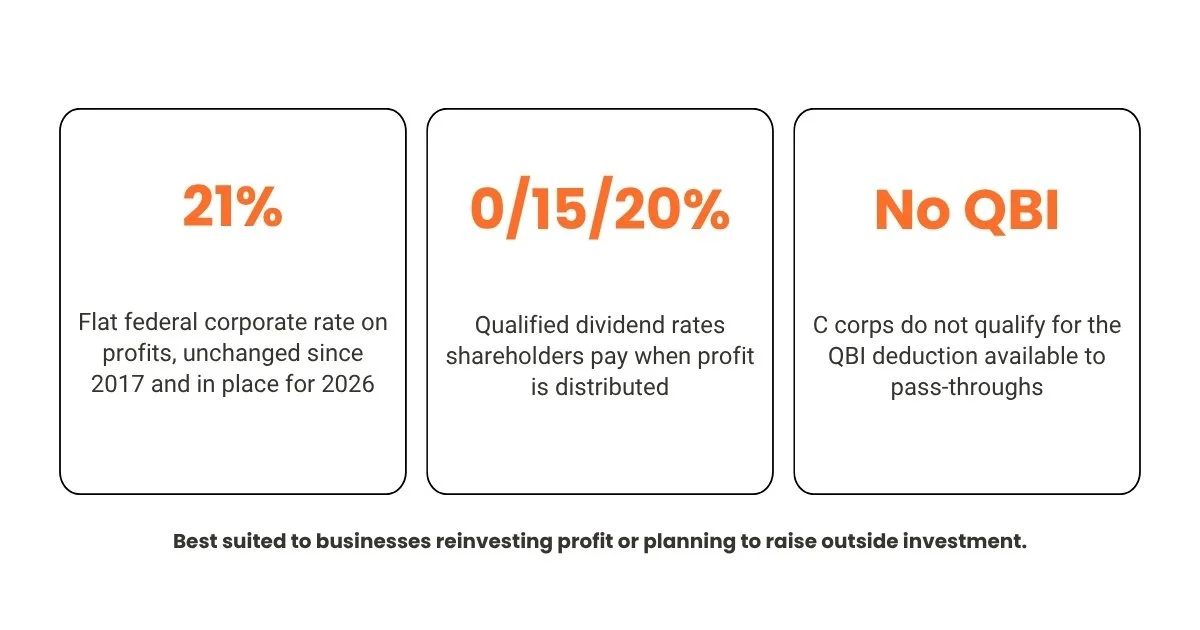
A C corp is a separate taxpaying entity, taxed at a flat 21 percent federal rate on its profits. That rate has stayed unchanged since the 2017 tax law and remains in place for 2026. The tradeoff is double taxation: the corporation pays 21 percent on its profit, and then shareholders pay tax again, at qualified dividend rates of 0, 15, or 20 percent, when that profit gets distributed to them. Combined, the effective rate on distributed C corp profit can run considerably higher than a pass-through structure. C corps also don't qualify for the QBI deduction available to pass-through entities. This structure tends to make the most sense for businesses reinvesting profit rather than distributing it, or those planning to raise outside investment.
The QBI Deduction Changes the Math for Pass-Throughs
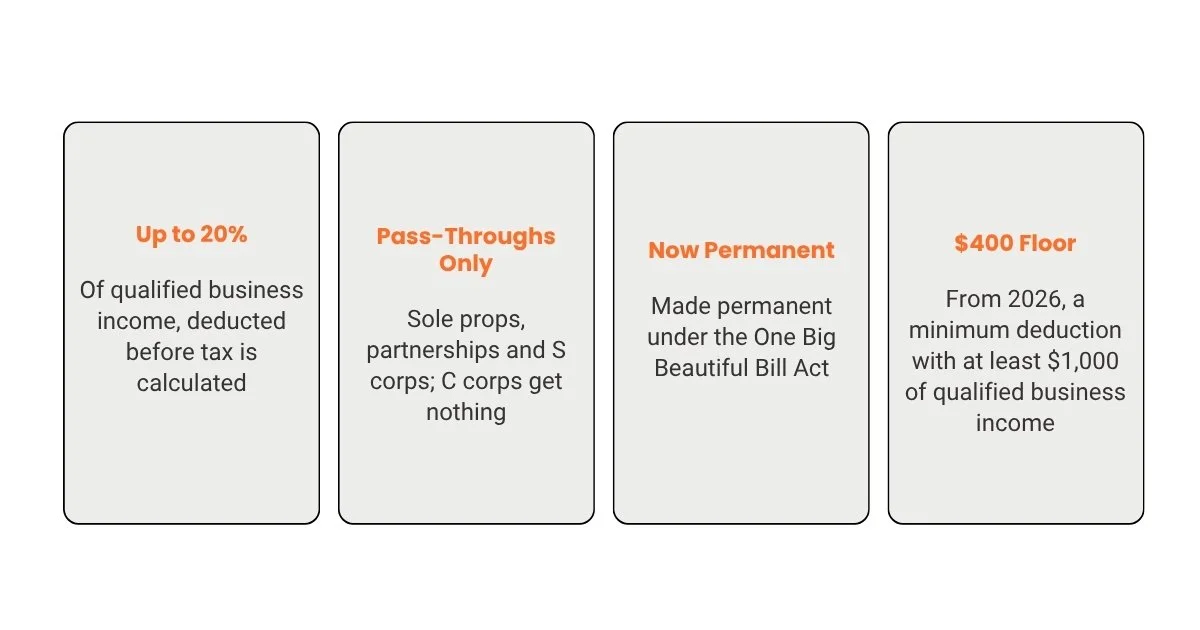
Sole proprietorships, partnerships, and S corps can generally deduct up to 20 percent of qualified business income before calculating tax, a benefit C corps don't get at all. This deduction was made permanent under recent federal legislation, the One Big Beautiful Bill Act, removing what had been a scheduled expiration. Starting in 2026, taxpayers with at least 1,000 dollars of qualified business income are also guaranteed a minimum QBI deduction of 400 dollars, even if the standard 20 percent calculation would produce less. For certain service-based businesses, the deduction phases out at higher income levels, which is worth factoring into the entity decision if that applies to your business.
How to Actually Think Through the Decision
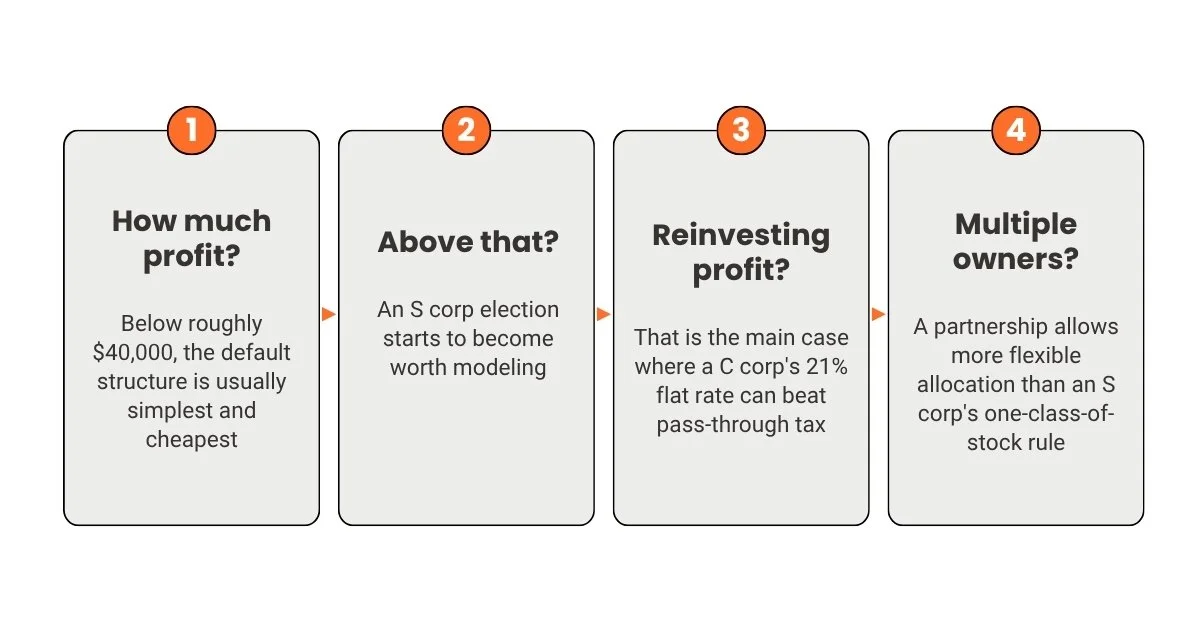
Rather than picking a structure and hoping it works out, walk through these questions in order: How much net profit does the business generate consistently? Below roughly 40,000 dollars, the default sole proprietorship or partnership structure is usually simplest and cheapest. Above that, an S corp election starts to become worth modeling. Are you planning to reinvest most profit rather than take it out? That's the main scenario where a C corp's 21 percent flat rate can beat pass-through taxation, despite the eventual double taxation on distributions. Do you have multiple owners with different roles or contributions? A partnership structure offers more flexibility in how income and losses get allocated than an S corp's stricter one-class-of-stock rule allows.
Frequently Asked Questions
-
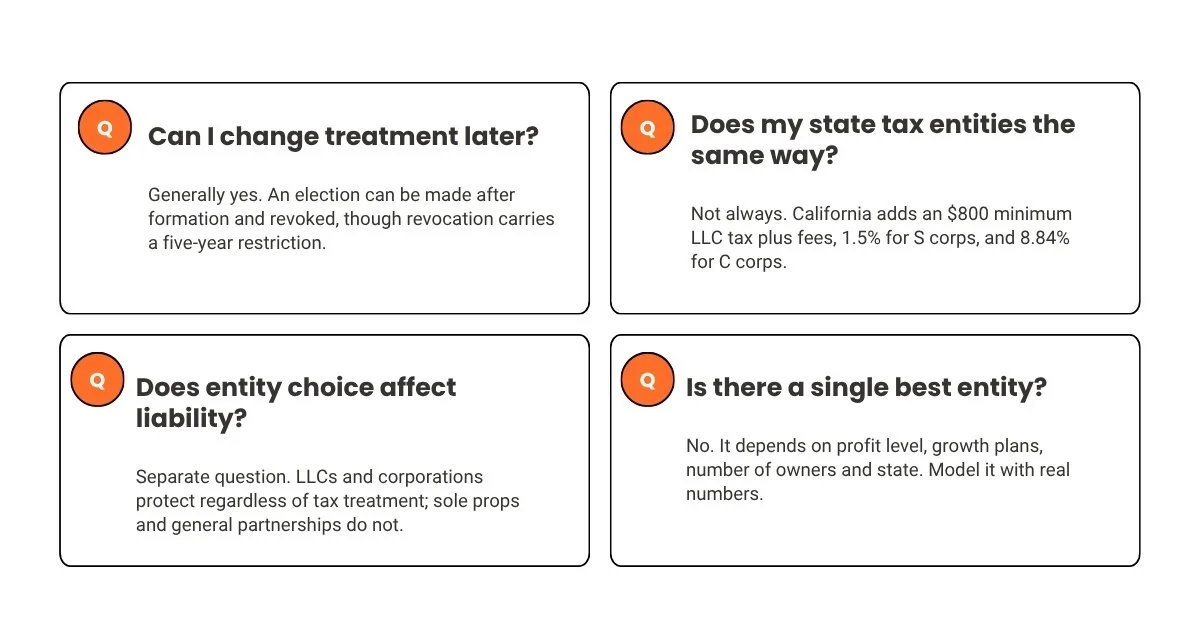
Generally yes. An LLC or corporation can elect S corp status after formation, and an S corp election can be revoked, though revocation carries a five-year restriction on re-electing without IRS consent. This is a decision worth revisiting periodically as your business grows, not a permanent lock-in.
-
Not always, and California is a good example of where it diverges. California imposes its own franchise tax structure on top of federal treatment, an 800 dollar minimum LLC tax plus gross receipts fees, or a 1.5 percent net income tax with an 800 dollar minimum for S corps, and its own 8.84 percent corporate tax rate for C corps, on top of the federal 21 percent. State-level cost is a real part of this decision, not an afterthought.
-
These are separate questions. LLCs and corporations both provide liability protection regardless of how they're taxed. A sole proprietorship and general partnership don't offer that protection at all. Tax treatment and liability protection should both factor into the decision, but they don't move together automatically.
-
No. The right structure depends on your specific profit level, growth plans, number of owners, and state. This is genuinely worth modeling with real numbers rather than following a generic recommendation, including ones in this post.
Your entity choice affects your tax bill every single year you're in business. A tax professional can model your actual numbers across structures before you commit to one.