Cost Segregation Studies: Accelerating Depreciation for Rental Property Owners
Most investors assume rental property depreciates the same way no matter what: 27.5 years for residential, 39 for commercial, straight-line, no way around it. A cost segregation study is how experienced investors legally break that assumption, by identifying parts of a building that actually qualify for much shorter depreciation schedules. It's one of the highest-impact tax strategies available to real estate investors, and one of the least understood.

What Is a Cost Segregation Study?
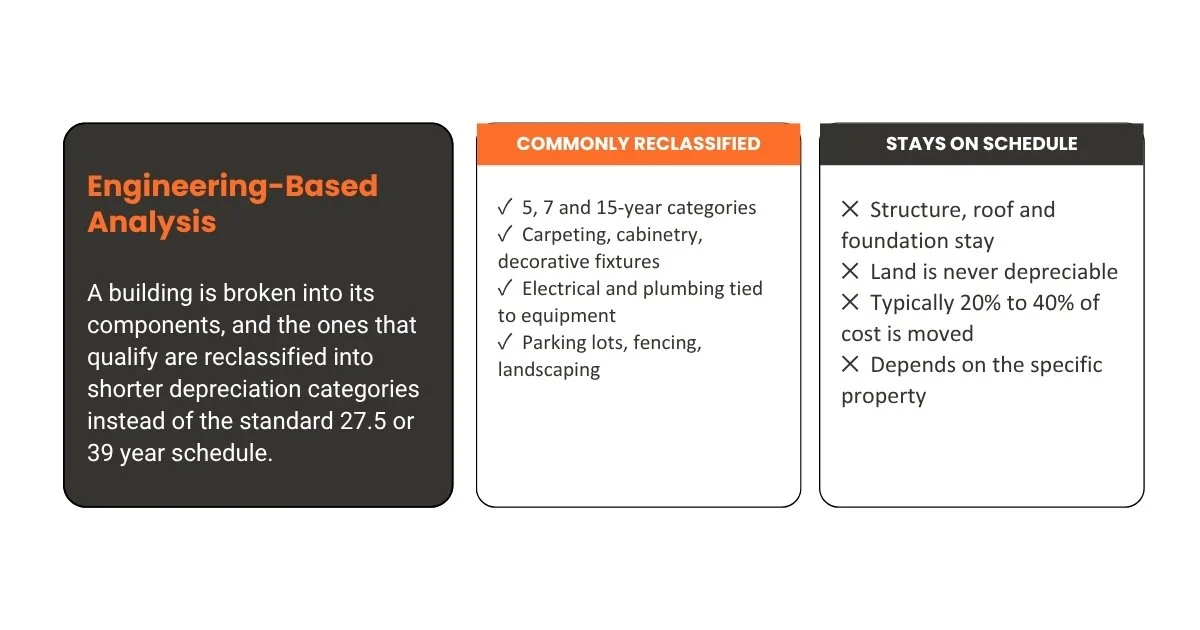
A cost segregation study is an engineering-based analysis that breaks a building down into its individual components and reclassifies the ones that qualify into shorter depreciation categories, typically 5, 7, or 15 years, instead of leaving the entire building on the standard 27.5 or 39 year schedule. Items like carpeting, certain electrical and plumbing tied to specific equipment, cabinetry, decorative fixtures, parking lots, fencing, and landscaping commonly qualify for reclassification. Depending on the property, a study can typically move 20 to 40 percent of a building's cost into these shorter categories.
How It Works With Bonus Depreciation
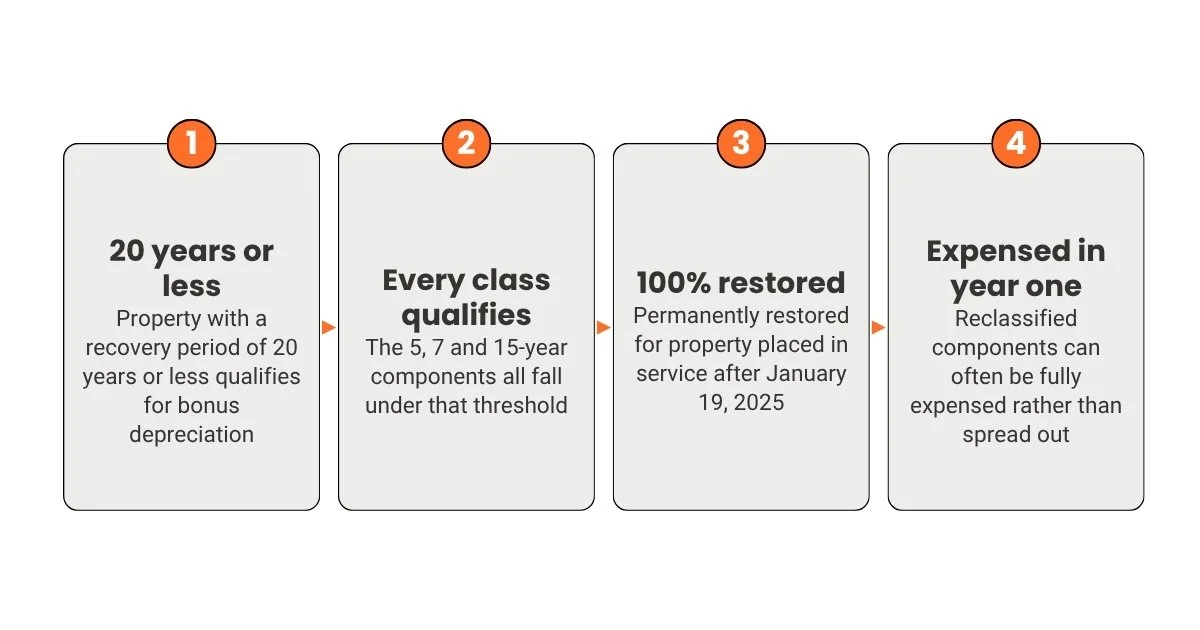
This is the part that's made cost segregation dramatically more valuable recently. Property with a recovery period of 20 years or less qualifies for bonus depreciation, and every asset class a cost segregation study identifies, the 5, 7, and 15-year components, falls under that 20-year threshold. Recent federal legislation permanently restored bonus depreciation to 100 percent for property placed in service after January 19, 2025, which means those reclassified components can often be fully expensed in year one rather than depreciated gradually. We cover the bonus depreciation rules themselves in more depth in our Section 179 vs. bonus depreciation guide. Before that legislation, bonus depreciation had been scheduled to phase down toward elimination by 2027, which made the cost segregation math far less compelling. That's no longer the case.
Who Should Consider a Cost Segregation Study?
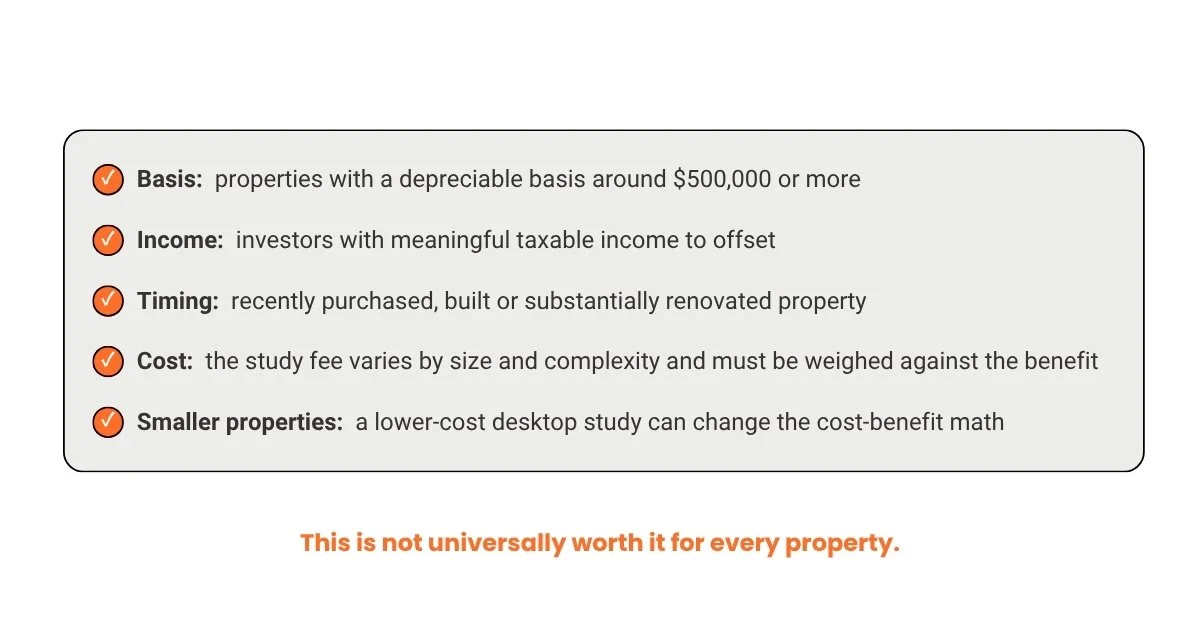
This isn't universally worth it for every property. It tends to make the most sense for properties with a depreciable basis around 500,000 dollars or more, investors with meaningful taxable income to offset, and properties that were recently purchased, built, or substantially renovated. The cost of the study itself, which varies by property size and complexity, needs to be weighed against the tax benefit. Smaller residential properties can sometimes work with a lower-cost desktop study rather than a full engineering field study, which changes the cost-benefit calculation.
The California Angle
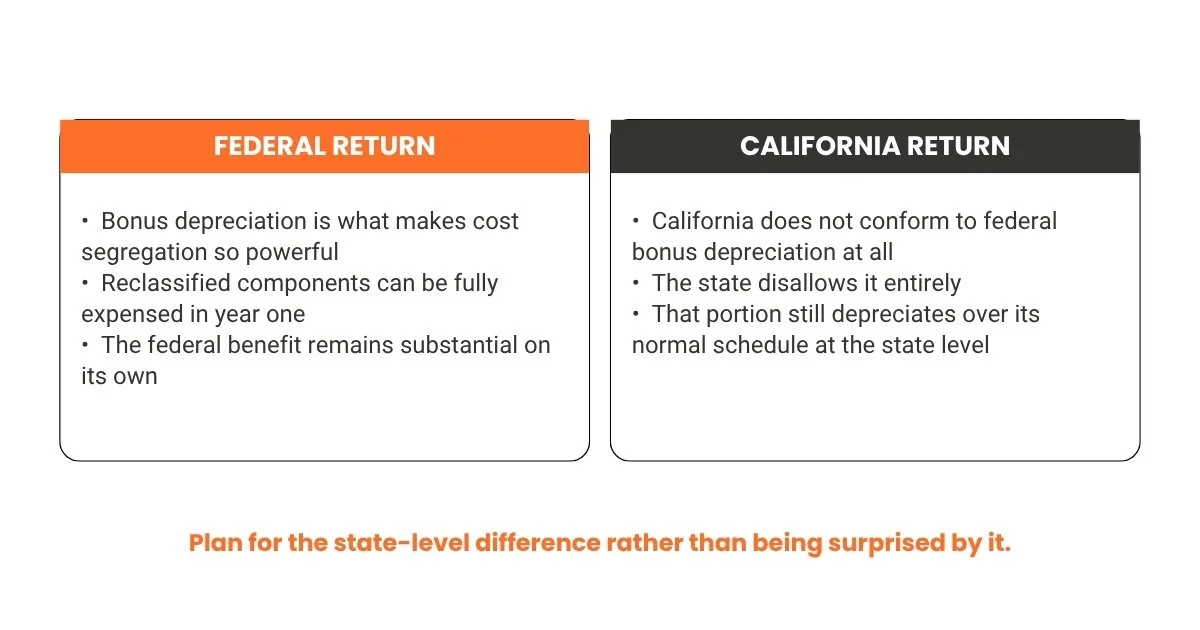
Worth flagging directly for California investors: bonus depreciation is what makes cost segregation so powerful on your federal return, but California doesn't conform to federal bonus depreciation at all. The state disallows it entirely, meaning the accelerated federal deduction from a cost segregation study doesn't flow through the same way on your California return, that portion still depreciates over its normal schedule at the state level. We go into this federal-versus-California gap in more detail in our Section 179 vs. bonus depreciation post. The federal benefit is still substantial on its own, but it's worth planning for the state-level difference rather than being surprised by it.
What the Process Actually Looks Like
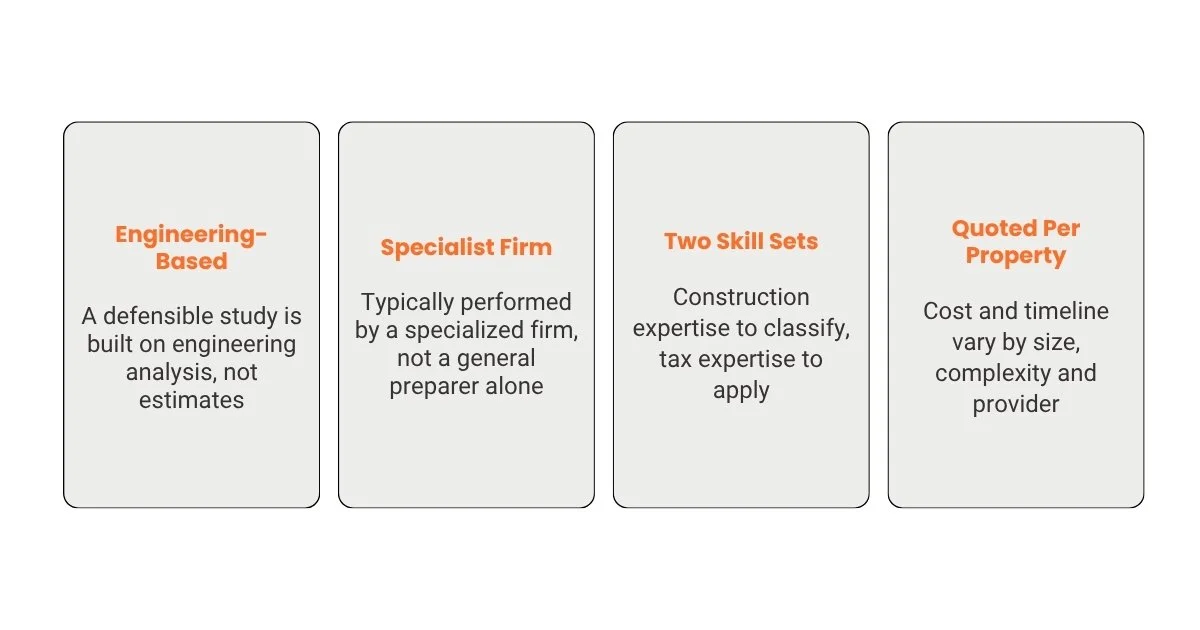
A defensible cost segregation study is engineering-based, typically performed by a specialized firm rather than a general tax preparer working alone, since it requires both construction/engineering expertise to properly classify building components and tax expertise to apply the classifications correctly. Cost and timeline vary meaningfully depending on the property's size, complexity, and the provider, so it's worth getting a specific estimate for your property rather than assuming a fixed cost.
A Simple Example
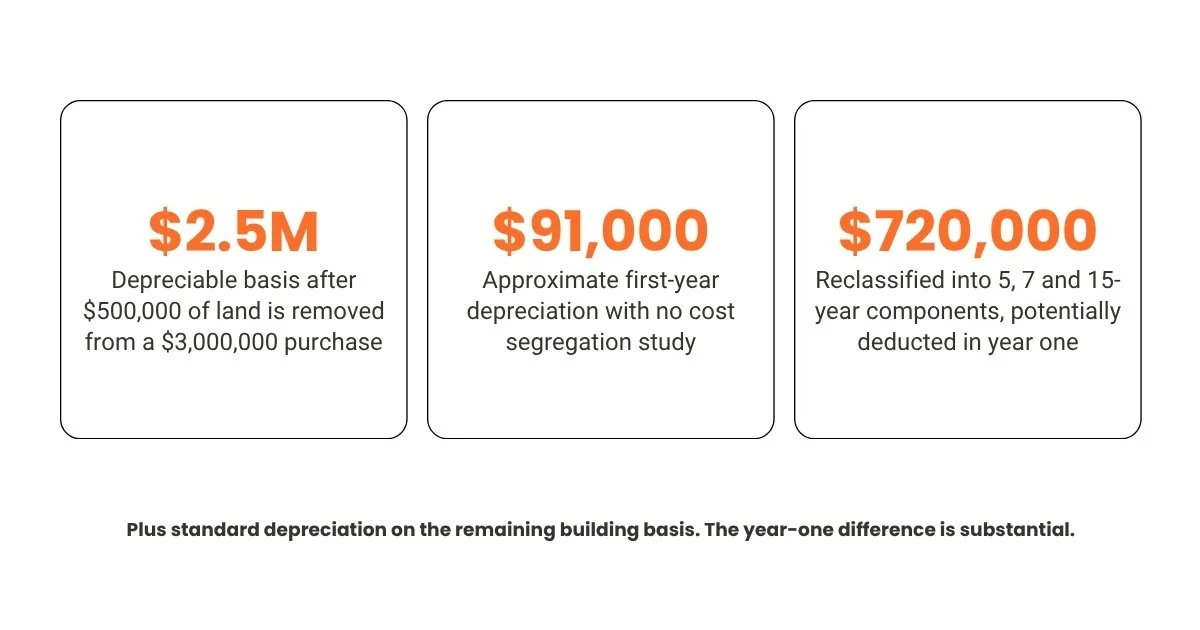
Say you purchase an apartment building for 3,000,000 dollars, with 500,000 dollars allocated to non-depreciable land, leaving a 2,500,000 dollar depreciable basis. Without a cost segregation study, straight-line depreciation on the full amount produces roughly 91,000 dollars in first-year depreciation. With a cost segregation study that reclassifies 720,000 dollars into 5, 7, and 15-year components, that entire 720,000 dollars can potentially be deducted in year one under 100 percent bonus depreciation, on top of the standard depreciation on the remaining building basis. The difference in year-one deductions is substantial.
Frequently Asked Questions
-
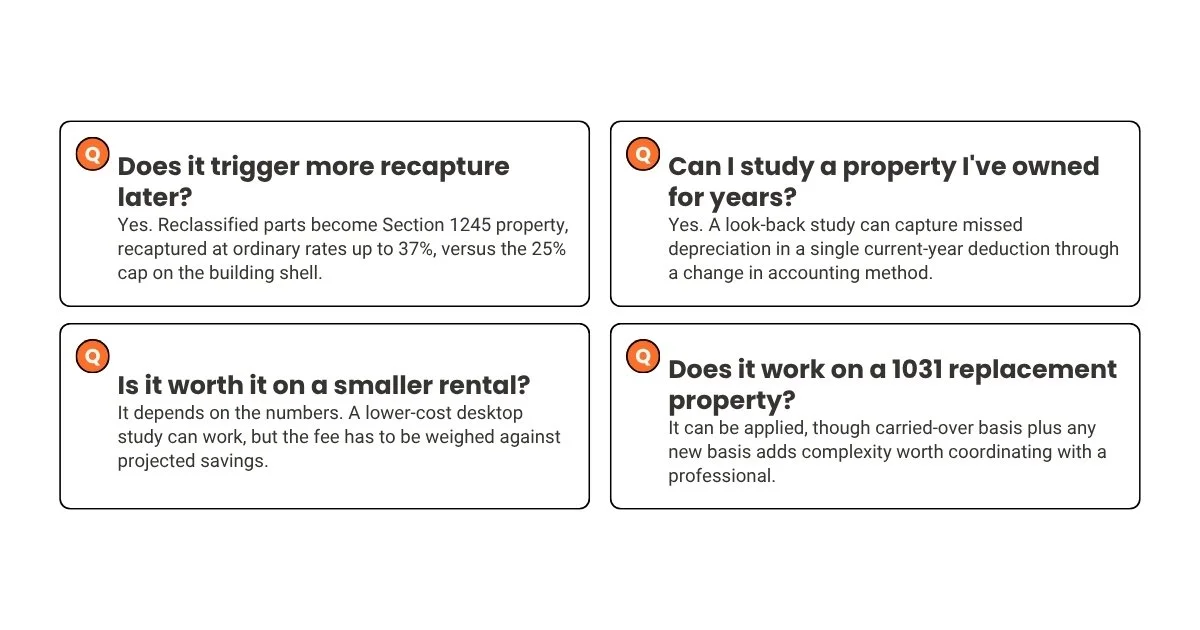
This is a genuinely important tradeoff, not just a footnote. Components reclassified through cost segregation become Section 1245 property, and on sale, all depreciation claimed on Section 1245 property is recaptured at ordinary income rates, up to 37 percent, rather than the 25 percent maximum rate that applies to unrecaptured Section 1250 gain on the building shell itself. In other words, cost segregation trades a larger, faster deduction now for a higher recapture rate on that specific portion later. For investors planning to hold the property for many years, the time value of the earlier deduction generally outweighs the eventual recapture cost, but this is worth modeling out with a tax professional rather than assuming it's a clear win in every situation, particularly for shorter holding periods.
-
Yes. A look-back study can be performed on a property you've already owned for years, and any depreciation that should have been claimed in prior years, but wasn't, can potentially be captured in a single current-year deduction through a change in accounting method, rather than requiring you to amend multiple past returns.
-
It depends on the numbers. Smaller properties can still benefit, particularly with a lower-cost desktop study rather than a full field study, but the cost of the study needs to be weighed against the projected tax savings for that specific property. This is worth a direct conversation rather than a blanket yes or no.
-
Cost segregation can be applied to a replacement property acquired through a 1031 exchange, though the interaction between the carried-over basis from the relinquished property and any new basis from additional funds invested adds complexity. This is worth coordinating directly with a tax professional given how the two strategies interact.
Cost segregation can meaningfully change what a rental property actually costs you at tax time, but it's a strategy worth modeling out carefully, not applying blindly. A tax professional can help you determine whether the numbers work for your property.