Foreign Bank Account Reporting (FBAR): Who Must File and When
If you have money in a foreign bank account, an inherited account overseas, or signature authority over an account that isn't technically yours, you may owe a filing that has nothing to do with your tax return.
It's called the FBAR, and the penalties for missing it, even accidentally, are some of the steepest in U.S. financial law. Here's who actually needs to file, when, and what's genuinely at stake.

What FBAR Actually Is
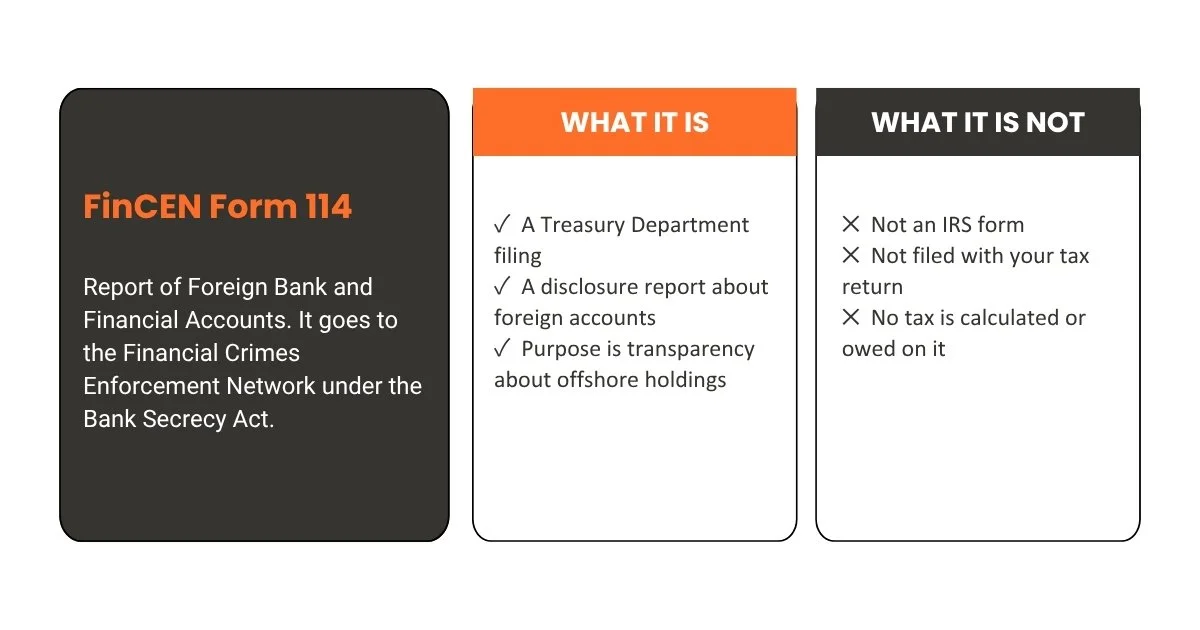
FBAR stands for Report of Foreign Bank and Financial Accounts, formally filed as FinCEN Form 114. It isn't an IRS form and isn't filed with your tax return at all. It goes to the Financial Crimes Enforcement Network, a bureau of the Treasury Department, under the Bank Secrecy Act.
It's a disclosure report, not a tax form, there's no tax calculated or owed directly on the FBAR itself. Its entire purpose is transparency: letting the government know that U.S. persons hold financial interests in accounts outside the country.
Who Has to File
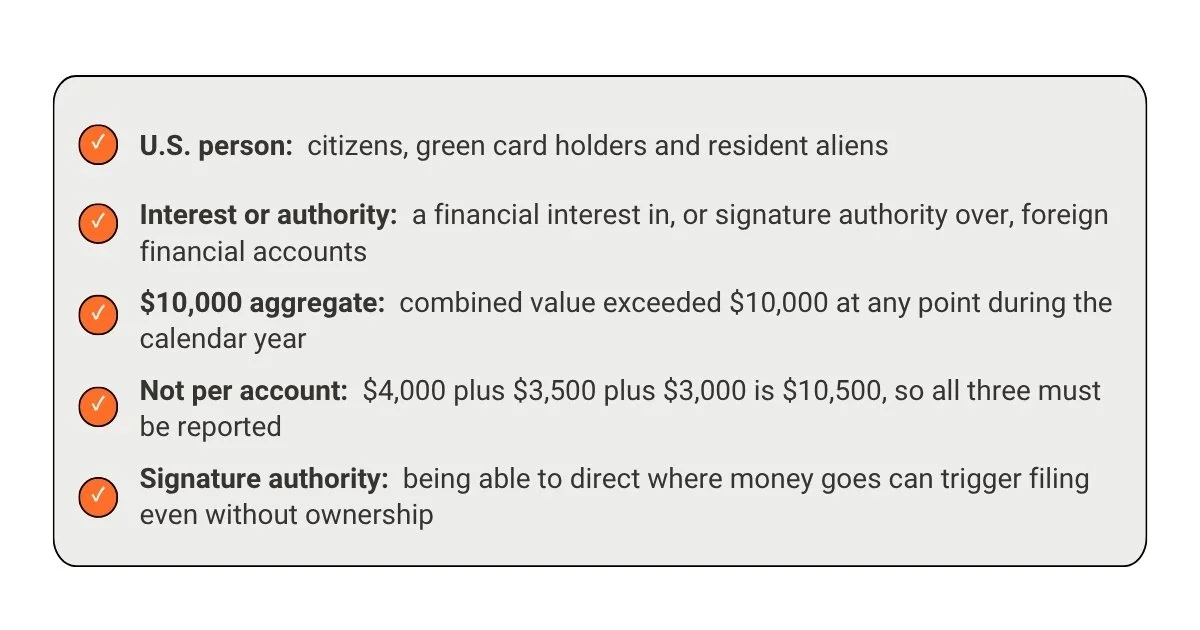
You're required to file if you're a U.S. person, which includes citizens, green card holders, and resident aliens, and you had a financial interest in, or signature authority over, one or more foreign financial accounts, where the combined value of all those accounts exceeded 10,000 dollars at any point during the calendar year.
The most common misunderstanding is assuming the 10,000 dollar threshold applies per account. It doesn't. It's an aggregate figure across every foreign account you have an interest in or authority over. If you have three accounts holding 4,000, 3,500, and 3,000 dollars respectively, that's a combined 10,500 dollars, and all three accounts must be reported, even though none individually crossed 10,000 dollars on its own.
Signature authority matters too, even without ownership. If you can direct where money goes in an account, a business account you manage but don't own, for example, that authority alone can trigger a filing requirement, separate from whether you have a personal financial stake in the account.
What Counts as the "Value" You Report
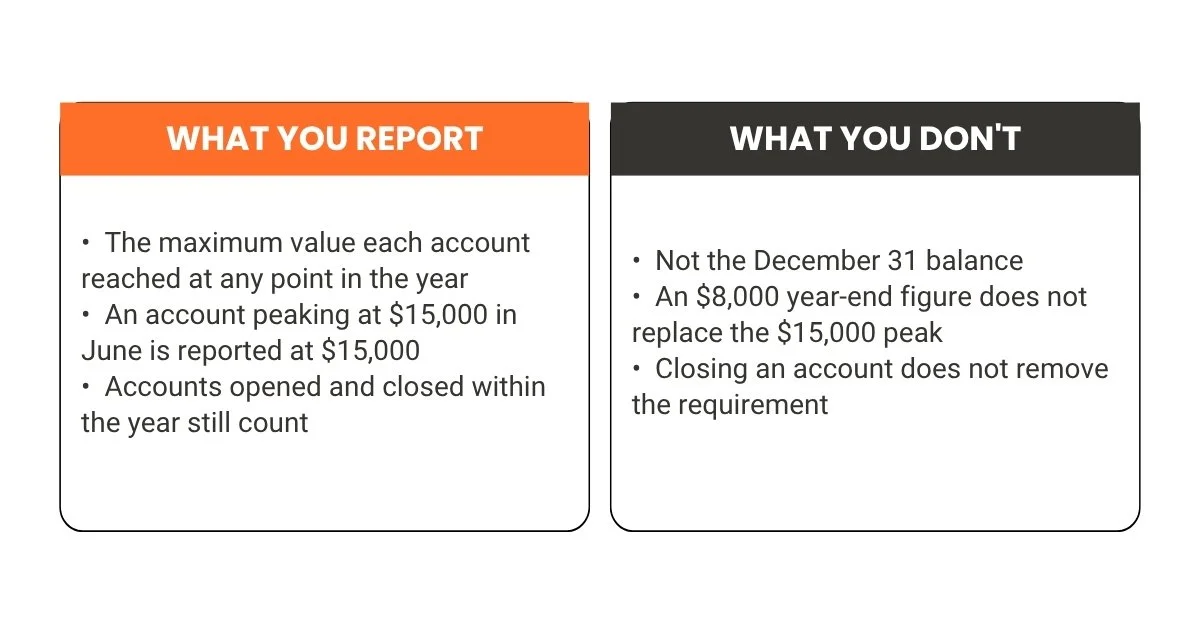
You report the maximum value each account reached at any point during the year, not the balance on December 31. If an account peaked at 15,000 dollars in June and ended the year at 8,000 dollars, you report the 15,000 dollar peak, not the lower year-end figure. Accounts you opened and closed entirely within the year still have to be reported if they crossed the threshold at any point while open.
The Deadline
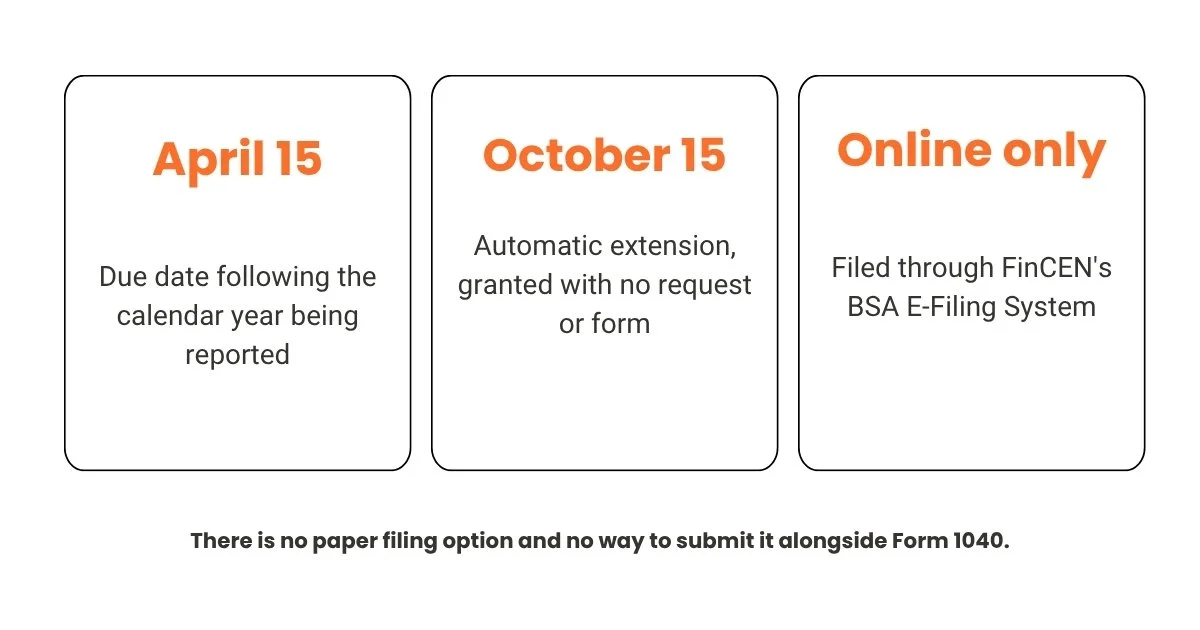
FBAR is due April 15 following the calendar year being reported, but every filer automatically receives an extension to October 15, with no request or form required to get it. It's filed exclusively online, through FinCEN's BSA E-Filing System, there's no paper filing option and no way to submit it alongside your Form 1040.
What Happens If You Don't File
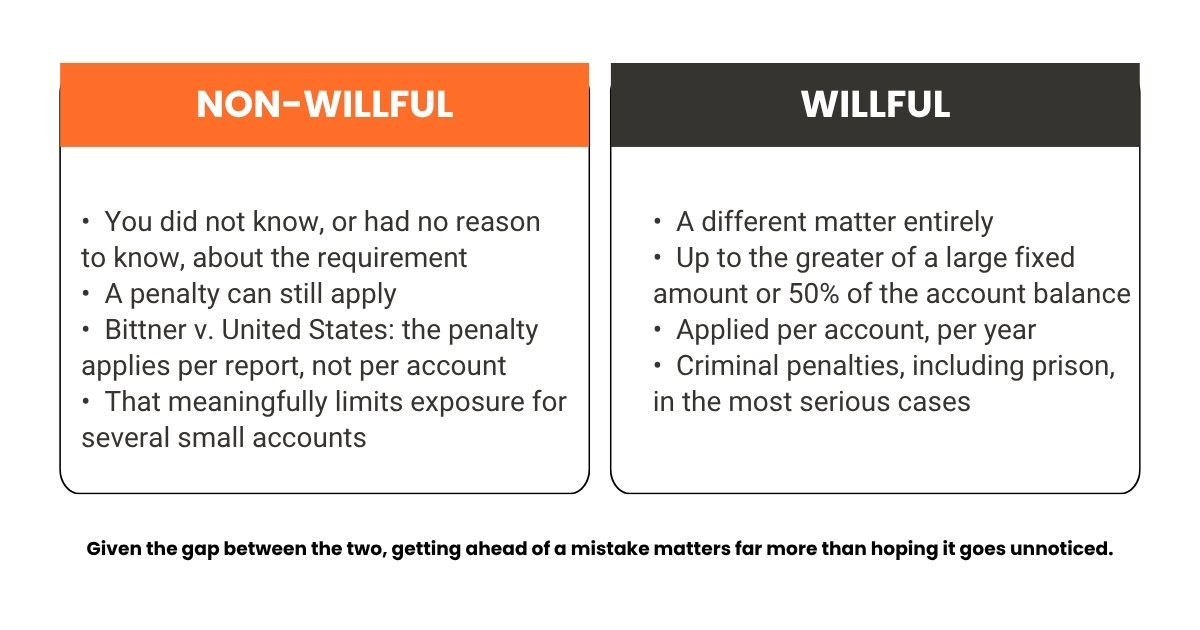
The penalty structure is genuinely severe, and it's worth understanding the distinction between the two categories. Non-willful violations, meaning you didn't know or had no reason to know about the requirement, can still result in a penalty, though a landmark Supreme Court decision, Bittner v. United States, established that the non-willful penalty applies per report, not per account, which meaningfully limits exposure for people with several small accounts who simply didn't know about the requirement.
Willful violations are a different matter entirely, penalties can reach the greater of a large fixed dollar amount or 50 percent of the account balance, per account, per year. Willful violations can also carry criminal penalties, including potential prison time, in the most serious cases. Given how severe the gap is between non-willful and willful treatment, this is exactly the kind of filing where getting ahead of a mistake matters far more than hoping it goes unnoticed.
FBAR vs. Form 8938: Two Separate Requirements
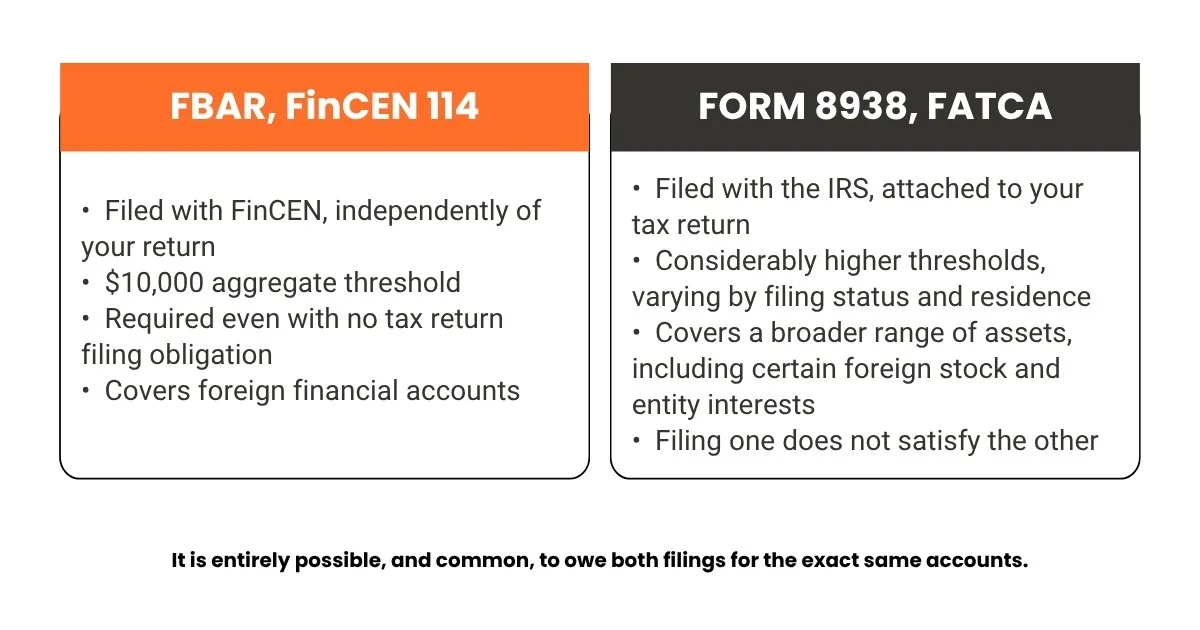
This is where a lot of confusion happens. Form 8938, filed with the IRS under FATCA rules, looks similar but is a genuinely separate requirement, different agency, different thresholds, different filing method. Form 8938 gets attached to your actual tax return, while FBAR is filed independently and has to be filed even if you don't have a filing obligation for your tax return at all. Form 8938's thresholds are considerably higher than FBAR's 10,000 dollar figure, and vary based on filing status and whether you live in the U.S. or abroad. Form 8938 also covers a broader range of assets beyond just accounts, including certain foreign stock and interests in foreign entities held directly.
It's entirely possible, and common, to owe both filings for the exact same accounts. Filing one does not satisfy the other.
Frequently Asked Questions
-
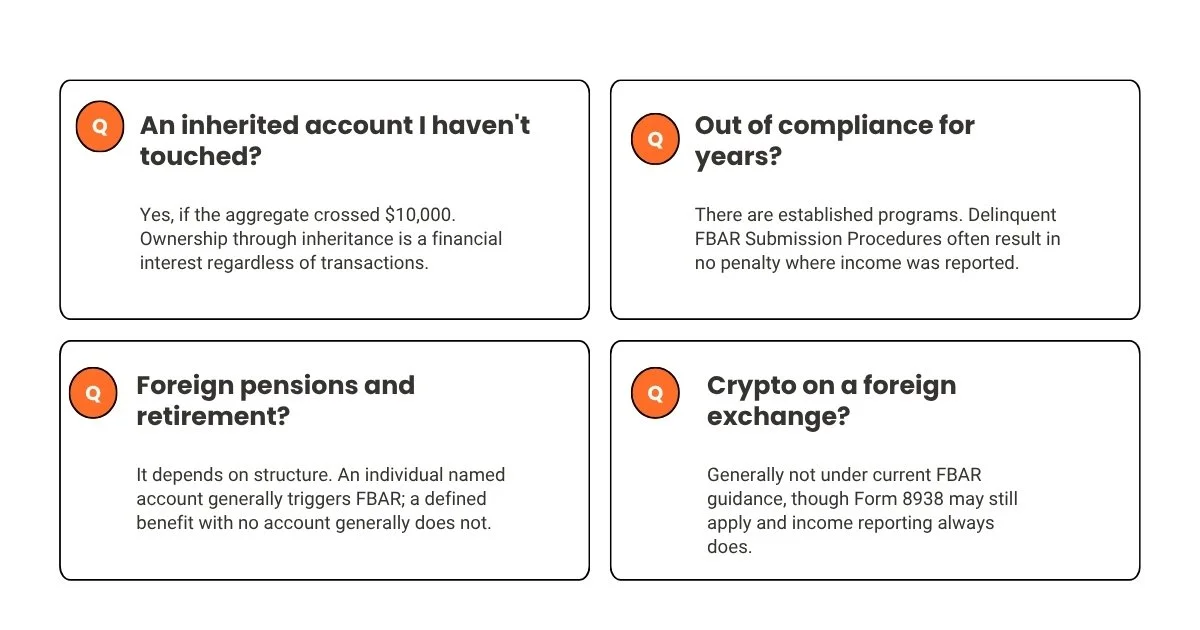
Yes, if the account's value crossed the 10,000 dollar aggregate threshold, ownership through inheritance still counts as a financial interest, regardless of whether you've made any transactions.
-
There are established programs for catching up. If you've reported all the related income on your tax returns but simply missed the FBAR itself, the Delinquent FBAR Submission Procedures often result in no penalty at all. For more complex situations involving unreported income, the IRS Streamlined Filing Compliance Procedures may apply, with different outcomes depending on whether you were living in the U.S. or abroad during the years in question. This is genuinely worth addressing proactively with a professional rather than waiting.
-
It depends on the structure. A foreign pension with an individual, named account, similar to certain overseas retirement plans, generally does trigger FBAR if it crosses the threshold. A pension that pays a defined benefit without an individual account generally does not. This distinction is genuinely technical and worth confirming for your specific plan rather than assuming either way.
-
Currently, FBAR generally does not apply to crypto held on a foreign exchange under existing guidance, though Form 8938 reporting may still apply depending on the value involved, and all crypto transactions remain reportable for income tax purposes regardless. This is an evolving area worth confirming given how actively crypto reporting rules have been changing.
FBAR penalties escalate quickly once a filing is missed, and the difference between willful and non-willful treatment can be enormous. A tax professional can help you determine what's actually required and get caught up cleanly if you've fallen behind.