Here's the answer a lot of people don't expect: for federal tax purposes, a single-member LLC and a sole proprietorship are taxed exactly the same way, by default. Forming an LLC doesn't change your tax bill on its own.
What it changes is liability protection, and it opens a door to an S corp election down the road that a sole proprietorship can't access nearly as cleanly. Here's how to actually think through the decision.

Federally, They're the Same Thing
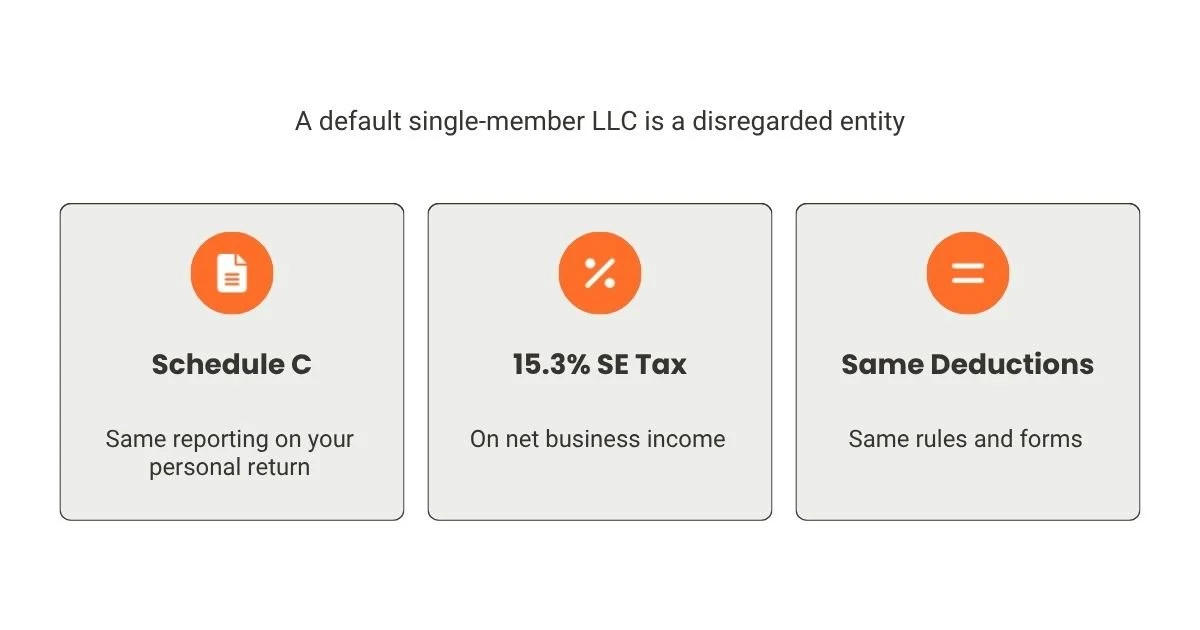
A single-member LLC that hasn't made any special election is treated by the IRS as a disregarded entity, meaning it's ignored for federal tax purposes and taxed exactly like a sole proprietorship.
Both report business income and expenses on Schedule C of the owner's personal return. Both pay self-employment tax, the full 15.3 percent, on net business income, we cover the mechanics in our self-employment tax guide. Both take the same deductions, follow the same rules, and file the same forms. There's no federal tax advantage to forming an LLC in its default configuration, none.
So What's the Point of Forming an LLC?
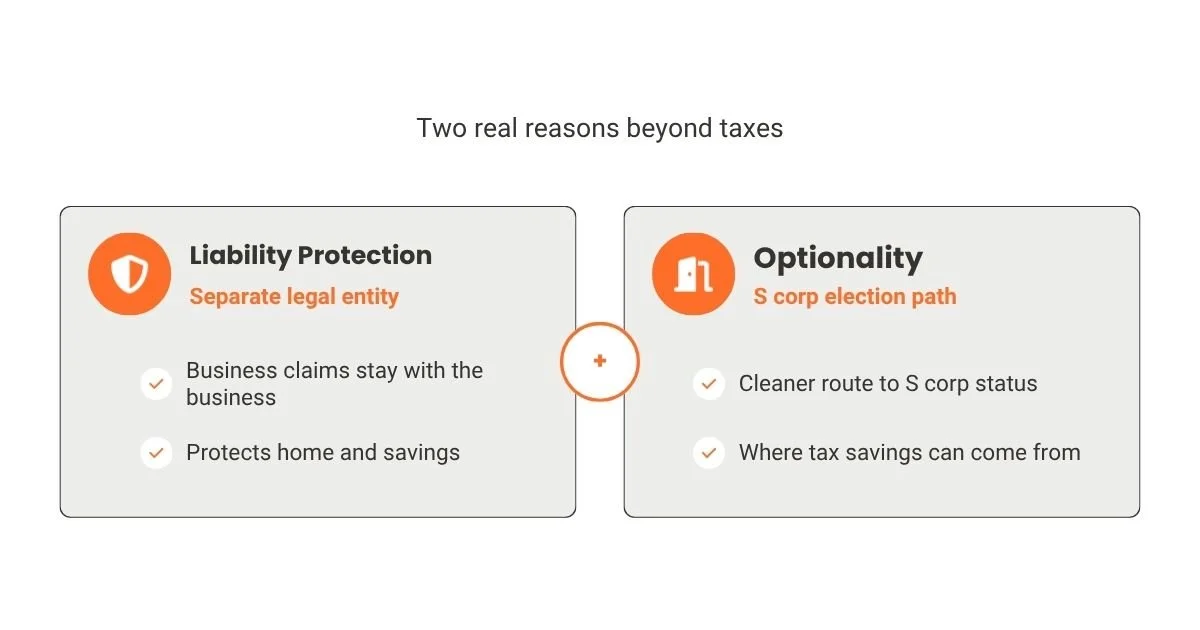
Liability protection is the real reason, and it's not a small one. A sole proprietorship creates no legal separation between you and the business, if the business gets sued or can't pay a debt, your personal assets, your home, your personal savings, are directly exposed. An LLC creates a separate legal entity, and in most circumstances, a lawsuit against the business stays limited to the business's assets rather than reaching your personal property.
For anyone with real liability exposure, client-facing work, physical premises, products, contracts, this protection alone often justifies the LLC regardless of any tax consideration.
The second reason is optionality. An LLC can elect S corp tax treatment, which we cover in our SMLLC S corp election guide, in a way that's considerably more straightforward than trying to get similar treatment as a sole proprietorship.
This election is where actual tax savings can eventually come from, but it requires the LLC structure to already be in place.
The California Cost Difference
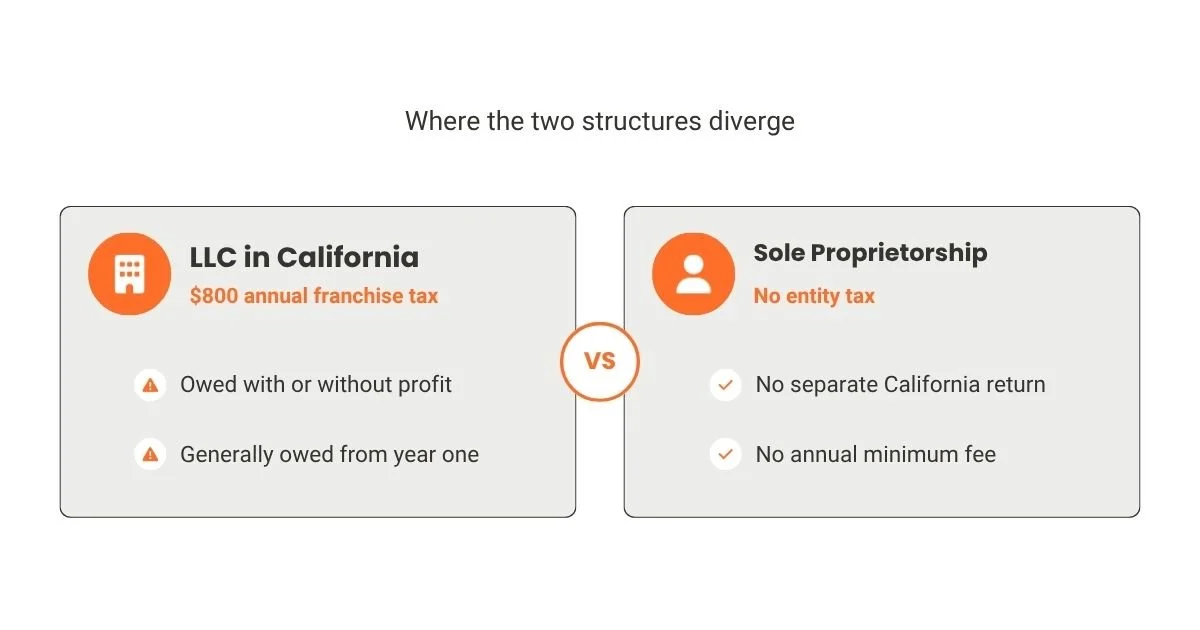
This is where the two structures genuinely diverge, and it's a real, recurring cost specific to operating in California. An LLC registered or doing business in California owes the state's 800 dollar annual franchise tax, and recent changes eliminated the first-year exemption that previously applied to newly formed LLCs, meaning new LLCs now generally owe this tax starting in their first year, not just their second. This tax applies regardless of whether the business made any money.
A sole proprietorship has no equivalent state-level entity tax, no separate California return beyond your personal filing, and no annual minimum fee just for existing. We cover the full mechanics in our California LLC franchise tax guide.
For a business just testing an idea, with minimal liability exposure and uncertain revenue, this 800 dollar annual cost is a real factor worth weighing against the liability protection benefit. For a business with genuine liability exposure or meaningful, consistent revenue, the calculation usually favors the LLC despite the added cost.
When a Sole Proprietorship Still Makes Sense
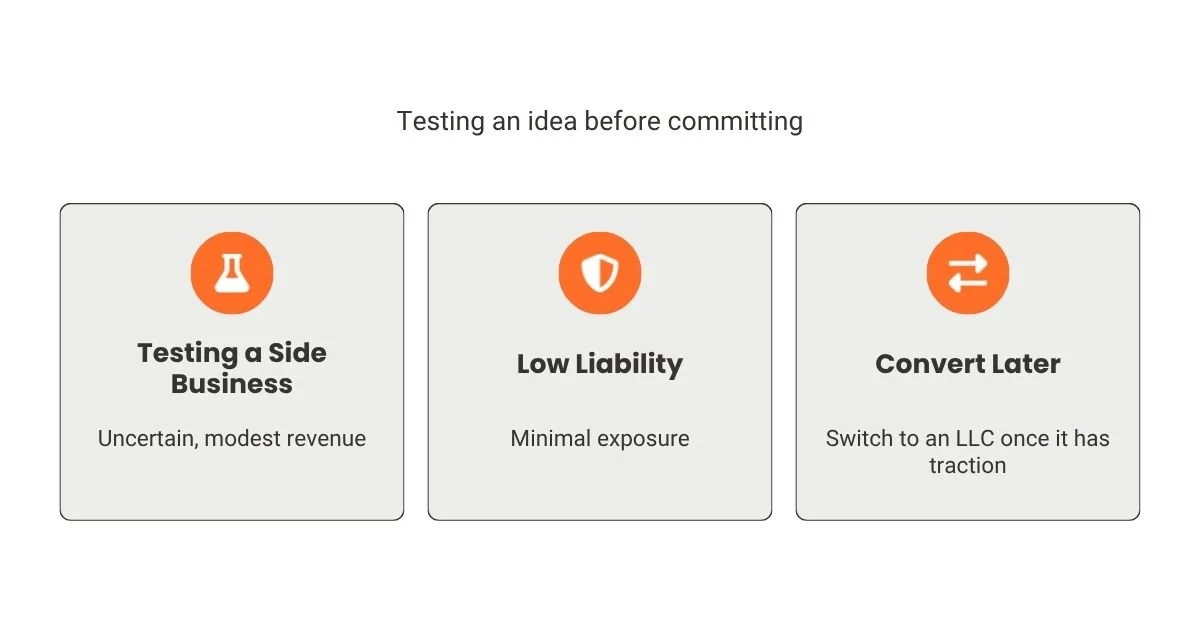
If you're testing a side business with uncertain, likely modest revenue, and your liability exposure is genuinely low, a sole proprietorship lets you operate with zero formation cost and no annual California franchise tax while you find out whether the business has real traction.
There's nothing wrong with starting this way and converting to an LLC once the business proves itself, switching mid-year is common and straightforward.
When the LLC Is Worth It
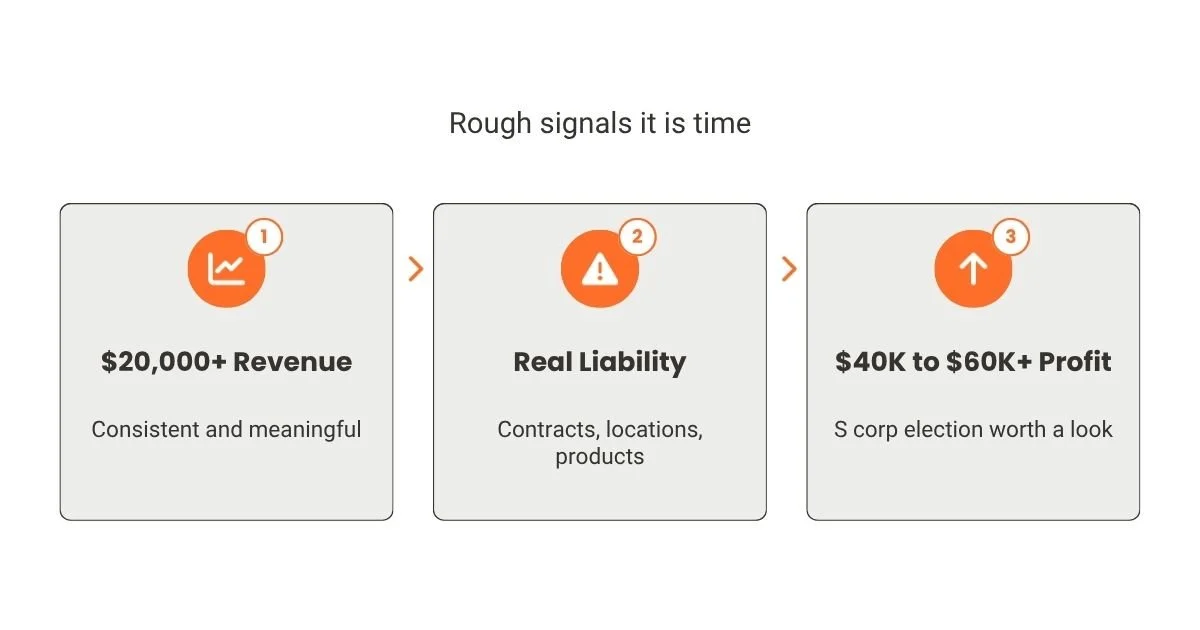
Once a business generates consistent, meaningful revenue, generally somewhere in the range of 20,000 dollars annually or more as a rough starting point, or carries real liability exposure regardless of revenue level, client contracts, physical business locations, products sold to the public, the liability protection alone tends to justify the LLC's added cost and paperwork.
And once profit climbs into a range where an S corp election starts to make sense, generally somewhere above 40,000 to 60,000 dollars in net profit as we've discussed elsewhere, having the LLC structure already in place makes that next step considerably smoother.
Frequently Asked Questions
-
Not by itself. Self-employment tax treatment is identical between a sole proprietorship and a default, disregarded-entity LLC, both pay SE tax on the full net business income.
Only an S corp election, layered on top of the LLC, changes that calculation.
-
No, sole proprietors can generally open business accounts using a DBA and their Social Security number or an EIN, though many banks and lenders do view an LLC as more credible or established, which can matter for financing or larger client relationships.
-
Yes, this is a common and generally straightforward transition.
It typically involves forming the LLC, transferring existing contracts, licenses, and accounts to the new entity, and updating your business's operating documentation, without needing to rebuild the business from scratch.
-
No. LLC liability protection has real limits, it doesn't shield you from your own personal negligence or wrongdoing, and courts can disregard the LLC's protection entirely in cases where personal and business finances weren't kept properly separate.
The protection is real, but it depends on maintaining the LLC correctly, not just having formed one.
Whether an LLC is worth the added California cost depends on your specific liability exposure and revenue trajectory.
A tax professional can help you weigh the real numbers rather than a generic rule of thumb.