Most charitable giving only produces a tax benefit if you itemize your deductions, and since the standard deduction roughly doubled a few years back, most retirees no longer do. A Qualified Charitable Distribution sidesteps that problem entirely. For IRA owners 70 and a half or older, it's often the single most tax-efficient way to give, and it can do more than just avoid tax on the distribution itself.

How It Works
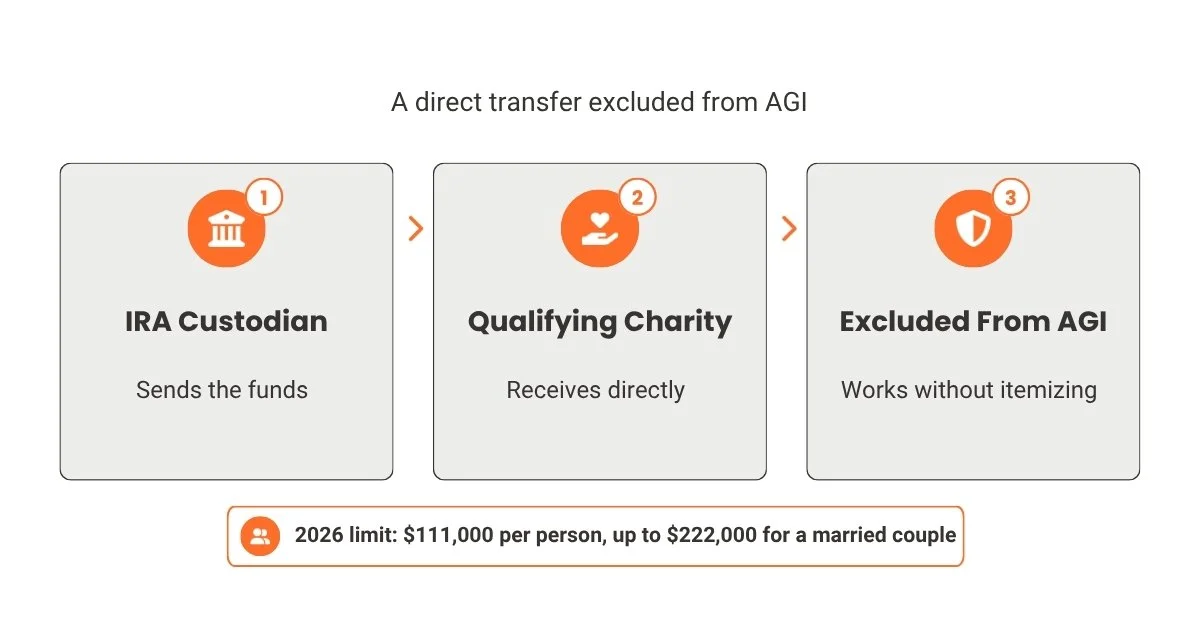
A QCD is a direct transfer from your traditional IRA to a qualifying charity, made by your IRA custodian, not routed through you personally. Because the money never technically passes through your hands as taxable income, it's excluded from your adjusted gross income entirely, not merely deducted. That distinction matters enormously: an exclusion helps you whether or not you itemize, while a deduction only helps if you do.
The annual limit for 2026 is 111,000 dollars per person, up from 108,000 dollars in 2025, since this limit has been indexed for inflation each year starting in 2024. Each spouse with their own IRA can make a QCD up to their own limit, so a married couple could direct as much as 222,000 dollars to charity in 2026 without any of it counting as taxable income.
Who Qualifies
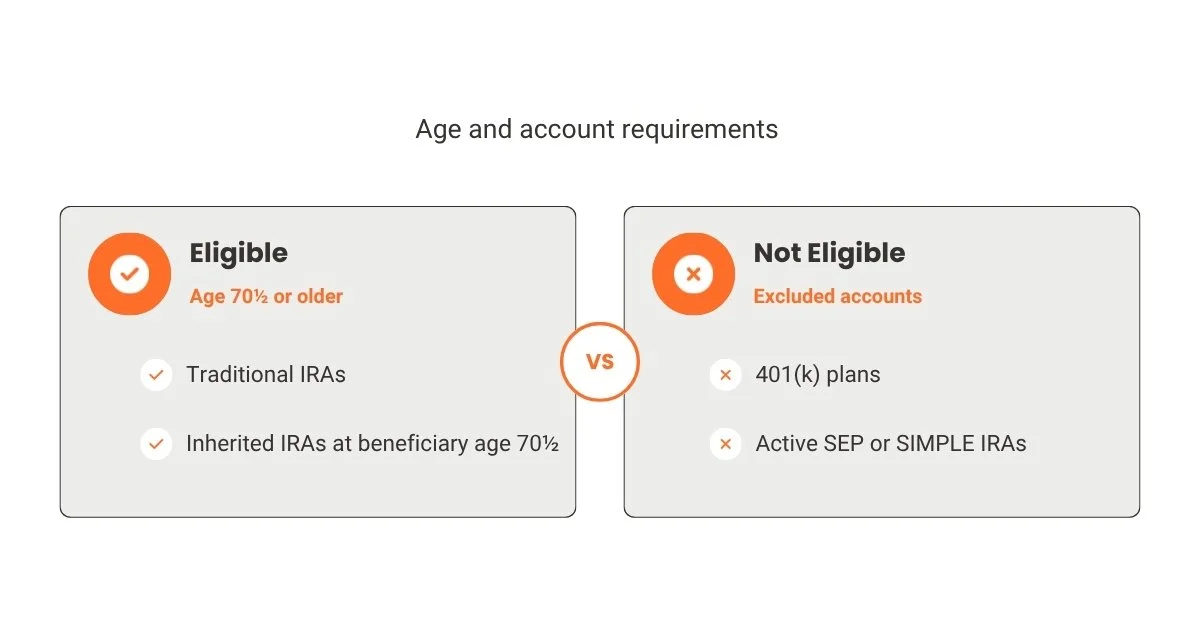
You have to be at least 70 and a half years old on the date of the distribution, this is a firm requirement, and notably a different, lower age threshold than the age your Required Minimum Distributions actually begin, 73 or 75 depending on your birth year under current law. That gap matters: you can start making QCDs years before RMDs are even required, which can be a genuinely useful way to draw down a large IRA balance ahead of forced distributions.
QCDs work from traditional and inherited IRAs. They generally don't work from an ongoing SEP or SIMPLE IRA still receiving employer contributions, and they don't work from a 401(k) at all. An inherited IRA beneficiary can make QCDs too, but only once that beneficiary personally reaches 70 and a half, a younger beneficiary inheriting from an older original owner doesn't qualify simply because the original owner would have.
QCDs and Your RMD
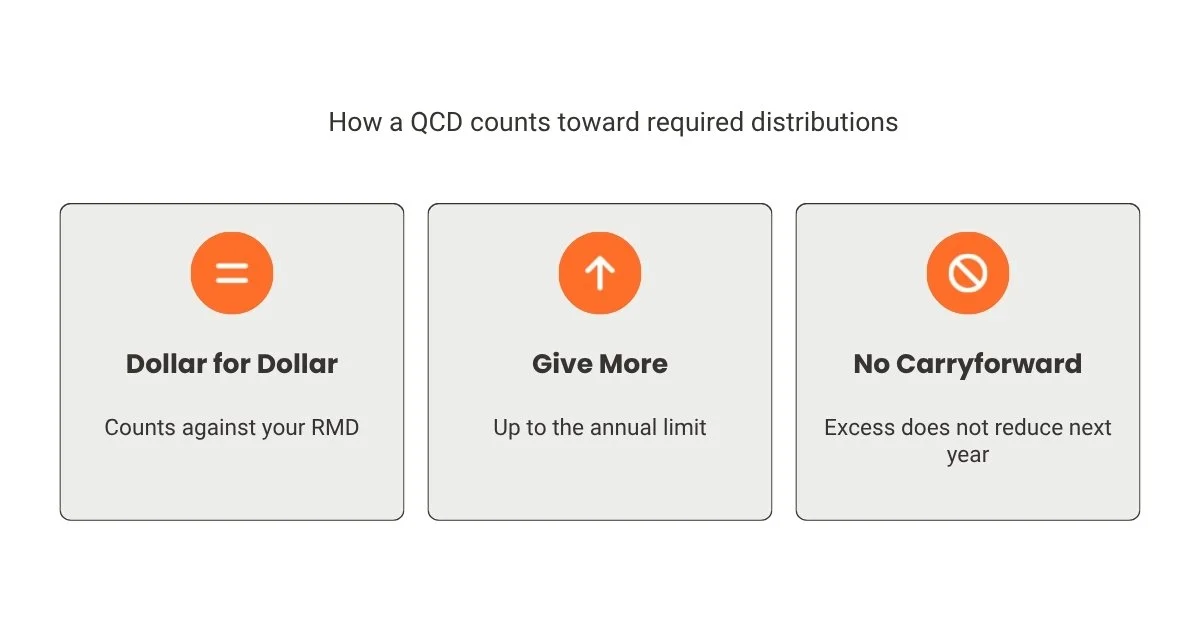
A QCD counts dollar for dollar against your Required Minimum Distribution for the year, we cover RMD mechanics in full in our RMD rules guide. You can give more than your RMD amount through a QCD if you want to, up to the annual limit, but any excess doesn't carry forward or reduce next year's requirement, each year's QCD and RMD are calculated independently.
A Benefit That Goes Beyond the Immediate Exclusion
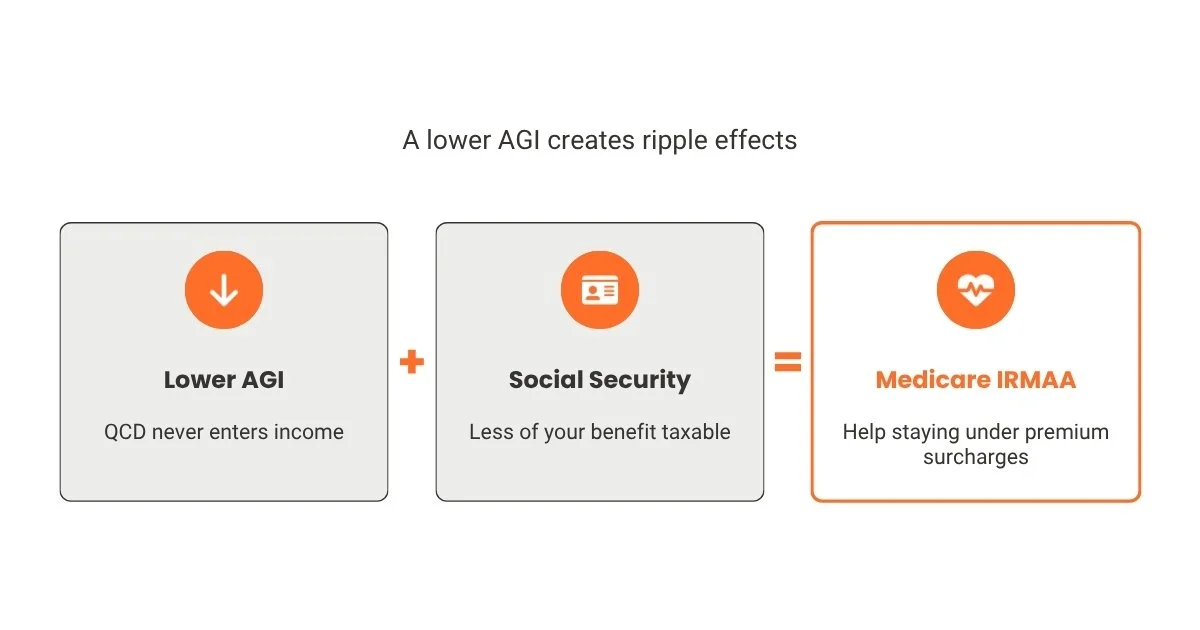
Because a QCD never enters your AGI in the first place, it can have ripple effects well beyond the charitable giving itself. A lower AGI can reduce how much of your Social Security benefit becomes taxable, which we cover in our Social Security taxability guide, since that calculation is based directly on a combined income figure built from AGI. It can also help keep you under the income thresholds that trigger higher Medicare Part B and Part D premiums through IRMAA surcharges. For a retiree who's charitably inclined anyway, a QCD can genuinely do more collective work than simply writing a check and hoping to itemize.
The New Split-Interest Option
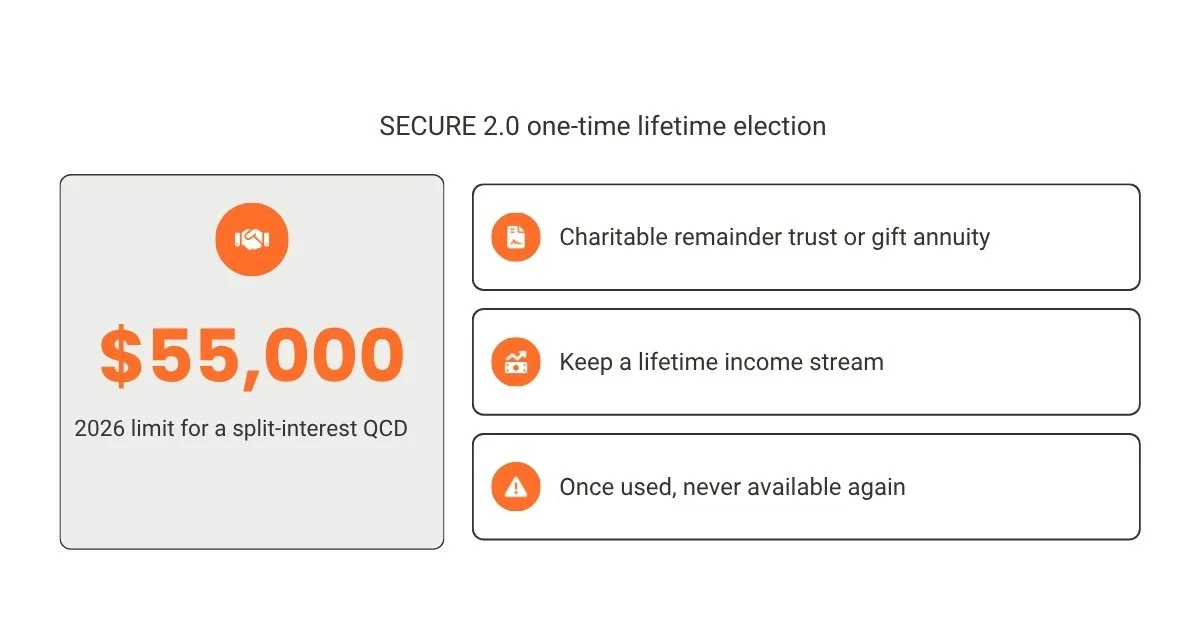
Recent legislation, SECURE 2.0, added a one-time opportunity to direct up to 55,000 dollars for 2026, up from 54,000 dollars in 2025, of a QCD toward a charitable remainder trust or charitable gift annuity, rather than directly to a public charity. This split-interest option lets you retain an income stream from the transferred funds during your lifetime, with the remainder eventually going to charity. It's genuinely a one-time, lifetime election, once used, in any amount, it's no longer available in future years, and it counts against your regular annual QCD limit for that year rather than being an additional amount on top of it.
Two Traps Worth Knowing About
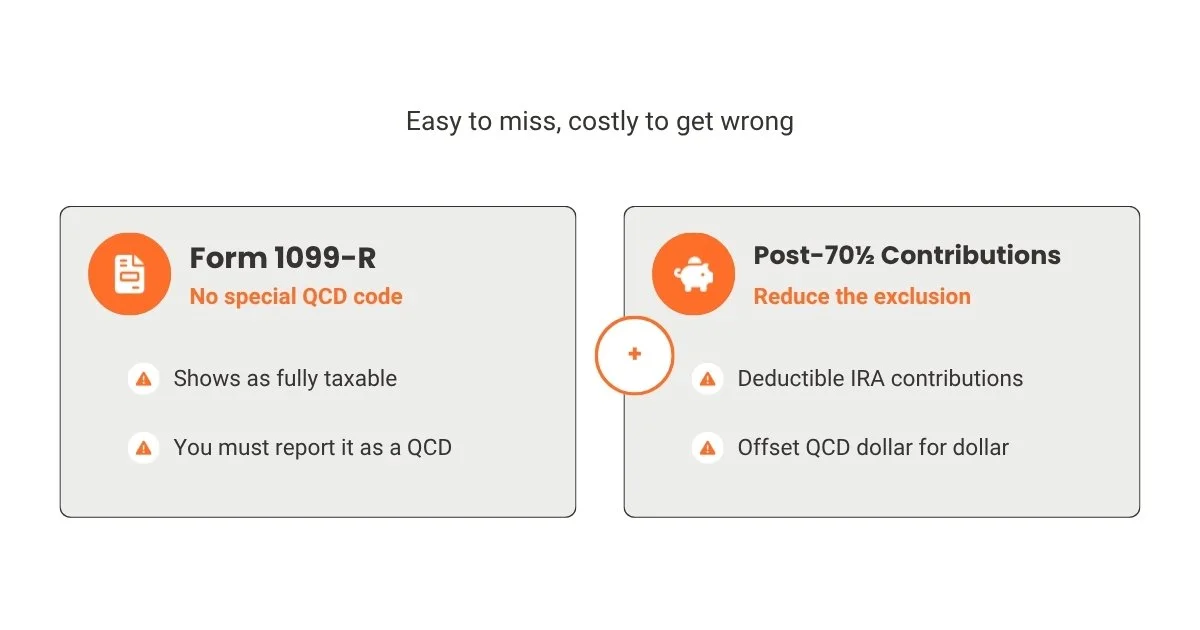
First, since IRA custodians report a QCD on Form 1099-R exactly like any other ordinary distribution, there's no special code identifying it as a QCD. The full gross amount shows up in Box 1 as if it were fully taxable. It's entirely on you, or your tax preparer, to correctly report it as a non-taxable QCD on your Form 1040. Missing this step means paying tax on money that should have been excluded.
Second, there's a specific anti-abuse rule for anyone still making deductible traditional IRA contributions after age 70 and a half. If you do, the amount you're able to exclude as a QCD gets reduced dollar for dollar by those contributions, under a specific ordering rule. This is a narrow situation, but worth knowing about if you're still working and contributing to a traditional IRA past 70 and a half while also planning to make QCDs.
Frequently Asked Questions
-
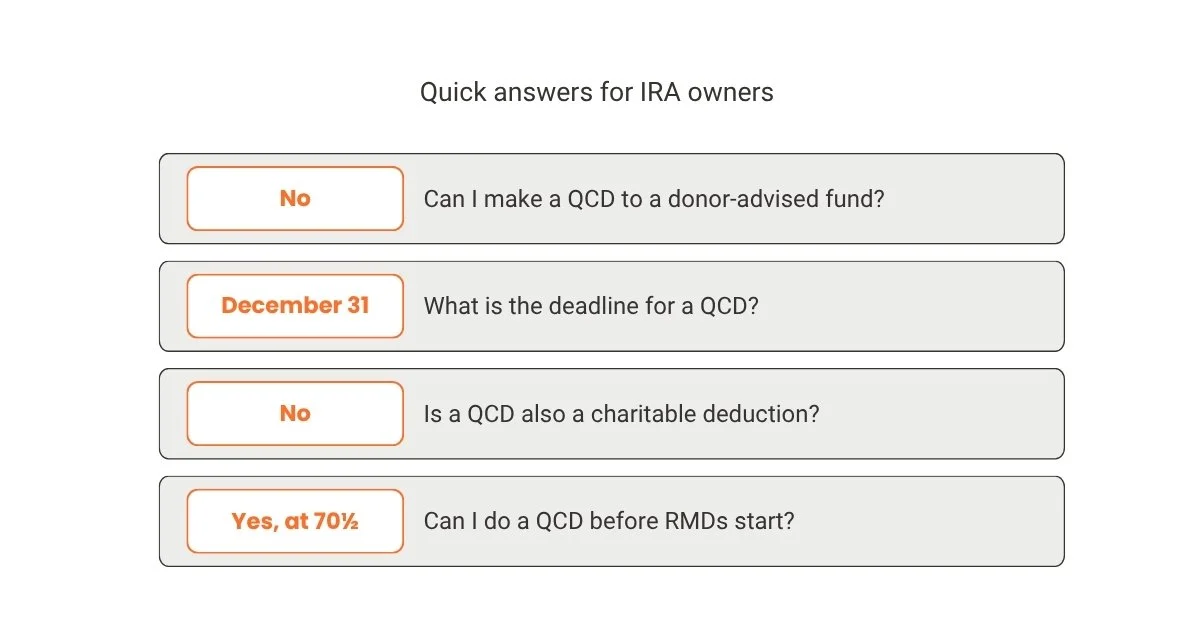
No. QCDs have to go directly to a qualifying public charity, donor-advised funds and private foundations generally don't qualify as recipients for this specific provision, even though they're common vehicles for other types of charitable giving.
-
December 31 of that tax year, the same as the deadline for taking your RMD. Given how the timing needs to line up with your custodian, and how December can get busy with other year-end coordination, initiating a QCD well before the deadline rather than waiting until the last week of the year is worth building into your routine.
-
No, and this is an important distinction. A QCD isn't reported as an itemized charitable deduction at all, it's excluded from income directly. You can't claim it as a deduction on Schedule A in addition to excluding it from income, that would be claiming the same benefit twice.
-
Yes, as long as you've reached 70 and a half, regardless of whether your RMDs have actually started yet based on your birth year. This is a meaningful planning opportunity for anyone in that gap between 70 and a half and their actual RMD start age.
A Qualified Charitable Distribution can support causes you care about while genuinely lowering your tax bill in ways that go beyond the giving itself. A tax professional can help you time it correctly and make sure it's reported properly.