The Qualified Business Income deduction lets S corp owners deduct up to 20 percent of their business income before calculating tax, on top of whatever other deductions apply. It's one of the most valuable pass-through tax breaks available, and it was made permanent by recent federal legislation after originally being scheduled to expire. But for S corp owners specifically, the number you actually get is directly tied to a decision you already make every year: your own salary.
What Counts as QBI for an S Corp Owner

Your Qualified Business Income is the net income reported on your Schedule K-1 from the S corp, not the company's total profit. Critically, your own W-2 salary as a shareholder-employee is not included in QBI, since reasonable compensation is treated as wage income, not business profit passing through to you. This means the higher your salary, the lower your remaining K-1 income, and the lower your QBI base the 20 percent deduction gets calculated against.
Say your S corp earns 200,000 dollars in profit and you pay yourself an 80,000 dollar salary. Your QBI is the remaining 120,000 dollars, not the full 200,000 dollars, so your starting deduction calculation is 20 percent of 120,000 dollars, 24,000 dollars, before any other limitations apply.
Below the Income Threshold, It's Straightforward
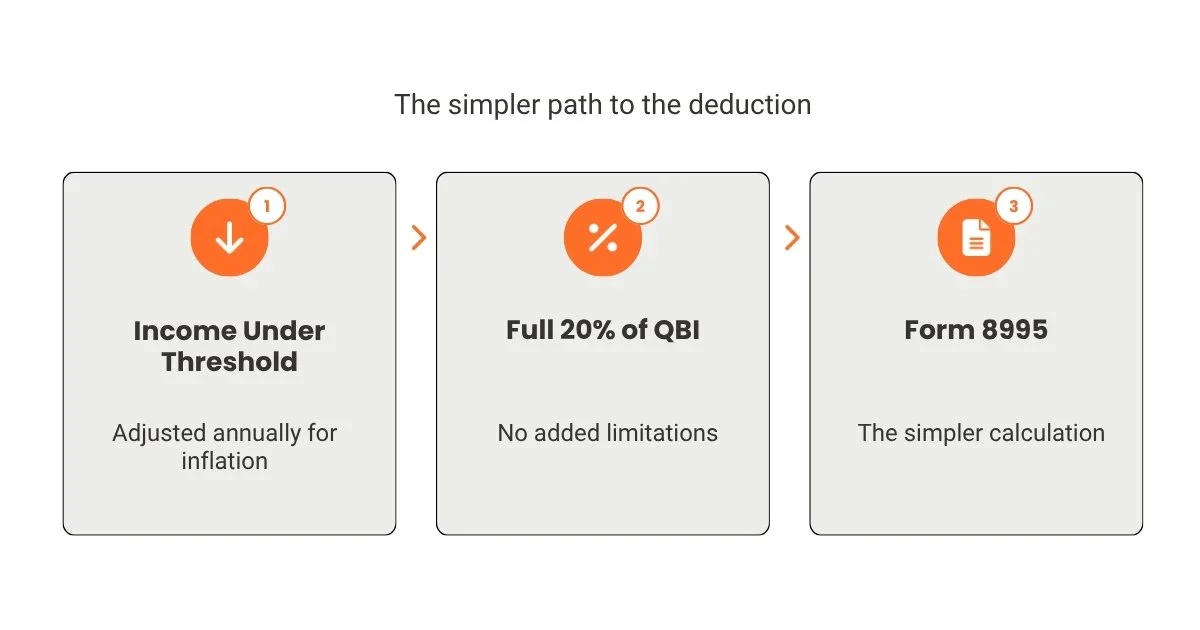
If your total taxable income falls under a threshold that adjusts annually for inflation, you generally get the full 20 percent deduction on your QBI without additional limitations, calculated on the simpler Form 8995. Above that threshold, two additional limitations can come into play depending on your business type and specifics.
The W-2 Wage Limitation
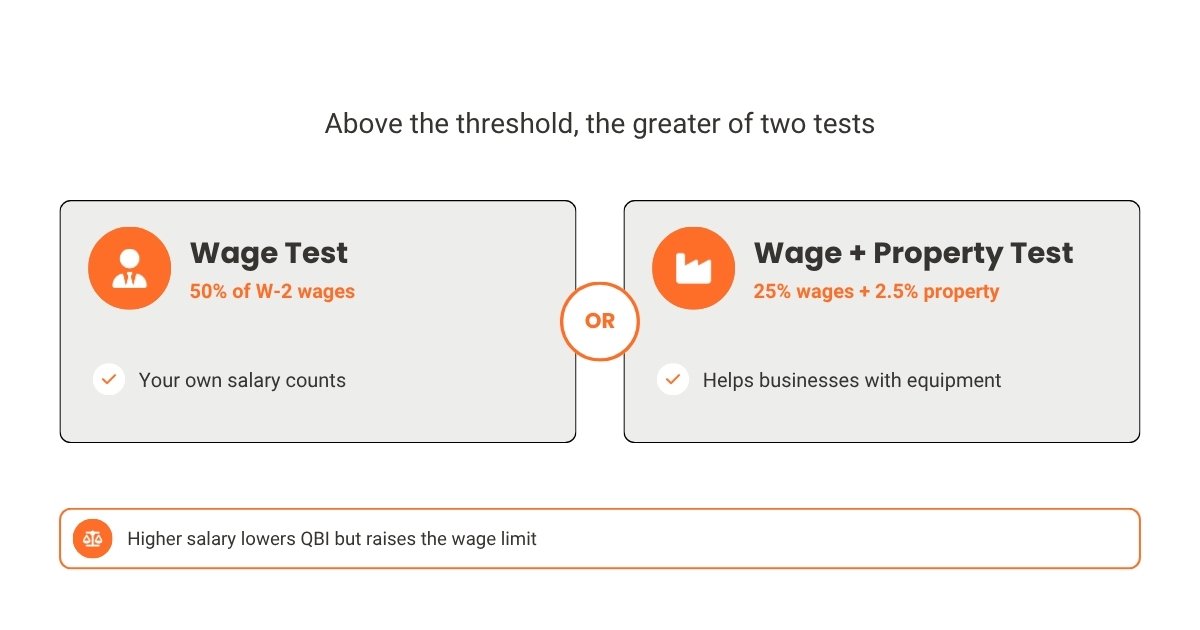
Once your income exceeds the threshold, your deduction can become limited to the greater of two calculations: 50 percent of the W-2 wages paid by the business, or 25 percent of those wages plus 2.5 percent of the unadjusted basis of qualified business property. For a typical S corp without significant equipment or real property, the wage test usually matters most, and here's the important part for S corp owners specifically: your own salary counts as W-2 wages paid by the business for this calculation. A higher salary lowers your QBI base, as covered above, but it also raises the wage limitation ceiling. Finding the right balance between these two competing effects is a genuine optimization problem, not something to set once and forget.
A Worked Example Above the Threshold
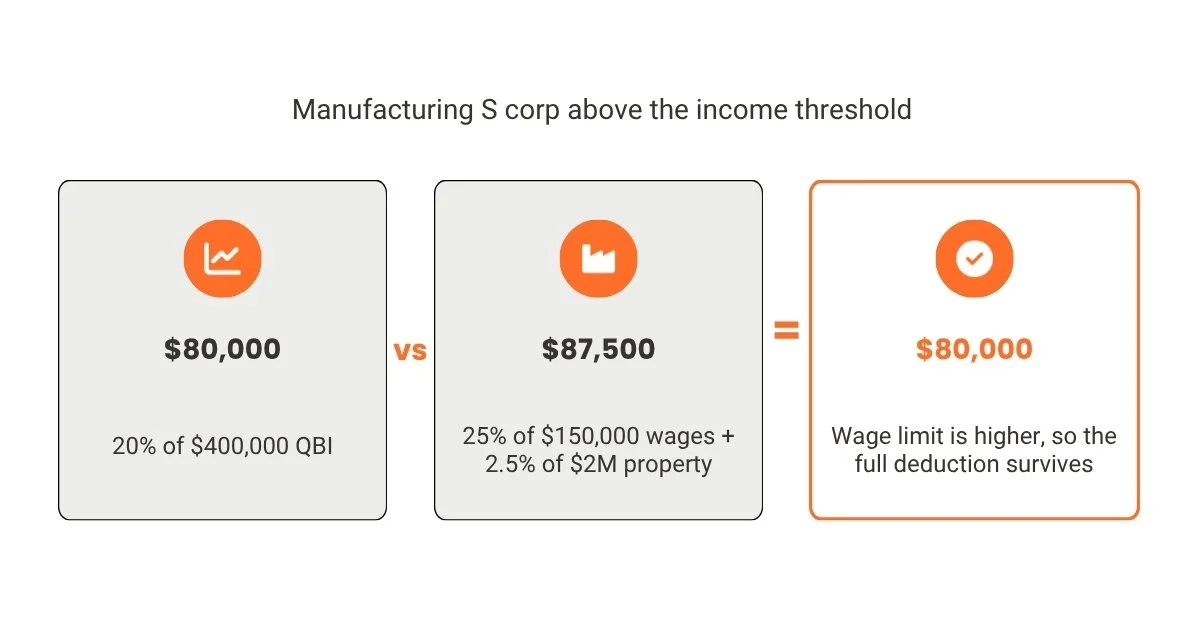
Consider a manufacturing S corp owner, above the income threshold, with 400,000 dollars in QBI, 150,000 dollars in W-2 wages paid, and 2,000,000 dollars in qualified property basis. The starting 20 percent calculation would be 80,000 dollars. The wage limitation offers two paths: 50 percent of wages is 75,000 dollars, or 25 percent of wages plus 2.5 percent of property basis comes to 87,500 dollars. Since you use whichever calculation produces the larger number, the property-inclusive path wins here, and the deduction is limited to the lesser of the original 80,000 dollar calculation and the 87,500 dollar wage limitation, landing at 80,000 dollars, the full tentative deduction survives in this case because the wage and property limitation exceeded it.
The SSTB Problem
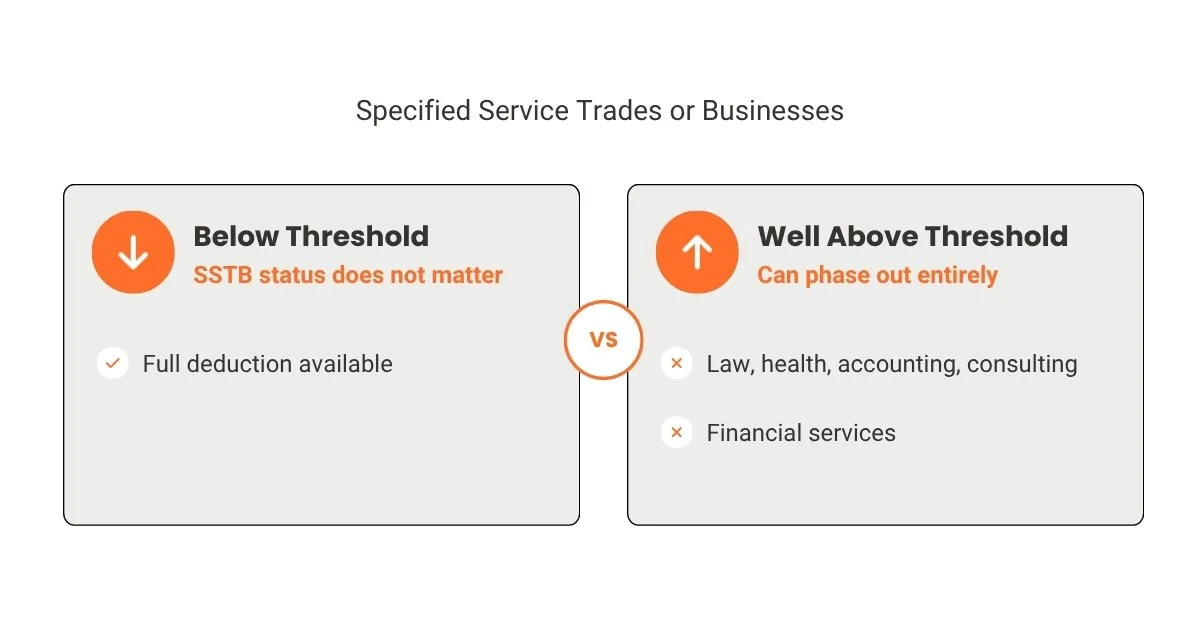
If your business is classified as a Specified Service Trade or Business, generally fields like law, health care, accounting, consulting, financial services, or businesses where the principal asset is the reputation or skill of the owners, the deduction doesn't just get limited above the income threshold, it phases out entirely once you're far enough above it. An SSTB owner with income well above the applicable range can lose the QBI deduction completely, regardless of how much they pay themselves in wages. Below the threshold, SSTB status doesn't matter at all, the distinction only becomes relevant once you're in or above the phase-in range.
The New Minimum Deduction
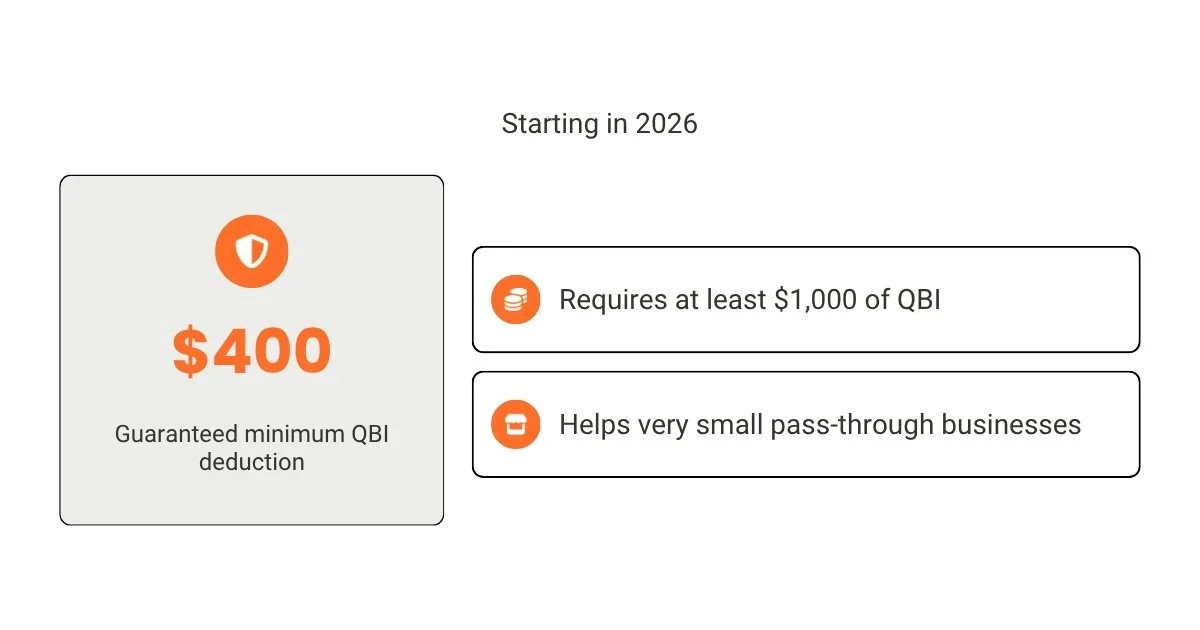
Starting in 2026, taxpayers with at least 1,000 dollars of qualified business income are guaranteed a minimum QBI deduction of 400 dollars, even if the standard calculation would otherwise produce less. This is a small provision in absolute terms, but it ensures very small pass-through businesses get some benefit even when the percentage-based math would round down to little or nothing.
Frequently Asked Questions
-
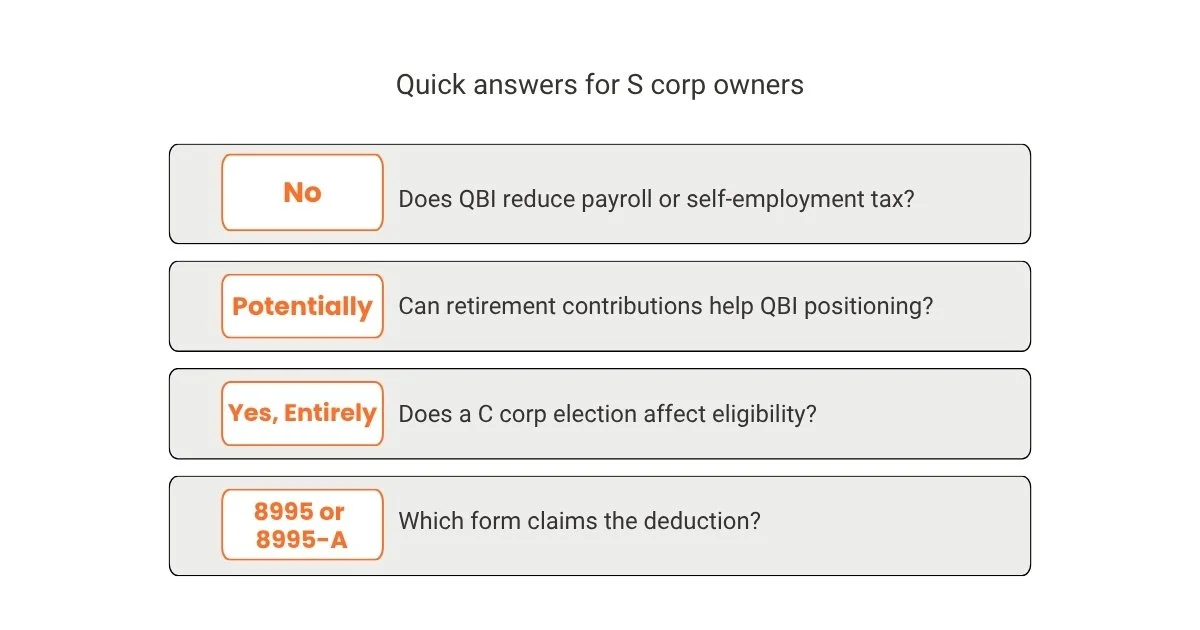
No. It reduces your taxable income for income tax purposes only. It has no effect on the payroll tax owed on your S corp salary or on any other payroll-related obligations.
-
Potentially, yes. Contributions to a retirement plan reduce your taxable income, which can help keep you below the income threshold where the wage and SSTB limitations start to apply, or reduce how deep into a phase-out range you land. This is worth modeling alongside your salary decision rather than in isolation.
-
Yes, entirely. QBI is only available to pass-through business income. A C corp doesn't generate QBI for its owners at all, since C corp profit is taxed at the entity level rather than passing through to a personal return.
-
Form 8995 handles the simpler calculation for taxpayers under the income threshold. Form 8995-A is required once you're above the threshold, since that's where the wage limitation, SSTB status, and property calculations all get worked through in detail.
Your salary decision as an S corp owner affects far more than payroll tax, it directly shapes your QBI deduction too. A tax professional can help you find the number that optimizes both together, rather than one at the expense of the other.