Roth Conversion Strategy: When It Makes Sense in Retirement
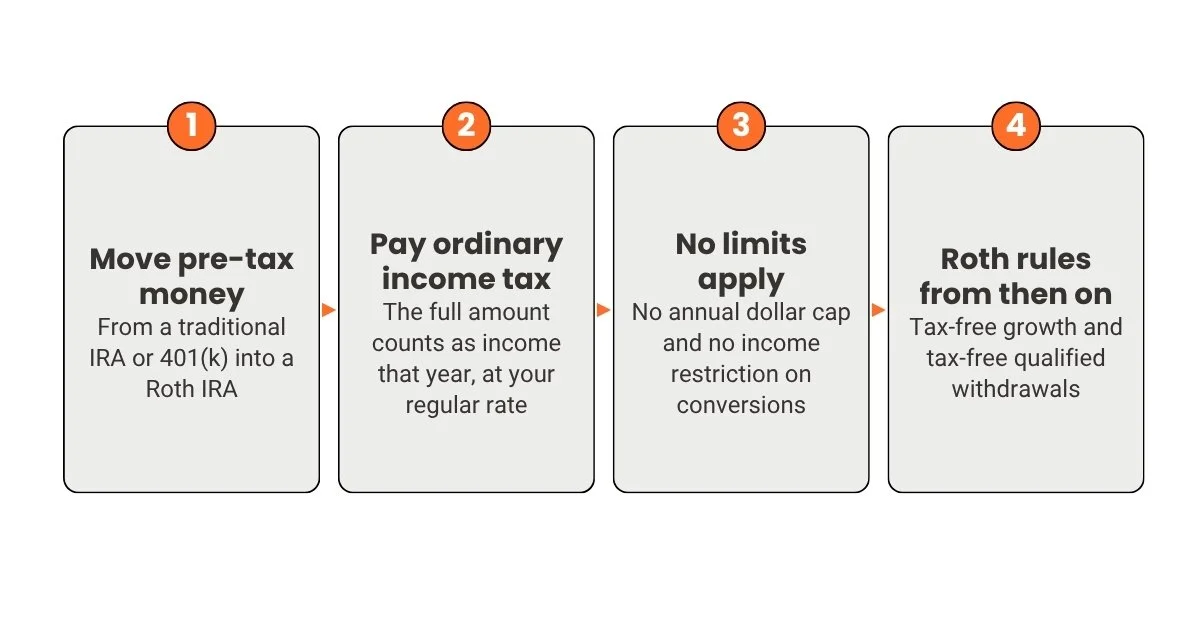
A Roth conversion is a simple idea with a lot of moving parts underneath it: you move money from a pre-tax account, like a traditional IRA or 401(k), into a Roth IRA, and you pay ordinary income tax on that amount in the year you convert. In exchange, that money grows tax-free from then on, and qualified withdrawals are never taxed again. The decision isn't automatic, it depends heavily on timing, your current versus expected future tax bracket, and a few details that are easy to overlook. Here's how to think it through.

How a Roth Conversion Actually Works
When you convert, the full amount moved counts as ordinary income for that tax year, taxed at your regular income tax rate, not a special conversion rate. There's no annual dollar limit on how much you can convert, and unlike direct Roth IRA contributions, which phase out at higher income levels, there's no income restriction on conversions at all. Once converted, the money follows Roth rules going forward: tax-free growth, and tax-free qualified withdrawals in retirement.
Why the "Convert Before Rates Go Up" Urgency Is Gone
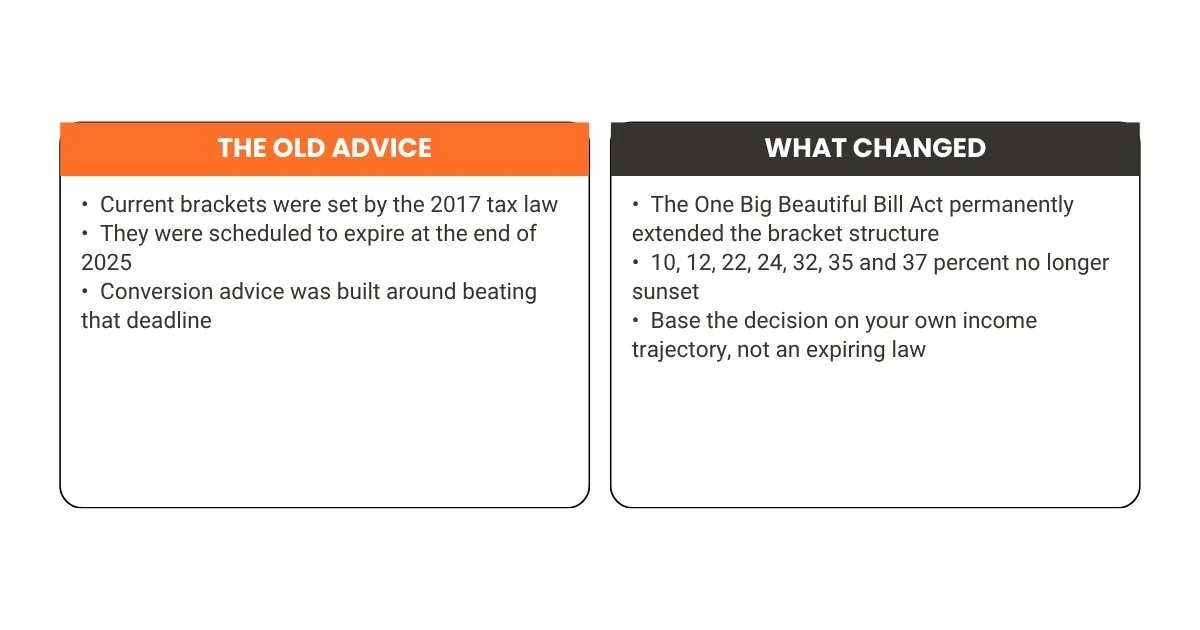
A lot of older Roth conversion advice was built around a looming deadline: the current tax brackets, set by the 2017 tax law, were scheduled to expire at the end of 2025 and revert to higher rates. Recent federal legislation changed that. The One Big Beautiful Bill Act permanently extended the current bracket structure, the 10, 12, 22, 24, 32, 35, and 37 percent brackets are no longer scheduled to sunset. That doesn't mean conversions stopped making sense, it means the decision should be based on your own income trajectory and bracket comparison, not a race against an expiring law.
The Best Window: Your "Trough Years"
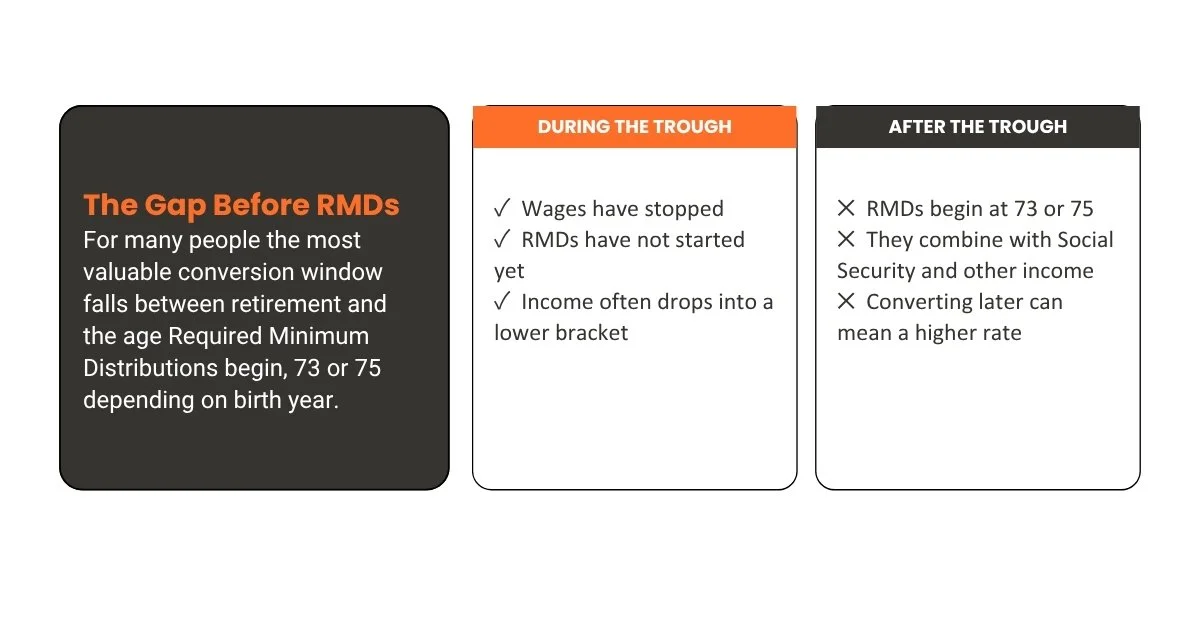
For many people, the most valuable conversion window falls in the gap between retirement and the age Required Minimum Distributions begin, 73 or 75 depending on your birth year. During those years, income often drops, since wages have stopped but RMDs haven't started yet, which can put you in a lower tax bracket than you'll be in once RMDs kick in and combine with Social Security and other income. Converting during that lower-income window means paying tax on the conversion at a lower rate than you'd likely pay later.
The Bracket-Filling Approach
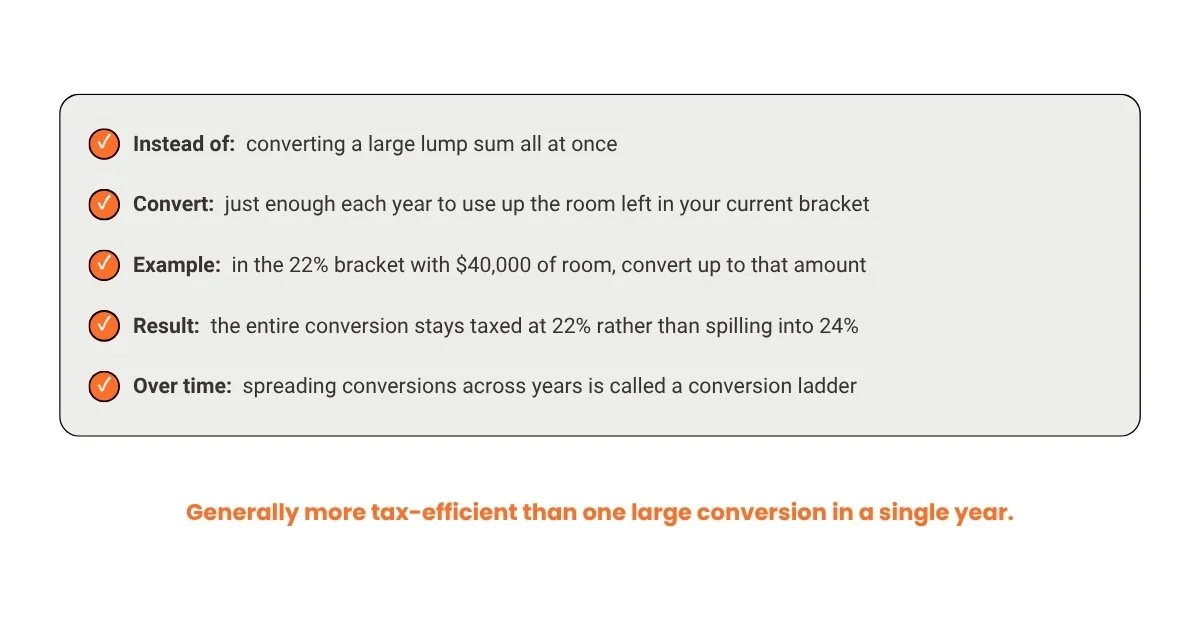
Rather than converting a large lump sum all at once, many people use a bracket-filling strategy: converting just enough each year to use up the remaining room in their current tax bracket without spilling into the next one. If you're sitting in the 22 percent bracket with room for another 40,000 dollars of income before hitting the 24 percent bracket, converting up to that amount keeps the entire conversion taxed at 22 percent. Spreading conversions over several years this way, sometimes called a conversion ladder, is generally more tax-efficient than one large conversion that pushes a big chunk of income into much higher brackets in a single year.
What Can Go Wrong: The Real Risks to Watch
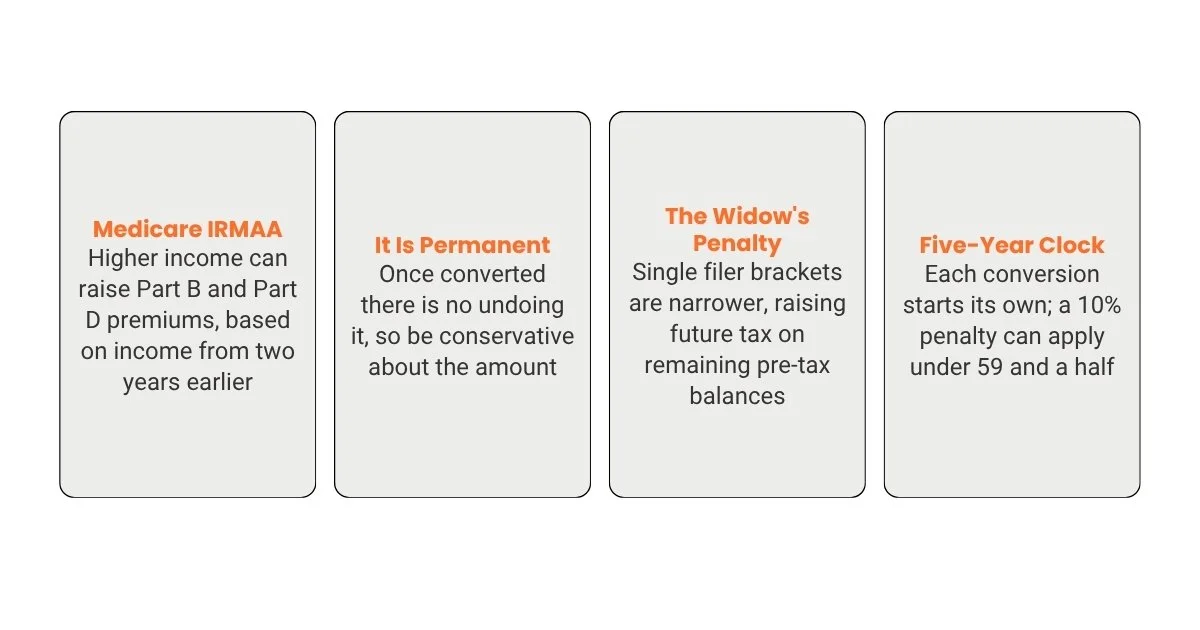
A conversion isn't free money, and a few specific risks are worth understanding before converting. Medicare premiums are one: higher income from a conversion can push you into a higher IRMAA bracket, increasing your Medicare Part B and Part D premiums, sometimes for a full year based on income from two years earlier. Converting too much in a single year can trigger this even if the extra tax bracket cost seems manageable on its own.
The conversion is also permanent. Once converted, there's no undoing it, so it's worth being conservative about the amount rather than assuming you can adjust course after the fact. And for couples where one spouse is significantly younger or in better health, it's worth considering the eventual shift to single filer status after a spouse passes away, since single filer brackets are narrower and can mean higher future taxes on remaining pre-tax balances, sometimes called the widow's penalty.
Each conversion also starts its own five-year clock. If you're under 59 and a half and need to access converted principal before that five-year period is up, a 10 percent penalty can apply. This generally isn't an issue for people who don't plan to touch the money until normal retirement age, but it's worth tracking if early access is a possibility.
Frequently Asked Questions
-
In most states with an income tax, yes, the converted amount is generally taxed at the state level as well as federally. California taxes converted amounts as ordinary income under its own bracket structure, which runs up to 13.3 percent at the top rate, on top of whatever federal tax applies.
-
No, there's no dollar cap on conversion amounts and no income restriction that blocks you from converting, unlike direct Roth IRA contributions, which do phase out at higher income levels.
-
Not automatically, but not never either. For some people, particularly those who expect meaningfully higher taxes in the future, paying a somewhat higher rate now can still result in lower total lifetime tax than waiting. This is a genuinely individual calculation that depends on your full income picture, not a rule that applies the same way to everyone.
-
No. Roth conversions are permanent under current tax law, there's no way to reverse a conversion once it's done. This is exactly why it's worth being deliberate about the amount converted each year rather than treating it as a low-stakes decision.
A Roth conversion can meaningfully reduce your lifetime taxes when it's timed right, and meaningfully increase them when it isn't. A tax professional can model your specific bracket situation before you convert anything.