S Corp vs. LLC: Which Saves More on Self-Employment Tax?
The question itself carries a small but important misunderstanding. An LLC and an S corp aren't two competing business structures you pick between when you start a business. An LLC is a legal entity, formed at the state level. S corp is a federal tax election, one that an LLC, or a corporation, can choose to make. So the real question isn't which one to form, it's whether electing S corp tax treatment for your existing LLC actually saves you money. Here's how to think through that.
LLC and S Corp Aren't Actually Alternatives
By default, a single-member LLC is a disregarded entity, and a multi-member LLC is taxed as a partnership. We cover the default disregarded entity treatment in detail in our single-member LLC tax guide. Either way, the LLC can elect to be taxed as an S corporation instead, without changing its legal structure at all. You keep the LLC, keep its liability protection, and simply change how the IRS taxes its income.

How an LLC Is Taxed by Default (No Election)
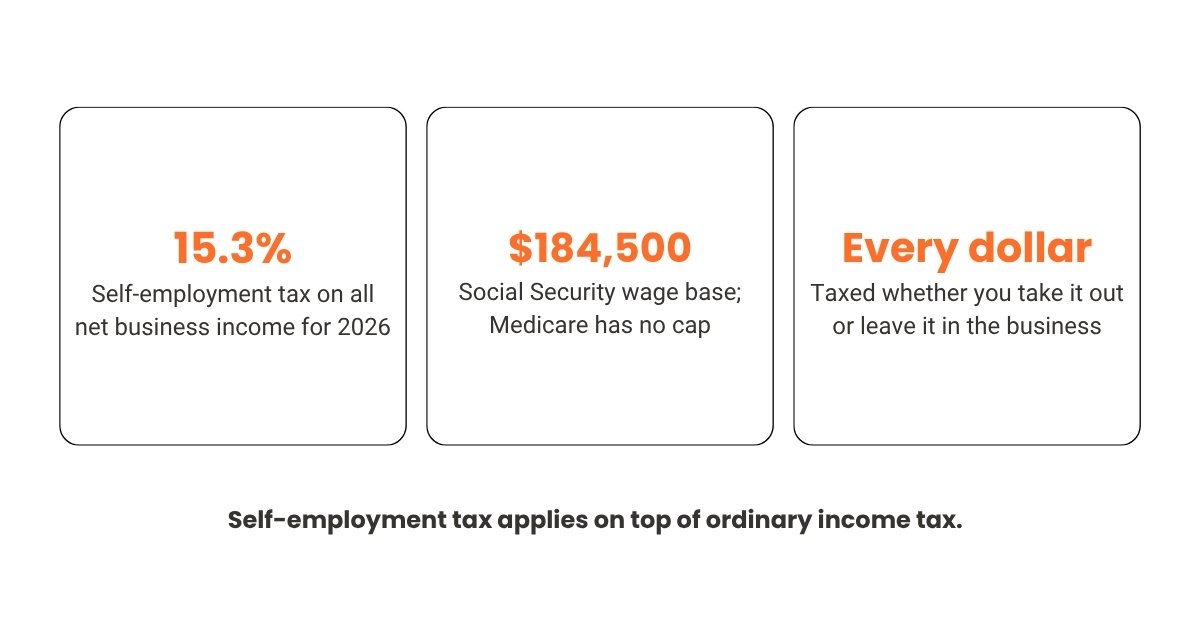
Without an election, all of an LLC's net business income is subject to self-employment tax, 15.3 percent for 2026, covering Social Security up to the 184,500 dollar wage base and Medicare with no cap. Every dollar of profit, whether you take it out of the business or leave it in, gets hit with that same 15.3 percent, on top of ordinary income tax.
How S Corp Election Changes the Math
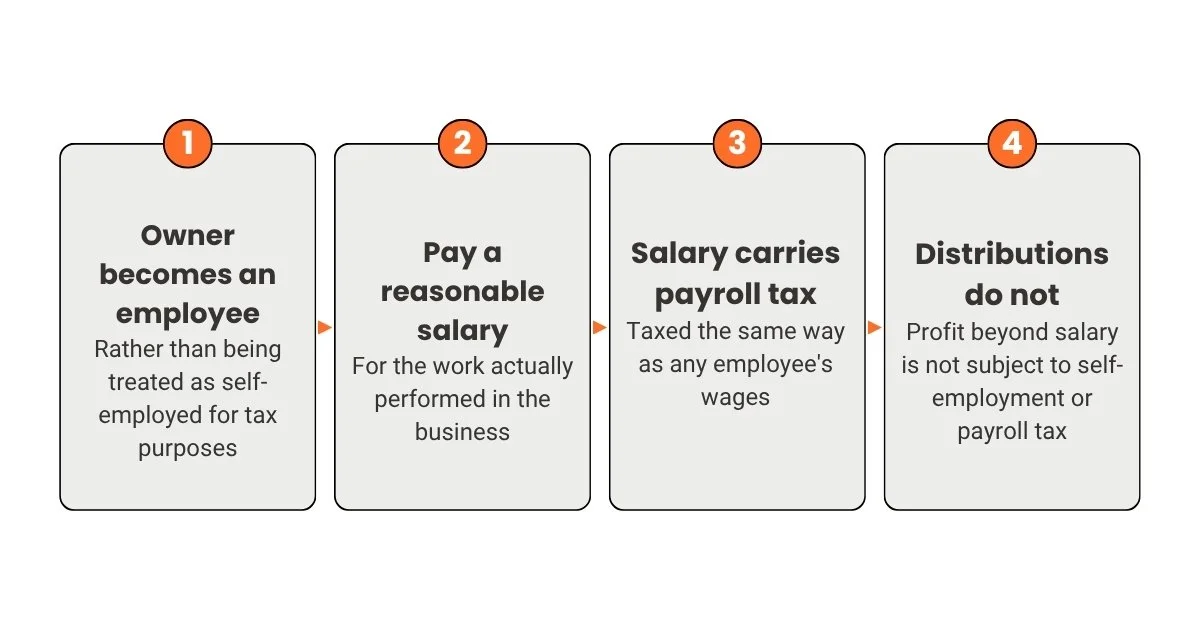
Once an LLC elects S corp status, the owner becomes an employee of the business rather than being treated as self-employed for tax purposes. The owner has to be paid a reasonable salary for the work they do, which we cover in detail in our reasonable compensation guide, and that salary is subject to payroll tax the same way any employee's wages are. But profit distributed to the owner beyond that salary is not subject to self-employment or payroll tax at all. That gap, between what's paid as salary and what's paid as distribution, is where the actual tax savings comes from.
A Simple Example
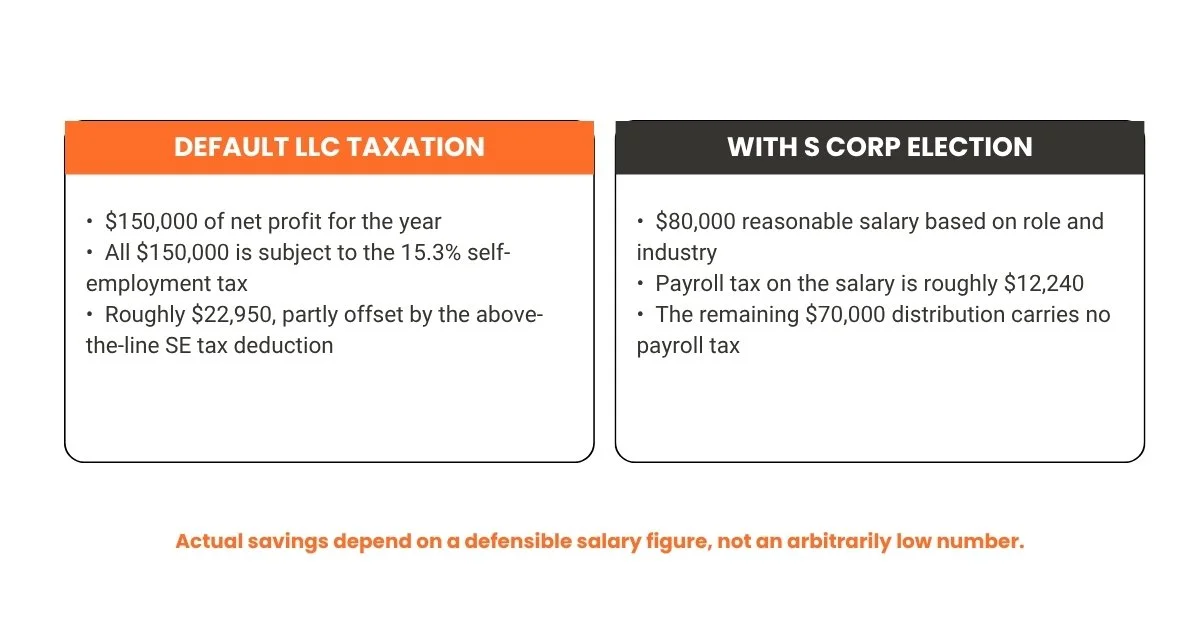
Say your LLC nets 150,000 dollars in profit for the year. Under default LLC taxation, all 150,000 dollars is subject to the 15.3 percent self-employment tax, roughly 22,950 dollars, though a portion of that gets offset by the above-the-line SE tax deduction.
Under an S corp election, say you set a reasonable salary of 80,000 dollars based on your role and industry. That salary is subject to payroll tax, roughly 12,240 dollars at 15.3 percent. The remaining 70,000 dollars, paid as a distribution, isn't subject to payroll tax at all. The difference between the two scenarios is real money, though the actual savings depends entirely on what salary figure is genuinely defensible for your specific situation, not an arbitrarily low number.
The Costs and Complexity S Corp Election Adds
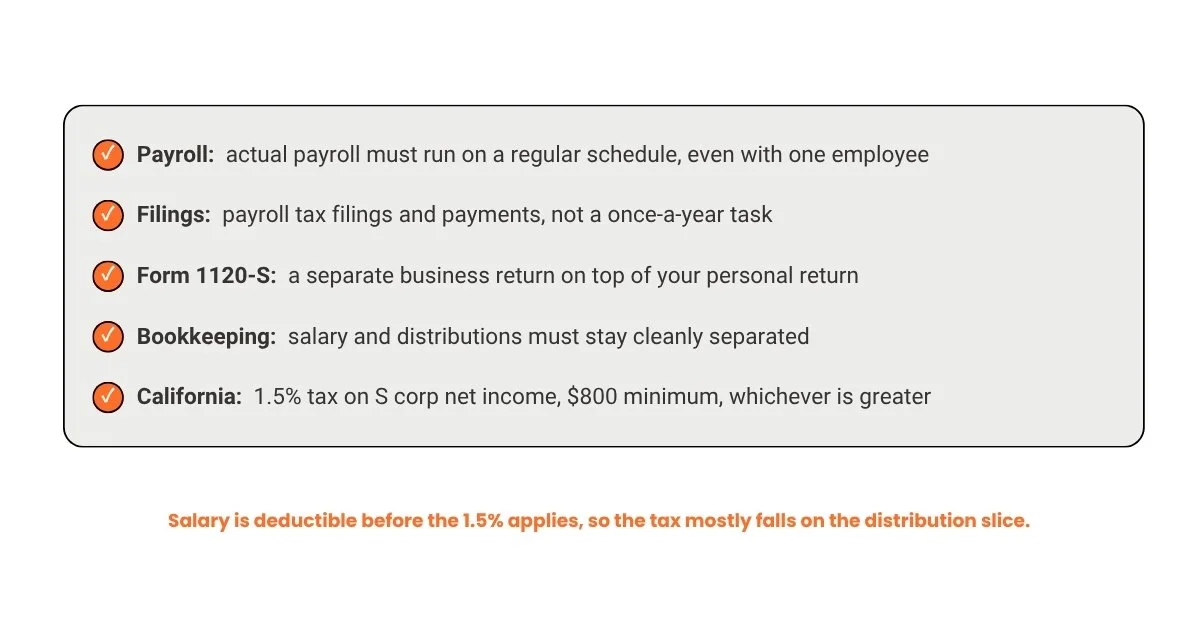
The savings pitch is only half the picture. Electing S corp status adds real costs and administrative work that a default LLC doesn't have. You have to run actual payroll, even if you're the only employee, which means payroll tax filings and payments on a regular schedule, not just once a year. You'll file a separate business tax return, Form 1120-S, in addition to your personal return. Bookkeeping needs to cleanly separate salary from distributions, since blurring the two undermines the entire structure.
California adds another layer worth knowing about directly. California doesn't fully conform to federal S corp treatment, the state imposes its own 1.5 percent tax on the S corp's net income, with an 800 dollar minimum, whichever is greater. Since salary is a deductible expense before that 1.5 percent is calculated, the tax mostly falls on the distribution portion, the same slice generating your federal payroll tax savings. That doesn't eliminate the benefit of electing S corp status in California, but it does shift where the breakeven point sits compared to a state with no similar tax.
When the Election Actually Makes Sense
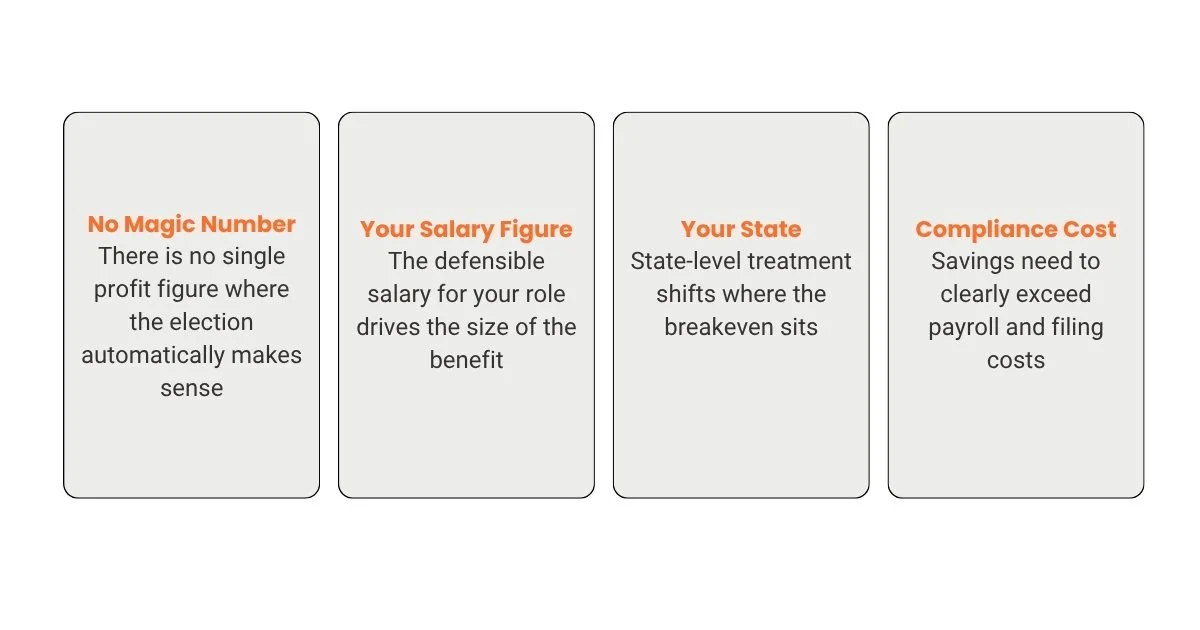
There's no single profit number where S corp election automatically makes sense for everyone, it depends on your reasonable salary figure, your state, and the actual cost of running payroll and filing the additional return for your situation. As a general pattern, the election tends to become worth considering once a business has enough consistent profit that the distribution portion, after paying a genuinely defensible salary, produces payroll tax savings that clearly exceed the added compliance costs. Below that level, the extra complexity often isn't worth it. This is a calculation worth running with real numbers for your specific business rather than assuming a rule of thumb applies.
Frequently Asked Questions
-
Not automatically. The business has to meet S corp eligibility requirements: no more than 100 shareholders, only one class of stock, and all owners must be U.S. citizens or resident individuals, trusts, or estates, not partnerships, corporations, or non-resident aliens. Most small, single-owner or family-owned LLCs meet these requirements without issue.
-
Yes. Form 2553 generally has to be filed within two months and 15 days after the start of the tax year you want the election to apply to, or at any point during the prior year. A brand-new business has 75 days from its formation date instead. Missing the deadline doesn't necessarily mean losing the option entirely, late election relief is available with reasonable cause, but it's simpler to file on time.
-
No. The election only changes how the business is taxed. The underlying LLC, and the liability protection that comes with it, stays exactly the same.
-
Yes, though revoking an S corp election has its own rules and timing, and generally you can't re-elect S corp status again for five years after a revocation without IRS consent. This is worth discussing with a tax professional before either electing or revoking, rather than treating it as an easy annual toggle.
Whether S corp election makes sense for your LLC depends on numbers specific to your business, not a general rule of thumb. A tax professional can run the actual comparison for your situation, salary, distributions, and all.