Most of the moves that actually reduce a business's tax bill have to happen before December 31, not at filing time in April. By then, the year is locked in. This checklist covers what to review and act on before year-end, including a few genuinely new items from recent federal legislation that a lot of last year's checklists won't have covered. Start working through this in October or November, not December 30.

Equipment and Depreciation
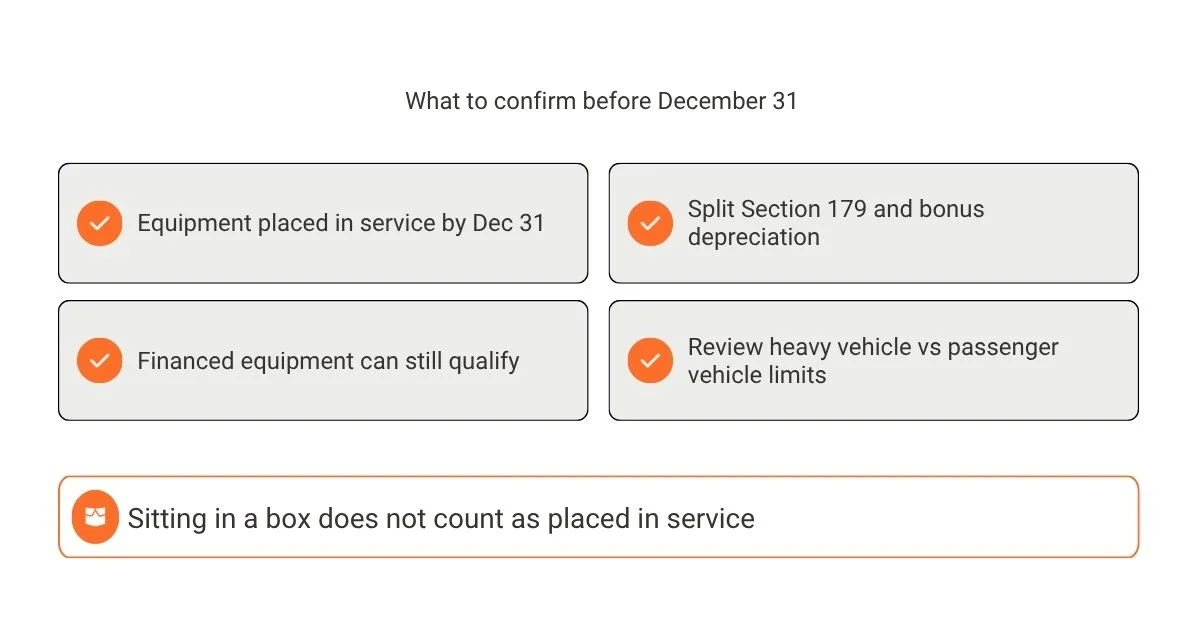
Confirm any equipment you want to deduct this year is actually placed in service by December 31, not just ordered or in transit. "Placed in service" means delivered, installed if applicable, and operational, sitting in a box doesn't count.
Decide how to split purchases between Section 179 (elected asset by asset, up to 2,560,000 dollars for 2026) and 100 percent bonus depreciation (automatic, no dollar cap). See our full breakdown in our Section 179 vs. bonus depreciation guide.
If financing equipment rather than paying cash, confirm you can still deduct the full purchase price, not just the payments made this year.
Review vehicle purchases against the relevant limits, heavy SUVs and trucks over 6,000 pounds GVWR get more favorable treatment than passenger vehicles, which are subject to separate luxury auto depreciation caps.
Owner Compensation
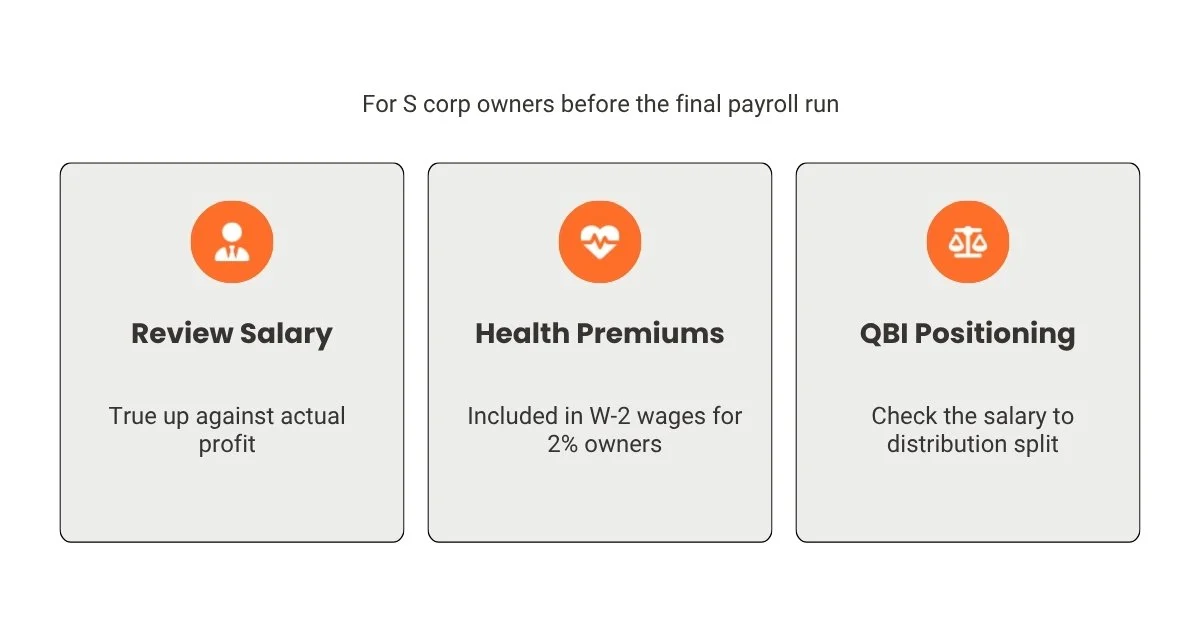
For S corp owners, review your salary against this year's actual profit before your final payroll run closes. This is your last chance to true up compensation within the current tax year, see our reasonable compensation guide for how that number gets determined.
If your S corp pays or reimburses your health insurance premiums as a 2 percent or greater shareholder, confirm those amounts are properly included in your W-2 wages.
Review whether your salary-to-distribution split is positioned well for the QBI deduction, since W-2 wages paid can affect QBI limitations at higher income levels.
Retirement Contributions
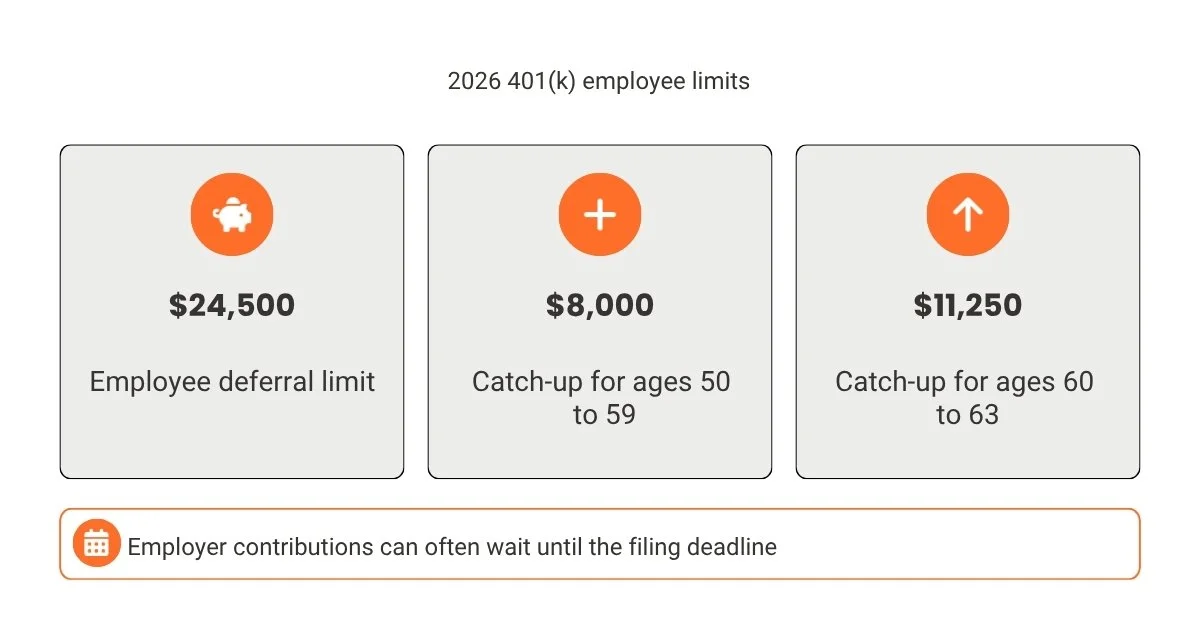
Confirm your retirement plan contributions for the year, both employee deferrals and any employer contribution. The 2026 employee 401(k) deferral limit is 24,500 dollars, with an 8,000 dollar catch-up for ages 50 to 59, and an 11,250 dollar catch-up for ages 60 to 63.
Note that employer contributions generally have more flexibility than employee deferrals, they can often be made up until your tax filing deadline, including extensions, rather than needing to be finalized by December 31.
If your income is high enough that catch-up contributions must be made as Roth contributions under recent rules, confirm your plan supports this before year-end.
Income and Expense Timing
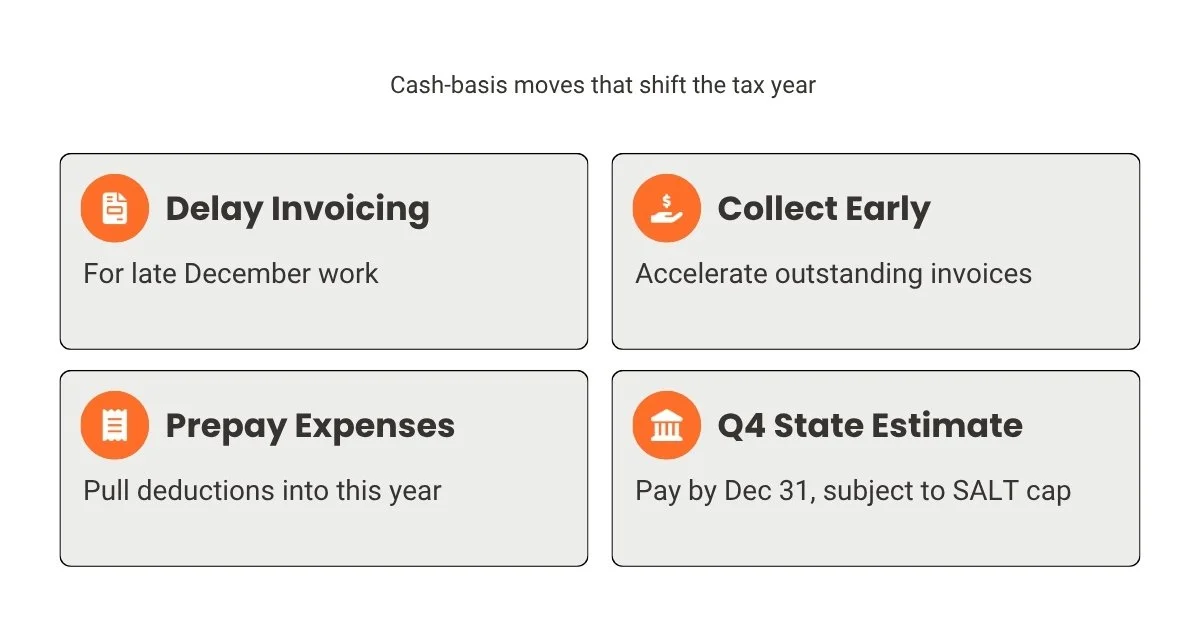
If you're a cash-basis business, review whether it makes sense to delay invoicing for work completed in late December, or accelerate collection of outstanding invoices, depending on whether this year or next year is the higher-income year.
Consider whether pulling deductible expenses into the current year, prepaying certain costs, making planned purchases early, makes sense given this year's income relative to next year's projection.
If you pay Q4 estimated state taxes before December 31 rather than the January due date, that payment may be deductible this year instead of next, subject to the SALT cap discussed below.
The New SALT Cap: A Real Planning Opportunity
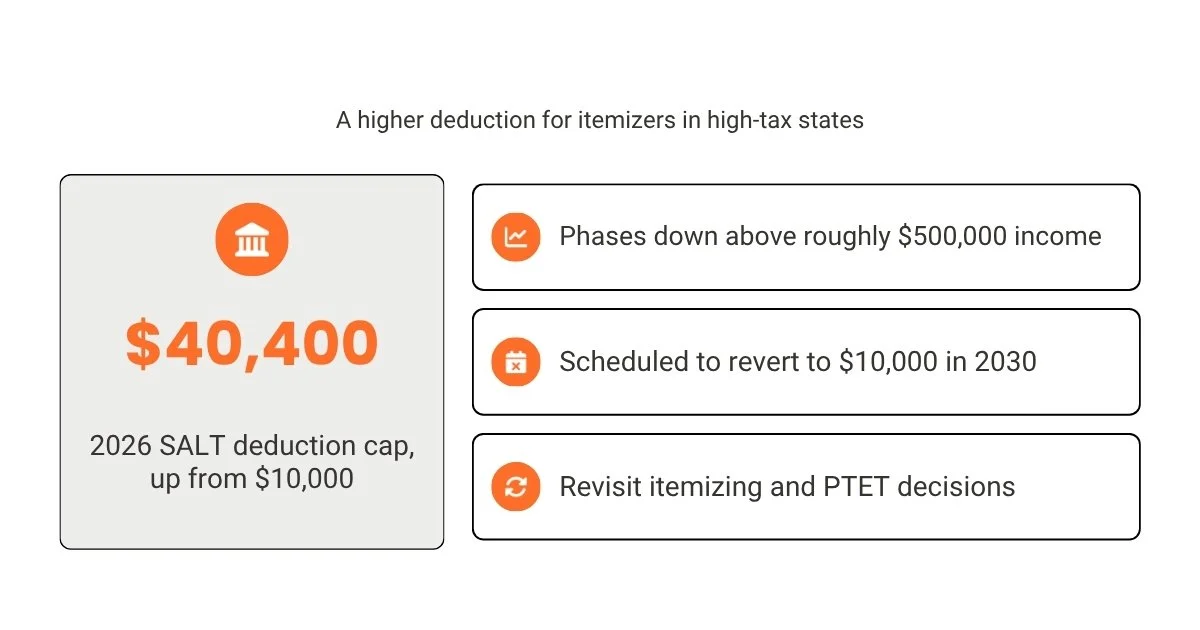
This is genuinely new for year-end planning this cycle. Recent federal legislation raised the SALT deduction cap from 10,000 dollars to 40,400 dollars for 2026, a significant increase for business owners who itemize and live in high-tax states. The higher cap phases down for taxpayers with income above roughly 500,000 dollars, and it's currently scheduled to revert to the original 10,000 dollar cap starting in 2030, so this is a meaningful but time-limited window.
Revisit whether itemizing makes sense this year given the higher cap, rather than assuming your prior standard-vs-itemized decision still holds.
If your state offers a pass-through entity tax election, confirm whether it still makes sense for your situation under the new, higher personal SALT cap, in some cases the calculus has shifted. California's PTET specifically requires a prepayment by June 15 to lock in the deduction for the year, worth flagging now for next year's planning cycle even though that date has already passed for the current year.
Other Items Worth a Quick Review
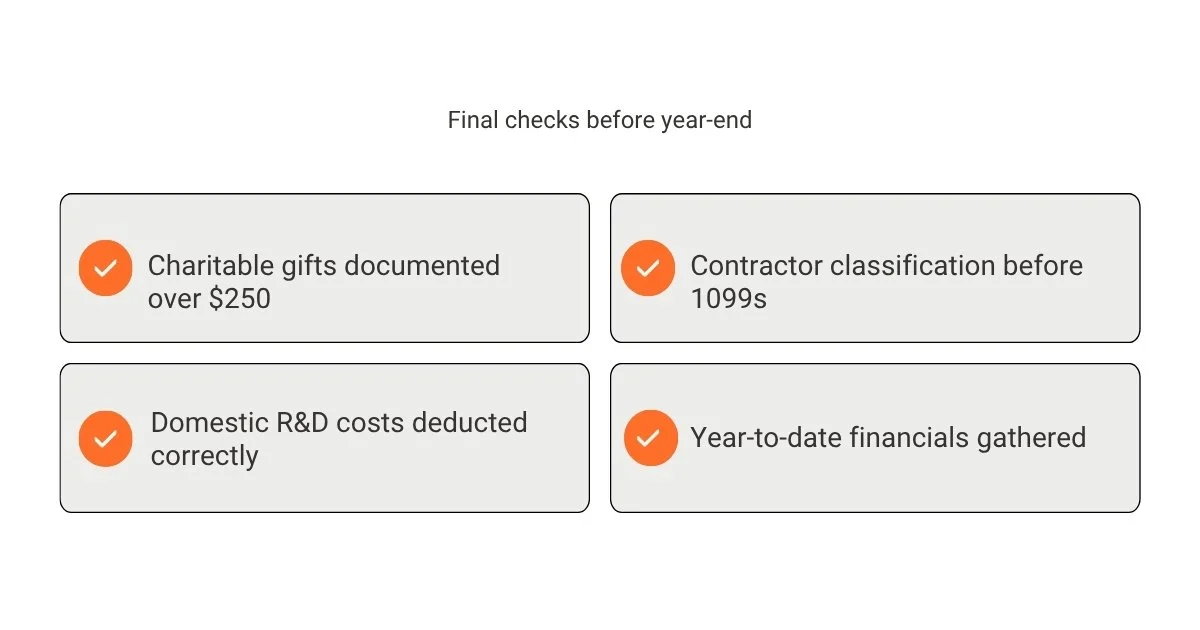
Finalize charitable contributions you intend to deduct this year, and confirm you have proper documentation for anything over 250 dollars.
Review worker classification for anyone paid as a contractor this year, misclassification risk is worth catching before issuing 1099s, not after.
If your business does any domestic research and development, confirm you're capturing this correctly, recent legislation restored immediate deductibility for domestic R&D costs rather than the multi-year amortization that applied for several prior years.
Pull together year-to-date financials, profit and loss, balance sheet, payroll reports, and fixed asset purchases, so your tax professional has a complete picture before year-end moves are finalized.
Frequently Asked Questions
-
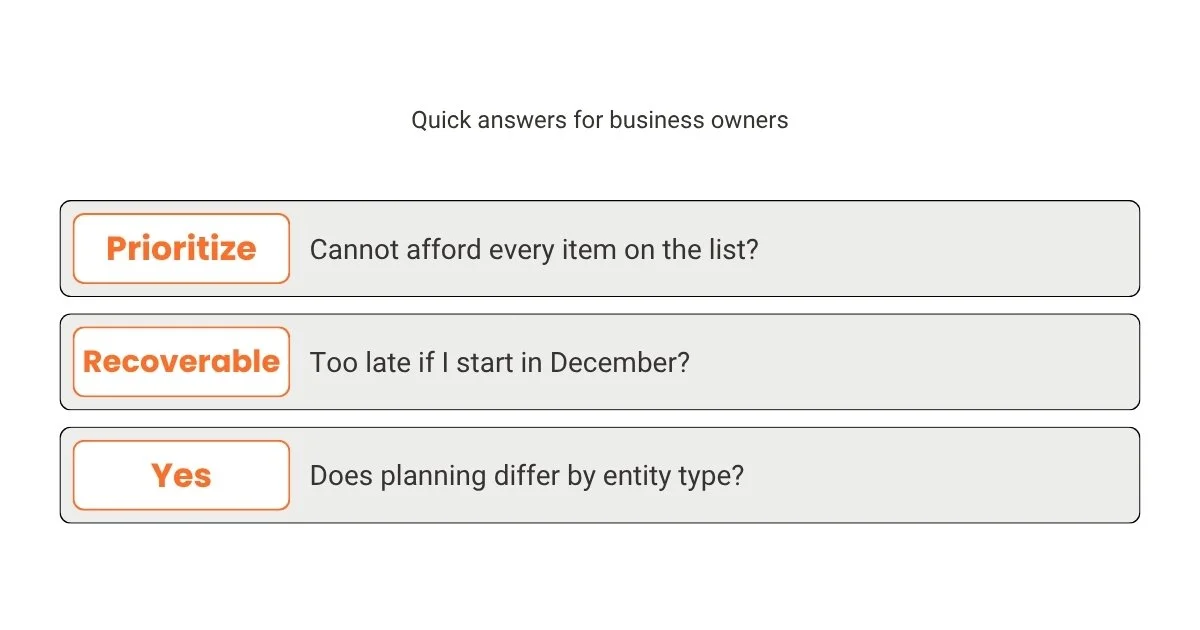
Prioritize based on return. Retirement contributions are often the highest-value move available, since they provide both an immediate deduction and tax-deferred growth. Equipment purchases only make sense if you genuinely need the equipment, a deduction shouldn't be the reason to buy something you don't need.
-
Not ideal, but recoverable if you move quickly. Many of the highest-value moves, retirement contributions in particular, have more flexible deadlines than people assume. The earlier you start, October rather than December, the more options stay realistically available.
-
Yes, meaningfully. A strategy that works well for a C corporation may not translate to a sole proprietorship, partnership, or S corp, and vice versa. This checklist covers items relevant across structures, but the specific numbers and priorities shift based on your entity.
Year-end tax planning works best with a few weeks of runway, not a few days. A tax professional can walk through this checklist against your actual numbers and help you prioritize what matters most before December 31.