We've covered the general S corp versus LLC decision before, but a single-member LLC electing S corp status is a bigger structural jump than the general comparison suggests. A default single-member LLC has essentially no federal compliance overhead: no separate return, no payroll, nothing beyond your personal Form 1040. Electing S corp status changes all of that at once, not gradually. Here's what actually shifts, and how to think about whether it's worth it.
What Changes the Moment You Elect
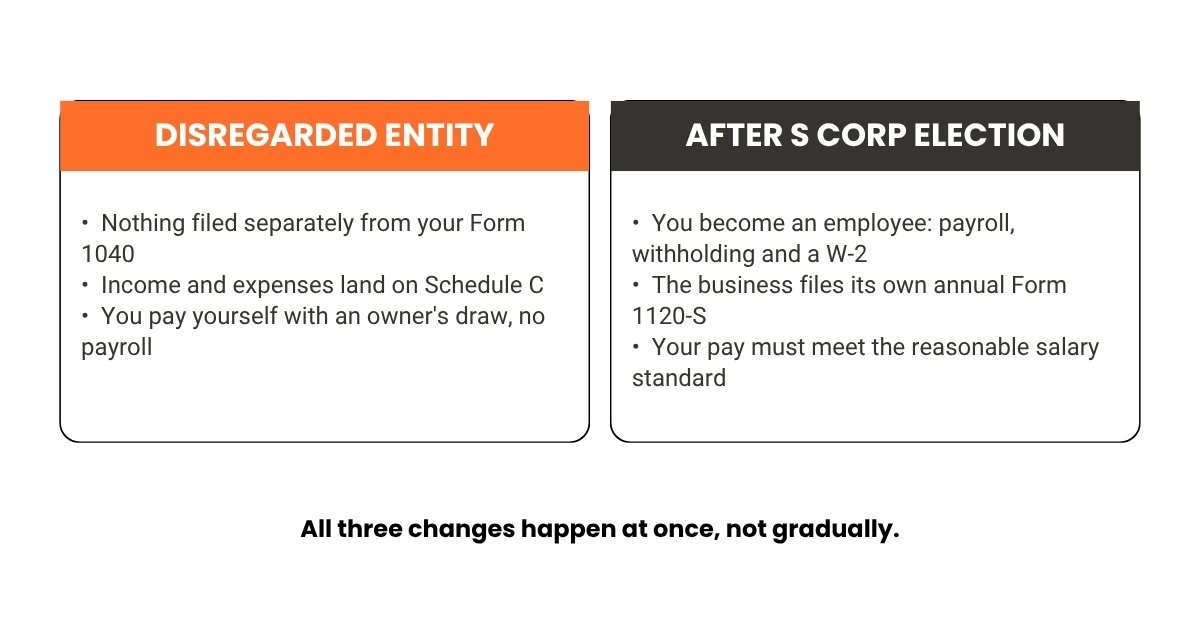
As a disregarded entity, your single-member LLC currently files nothing separately. Business income and expenses land on Schedule C of your personal return, and you pay yourself by simply taking money out of the business, an owner's draw, with no payroll involved. We cover this default treatment in full in our single-member LLC tax guide.
The moment your SMLLC elects S corp status, three things change simultaneously. First, you're now an employee of your own business rather than self-employed, which means an actual payroll system, tax withholding, and W-2 issuance, not a draw. Second, the business has to file its own annual return, Form 1120-S, separate from your personal return. Third, your compensation has to meet the reasonable salary standard we cover in our reasonable compensation guide, since the IRS scrutinizes owner-employee salaries at S corps specifically.
Why This Election Actually Saves Money
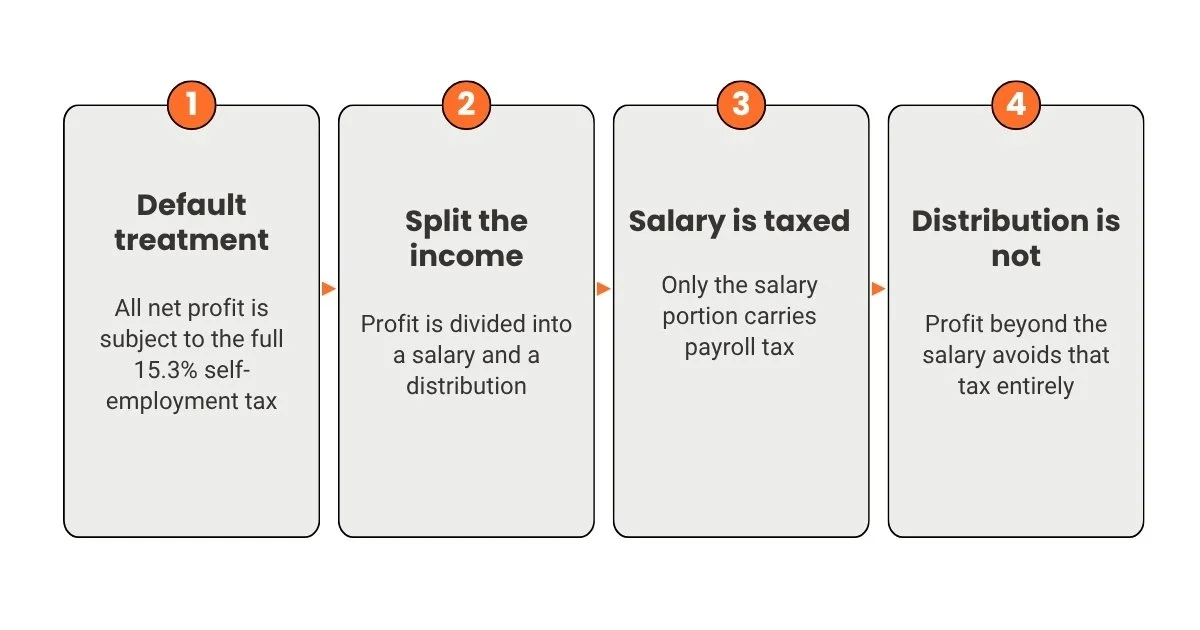
The mechanics are the same as the general S corp savings we cover in our S corp vs. LLC guide: only your salary is subject to self-employment-style payroll tax, while distributions beyond that salary aren't. As a disregarded entity, all of your net profit is subject to the full 15.3 percent self-employment tax. Once you elect S corp status and split income into salary and distribution, only the salary portion carries that tax.
The Trade-Off: What You're Signing Up For
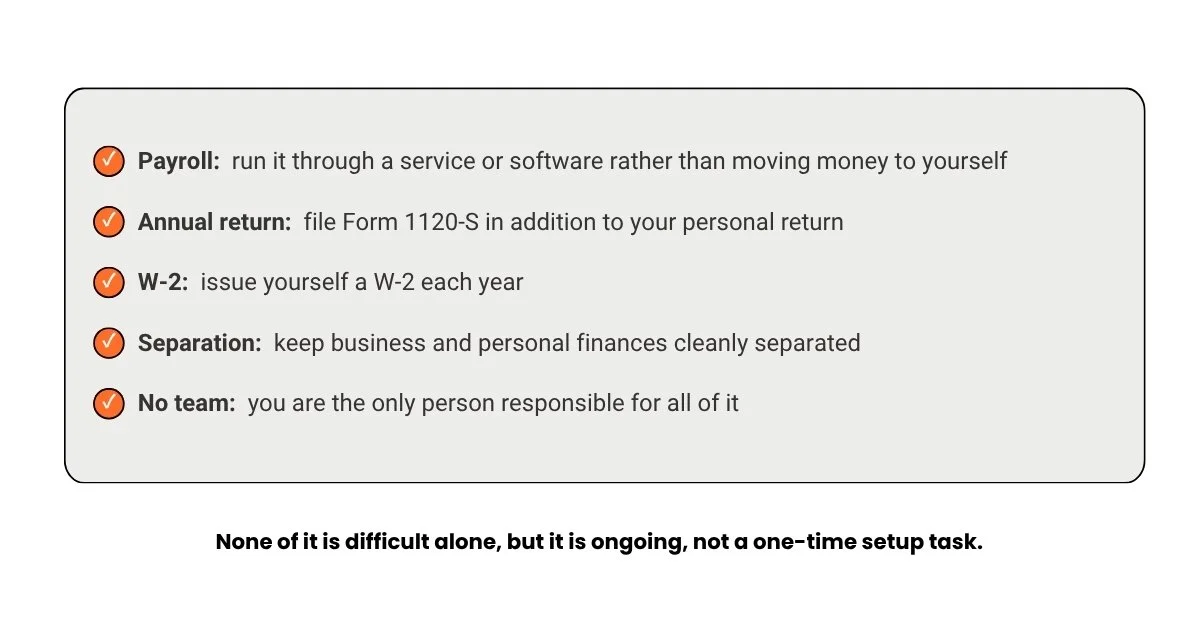
This is where the single-member situation deserves more attention than it usually gets. You're the only person in the business, which means you're also the only person responsible for running payroll correctly, filing the corporate return on time, and keeping your own compensation defensible. There's no team to absorb this work. Concretely, that means: running payroll through a service or software rather than simply moving money to yourself, filing Form 1120-S annually in addition to your personal return, issuing yourself a W-2, and keeping business and personal finances cleanly separated in a way that holds up if questioned.
None of this is difficult individually, but it's a meaningful step up from the near-zero compliance burden of the default disregarded entity structure, and it's ongoing, not a one-time setup task.
When the Profit Level Makes This Worth It
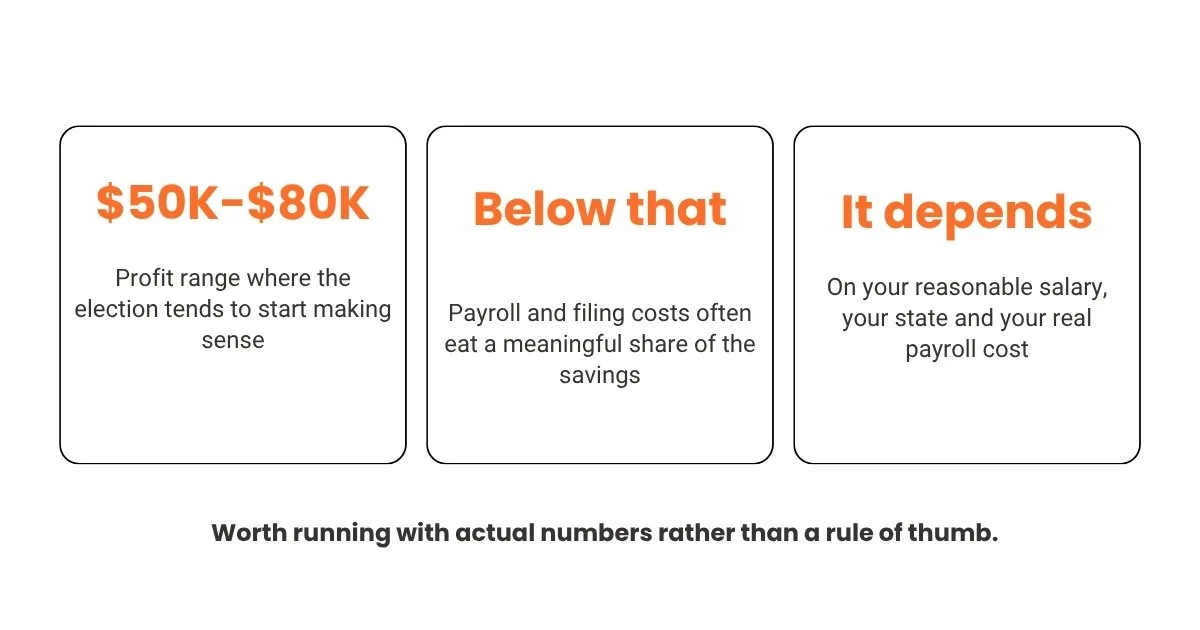
There's no single dollar figure that applies to everyone, but as a general pattern, this election tends to start making financial sense once annual business profit consistently runs somewhere in the 50,000 to 80,000 dollar range or higher, though the real answer depends on your specific reasonable salary figure, your state, and what running payroll actually costs for your situation. Below that range, the payroll and filing costs often eat up a meaningful share of whatever tax savings the election would produce. This is a calculation worth running with actual numbers rather than a rule of thumb.
Frequently Asked Questions
-
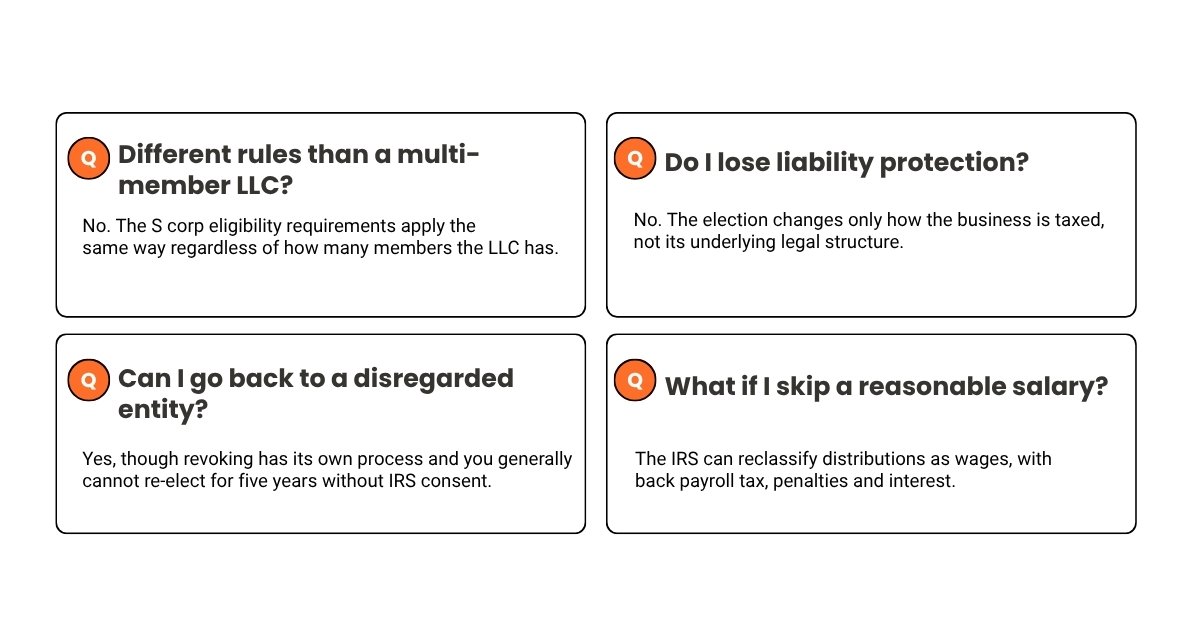
No. The S corp eligibility requirements, domestic entity, no more than 100 shareholders, one class of stock, eligible shareholders only, apply the same way regardless of how many members the LLC has.
-
No. Electing S corp status only changes how the business is taxed, not its underlying legal structure. Your LLC's liability protection stays exactly the same.
-
Yes, though revoking the election has its own process and timing, and you generally can't re-elect S corp status again for five years without IRS consent. It's worth treating this as a considered decision rather than something to toggle casually.
-
The IRS can reclassify some or all of your distributions as wages, subjecting them to back payroll tax, penalties, and interest. Since you're the only shareholder-employee, there's no one else's compensation to point to as a benchmark, which makes getting this number right especially important. Our reasonable compensation guide covers how that figure gets determined.
Electing S corp status for a single-member LLC can genuinely save money, but it also means taking on real payroll and filing obligations with nobody else to share the work. A tax professional can help you figure out whether the numbers actually work in your favor.